Category Archives: History of science

Book review: A Veritable Eden – The Manchester Botanic Garden, a History by Ann Brooks (2011)

This is a book review that’s been in press for many months in the Manchester Region History Review, and I finally found out that it had appeared and I’d missed it!  Anyway I thought this would be a good opportunity to present the review to a wider audience who might be interested, and to correct a couple of typos in the printed version.

A Veritable Eden – The Manchester Botanic Garden, a History. Ann Brooks (2011). Windgather Press, Oxford. RRP – £25.

The plant kingdom globally contains an estimated diversity of 350,000 species. In the UK we can boast only some 1500 native species, a legacy of both our status as a collection of modestly sized, temperate zone islands, and the effect of the last ice age which scoured much of the land surface of its previously established flora. A depauperate flora, combined with plant envy of the botanical riches of other countries, may be one reason why British botanic gardens have been important in cataloguing and describing the world’s plant diversity, and in augmenting that flora by cramming our gardens with exotic specimens from overseas.

This long history of plant study and horticulture can be traced back to at least the mid 17th century, with the founding of what was to become Oxford Botanic Garden. Since that time, Britain’s botanic gardens have played a significant role in the economic development of both the country and its former Empire, and continue to be important in science and education, and in the leisure and recreation of the British people.

Previous work on the history of botanic gardens in Europe has tended to concentrate on the large metropolitan botanic gardens, particularly Kew, with their star botanists and international networks of contacts and collectors (e.g. Brockway 1979, Endersby 2010, Ollerton et al. 2012). The smaller provincial botanic gardens, in contrast, have been rather neglected by historians, despite the fact that almost every large British city possessed one, and that they have been an important part of local leisure and education. This is a tradition that stretches from the early 19th century and continues through to the more recent founding of the Eden Project and the National Botanic Garden of Wales.

The history and current utility of such spaces is, as their study reveals, a story that extends far beyond the horticultural and botanical realms, into social, political and economic history. In A Veritable Eden Ann Brooks introduces us to the “chequered history including national fame and financial disaster” of Manchester Botanic Garden, which existed from 1831 to 1908. This meticulously researched book explores not only the role of the Garden in local social life, but also the local political intrigues, personality clashes and mismanagement that ultimately doomed the garden. This is exemplified in the way that an un-Victorian attitude to financial prudence (commissioning ambitious building works when finances were in poor shape) collided with a very Victorian snobbery: by refusing to allow the paying general public entry to the Garden more than one afternoon a week, a funding stream that may have saved the Garden was effectively curtailed. To paraphrase the author, exclusivity was more important than income.

This was not the only policy that appears inexplicable to the modern reader. Early in its history the subscribing, largely middle class membership of the Garden made it clear that pleasurable perambulations around the site were all that they were interested in, and any pretence to education went when “in 1848 science was eliminated and the horticultural garden…was dismantled”. In this regard it was undoubtedly the people of Manchester, rather than botanical science per se, who were the principle losers, as the large botanic gardens of European capital cities dominated plant exploration and plant science up to the present day. Nonetheless the policy jars with Victorian notions of self-improvement.

A Veritable Eden originated as Dr Brooks’ PhD thesis and in general it is engagingly written, demonstrating the author’s fascination for her subject, and well illustrated with material from her personal collection and elsewhere. But there are some places where a firmer editorial hand would have made for a better book. It is clear that a few small sections have been replicated from the thesis out of context, for example a paragraph about the role of a “putter-out” on pp. 60-61. On p. 91, to give another example, we read that a Garden report concluded that “the Curator should be charged with ‘gross ignorance and mismanagement’ and that he should be replaced”; this is repeated, only three lines later, as “a charge of ‘gross ignorance and mismanagement’ should be brought against [the Curator]”. Finally, to anyone with a botanical, as opposed to historical, training the misspelling and misrendering of scientific names for some plants will jar, such as “Dickensonia” for Dicksonia and “Victoria Regia” for Victoria regia (itself an old synonym, the plant is now called Victoria amazonica).

Such editorial oversights detract only a little from the telling of the story of Manchester Botanic Garden and could easily be rectified if the book goes to a second edition. Which I hope it does; it’s a great contribution both to the local history of the city and to our understanding of the history of provincial botanic gardens.


References

Brockway, L.H. (1979) Science and Colonial Expansion: The Role of the British Royal Botanic Garden. Yale University Press.

Endersby, J. (2010) Imperial Nature: Joseph Hooker and the Practices of Victorian Science. University of Chicago Press.

Ollerton, J., Chancellor, G. & van Wyhe, J. (2012) John Tweedie and Charles Darwin in Buenos Aires. Notes and Records of the Royal Society 66: 115-124


Originally published as:  Ollerton, J. (2014) Book review of: “A Veritable Eden” by A. Brooks. Manchester Region History Review 25: 153-154


Pollination syndromes: a brief update on recent developments, and news that Stefan Vogel has passed away

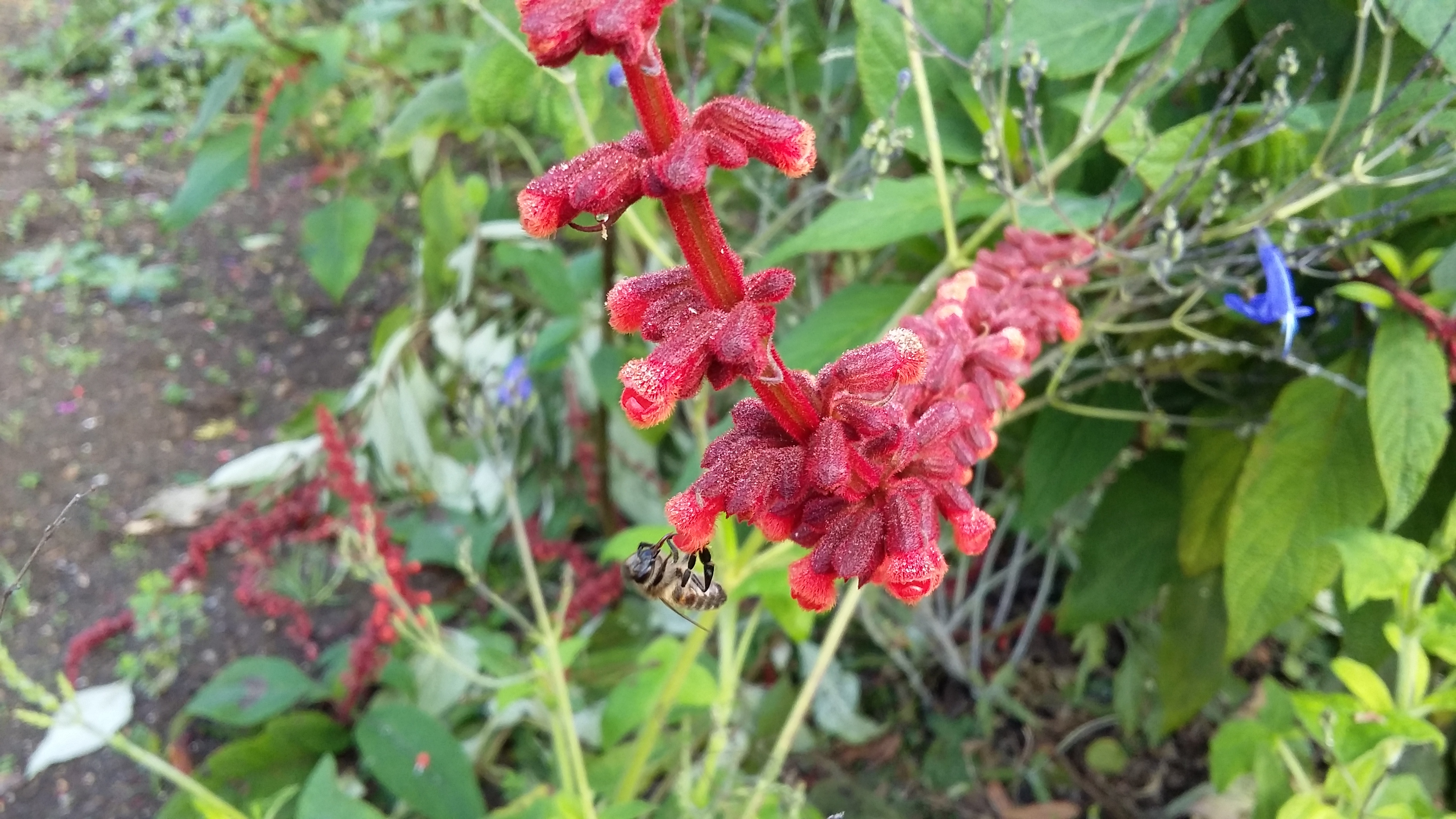
Bee on Salvia - OBG - November 2015

In a recent post I discussed the current debates about “pollination syndromes”, which I described as “sets of flower characteristics that have repeatedly evolved in different plant families due to the convergent selection pressures applied by some groups of pollinators”.

The authors of the Ecology Letters paper that I discussed (Rosas-Guerrero et al. 2014) have now replied to our original critique of their approach and you can read that reply (Aguilar et al. 2015) in Journal of Pollination Ecology by following this link.  Readers can make up their own minds as to whether the authors have responded adequately to our concerns, but I just briefly wanted to raise three points.

The first is that much of these authors’ response is focused on an earlier paper of ours (Ollerton et al. 2009) rather than on our critique per se.  Nick Waser, Mary Price and myself have therefore written a second response that deals with some of the misunderstandings apparent in that piece; it’s available to download here.

The second point relates to the existing literature on pollination syndromes and pollinator effectiveness used by Rosas-Guerrero et al. (2014); as we demonstrated in our critique this is clearly a biased data set that is skewed towards groups of plants with relatively large flowers, “interesting” pollination systems, and text book examples of classical pollination syndromes such as bird and bat pollination.  Researchers who study flowers and their pollinators choose their subjects based on a whole set of criteria, but random selection is not one of them.  However as far as we can judge, Aguilar et al. (2015) seem to be arguing that drawing strong, “universal” conclusions about syndromes from this highly biased data set is perfectly acceptable because of the statistical rigour of formal meta-analysis. I’d re-iterate our main point that no amount of statistical rigour and exhaustive literature searching can take into account inherent biases within the primary data (i.e. the literature itself).

Finally, Aguilar et al. (2015) claim that “human disturbance of natural habitats has caused disruptions in patterns of mutualistic interactions that may partly explain the presence of the diverse pollinator assemblages that are frequently found in pollination studies”.   It seems to us to be disingenuous to argue that pollination syndromes are universally valid and then to essentially concede that there are lots of wrong visitors (“secondary” pollinators), and to explain that with the idea that everything is disturbed in the Anthropocene.  If this is really the case then we probably need to throw out a lot of our understanding of evolutionary ecology as a whole, not just studies of plant-pollinator interactions.

Clearly we don’t accept this argument and in fact it has echoes of arguments that have been going on since the 19th century (Waser et al. 2011): more than 130 years ago the Darwinian biologist Hermann Muller was criticising Federico Delpino (one of the original architects of the idea of pollination syndromes) for ignoring the “wrong” flower visitors.  Interestingly, Delpino was a fundamentally a teleologist who saw purpose in nature, expressed through (as he perceived them) the highly ordered relationships between flowers and pollinators.

As we discuss in the Waser et al. (2011) paper, Stefan Vogel was another prominent pollination biologist, and advocate of the importance of pollination syndromes, who was also fundamentally teleological in his thinking.  I was sad to learn that Stefan passed away very recently, in what I believe is his 90th year.  I was fortunate enough to meet Stefan at a symposium in honour of his 80th birthday at the International Botanical Congress in Vienna in 2005.  He graciously signed my copy of The Role of Scent Glands in Pollination and said, with a twinkle in his eye, “you and I have probably got a lot to discuss”. Unfortunately we never got the opportunity, but later I dedicated our 2009 paper on Ceropegia pollination to him “in honour of his pioneering work on pollination” in the genus.  Stefan’s legacy of research, particularly in the tropical regions of South America, is a fitting tribute to his memory.

Pollination syndromes clearly continue to attract much interest in the scientific literature, and just this week I was intrigued to see a paper by John Benning showing that a species of Ericaceae that looks as though it “should” be pollinated by bees is actually moth pollinated.  No doubt the discussion of the evolutionary extent and predictability of pollination syndromes will continue for some time to come.

Why do ecologists not become physicists?

There are a few examples of physicists moving fields into ecology, perhaps most notably Robert May, but I don’t know of any examples where ecologists have entered physics.  Are there any?

If not there may be a good reason for this, as Steve Heard’s post about his tongue-in-cheek Centrifugal Theory of Species Diversity, and the resulting discussion in the comments, indicates.

I’ll leave you to read it, only to note that if the Ollerton Modification of Heard’s Conjecture is ever shown to be correct, I want my share of the Nobel!

Are tropical plants and animals more colourful? Not according to a new study!

Cinnabar caterpillars 1 P1020535

The notion that tropical ecosystems are somehow “different” to those at higher latitudes is a pervasive one in ecology and biogeography, that has its roots in the explorations of 18th and 19th century Europeans such as von Humboldt, Darwin, Wallace, and Belt.  All of these authors expressed their amazement at the biological riches they observed in their tropical explorations, and how different these habitats were to those they knew from home.

In many ways the tropics are special, of course and we know that they contain many more species than most other parts of the world; indeed my own work has shown that the tropics have significantly more types of functionally specialised pollination systems, and that the proportion of wind pollinated species is lower in tropical communities.  However tropical plants are not, on average, more ecologically specialised (that is, they do not use few species of pollinator) and, as the recent guest blog on Dynamic Ecology argued, there is a growing body of evidence to say that overall tropical interactions between species are not stronger and more specialised than those in the temperate zone (though there are others who dispute this and it’s an ongoing debate).

One of the central tenets of the “tropics are special” idea is that the tropics are more colourful; or rather that the biodiversity of the tropics tends to be more garish, gorgeous, and spectrally exuberant, than that of other parts of the globe.   Now a new study by Rhiannon Dalrymple, Angela Moles and colleagues, published in the journal Global Ecology and Biogeography, has challenged this idea for flowering plants, birds, and butterflies in Australia, using sophisticated colour analysis rather than relying on human impressions. Following that link will take you to the abstract and you can read it yourself; however I wanted to summarise their findings by quoting from the first section of the discussion in the paper:

Contrary to predictions…[our]…results have shown that tropical species of birds, butterflies and flowers are not more colourful than their temperate counterparts. In fact…species further away from the equator on average possess a greater diversity of colours, and their colours are more contrasting and more saturated than those seen in tropical species.”

It’s a really, really interesting study that, as the authors say, runs counter to all of our expectations.  Gradually ecologists and evolutionary biologists are testing some long-standing assumptions about the tropics and the results are proving to be a challenge to preconceived ideas about patterns in the Earth’s biodiversity.

———————————————

Full disclosure: senior author on the paper Angela Moles was my co-author on that Dynamic Ecology blog, based on which we’ve written a short review article that (hopefully) will be published soon.  Other than that I have no vested interest in the study.

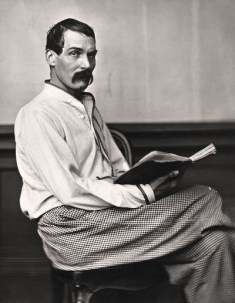
Sex and drugs and the source of the Nile: Sir Richard Francis Burton

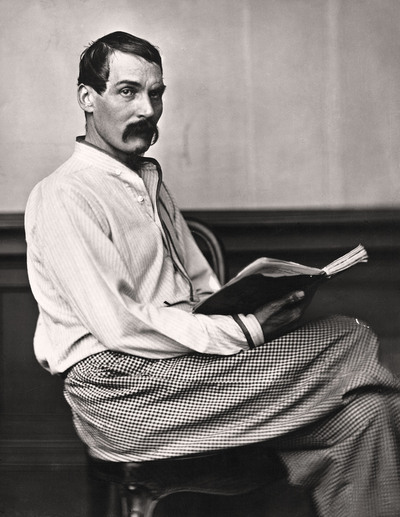
Burton photo

They say that things often come in threes, and so it has appeared recently in relation to an individual I have long admired and been fascinated by: Captain Sir Richard Francis Burton.  As far as I’m aware there is no significant Burton-related anniversary in 2015 (other than it being 125 years since his death), but nevertheless he’s popped up in a couple of places of late.  First of all there was a Radio 4 Great Lives programme about the man; then yesterday there was an article in Nature by Professor Clare Pettitt and on Wednesday night, at a Wildlife Trust event in Cambridge, I found myself chatting to a man whose name badge stated “Richard Burton”.

Clearly the universe was trying to tell me something and it reminded me of a piece of writing that I produced in October 1990 (!) to mark the 100th anniversary of Burton’s death, and never published.  To put this in context, I was 25, about a year into my PhD research, and anticipating the birth of my first child in December.  Re-reading the piece has been less painful than I thought it would have been. Some of the writing is a little clumsy and there are other aspects that I’d now focus on, but it’s not too bad.  Having said that, Karin said it sent her to sleep and that my writing has improved a lot in 25 years, so there’s no pleasing everyone!

Anyway I thought I’d post this piece of writing (very lightly edited) as an indulgent missive from my 25 year old to my 50 year old self.  And it’s dedicated to my daughter Ellen in her 25th year.

———————————————————-

Often, simply striving for fame is not enough. No matter how daring your exploits or how much you publish, the contingencies of history conspire to obscure you, consigning your life and works to the realms of the scholar or to that nebulous coterie, the “enthusiasts”. Such has been the fate of one of the most exciting of the many outstanding lives of the Victorian age.

This week marks the one hundredth anniversary of the death of one of our most important, yet underappreciated, scholar-travelers, Captain Sir Richard Francis Burton. Such anniversaries always seem to necessitate a reassessment of the celebratee’s life and work, and this one is no exception; two major new biographies, an extensive “biobibliography” chronicling Burton’s literary output, and a film “Mountains of the Moon“. Yet for all this, Burton is still not a widely known figure; although his adventures far surpass, in daring and in accomplishment, his contemporaries Livingstone and Stanley, still he does not enjoy their household-name status. This is in spite of, between 1890 and 1989, the publication of at least eight biographies, a bibliography, and many articles and essays devoted to the man’s exploits. Add to this Burton’s own vast literary output, none of which is noted for any bashful self-deprecation on the part of the author, and one begins to wonder at the criteria we use to apportion recognition.

Richard Francis Burton was born in 1821, the son of an army officer, Colonel Joseph Burton. His early life was spent travelling Europe with his family, fueled by the incessant wanderlust of his father. This gypsy start to life, as well as being an obviously formative prelude to his later travels, seemed to encourage the rowdier, untamed, hell-raising aspects in the characters of Richard and his brother Edward. The despair of their parents, the pair were soon packed off to college in England; Edward to Cambridge, Richard to Oxford. College and academic life did not suit either of the boys, and both left (in Richard’s case, forcibly; he was sent down after attending a proscribed horse race) to pursue military careers. Over the next 50 years, Richard Burton devoted himself to restlessly wandering the world, roaming Africa and Asia, North and South America, and Europe. He was one of the first Europeans to visit the Islamic sacred cities of Medina and Mecca; he explored India, often on covert missions for the British government; travelled in Africa where he searched for the source of the Nile (and only missed discovering it through ill-luck and the machinations of others); he lived for a time in South America as consul at the port of Santos in Brazil and observed first-hand the war between Paraguay and the allied forces of Argentina, Brazil and Uruguay; and in all travelled and observed enough to satisfy several lifetimes.

During his wanderings Burton saw and experienced much, events which invariably he became curious about, investigating further, writing down his views. Whether it was local uses of medicinal and psychoactive plants; details of tribal ritual, or the niceties of local sexual practice; the grammatical fine points of local dialects; geological formations; curiosities of natural history; or simply the price of staple vegetables in a native market, Burton was interested. These details inevitably found their way into his many books, articles and learned papers, packing paragraphs of ethnological, geographical, archaeological and natural history minutiae into his accounts of travels and expeditions.

It is Burton’s polymath approach to scholarly work that is the man’s most interesting feature. Perhaps it was his limited formal education (travelling tutors, two terms at Oxford) that fostered this approach. Though in many ways laudable, conventional academia can lead to a blinkered approach to research, ivory-towerism at its worst. If Burton had limited himself to purely single-strand studies, for example oriental languages (or even language), as may have resulted from following an academic career, the world, and Richard Francis Burton, would have been far poorer. Had he only recorded the bare geographical necessities required of, for example, his travels in the Great Lakes region of Africa, what dry accounts they would have been, and what details we would have lost.

This is not to say that Burton’s work was not scholarly, far from it. His translation of the Arabian Nights, although not the first, is certainly the definitive version, rich in anecdotal footnotes from a man for whom the deserts of Arabia were perhaps his first real home (as a child and a young man he had hated Britain, especially its climate), and his research and translation of the works of the Portuguese poet-explorer Camoes shows Burton at his most academic.

Burton has perhaps been more misunderstood, loathed and ignored than any of his contemporaries, or any comparable figure before or since. This is in part due to the man’s interests during his lifetime: translations of obscure erotica such as the Kama Sutra; a more than passing interest in the ins-and-outs of male and female circumcision; undercover reconnaissance of Indian homosexual brothels (which invariably led to rumours about Burton himself) all added to his infamy. Perhaps more than anything else, this meant that most of Burton’s books were not widely read, a trend which continues today, aided by the inflated prices demanded by booksellers for even the most popular of his works.

As if our view of Burton were not obscured enough, his over-zealous wife Isabel sought to soften history’s account of her “Jemmy” by burning almost all of his private papers after his death; writings which may have cast light on this enigmatic man were consigned wholesale to the grate. Because of this, Burton’s biographers have tended to be hard on Isabel, dwelling on her attempts to instill Catholicism into her part Muslim, part Atheist husband, and, of course, on her literary pyromania. This may be because of frustration on their part; biographers and commentators have never really been able to reason Burton out, and large parts of his life remain veiled in secrecy and obfuscation. The task has not been aided by Isabel’s actions. Yet she was devoted to Burton, who was never the easiest of men to get along with, being often bad tempered or absent for months on end.

But Isabel is only a scapegoat. Mainly, the problem is that there never has been any other person to compare with Burton. How could any man hope to fulfill all that he aspired to? Why the incessant wandering in search of new experiences? Why was it that the man did not focus his energies, rather spreading himself across a continent of interest, his curiosity endless? It has been said that if Richard Burton had concentrated his mind in this way, he could have been one of the foremost intellects of his time, rivaling Darwin or Huxley, Edison or Swan. Yet this misinterprets the man. It is doubtful whether Burton could have disciplined himself enough to centre on a single area of research; Burton was a searcher, a shifter of interests. Burton’s writings have been criticised as being unstructured, cluttered and self-indulgent, almost as if he had not the time nor inclination to properly revise and edit, but simply wanted to get the current project out of the way in order to get on with the next. This is borne out by the fact that, towards the end of his life, he had eleven desks set up in the study of his home in Trieste, where he was consul; each desk was for a different project and, when he tired of one, he would move to another, as if restlessly seeking for something.

But none of this need be considered as faults in Burton’s character; he was probably no more flawed, neurotic or self-obsessed than any of the great men of his time. It seems impossible than an intellect as deep and all-encompassing as his, which mastered some twenty nine languages, produced fifty books (many of them comprising more than one volume) plus innumerable essays and articles plus all the work that Isabel burned, could ever hope to be completely stable and well adjusted. Eccentricities of writing and behaviour seem inevitable.

Now, one hundred years after his death, is as good a time as any to properly reappraise the life of Richard Francis Burton. As an explorer, anthropologist, geographer, linguist, orientalist, translator, diplomat, swordsman, writer (and a lot more besides) he stands unrivalled by the broad sweep of his experience and knowledge. Yet his private life seems consistently to get in the way of any objective assessment of the man and his accomplishments.

The scandalous view of Burton, prevalent in England during his life and long after his death, was as a man obsessed by sex, a delver into the sordid details of native life and custom, promoter (though not practitioner, Isabel would never have allowed it) of polygamy, an unpopular critic of certain governmental interventions abroad, a user of cannabis, opium and other, more exotic drugs, and an ill-tempered, frequently drunk, godless, misogynist racist. His reputation as a fighter, even a murderer, was often played up by Burton, though there has is only one well documented account of him ever killing anyone, and then in self defence. Yet the real Burton, so far as we can tell, does not deserve this misrepresentation. His interest in all things erotic was partly academic and partly out of concern for the then current view that women should not find pleasure in sex. Are these the motives of an over-sexed misogynist?   His use of drugs, including alcohol, is well known, but was not unusual amongst Victorians exposed to the influences of the Far East, or for whom port, wine and whiskey were often viewed as medicinal necessities. Finally, Burton was no more racist than most Europeans of his time, yet it was from an intellectual stand point, not an emotional or cultural one. Most of the great academics of the period believed that there was a progression of human development, with white Europeans at the pinnacle. But no one who deeply despised Arabs or Indians could live and worship amongst them the way Burton did. He may have severely criticised them, but then he criticised everyone.

All of this points to a man more liberal than many people have believed; Burton was in many ways a free thinker, particularly given his upper middle class military background. Finally, there is the matter of his atheism, if such it was, which would today raise few eyebrows. Yet the man lived and prayed for much of his life as a Muslim, had been initiated into an esoteric Sufi brotherhood, and before that into a Hindu sect. This is not the life of a godless man, in the accepted sense of the word, but of a man searching for truth, who was too intelligent to believe he had ever found it in the rosary beads of his wife’s Catholicism or in the calling chant of a muezzin.

The life of Richard Francis Burton was dogged by ill-luck and, certainly towards its end, ill health, and furthermore seemed cursed by the intransigence of government officials and individuals with grudges. A character such as his finds no difficulties in making enemies, yet they always seemed to be foes with influence, willing to block his attempts at organising expeditions or soliciting official help for schemes to further the British Empire, or its servant Burton. He never did find the source of the Nile; this single act, more than any other, would have ensured his position as the greatest of the Victorian explorers. Yet had he been successful, would the constant round of lecture tours, press interviews, official visits, and all have given him time to think and write about anything else? I believe it would, though whether it would have satisfied his roving curiosity and incessant wanderlust seems unlikely.

How does a scientist’s h-index change over time?

Since its introduction a decade ago the h-index has rapidly become the most frequently used measure of research productivity and citation impact amongst scientists.  It’s far from perfect and has been criticised from a number of perspectives, particularly when used as a blunt tool for assessing a scientist’s “quality”.  Nonetheless it’s a useful measure that allows some comparison within research fields and (I think more importantly) gives individuals one method, amongst any number, of assessing the influence their work is having on their discipline.

Put simply, an individual’s h-index is calculated by ranking their publications by number of citations; the point at which the rank position of a publication is at least equal to the number of citations for that publication is the h-index.  For example, if a scientist has 18 papers all with at least 18 citations, their h-index is 18.  As soon as another publication reaches 19 citations, their h-index will go up to 19, and so forth.

That’s an important point about the h-index (and indeed all other measures of success/impact/whatever) – they are not static and they change over time.  As the Wikipedia entry that I linked to above notes, the originator of the index, Jorge Hirsch, suggested that 20 years after their first publication the h-index of a “successful scientist” will be 20; that of an “outstanding scientist” would be 40; and a “truly unique” scientist would have an h-index of 60. However, this will vary between different fields, so any comparisons are best done within a discipline.

One question that I’ve not seen widely discussed is how an individual’s h-index changes over time (though see Alex Bateman’s old blog post about “Why I love the h-index“, where he refers to the “h-trajectory”).  Does the “successful scientist” typically accrue those 20 h-index points regularly, 1 point per year, over the 20 years?  Or are there years when the h-index remains static and others when it increases by more than the average of 1 point per year?  If the latter, what’s the largest annual leap in an h-index that one could reasonably expect?  Finally, if we were to plot up the h-index over time, what shape curve can we expect from the graph? [2026 UPDATE: see the comments below about the fact that an h-index can, in rare circumstances, go down].

On one level these are purely academic questions, the result of some musing and window gazing during a bus ride between campuses a couple of weeks ago.  But there’s also a practical aspect to it, if scientists wish to track this measure of their career progression.  For an early career scientist starting out with their first few publications, it’s easy to record their h-index as it changes over time from this point forward.  But what about a mid- or late-career scientist who started publishing long before the h-index was even thought of?  How do they reconstruct the way in which their h-index has evolved over time, should they be so inclined?

As far as I know there’s no simple, automatic way to do it (but please correct me if I’m wrong).  Indexing and citation systems such as Web of Science and Google Scholar give the current h-index and no indication of past history, you have to work it out for yourself.  Which is what I’ve done, and the procedure below is (I think) the most straightforward* way of reconstructing the evolution of an h-index.

So, pour yourself a cup of coffee** and settle in for a bit of academic archaeology.

I’m going to demonstrate the process using Web of Science (WoS)***, but it should be identical in overall procedure, if not in detail, in Google Scholar, Scopus, etc.  However be aware that Google Scholar is much less conservative in what it counts as a citation, hence h-indexes from that source are typically significantly higher than from others.

The first thing to do after you’ve logged on to WoS is to perform a Basic Search by author name, across all years; I’ve done this for All Databases as some of my**** publications (specifically peer-reviewed book chapters) are not listed in the WoS Core Collection database (the default selection):

Screen Shot 1 2015-05-10 at 08.03.59 copy

Perform the search then select Create Citation Report.  This will return a pair of graphs showing number of publications per year and number of citations per year, plus a table with some metrics about average citations per year, etc., and a value for the current h-index of that author:

Screen Shot 2 2015-05-10 at 08.12.12 copy

Below that is a list of publications for Ollerton, J ranked by number of times cited:

Screen Shot 3 2015-05-10 at 08.31.13 copy

As you can see, WoS indicates that the h-index of Ollerton, J is 23.  That’s incorrect, it’s actually 22 (i.e. a not-quite-successful scientist) because despite having a relatively uncommon name, there are other people called Ollerton, J who publish (including my cousin Janice).  However it’s a simple matter to remove any publications that are not your own using the check boxes against each publication and the “Go” button.  Ignore any publications that are ranked lower than your h-index.

Once you have a clean list, use the drop-down menu underneath the page to save your list as either a text or Excel file; again, just save the publications that are contributing to your h-index by choosing the number of records that corresponds to your h-index [UPDATE: however see Vera van Noort’s comment below about the possible influence of early publications that were only cited once or twice on your early h-index.  UPDATE x 2:  see also the later comments by Alex Bateman and Vera – later publications can drop out of the h-index list too.  This wasn’t an issue for my set of publications, but it’s worth checking if you’re following this procedure].

The Excel***** file is easiest to work with: it provides you with the two graphs shown on the WoS citation report plus details of the publications, average citations and so forth, and all the raw data on number of citations per year back to 1950 (click on each image for a larger view):

Screen Shot 4 2015-05-12 at 16.22.15 copy

To make the spreadsheet easier to work with I advise deleting all the stuff you don’t need, including the figures and the columns from 1950 up to the date of your first publication.

You now have to calculate cumulative number of citations over time for each publication using the Sum function (I’ll not go into details, should be straightforward if you know your way around Excel).

Next, copy all of the data and paste-special onto another sheet, selecting “values” (to just paste the data, not the formulae) and “transpose” (to turn the data 90 degrees) from the paste-special options.  Remove the original data to just leave the cumulative citations and then select all of the data and use the Custom Sort function to order the rows by by date of publication:

Screen Shot 4 2015-05-14 at 09.24.38 copy

Now it’s a matter of going along the columns and recording the number of publications that exceed the h-index for the previous column; I’ve colour-coded this below to make it easier to see:

Screen Shot 6 2015-05-14 at 08.37.38 copy

Finally, graph up the data:

Screen Shot 7 2015-05-14 at 09.05.41 copy

The results are interesting (or at least I think so).  In relation to the questions I posed above its clear that there are periods when the h-index doesn’t increase for a couple of years; more periods when the h-index increases by one each year; and a couple of years when the h-index increases by 2 points.  But that’s the maximum and I suspect that increasing by 3 or more index points in a year would be very unusual indeed (though see my second point below).

Although there’s a clear “lag phase” in the first five years when the h-index hardly changes, there are also periods when there’s no increase in h-index much later, e.g. 2013/14, so this stasis is not restricted to the beginning of my career.

Some final points:

1.  Make sure your citation data on Web of Science is accurate.  I have found LOTS of mis-citations of my publications over the years, by  authors who include incorrect dates, volume numbers, page numbers, even authors, in the references they cite.  WoS has a facility for correcting these mis-citations, but you have to let them know, it’s not automatic.

2.  How representative are my results for the population of ecologists or scientists more generally?  I have no idea but I hope others go through the same procedure so that we can begin to build up a picture of how the h-index evolves.

*No doubt this could be automated in some way and perhaps this will stimulate some competent programmer or app developer to do so, but doing it by hand is so straightforward that I’m not sure it’s worth the effort of constructing a working system.  Certainly the Excel part of the procedure could be done more elegantly in R.

**Other beverages are available.

***Other indexing and citation systems are available.

****Other scientists are available 🙂  But it doesn’t seem fair to use someone else as an example.  In any case, consider this another post reflecting on my life and career in my 50th year on this planet!

*****Other spreadsheets are available.  That’s the last one, promise.

What Einstein didn’t say about bees – UPDATE – May 2021

https://i0.wp.com/www.impawards.com/intl/misc/2012/thumbs/sq_more_than_honey.jpg

It’s more than 6 years (!) since I wrote this post. Over that period I’ve been asked many times about the Einstein bee quote and I’ve always replied that it’s made up, and that further more, Einstein was a physicist: he had no interest in bees!

Turns out, that’s not quite correct. There’s still no evidence that Einstein stated the infamous bee quote; however he does seem to have had an interest in bees. A newly-discovered letter from the great man mentions his admiration of the work of Karl von Frisch, whose research on the honey bee ‘waggle dance’ earned him a Nobel Prize. There’s a couple of news stories online about this: here’s one from Cosmos, and another from The Conversation. The original paper discussing the letter, by Adrian Dyer and colleagues, can be viewed here.

So I will have to moderate my response in the future, but it doesn’t change the big picture: Einstein never said it!

———————————————————————————————————————–

In the 100th anniversary year since Albert Einstein published the paper on his General Theory of Relativity, it’s saddening to think that one of the things that he will be best remembered for is something he did not say.  There are various versions of it, but they all amount to the same thing:

“If the bee disappeared off the surface of the globe, then man would have only four years of life left. No more bees, no more pollination, no more plants, no more animals, no more man.”

This statement could be dissected and disproved in numerous ways:  for example, there’s over 20,000 species of bees, so what is “the bee”?  Plus most of our crops are not bee (or even insect) pollinated, they are wind pollinated grasses such as wheat and rice.  Etc. etc.

But what is particularly annoying about it is – EINSTEIN NEVER SAID IT!  As far as anyone is aware he had no interest in bees whatsoever and the original source was a Canadian beekeepers’ journal in the 1940s.

It’s even more annoying that, despite the fact that we’ve known the statement is both factually incorrect and not by the great man, documentary film makers and journalists are STILL using it to support their work.  The latest example I’ve seen is this documentary, the poster of which is shown above.

Rant over: back to reading paperwork for a meeting this afternoon.

UPDATE:  I’d forgotten that Tom Breeze at University of Reading posted a fuller account of Einstein’s (non) quote last year – here’s the link.

What do academics do once the research is published?

P1010513

At the University of Northampton we run a programme of generic training workshops aimed at research students (MPhil and PhD) from across all disciplines.  I contribute to several, including one called “Getting Published”, usually run with my colleague Professor Ian Livingstone.  This focuses on academic papers/articles (phraseology varies with subject) and covers all of what you might expect such a workshop to feature, including asking about motivations for wanting to publish research*, when is the right time to publish your research**, issues about co-authorship***, and so forth.

One of the key aspects of the workshop is a flow chart of the process of getting published, beginning at “do the research”, moving on to writing it up, choosing a journal, submitting to a journal, peer review, dealing with reviewers’ comments, writing a covering letter, coping with rejection, re-submission to the same or a different journal, celebrating acceptance, etc.  All fairly standard stuff.

By this point we’re about three-quarters of the way through the workshop, so I ask a question:

“OK, you’ve gone through the whole process (which can take anything from months to years) and your paper has been published.  You’re very pleased, of course.  What do you do next?”

Responses at this point are typically a blank expression, or perhaps “What else is there to do?  The paper’s published, we’ve done our job.  Move on to the next”.  In other words, the general feeling seems to be that the process stops when the research is published.  I politely suggest that this is not so, that you’re still only part-way through the process, and explain why, starting with this table:

Clinical:                                  48.9%

Biological Sciences:           37.8%

Environment:                       37.3%

Physical Sciences:              42.3%

Social Sciences:                   55.4%

Business:                                57.2%

Humanities:                          77.5%

These figures are the percentages of un-cited research papers (in 2005, by broad discipline) published in the UK for the period 2000 to 2004.   The total number of un-cited papers is 122,771****.  There are other similar statistics available, some with broader time windows, but they all point to the same conclusion: in all disciplines, a high proportion of research papers are never referred to by other researchers in the field.  And in some disciplines it’s the majority of papers.

That’s not to say that the research is no good, or even that it’s not being read, but it’s certainly not being cited.  Citation is not the only measure of the “quality” of a piece of work of course, but it at least indicates that peers have read the work, and citation is central to a range of widely used metrics, including the h-index.

This usually comes as a shock to the postgrads, as it does to many established academics!  The low average citation rate of papers is mainly a response to the sheer volume of research currently being published, as I’ve discussed previously in relation to the field of pollination ecology.

How do researchers in a field decide which papers they are going to read and/or cite, and which they ignore?  It’s been suggested that academics often have quite conservative citing patterns, referring again and again to the same work or authors in their own papers.  How can a researcher break through this conservatism and have their own work cited?

One answer is to promote your work after it’s published and the workshop offers some ideas on how to do this:

  • Send PDFs of your papers to other researchers, whether you know them personally or not.  I’m always happy to receive copies of papers that I might otherwise miss.
  • Deposit copies with your institutional electronic repository (at Northampton that’s NECTAR)
  • Tell the world about it using social media, either general (Twitter, Facebook, LinkedIn) or academic (ResearchGate, academia.edu)
  • Send announcements to email discussion groups in your field
  • If you blog, write a post about it (as I did for the pollinator extinctions paper last month)
  • If the work is particularly novel/important/high impact, consider writing a press release with your institution’s press office, or at least a news item on the website.
  • Consider writing up your research as a non-academic piece in a magazine or newspaper for a wider, public audience (see comment below)
  • Present the work (and cite it) at conferences & seminars (the old fashioned way…..)

This kind of “self promotion” is anathema to some academics, for reasons that are not clear to me but may relate to misguided notions about sullying the purity of their work with grubby advertising, something that’s been discussed over at the Dynamic Ecology blog.

But if you don’t promote your work, no one else will do it for you!  Doing research and writing books and papers is a creative endeavour just as much as any of the arts or music.  Would we expect an artist to not advertise the work they do?  Or a musician to keep compositions to themselves.  No, they have exhibitions and concerts, and use advertising in all its forms, to promote their work.

Ultimately a piece of research is only as good as its reception by the audience at which it’s aimed: some brilliant research findings have been ignored for decades because it had disappeared into academic obscurity.  This is likely to happen even more in the future, I’d suggest, given the amount of work that’s being published.

Do you have other strategies for promoting your work?  Or do you disagree with some of what I’ve said?  Feel free to comment, I’d be happy to hear from you.

*”earning money” occasionally pops up as a (naive) reason, so we have to point out that academics rarely get paid for their academic publishing, other than (meagre) book royalties.

**As soon as is feasible, even if it’s a short literature review.

***Make sure everyone, especially supervisors, is clear about which work will be co-authored, which will not, and why.

****Source: PSA target metrics for the UK research base, Office of Science and Technology, DTI (2005)

“one of the referees says floresianus actually means ‘flowery anus’ so it should be floresiensis

Tring 8

In a parallel universe I work as a paleoanthropologist, a topic that has fascinated me ever since as a teenager I read Donald Johanson’s account of the discovery of Lucy (Australopithecus afarensis).  At university I took a short human evolution course and could easily have been swayed into doing research in that area were it not for my fascination with plants and ecological interactions (there are also parallel universes in which I’m a marine biologist, palaeontologist, gardener, sound engineer, etc….you get the picture).  I still keep half an eye on the paleoanthropological literature and enjoyed reading this interview on the Nature website with the discoverers of Homo floresiensis, the so-called “hobbit” fossil hominids, which added significantly to our understanding of the biodiversity of the human evolutionary lineage.

The line that “one of the referees says floresianus actually means ‘flowery anus’ so it should be floresiensis“, and some of the other anecdotes, give lovely insights into how science works, and the way it often follows a random, haphazard path, not at all the clear and logical route that non-scientists assume.  And it shows how the peer-review process can pick up and correct errors in a manuscript that could haunt any scientist’s career…..

Travelling west to go north (BES Macroecology meeting day 1)

2014-06-24 08.00.19

Birmingham New Street, with its subterranean platforms accessed by narrow concrete gullets, must be one of the ugliest and most unpleasant major railway stations in Britain.  It’s also, thanks to the redevelopment work currently being carried out, one of the most confusing for the traveller who only occasionally passes through.  Ugly and unpleasant I can handle if it functions well: but ugly and unpleasant AND confusing is not good.  It’s a huge contrast to Milton Keynes station which I went through last week on the way to Chester, where the open, airy platforms look out onto embankments covered in wild flowers (see the photo above).  While waiting for the train at Milton Keynes I spotted butterflies and bees visiting flowers only feet from passing high-speed engines.

As I start this post I’m sitting on Platform 9A at Birmingham waiting for a train at 0949 to Nottingham where I’m attending the British Ecological Society’s Macroecology Special Interest Group’s annual conference.  In fact I should be on the train which left platform 12A at 0919, but trying to find the unsignposted 12A, followed by a detour to pick up a coffee, meant that I missed the train by about a minute.  Not to worry, gives me an opportunity to rant about Birmingham New Street station.

The BES Macroecology SIG has been established for three years and I blogged about the inaugural meeting in London back in 2012.  I missed last year’s meeting in Sheffield so thought I’d make a special effort to get to the Nottingham event this year, even though it involves heading west (to Birmingham) to travel north (to Nottingham).

Day 1 of the meeting started with the first of two keynote addresses by Catherine Graham from Stony Brook University.  Cathy focused on her work on that most charismatic of flower visitors, the hummingbirds.  In the first talk she dealt with the importance of thinking about phylogenetic scale when conducting analyses.  Lots of thought provoking ideas and a huge amount of information to digest.

As I’m speaking on the second day I could relax and listen to some interesting talks by established and early career researchers, and PhD students, most of whom have been given 7 minutes (!) to present their work.  It’s been a challenge to whittle the final part of the talk I gave in Copenhagen last week into such a short format, but we’ll see how I get on tomorrow.  Highlights of day 1 for me included Joe Bailey talking about urbanisation, climate and alien vascular plants in the UK; Nova Mieszkowska’s work on inter-tidal species; Sive Finaly on whether Madagascan tenrecs are an example of an adaptive radiation (answer = “maybe”); and Guy Harrington on studying fossils in a macroecological manner.  But really but all the talks were good and I learned something from each of them.

As I mentioned in that post back in 2012, defining “macroecology” is problematic and there are still those who see it as synonymous with biogeography.  Perhaps one difference is that biogeography has traditionally tended to focus on patterns (e.g. how species richness changes as one moves form the poles to the tropics) whereas macroecology also seeks to explain those patterns in terms of processes, using very sophisticated statistical and mapping approaches.  But even that fails to fully appreciate biogeography which has a tradition of also trying to infer processes (for example Joseph Hooker’s 19th century work on the distribution of plants included hypothetical explanations), though without the modern analytical tools that are available to the macroecologist.  It’s a debate that will no doubt go on, though perhaps it’s a sterile one.  Does it matter what we call it as long as the science is sound?