
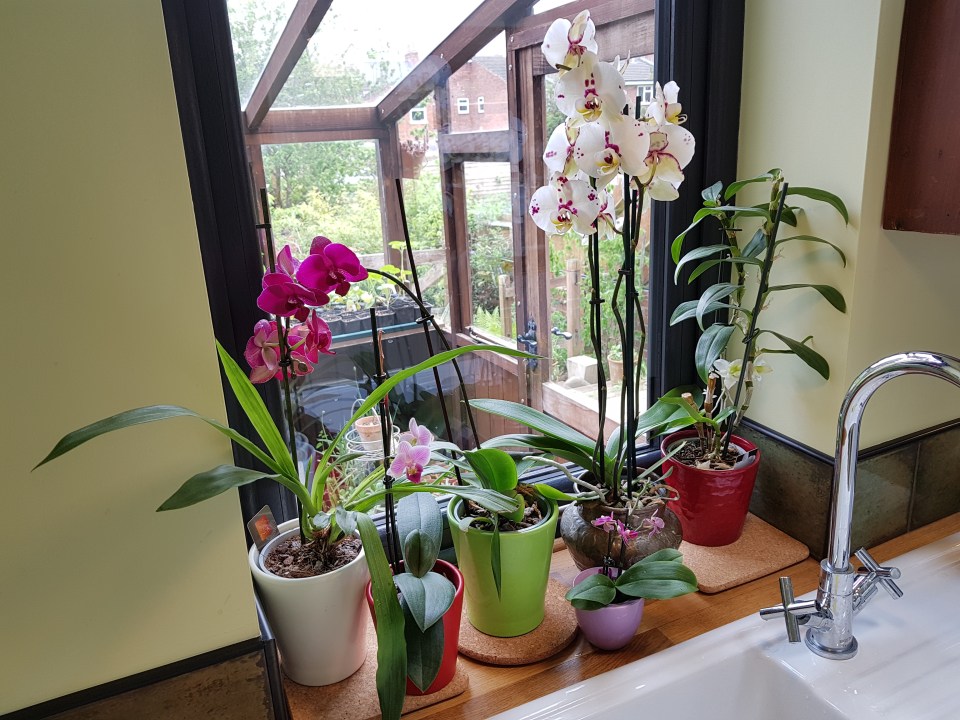
One of the major trends in horticulture over the last 20 years or so has been the rise in popularity of orchids as house plants. Orchids used to have a reputation as being delicate, choosy, costly things that needed expensive glasshouses, heating, and humidity systems to grow. Some groups of orchids are certainly like that, but many are not (Orchidaceae is one of the two largest families of plants, after all). These days it’s impossible to walk into any supermarket or department store and not see orchids for sale at a reasonable price, orchids that are tough and can withstand the relatively dry, centrally heated houses in which most of us in Britain live.
The majority of these orchids are varieties of Phalaenopsis, the moth orchids. Intensive hybridisation by commercial growers has meant that there is an almost inexhaustible range of flower colours, shapes, sizes and patterning available. Take a look at this gallery of images and you’ll see what I mean, or go into a shop that sells such orchids and observe that almost no two are alike.
This is the stuff of natural selection: genetic variation in the phenotype that can be acted upon by a selective agent. In this case it’s the growers of orchids who choose the most attractive types to sell and discard the others. If this variation emerged in wild populations most of it would disappear over time, but some, just occasionally, would be selected for by a different group of pollinators and go on to form a new species. This is much more likely to happen if the individuals with this variation are isolated from the rest of the population in time or space, for example if they flower later or have been dispersed to a distant valley or mountaintop (termed allopatric speciation). But it can also happen within populations – sympatric speciation.
Back in 1996, near the start of this orchid explosion, one of my earliest papers was a speculative commentary in Journal of Ecology called “Reconciling ecological processes with phylogenetic patterns: the apparent paradox of plant-pollinator systems”. It generated some interest in the field at the time and has picked up >250 citations over the years, mostly other researchers using it as supporting evidence for the discrepancies we see when trying to understand how flowers evolve within a milieu of lots of different types of potential pollinators selecting for possibly diverse and contradictory aspects of floral form. In that paper I made a passing comment that I expected the reviewers to criticise, which they did not. Once it was published I thought that perhaps other researchers in the field would critique it or use it as a jumping off point for further study, which has not really happened either. This is what I wrote:
“It appears that pollination systems are labile and may evolve quite rapidly….plant breeders can obtain a fantastic range of horticultural novelties through selective breeding over just a few generations.”
This is horticulture holding up a mirror to the natural world and saying: “This is how we do it in the glasshouse, look at the variety we can produce over a short space of time by selecting for flower forms; can nature do it as quickly, and if so what are the mechanisms?”
I still believe that pollination ecologists could learn a lot from horticulture and there’s some fruitful (flowerful?) lines of enquiry that could be pursued by creative PhD students or postdocs. Here’s one suggestion: part of the reason why these Phalaenopsis orchids are so popular as house plants is that they have very long individual flower life times, often many weeks. Now we suspect that floral longevity is under strong selection; see for example research by Tia-Lynn Ashman and Daniel Schoen in the 1990s. This showed that there is a negative correlation between rate of pollinator visitation and how long flowers stay open. Plants with flowers that are not visited very frequently stay open much longer, for example the bird-pollinated flowers of the Canary Islands that may only be visited once or twice a day, and which can remain open for more than 20 days. Is the floral longevity shown by these orchids (or other groups of plants that have been horticulturally selected) beyond the range found in natural populations? If so, what are the underlying physiological mechanisms that allow such extreme longevity? If not, does this mean that there is an upper limit to the lifespan of flowers, and if so, why?
In the mean time I’m going to enjoy the orchids above that sit on our kitchen windowsill. They actually belong to my wife Karin who has developed something of an interest in them in recent months. The big spotty one is a late birthday gift for her that I picked up this morning from a local flower shop, and which stimulated this post as I was walking home. I’d bet that we never see another one like it!



 Prof. Jeff Ollerton - ecological scientist and author