Category Archives: Biodiversity and culture

Adaptable Elder – and a nice review of my book by Mark Avery!

One of the many things that I love about Common Elder (Sambucus nigra), and which I didn’t have space to properly convey in my article about the species last year, is just how adaptable it is as a species. The tree possesses a lot of what biologists term “phenotypic plasticity“. This is the ability of an organism to flexibly change aspects of its morphology or behaviour or physiology in response to differences in the environment. Plants are especially good at this because, if they find themselves growing in less-than-optimal conditions, they can’t just uproot themselves and leave for pastures new. This is obvious to anyone who has seen a houseplant struggling in a dark corner of a room: the poor plant will etiolate and bend as its yellowing foliage tries to reach the light from a distant window. The same plant grown on a sunny windowsill will be more compact, greener, and healthier.

When it comes to Elder, and indeed other trees, winter is often the best time to see this plasticity, when the trunks and boughs are not cloaked in greenery. On a coastal walk at Klintebjerg yesterday, I spotted three rather different phenotypes of Common Elder which nicely illustrate this environmental context dependency.

The first was a wind-tortured tree growing at the base of a low hill, directly in the teeth of the prevailing Kattegat weather, its trunk bent away from the sea and its branches lopsidedly pruned:

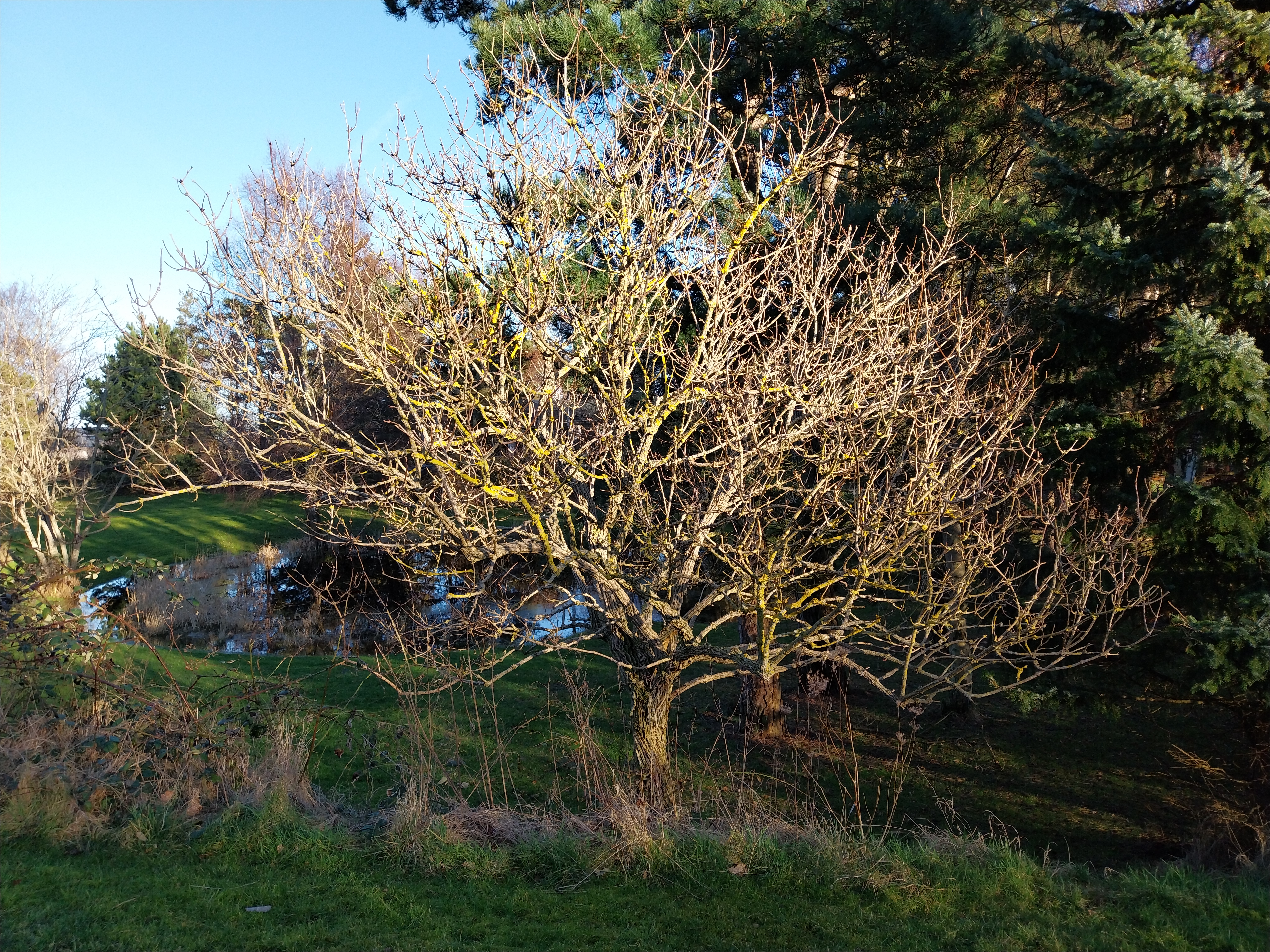
The second was a more fortunate specimen, growing in the lee of that same hill and allowed to spread its symmetrical arms, as though waiting to embrace any passing birds. It had clearly never been pruned back by the landowner, who had allowed it to grow as a fine, single-trunked small tree:
As we walked back down the hill via a narrow path, enclosed and over-topped by a fairy tale canopy of dense, twisted Blackthorn (Prunus spinosa), I spotted another phenotype, different again. I initially thought that they were the stems of a woody climber, perhaps Old Man’s Beard (Clematis vitalba) or European Honeysuckle (Lonicera periclymenum). When I looked closer it was clear that these were Elder, growing narrow and long, using the Blackthorn as support, as they struggled to reach up through the canopy to gain the light:
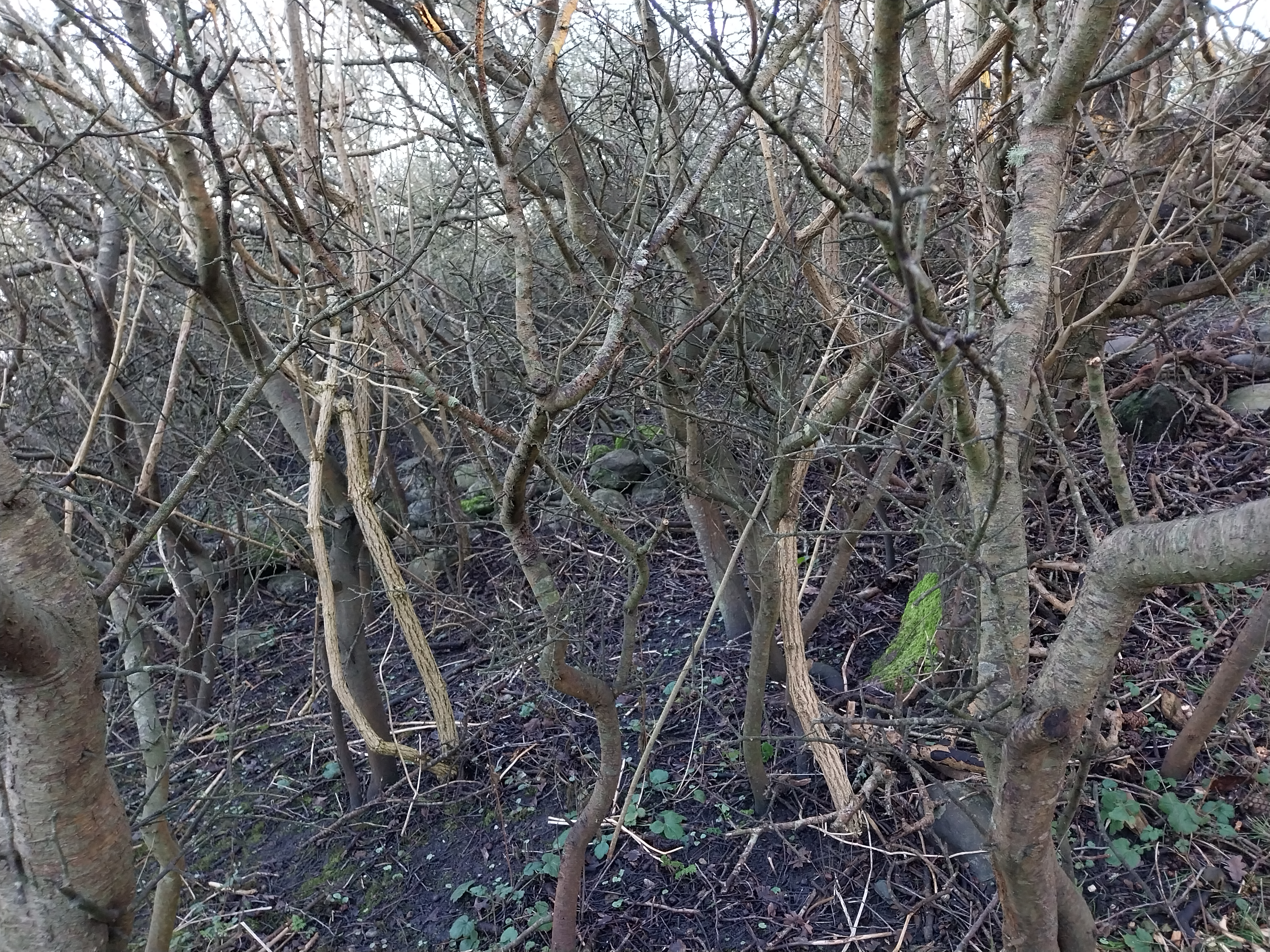
There were several individuals like this, presumably the result of seed dispersal by birds perched within the Blackthorn. I don’t think that I’ve ever seen Elder growing in quite this way before, but then how often do we get to peer deeply into the secrets hidden within a dense Blackthorn patch?

I had only planned to write about Common Elder today, but I can’t resist mentioning that, over on his blog, ornithologist Mark Avery has written a very nice review of Birds & Flowers: An Intimate 50 Million Year Relationship. He describes my book as having:

…a lightness of touch and tone that should not be taken for lightness of understanding….This is a fine example of a book which is pitched to increase the public understanding of ecology and evolution, and succeeds.

Thank you Mark, that’s very gratifying to read, and I’m glad that you enjoyed it!

Read my author interview and get a 25% discount off ‘Birds & Flowers’, ‘Pollinators & Pollination’ and other books from Pelagic Publishing!

I recently did a short interview with Pelagic Publishing’s marketing person, Sarah Stott, which you can read here: https://pelagicpublishing.com/blogs/news/birds-and-flowers-author-interview.

On that page you can sign up to Pelagic’s newsletter (which I STRONGLY recommend, because they produce some great natural history and science books, and not just mine!) and by doing so you can receive a 25% discount on all orders.

What are you waiting for?

It’s publication day – “Birds & Flowers” is officially out!

After what seems like a long wait, for me at least, today marks the official publication of Birds & Flowers: An Intimate 50 Million Year Relationship! I received my advance copies on Friday, an event that Karin commemorated with a short unboxing video:

https://www.facebook.com/100000638827245/videos/2177574652581431

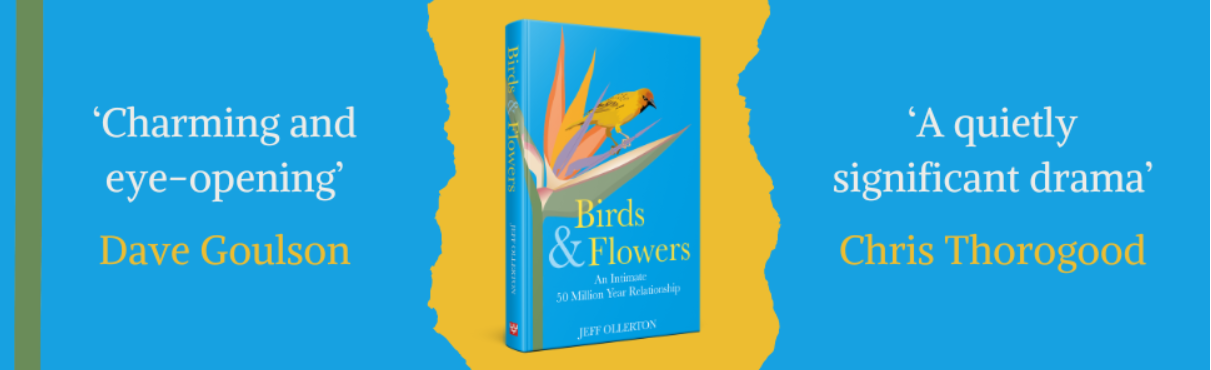
It’s been a long journey from pitching the initial idea to Pelagic Publishing back in early 2021, through the various drafts that have culminated in the finished book. As you can see from the images on this post and the endorsements on the publisher’s web site, Birds & Flowers has so far been warmly received. I hope that future reviews are as positive!

A few people have asked me what’s next. In fact I have definite plans (as in topics, provisional titles, the start of chapter structure, and even some initial writing) for three more books. The next one is actually about half written, but then I have been working at it, on and off, for 30 years! Watch this space for more details…

In the shorter term, Karin and I are returning (permanently) to the UK at the start of March. We’ve enjoyed our time in Denmark, it’s been a fun two and a half years, but we’re missing our immediate family plus we both have some interesting work possibilities to pursue. In mid-April I will be going to China for three months to work with my colleague Zong-Xin Ren at the Kunming Institute of Botany. I’ll be sure to blog about my adventures there!

In the meantime, if you buy my book or borrow it from the library or from a friend, please let me know what you think in the comments section below.

Pollinators and mental health: join us for a free webinar!

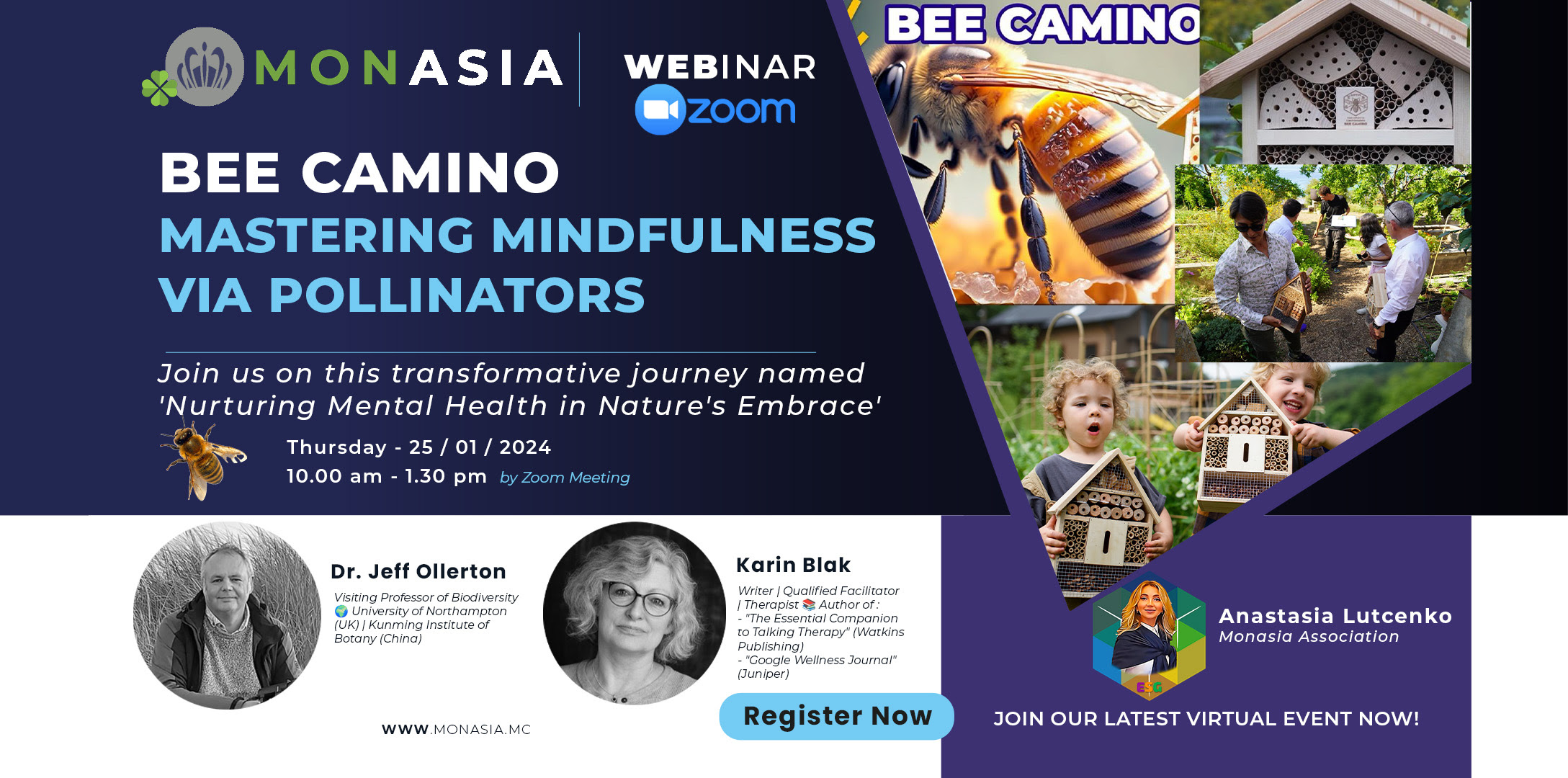
In recent months, Karin and I have worked with the charity MONASIA and their Bee Camino project to develop a joint webinar. Here are the details, taken directly from MONASIA’s publicity:

In the intricate choreography of nature, the honey bee’s life mirrors the enchantment of a mystical well: ‘The more you draw from it, the more it fills with water.’ Karl Von Frisch’s profound words beautifully capture the essence of the honey bee’s existence. Honey bees are only one type of bee, however, and there are many other pollinators, whose tireless efforts sustain the delicate balance of ecosystems. Much like a well that replenishes when quenched, the pollinator’s purpose appears boundless, offering a timeless wellspring of inspiration for those attuned to the marvels of the natural world.

Inspired by the Bee Camino project, MONASIA brings you a transformative experience connecting nature and mindfulness.

Join us on this transformative journey named ‘Nurturing Mental Health in Nature’s Embrace,’ as we draw from the enchanting well of the bee’s life—a source of wisdom, sustainability, and a profound connection to the intricate rhythms of our planet.

The event takes place on Thursday 25th January, 10:00 to 13:30 CET, and you can book a free place by following this link: https://www.eventbrite.co.uk/e/bee-camino-mastering-mindfulness-via-pollinators-tickets-796075783097

Want to keep up with what’s going on in nature conservation and biodiversity? Subscribe to Mike Shanahan’s ‘Nature Beat’!

The world of nature conservation is fast moving and complex. New opportunities for wildlife and threats to biodiversity seem to arrive almost daily, there are regular high-level meetings focused on conventions and policies, and an endless stream of scientific research being published in the world’s journals. Keeping up with all of this is impossible; trying to keep up with it is exhausting.

For this reason I’ve recently subscribed to Mike Shanahan’s newsletter The Nature Beat on Substack. Mike’s a writer with a background in science research. His PhD was on fig ecology and he wrote an excellent book about the ecological and cultural importance of these fascinating trees called Ladders to Heaven which was one of my five book choices on the Shepherd site.

The Nature Beat is described by Mike as being:

primarily aimed at journalists covering topics such as biodiversity, conservation, wildlife trade, ecological restoration and so on. Of course, non-journalists may also find it useful.

As a non-journalist trying to keep abreast of what’s happening in this complex and rapidly evolving arena, I find it extremely useful! For the past couple of months I’ve opted for the free subscription, but from today I’m going to pay. The kind of insights and expertise that Mike brings to his newsletter are invaluable for anyone interested in how our world is changing, for the worse and for the better. Please subscribe and if you find the content useful, and can afford it, consider upgrading to the paid version.

Read a preview of my new book ‘Birds & Flowers: An Intimate 50 Million Year Relationship’

In the run up to release of my new book Birds & Flowers: An Intimate 50 Million Year Relationship, my publisher, Pelagic, has updated the book description and provided a preview of some of the pages and colour plates – follow this link to view them. On that page you can also pre-order the book direct from Pelagic Publishing, who will ship worldwide, or it’s available from many of the online book sellers.

I’m really excited to be sharing this with the readers of my blog and can’t wait for publication day! Early in 2024 I hope to do some talks, online and in person, to promote the book – so watch this space.

With best wishes to you all and hopes for a peaceful, and more sustainable, New Year.

Corrections to the first edition of “Pollinators & Pollination: Nature and Society”

Books are never perfect. In the run-up to publication of Birds & Flowers: An Intimate 50 Million Year Relationship, I am all too aware that this is a truth that’s a cause of anxiety, and sometimes sleeplessness, for all authors. One category of imperfection is tipographical* errors have been introduced at some point in the process of writing and editing. In the past these were corrected in the first edition of a book by the inclusion of errata slips, and such errors are sometimes important in determining the true first editions of older books. On page 20 of the first edition of Darwin’s Origin of Species, for example, there is a misspelling of the word “species”**. This was corrected in the second edition but is an important marker of an extremely valuable book, intellectually and (now) commercially.

A second category involves errors of fact or interpretation or expression that, with hindsight and reader feedback, require correction, or at least acknowledgement, by the author. These are the ones that really make an author squirm inside, even though we know that they are inevitable: we are, after all only human.

It turns out that there are a few examples of both categories in the first edition of my 2021 book Pollinators & Pollination: Nature and Society. Some of them have been corrected in the second edition, but if you purchased the first edition then these are what you should look out for:

P22 – ‘Unmated queens and males (drones) are produced by the colony later in the season’ changes to: ‘Unmated queens and males (drones) are produced by the colony from spring onwards.’

P30, Fig 2.9 – Correct ‘Tabaernemontana’ to Tabernaemontana

P51, Figure 3.8 – title – it should read C. rhynchantha [there’s an h missing]

P57 – ‘The bank that Darwin was referring to is on his property at Down House in Kent, and it was one he observed many times during his walks through the garden.’ changes to ‘The bank that Darwin was referring to is near his property at Down House in Kent, and it was one he observed many times during his walks in the area.’***

P146 – ‘I’ve even see them attack and kill honey bees’ should read: ‘I’ve even seen them….’

P169 – in the title for Figure 10.5, Anon (2019) should be Anon (1919) [in some presentation copies of my book I have corrected this and initialed the change]

P259 – this reference: Klein, A.-M., Steffan-Dewenter, I. and Tscharntke, T. (2003) Fruit set of highland coffee increases with the diversity of pollinating bees. Proceedings of the Royal Society B 270: 955–961. doi: 10.1098/rspb.2002.2306.

Should be replaced by:

Klein, A.-M., Steffan-Dewenter, I. and Tscharntke, T. (2003) Bee pollination and fruit set of Coffea arabica and C. canephora (Rubiaceae). American Journal of Botany 90, 153– 157. doi: 10.1046/j.1365-2664.2003.00847.x

The last two have yet to be corrected and will need to wait for the third edition:

P119 – the Rader et al. study did not include birds and bats, just insects.

P262 – “Nabhan, G.P. and Buchmann, S.” should read “Buchmann, S. and Nabhan, G.P.”

That final error is really embarrassing because, as I point out in the chapter ‘The Politics of Pollination’, their book The Forgotten Pollinators was an inspirational one for stimulating research and action around pollinator conservation! I can offer no explanation for why the order of the authors got reversed in my head.

My sincere thanks to those readers who pointed out some of these errors. My hope is that Birds & Flowers has fewer, but I may be fooling myself…

*You see what I did there?

**Proof-reading is boring and soul-destroying for any author, but really Mr Darwin?!

***If there is an after-life, I’d like to think that Darwin’s now enjoying this error after my snarky comment in the second footnote. To which I’ll respond: watch out for a doozy of a footnote about a Darwin footnote in Birds & Flowers!

‘…people would need to be very weak in the head… before it would occur to them to go into the garden and eat snails…’

‘…people would need to be very weak in the head… before it would occur to them to go into the garden and eat snails…’

Anon. (1867)

Delighted to announce that my essay “A short history of snail-eating in Britain” will be in October’s issue of British Wildlife magazine. This is a topic that’s intrigued me for many years because it has a close connection to the snail-eating habits of folks (my own family included) in the area of the north-east of England where I grew up. Hopefully it will also interest, and surprise, the readers of British Wildlife!

“Birds & Flowers” book update: here’s the list of chapters!

Today I returned the final, edited files of the book manuscript to the publisher. It’s been a long summer of ‘fine distinctions and nice judgements’, to quote my editor, the inimitable Hugh Brazier. Now that’s all finalised, I thought that it was time to share the chapter titles with you – here goes:

Introduction: Encounters with birds and flowers

1         Origins of a partnership

              Understanding 50 million years of bird and flower evolution

2          Surprising variety

              The astounding diversity of pollinating birds

3           Keeping it in the family

                 Accounts of the different groups of bird pollinators

4          A flower’s point of view

              How many plants are bird-pollinated, and where are they found?

5         In the eye of the beholder

              What do bird flowers look like?

6          Goods and services

              The enticements given to birds for pollinating flowers

7         Misaligned interests

              The ongoing conflicts between flowers and birds

8          Senses and sensitivities

              How bird brains shape the flowers that they pollinate

9          Codependent connections

                Networks of interacting flowers and birds

10        Hitchhikers, drunks and killers

              The other actors in the network and how they affect the main players

11        The limits to specialisation

              How ‘specialised’ are the relationships between birds and flowers?

12         Islands in the sea, islands in the sky

                  Isolation, in oceans or in mountains, results in some remarkable interactions

13         The curious case of Europe

              Why did we believe that Europe had no bird-pollinated flowers?

14         ‘After the Manner of Bees’

              The origins of our understanding of birds as pollinators, and their cultural associations

15        Feathers and fruits

                Birds as pollinators of edible wild plants and domesticated crops

16        Urban flowers for urban birds

              Bird pollination in cities and gardens

17       Bad birds and feral flowers

              The impact of invasive species

18         What escapes the eye

                 The decline and extinction of bird–flower relationships

19         The restoration of hope

                  People as conservationists of birds and their flowers

There you have it! I’m incredibly excited that the book is now just about finished (I still have to proof read the typeset text and produce an index) and I look forward to finally having a copy in my hands. Birds & Flowers: An Intimate 50 Million Year Relationship is available for pre-order from Pelagic Publishing, or via online bookshops.

Positive Effects of Gardening and Experiencing Nature – clinical trials underway!

Regular readers of the blog will know that I’m a keen gardener as well as having a deep interest in the natural world, and I know from personal experience how being amongst plants, flowers, birds and insects can lift a person’s mood and improve their health.

It was interesting, therefore, to get a message via my Contact page from a tutor on the Students For Research programme. They had been looking at my blog and the tutor had challenged her students to find a web resource that they thought might interest me. And indeed they succeeded! They found this web page about Clinical Trials on the Positive Effects of Gardening and Experiencing Nature and it makes for very interesting reading. There’s a lot of good research happening in this area.

It’s a topic that my wife Karin and I have discussed a lot and which, as a therapist and author, she’s written about several times – see for example this piece about How Pollinators Benefit Our Wellbeing and the BBC Gardeners’ World podcast interview she did about how gardens help to build relationships.

So many thanks to the students on the programme for finding that resource and to the tutor for sending it to me.