Category Archives: Apocynaceae

Something for Blue Monday – the only known blue flowered asclepiad

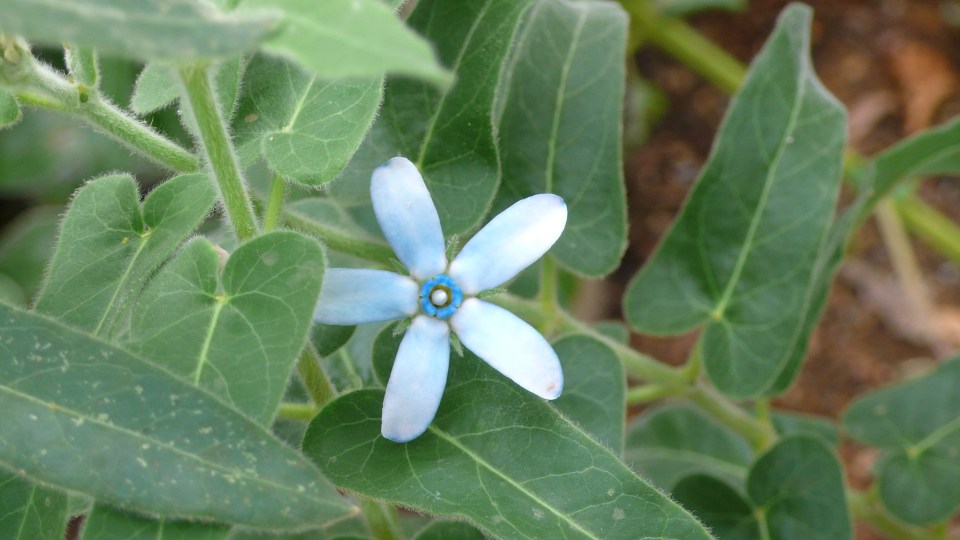
Tweedia caerulea - OBG 2014-11-06 11.33.14

Today is Blue Monday – reckoned to be the most depressing day of the year, though I’m in a very good mood: just back from a great 9am seminar with my final year students taking the Biodiversity & Conservation module.  They presented some really interesting, diverse and thought provoking papers as part of their assessment for this module; it’s a great group to teach.

But if you are suffering from the blues this morning, here is a photograph to cheer you up.  As far as I am aware Tweedia caerulea (also known as Oxypetalum coeruleum)  is the only known blue flowered asclepiad (that’s to say, a member of the family Apocynaceae subfamily Asclepiadoideae – what used to be the family Asclepiadaceae*).

No one is sure why blue is such a rare colour within the asclepiads (and indeed the Apocynaceae as a whole) and it may be connected to the pollination system of this plant.  However we don’t know what pollinates Tweedia caerulea in the wild so it’s hard to test that idea; other species within this group are variously pollinated by wasps, bees, flies, moths, etc.  Truly blue flowers (as opposed to some shade of purple or violet) are relatively uncommon generally amongst the flowering plants and the source of much interest and excitement in those groups where they do occur, for example the Himalayan Poppies (Meconopsis).

Tweedia caerulea is easy to grow from seed but not so easy to get through the winter in the UK, so in the past I’ve grown it as an annual in the garden.  Apart from the colour, one of the other reasons I like this plant is that it’s named after the 19th century plant collector John Tweedie whose life I’ve been researching over the past 20 years or so – see this paper for example.


*The asclepiads are my favourite group of plants, and one that I’ve published quite a bit of research on, so I was a bit miffed when the taxonomic rank of the family was relegated to subfamily.  But it makes evolutionary sense and now gives me a much larger family of plants on which to research, so every cloud etc. etc.

Pollinator biodiversity and why it’s important: a new review just published – download it for free

P1110763

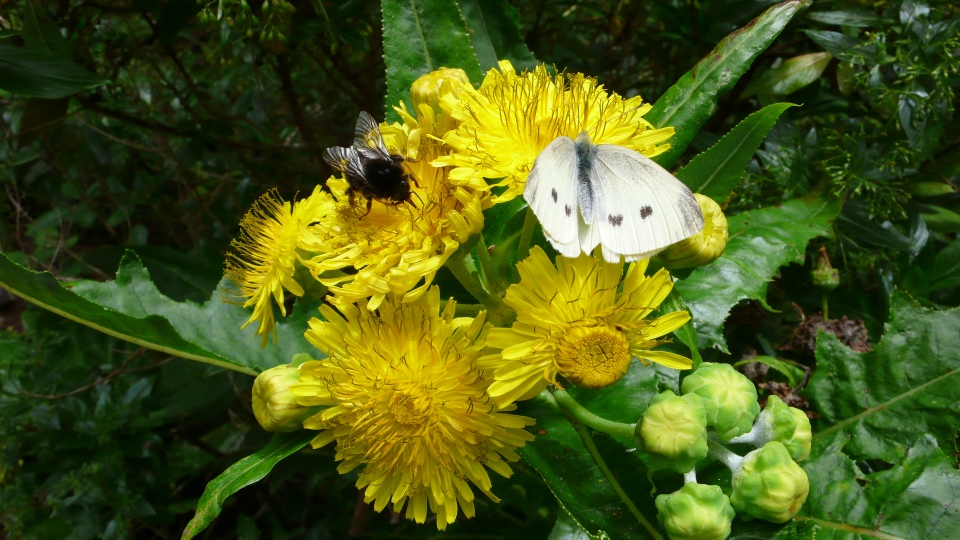
In a new review paper that’s just been published in the Annual Review of Ecology, Evolution and Systematics I have looked at the question of just how diverse the pollinators are, and why pollinator biodiversity is ecologically important and therefore worthy of conservation.  I’ve taken a deep time and wide space approach to this, starting with what the fossil record tells us about when animal pollination evolved and the types of organisms that acted as pollinators in the past (the answer may surprise you if you’re unfamiliar with the recent paleontological literature on this topic).  Some of the most prominent biogeographical patterns have been highlighted, and I have tried to estimate the global diversity of currently known pollinators.  A conclusion is that as many as 1 in 10 described animal species may act as pollen vectors.

As well as this descriptive part of the review I’ve summarised some recent literature on why pollinator diversity matters, and how losing that diversity can affect fruit and seed set in natural and agricultural contexts.  Extinction of pollinator species locally, regionally, and globally should concern us all.

Although I was initially a little worried that the review was too broad and unfocused, having re-read it I’m pleased that I decided to approach the topic in this way.  The research literature, public policy, and conservation efforts are currently moving at such a fast pace that I think it’s a good time to pause and look at the bigger picture of what “Saving the Pollinators” actually means and why it’s so important.  I hope you agree and I’d be happy to receive feedback.

You can download a PDF of the review entitled Pollinator Diversity: Distribution, Ecological Function, and Conservation by following that link.

Pollination ecologists should also note that in this same volume of Annual Review of Ecology, Evolution and Systematics there’s a review by Spencer Barrett and Lawrence Harder called The Ecology of Mating and Its Evolutionary Consequences in Seed Plants.  If you contact those authors I’m sure they’d let you have a copy.

Fly pollination in the trap flower genus Ceropegia: a new study just published

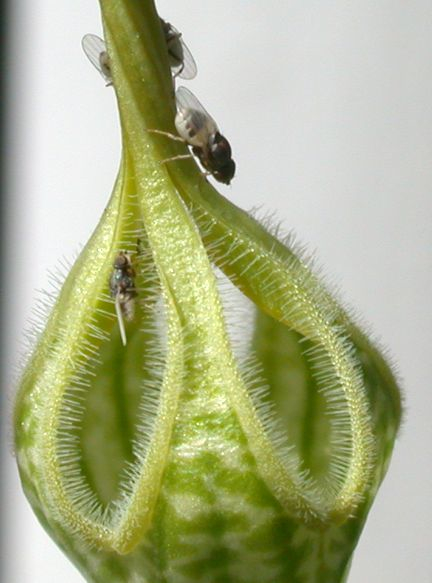
Flies on C. arabica from Sage Reynolds

Pollination of flowers by flies (the insect order Diptera) has long fascinated me, in part because it often subverts the idea of what “normal” flowers should look like, but also because it is much less well studied, and appreciated, compared to bee pollination.  This is despite the fact that fly pollinated flowers are at least as frequent as bee pollinated flowers in many plant communities, as I show in a forthcoming review in the journal  Annual Review of Ecology, Evolution and Systematics (more on that in November when it’s published).

Over the past decade I’ve been studying the large plant genus Ceropegia in the family Apocynaceae (subfamily Asclepiadoideae).  The flowers of these species temporarily trap their fly pollinators, releasing them after a period, during which pollination takes place and/or pollen is picked up.  The latest study from this work has just been published in the journal Flora, in collaboration with colleagues from eight different countries.  The title is:

Diversity of Diptera families that pollinate Ceropegia (Apocynaceae) trap flowers: an update in light of new data and phylogenetic analyses

If you follow that link you can download the PDF for free for the next 50 days.

One of the main findings from this new study is that the diversity of fly families that pollinate Ceropegia spp. is much greater than we had previously realised.  The total now stands at 16 different families, including some that rarely, if ever, pollinate other plants (as far as we yet know).

Another important finding is that this clade, which may contain as many as 1000 species in total, seems to have diversified despite that fact that all species are apparently fly pollinated.  This is unusual: diversification of plant clades often involves shifts to very different groups of pollinators, e.g. bee to bird or bat pollination.

There’s still lots to discover about this group of plants and this is just the latest output from what is an ongoing project focused on Ceropegia and the Apocynaceae more generally.

Here’s the abstract:

“Pollination by flies (Diptera) has been important to the diversification and ecology of the flowering plants, but is poorly understood in contrast to pollination by other groups such as bees, butterflies and birds. Within the Apocynaceae the genera Ceropegia and Riocreuxia temporarily trap flies, releasing them after a fixed, species-specific period of time, during which pollination and/or pollen removal occurs. This “trap flower” pollination system shows convergent evolution with unrelated species in other families and fascinated Stefan Vogel for much of his career, leading to ground-breaking work on floral function in Ceropegia (Apocynaceae). In this new study we extend the work of the latest broad analysis published by some of the authors (Ollerton et al., 2009 − Annals of Botany). This incorporates previously unpublished data from India and Africa, as well as recently published information, on the diversity of pollinators exploited by Ceropegia. The analyses are based on a more accurate phylogenetic understanding of the relationships between the major groups, and significantly widens the biogeographic scope of our understanding of fly pollination within Ceropegia. Information about the pollinators of 69 taxa (species, subspecies and natural varieties) of Ceropegia is now available. Twenty five families of Diptera are known to visit the flowers of Ceropegia, of which sixteen are confirmed as pollinators. Most taxa are pollinated by species from a single family. Overall, there were no major biogeographic differences in the types of Diptera that were used in particular regions, though some subtle differences were apparent. Likewise there were no differences between the two major clades of Ceropegia, but clear differences when comparing the range of Diptera exploited by Ceropegia with that of the stapeliads. This clade, one of the largest in the Asclepiadoideae, is a fascinating example of a species radiation driven by an apparently relatively uniform set of pollinators.”

Photo credit: flies on flowers of Ceropegia arabica in cultivation by Sage Reynolds.