Author Archives: Jeff Ollerton

Unknown's avatar

About Jeff Ollerton

Independent consulting scientist and author, working on understanding and conserving biodiversity

A train ride through American climate change

For the past week Karin and I have been travelling in the USA, starting in Denver, driving to Gunnison, then on to Grand Junction, Colorado, to catch the Amtrak California Zephyr train for a 36 hour trip to Chicago. Our final destination is a workshop on conservation of monarch butterflies and their milkweed host plants near Washington DC next week.

I’ll post something about the Gunnison leg of our journey at a later date, and of course the workshop.  But as I write the first draft of this post, we are passing through flooded Iowa farmland and I wanted to get some thoughts down about a repeating theme of our travels so far: climate change.

Our original destination in Colorado was the Rocky Mountain Biological Laboratory (RMBL), an almost legendary research venue for pollination ecologists. We were meeting up with my long-time friends and colleagues Nick Waser and Mary Price, with whom I’ve collaborated on various papers since the mid-90s. However we never made it to RMBL: unseasonably late snow had not yet been ploughed from the road up to the site and the only way in and out was with skis or snowshoes. Some hardy researchers were already there, but the limited time we had in Colorado made it impractical for us to make the journey:
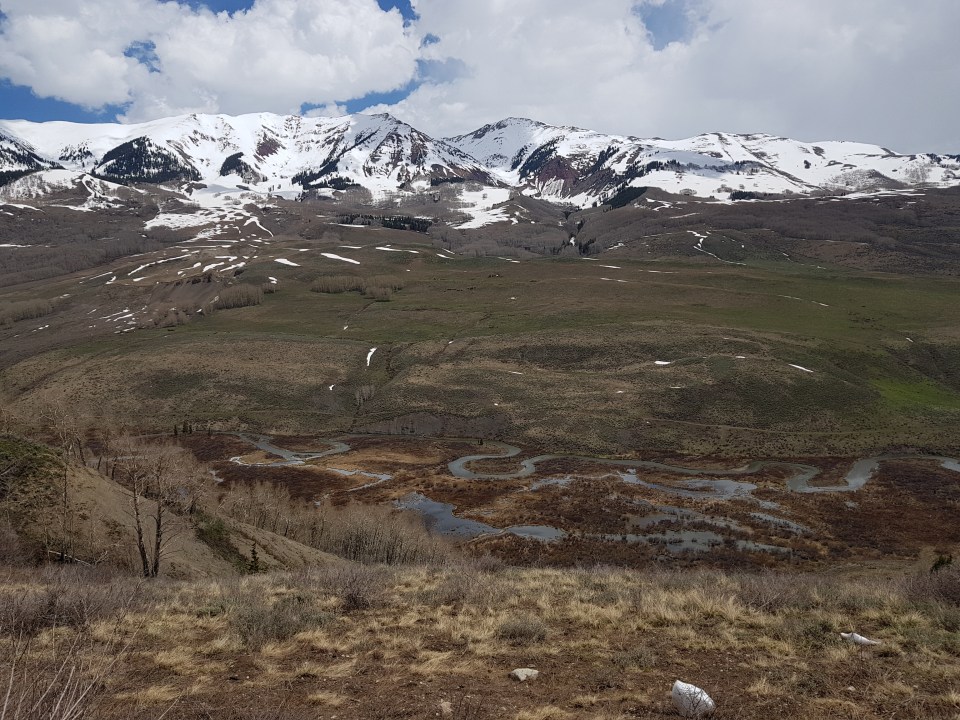
2019-06-01 11.46.04

Unseasonable snow does not, of course, climate change make; but that was our first hint that there’s something odd about the weather in North America at the moment.

Fast forward a few days and we picked up the Zephyr in Grand Junction, the start of an incredible journey through spectacular Rocky Mountain scenery and then down into the flat agricultural lands of Nebraska and Iowa. We had a sleeping cabin and, following a stop in Denver, we drifted off to the slow chug-a-chug of the Zephyr’s wheels and the occasional distant whistle from the front engine – it’s a loooong train!

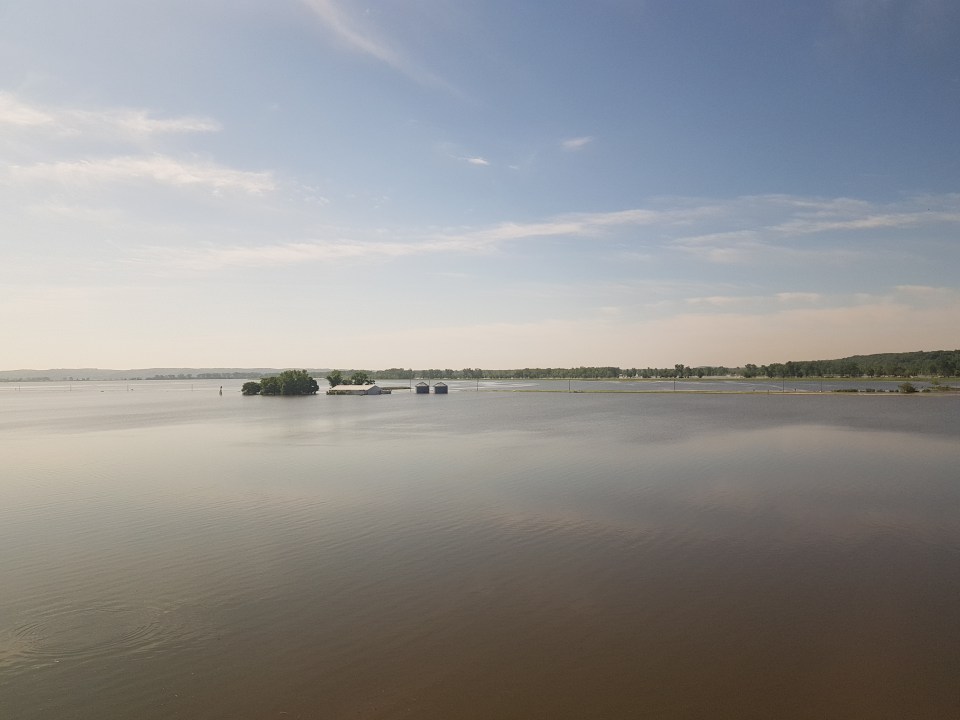
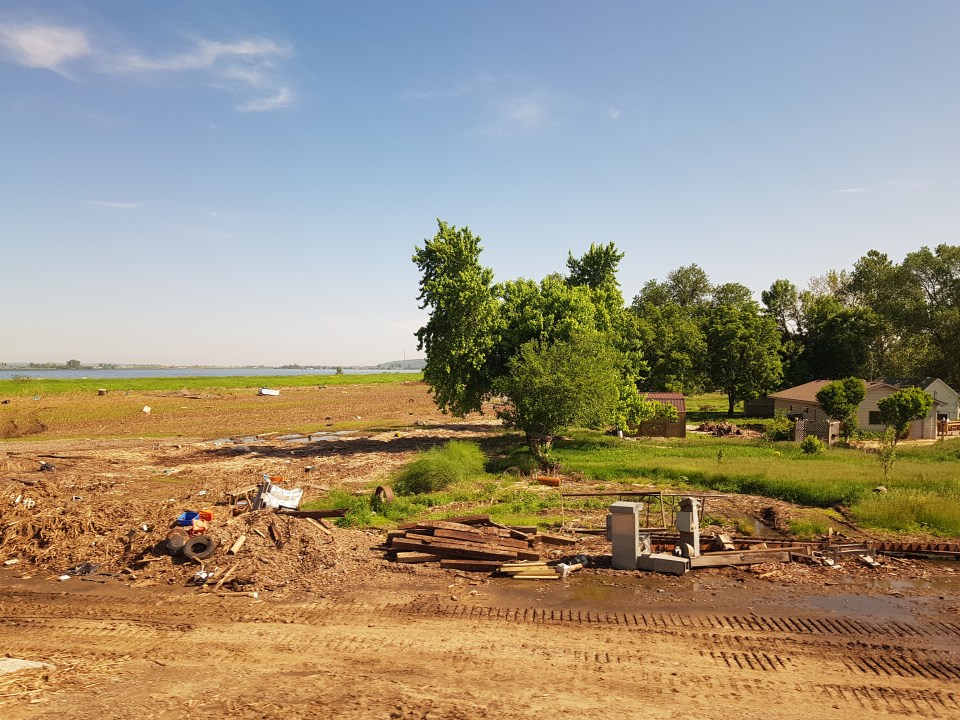
The next morning we were still in Nebraska and it was then that things started to get both interesting and worrisome. One of the conductors gave us a running commentary about the heavy rainfall that had caused flooding in this region during May and June – see this recent account from NASA’s Earth Observatory.  As you can see from the images below (snapped from the train as we passed, so excuse the quality), flooding is still an issue along the Platt and Missouri Rivers, both of which had over-topped their adjacent levees at various points. A conservation area, the Fontanelle Forest Preserve, had turned from woodland into wooded swamp:
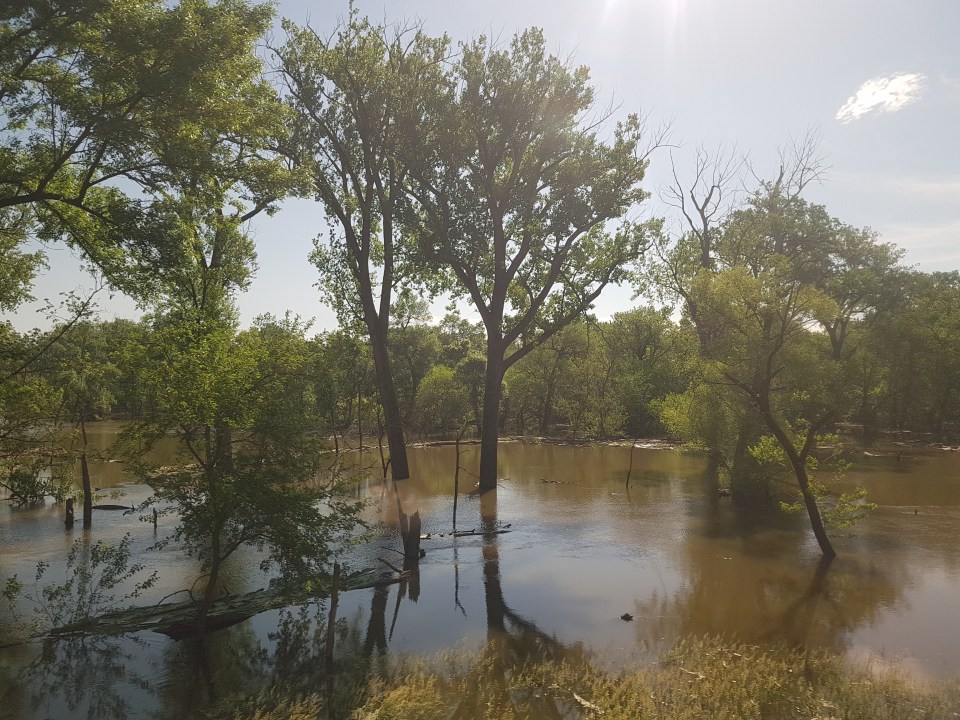
2019-06-05 09.29.06

This is not the river Missouri – it’s actually about quarter of a mile beyond those trees:
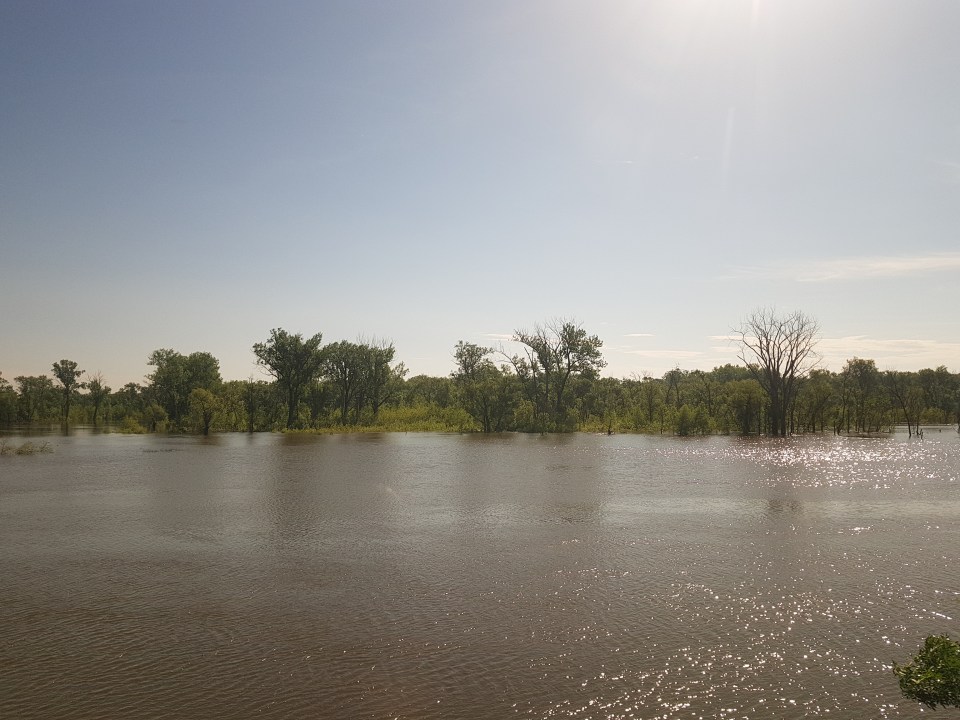
2019-06-05 09.28.27

Adjacent farmland was completely flooded shortly after corn crops had been planted. Farm buildings were washed out and their occupants had been forced to leave with little notice. These are areas that do not normally flood and the impact of this heavy rain has been significant and will last long into the future:2019-06-05 09.51.37
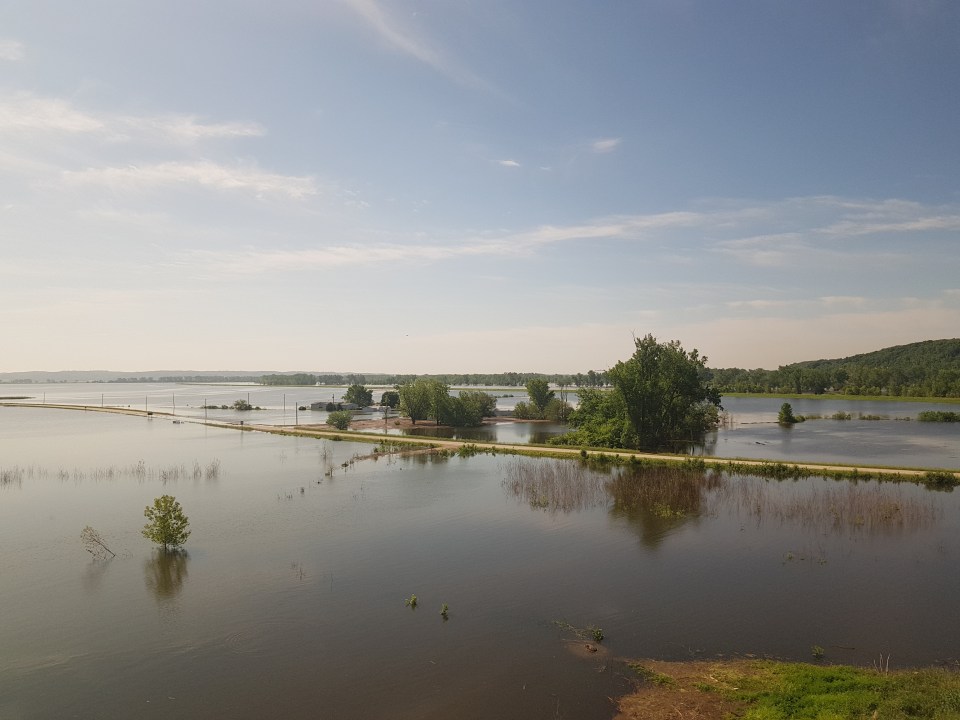
2019-06-05 09.51.59

Infrastructure such as roads and bridges were also damaged.  The Union Pacific rail bridge across the Platt was partly washed away and has had to be rapidly rebuilt, but only after a new access road was established:
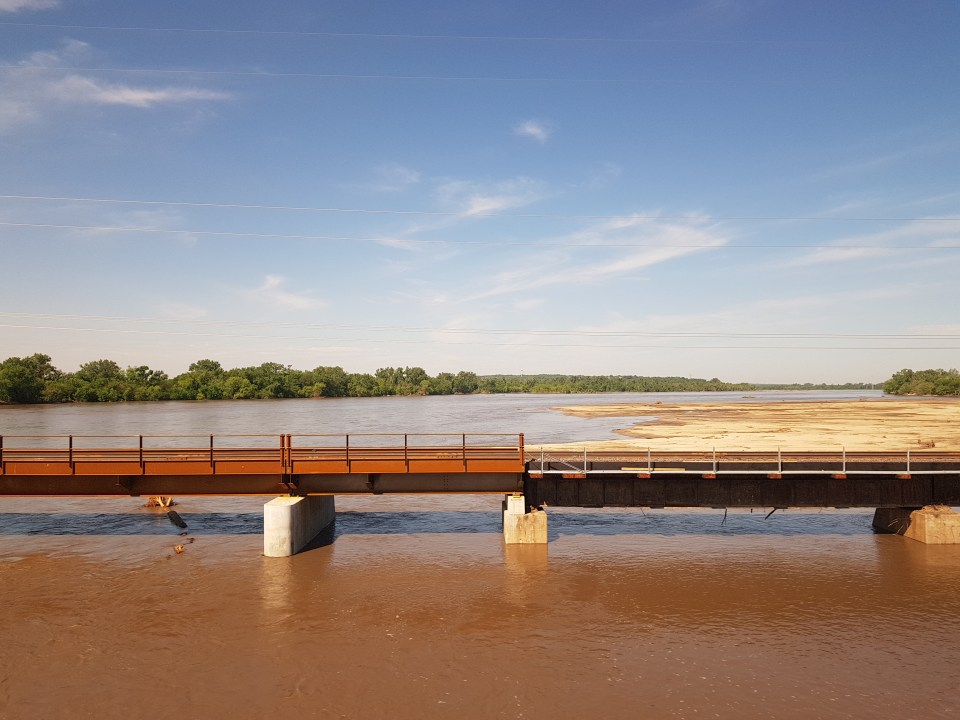
2019-06-05 09.41.15

Everywhere we looked there was flooding:
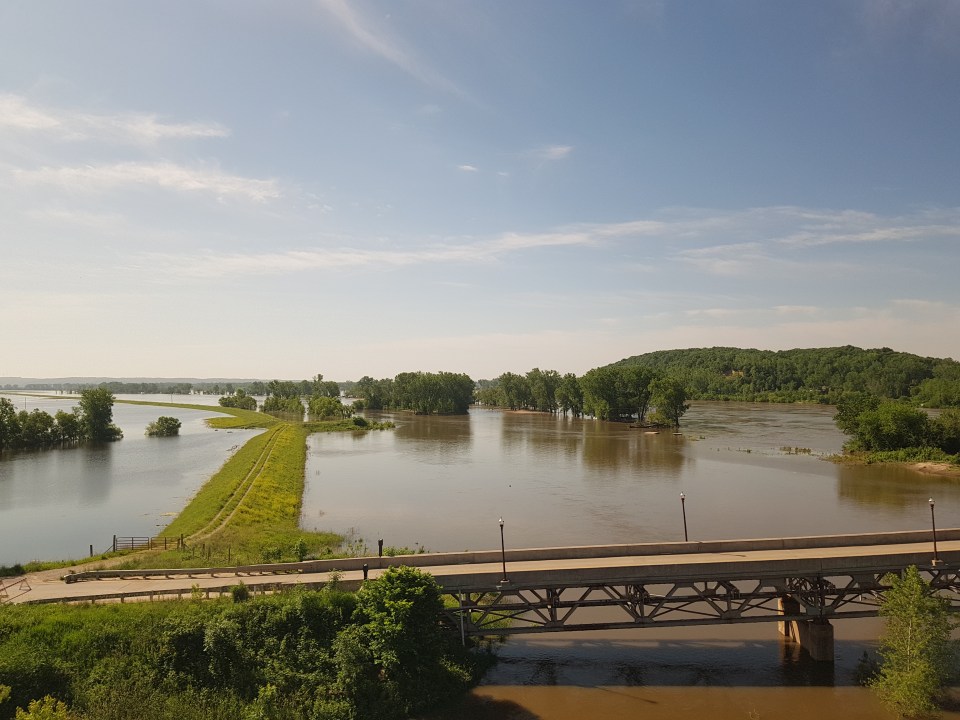
2019-06-05 09.51.10

A nearby industrial estate and trailer park had also been flooded, with a lock-up garage of classic American cars under seven feet of water, and the residents and businesses have been told to leave permanently. This area cannot be guaranteed flood-free in the future and will be leveled and allowed to return to nature:
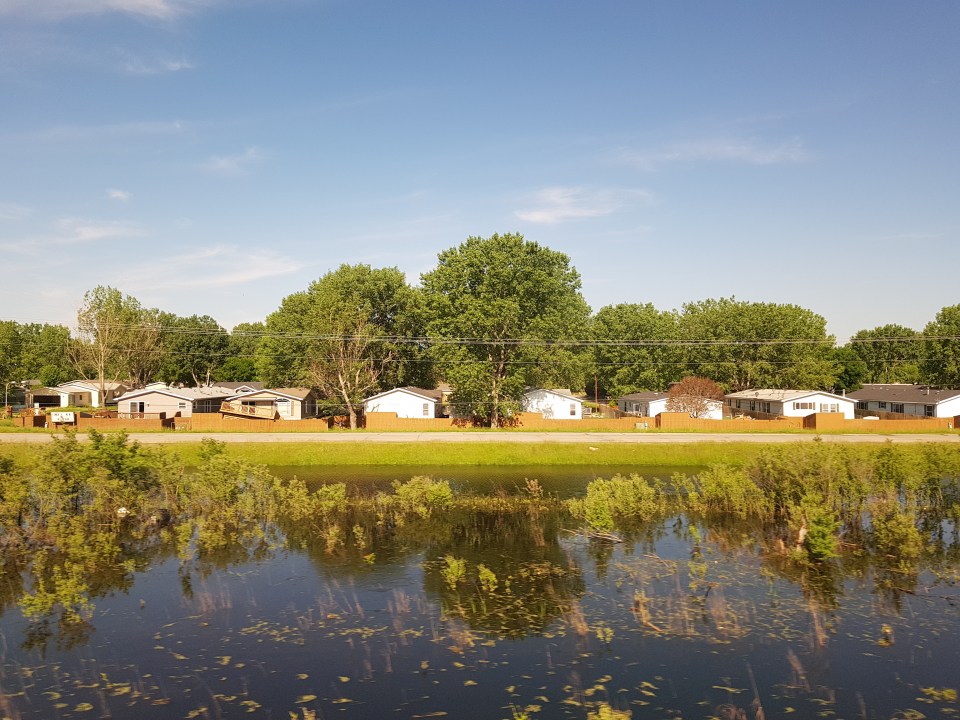
2019-06-05 09.34.40

A local portaloo company was also flooded out and we observed the plastic toilets washed up along a lakeside that used to be a field of corn.  Superficially amusing, until you realise that this represents the loss of someone’s livelihood:
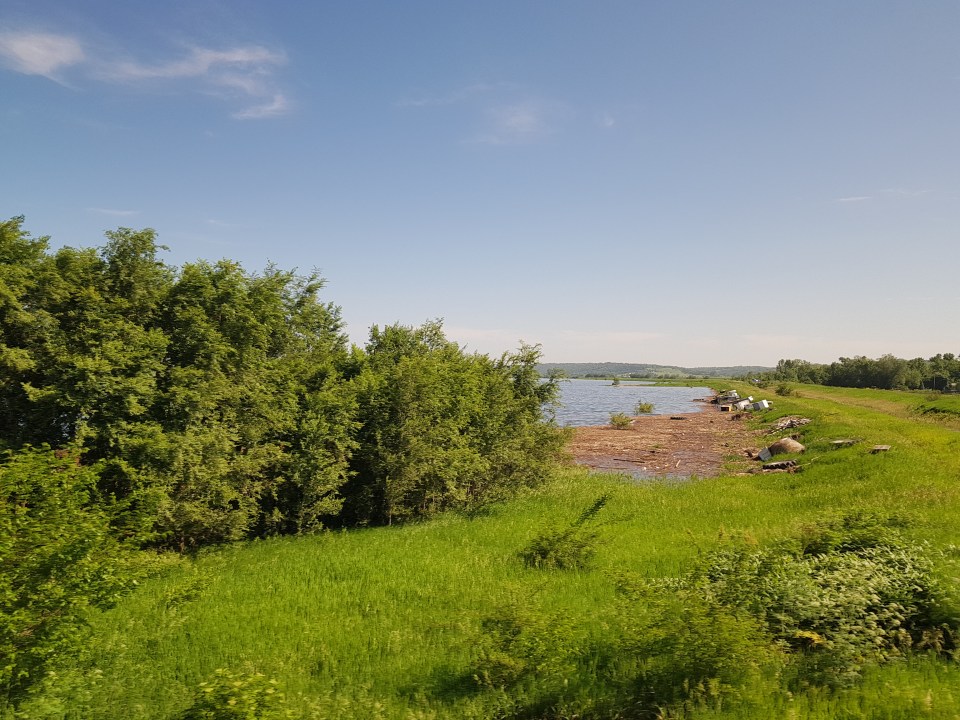
2019-06-05 09.55.44.jpg

Along the train tracks ballast had been piled up to begin a programme of raising the track bed. Residents of the nearby town of Pacific Junction (population about 470) have been told to either sell their homes to the government, and move out, or face ever-rising costs of flood insurance – see this recent local newspaper article. Pacific Junction used to be an important rail terminus and some of the families have been there for generations.   Let’s be clear what this means for these people – they are displaced from their homes, they are climate refugees in their own country.
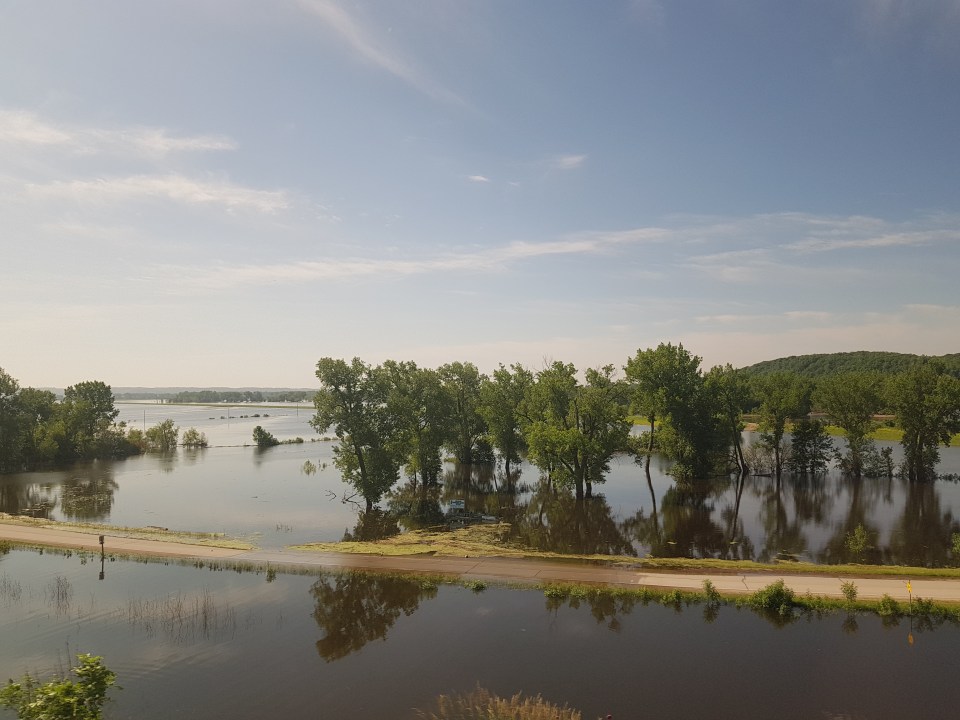
2019-06-05 09.51.26

2019-06-05 09.55.58

After we had passed through this area I chatted with one of the train stewards who mentioned that his Louisiana home had been flooded out in August 2016. He was forced to pay $400 per year flood insurance to protect his belongings and home from future events, in a part of the state that had no prior history of flooding.  “But your President says that climate change is not a problem” I probed.  He gave me a look that said more than words could ever convey. “Don’t get me started on that” he replied. A nearby passenger, a young guy, chimed in: “We’d be here all day!”  Trump’s rhetoric is changing slightly and, if anything, becoming less coherent and more deranged as he talked yesterday of “good climate” and “weather going both ways”.

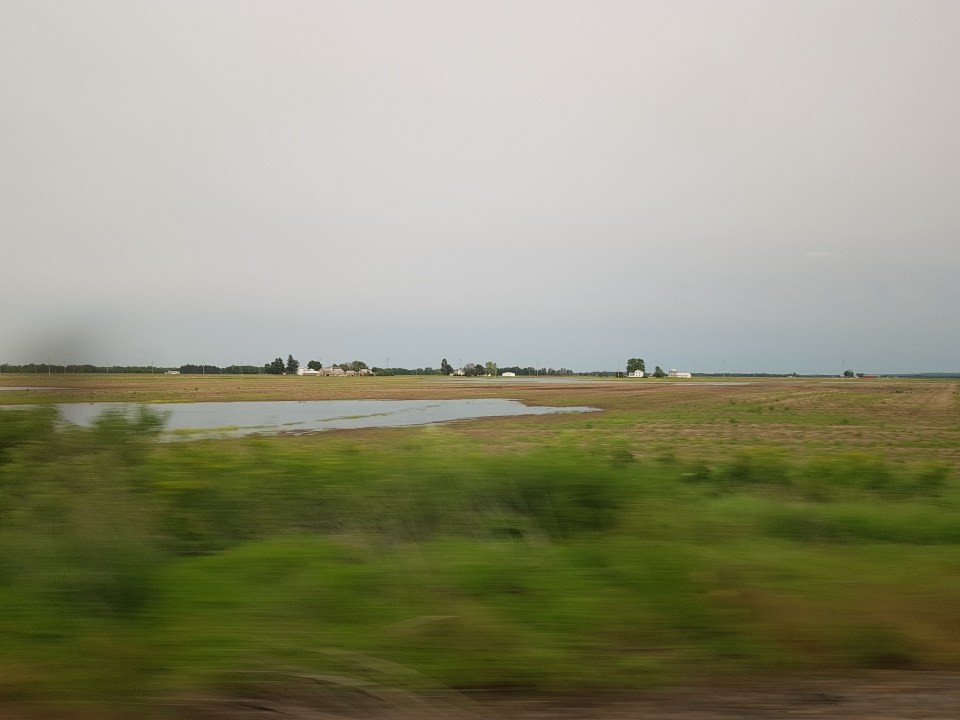
All along the train route to Chicago we saw the same thing, over hundreds of miles and hour after hour – partially or completely flooded fields, crops washed away or submerged under water.  Large ponds in otherwise pristine, planted fields of parallel lines where the first growth of wheat was showing:
2019-06-05 18.44.11

Karin tells me that the flooding around the Mississippi was even worse, but I’m afraid that I slept through it; long train journeys are wonderful, but tiring!

This is just a snap shot of what climate change is doing to the USA at the moment; it’s creating climate refugees in a number of states – see this article for instance. Wildlife seems to be the only thing that’s benefiting as nature reclaims farmland and urban areas: the flooded fields we passed were full of herons, wildfowl, and other water birds. But in the longer term who knows what these changing weather patterns will bring for biodiversity and human society. The only certainty is that change is coming.

Rediscovery of a plant species 170 years after it was lost from the Northamptonshire flora

2019-05-23 11.42.26

This past week I’ve been hosting a postgraduate researcher from the University of New South Wales in Australia.  Zoe Xirocostas has been recruited to work on a project on which I’m a collaborating with Prof. Angela Moles and Dr Stephen Bonser (University of New South Wales) and Dr Raghu Sathyamurthy (CSIRO).  It’s funded by the Australian Research Council and will run from 2019-2022.

Zoe’s PhD is about understanding the role of herbivores and pollinators in determining how plant species native to Europe have become invasive in Australia.  She arrived with a wish-list of species that she wants to study at sites in the UK (Northampton), Spain, Estonia, France and Austria, in order to compare them with populations in Australia.  One of those species was small-flowered catchfly (Silene gallica), a plant that I hadn’t seen in Northamptonshire.  The NBN Atlas account for the species shows almost no records for central England and when I checked the Northamptonshire Flora it stated that the species had last been recorded in the county in 1843.  Clearly this was not a plant we could study for this phase of the project.  Or so we thought.

By coincidence, the week of Zoe’s preliminary fieldwork coincided with two days of surveys of the University of Northampton’s new Waterside Campus by staff and students.  This is part of an ongoing project to understand how the development has affected local biodiversity.  Friday was to be the last spring bird survey of the season (see this recent post updating that project) and Thursday was to be devoted to plants and bees.

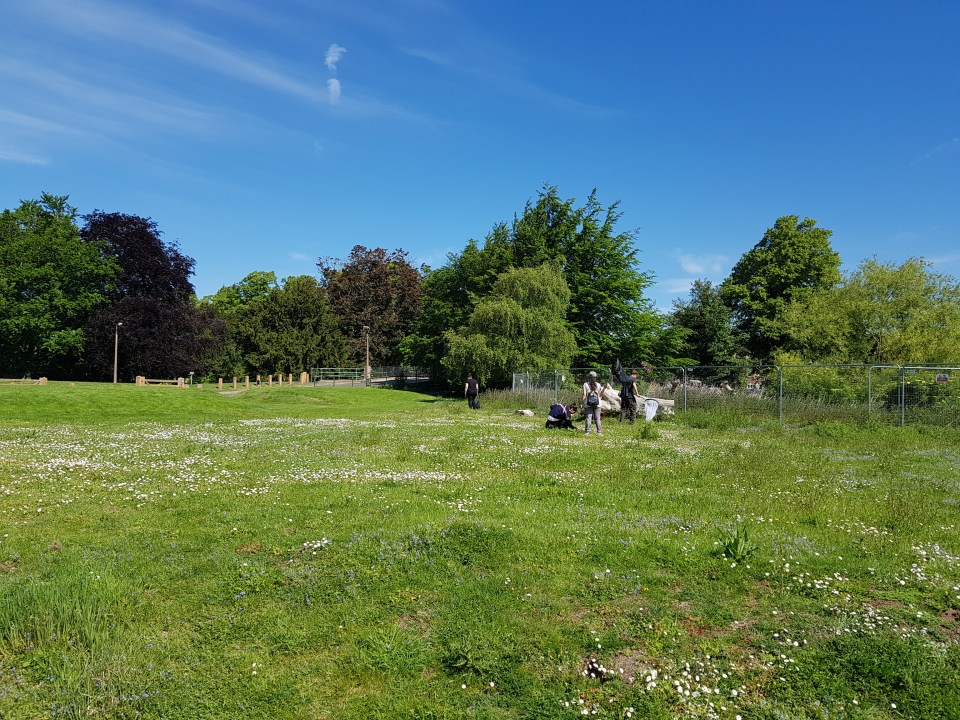
To help with this we had the assistance of two County Recorders: Ryan Clark for the bees and Brian Laney for the plants, both hugely knowledgeable and enthusiastic about Northamptonshire’s biodiversity.  We started the surveys on an area of short-cropped, species-rich turf that is being maintained by a combination of rabbit and Canada goose grazing:

2019-05-23 10.23.22.jpg

In no time at all Brian had racked up dozens of plant species; it’s really a very rich site indeed.  Bees were fewer and further between, but after an hour we had a list of about 10 species, including one of my favourites, the ashy mining bee:

2019-05-20 15.22.16

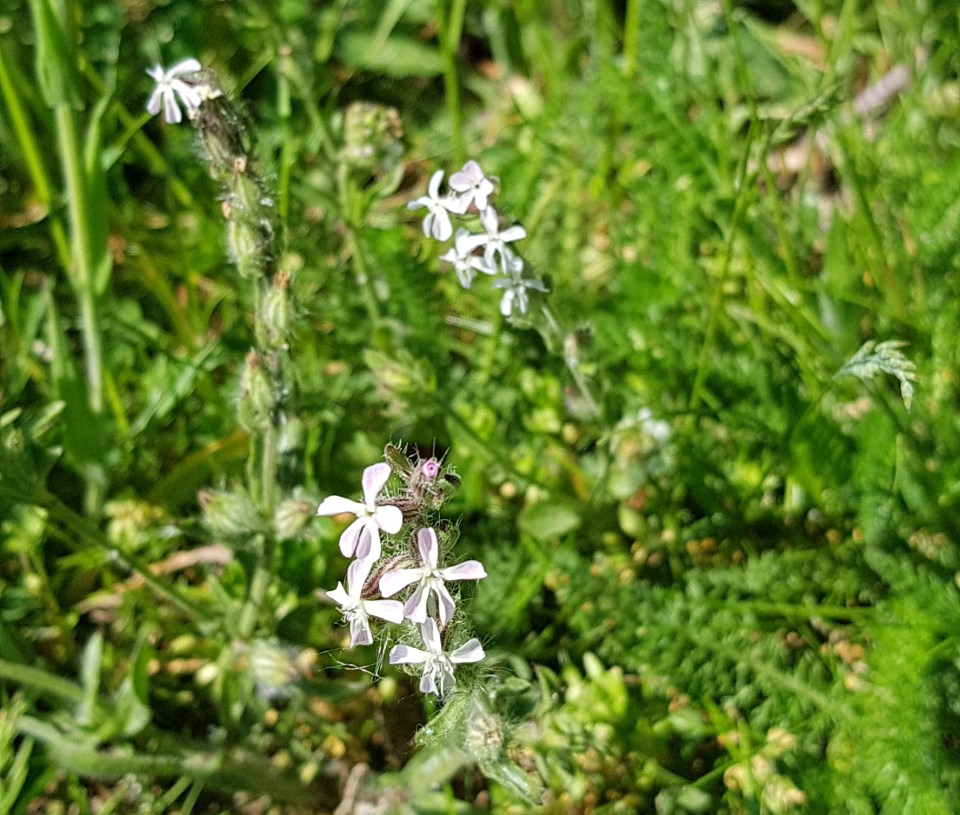
Zoe and her field assistant Susmita were busy bagging flower heads for the pollination experiments when suddenly we heard an excited shout from Brian.  He had moved on to look at some plants that were coming up in a disturbed area of ground some distance away.  Unbelievably, Brian had found small-flowered catchfly!  More than 170 years after it had last been recorded in the county.  On our campus!  We rushed over to take a look, and there it was, near a path that Zoe and I had walked just a couple of days before and completely failed to spot it.  In our defence, although it is striking in close up (see the image at the top of this post) it hides itself very well among other plants:

2019-05-23 11.42.16

An amazing discovery!  But what is this plant doing here?  The answer is that small-flowered catchfly is an annual species of disturbed areas, it requires soil to be turned over in order to allow its seeds to germinate from the soil seed bank.  The construction work on the site has involved moving around hundreds of tons of soil and this has provided ideal conditions for the plant and for many others that are associated with this kind of habitat.  The challenge now will be to work with the university’s estates department to decide on a management plan that involves regular rotovating of that area.  That shouldn’t be too hard, they are as keen to maximise the biodiversity of the campus as we are.

The natural world is full of surprises, especially “lost” species turning up unexpectedly.  Soil seed banks for some species can be very persistent, with seeds remaining dormant for decades or even hundreds of years until conditions are right for germination.  It’s very satisfying to be present at just the right time to see it happen!

To finish here’s a shot of the survey team, minus one member (Vivienne) who had to leave early; from left to right – Ryan, me, Brian, Susmita Aown, Duncan McCollin, Zoe, Janet Jackson:

2019-05-23 14.38.02

What happens when pollinators lose their flowers? A new study suggests some answers


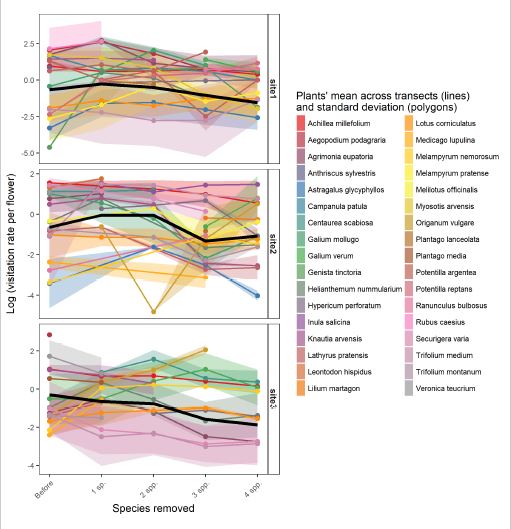
Biella et al image

Pollinators such as bees and butterflies are highly dependent on flowers to provide nectar as food; at the same time, those plants are reliant on the pollinators for reproduction.  Over the past few decades, declines in both flower and pollinator diversity and abundance have prompted ecologists to wonder about the consequences of flower loss for pollinator communities and for plant pollination.

In a ground breaking new study, a team from institutions in the Czech Republic and the University of Northampton in the UK have published the results of experiments that seek to answer these questions.  Led by PhD researcher Dr Paolo Biella, the team performed experiments in both countries that involved temporarily removing thousands of flower heads from grassland plant communities.  They assessed how the pollinator assemblage responded to their removal, and how effectively the remaining flowers were pollinated.  The team focused on generalist plant species that support the majority of pollinators within a community because these have traditionally been less well studied than highly specialised relationships.

The results are published today in the open access journal Scientific Reports and provide the first demonstration of the ways in which pollinators flexibly adjust their behaviour when faced with a sequential loss of resources.  This flexibility is constrained by the type of flowers they visit, however:  pollinators will tend to switch to flowers of a similar shape to the ones that have been lost.  From the plant’s perspective, things are less clear: the patterns of pollination for the remaining species were idiosyncratic and not as predictable.  Some plants received more pollination during the experiment than before, others less.

For the first time we are seeing the consequences of sudden loss of flowers for both the pollinators and the plants in a habitat.  That the pollinators can respond flexibly to this loss is a welcome indication that these insects might be more resilient to sudden changes than we had thought.  However, the erratic pollination of the flowers shows that there is a great deal of random chance within these ecological systems that is not easily predictable.  In the same week that the UN’s Intergovernmental Science-Policy Platform on Biodiversity and Ecosystem Services (IPBES) Global Assessment Report on Biodiversity and Ecosystem Services was published, our study reminds us that there is much that we do not currently understand about the consequences of sudden changes in the natural world.

One of the team’s recommendations is that pollination-generalist plant species should be given much more attention in conservation assessments than has previously been the case.  These plants are at the core of plant-pollinator communities and without them the rarer and more specialised species could not exist.

Details of the study are as follows:

Biella P., Akter A., Ollerton J., Tarrant S., Janeček Š., Jersáková J. & Klecka J. (2019) Experimental loss of generalist plants reveals alterations in plant-pollinator interactions and a constrained flexibility of foraging.  Scientific Reports 9: 1-13

Here’s the abstract:

Species extinctions undermine ecosystem functioning, with the loss of a small subset of functionally important species having a disproportionate impact. However, little is known about the effects of species loss on plant-pollinator interactions. We addressed this issue in a field experiment by removing the plant species with the highest visitation frequency, then measuring the impact of plant removal on flower visitation, pollinator effectiveness and insect foraging in several sites. Our results show that total visitation decreased exponentially after removing 1-4 most visited plants, suggesting that these plants could benefit co-occurring ones by maintaining high flower visitor abundances. Although we found large variation among plant species, the redistribution of the pollinator guild affected mostly the other plants with high visitor richness. Also, the plant traits mediated the effect of removal on flower visitation; while visitation of plants which had smaller inflorescences and more sugar per flower increased after removal, flower visitors did not switch between flower shapes and visitation decreased mostly in plants visited by many morpho-species of flower visitors. Together, these results suggest that the potential adaptive foraging was constrained by flower traits. Moreover, pollinator effectiveness fluctuated but was not directly linked to changes of flower visitation. In conclusion, it seems that the loss of generalist plants alters plant-pollinator interactions by decreasing pollinator abundance with implications for pollination and insect foraging. Therefore, generalist plants have high conservation value because they sustain the complex pattern of plant-pollinator interactions.

Biodiversity and climate change: a hierarchy of options

Conservation hierarchy image

The related issues of how to conserve biodiversity and reduce the impacts of climate change have never had such a high public profile as they do at the moment.  The activities of Extinction Rebellion caught the attention of the media around the world, for example here in London.  Numerous organisations, cities, regions and countries have declared a Climate Emergency.  And IPBES – the Intergovernmental Science-Policy Platform on Biodiversity and Ecosystem Serviceshas released a summary of its first global assessment with the full report due later this year, and explicitly makes the link between conservation of biodiversity and reducing the effects of climate change.

Timed to coincide with all of this, the University of Cambridge has announced that it is setting up a Centre for Climate Repair in order to explore hi-tech “fixes” to climate change, such as spraying sea water into the atmosphere in order to reduce warming at the poles, and sucking CO2 out of the air using large machines.  I think it’s fair to say that this was met with some scepticism on social media; here’s some examples:

Other people have pointed out that nature-based solutions are the most likely to be successful, and provide a boost for biodiversity at the same time:

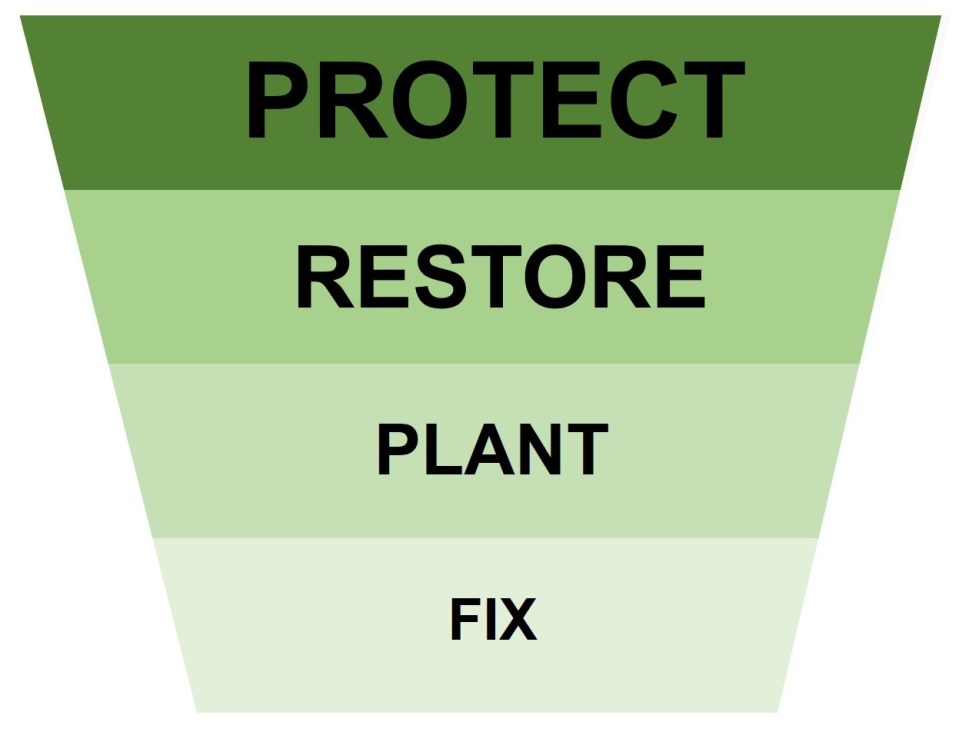
All of this reminds me of the Waste Hierarchy in its various iterations – you know the sort of thing – “Reduce > Reuse > Recycle”, where reduction in waste produced is best, followed by reuse of waste resources, with recycling being the least good option (but still better than just land-filling the waste).  As far as the link between conservation of biodiversity and reduction of the effects of climate change goes, there’s a parallel hierarchy – see the image at the top of this post – that sets out the order of priorities:

PROTECTION of ecosystems using the full force of national and international laws and conventions has got to be the top priority.  Otherwise any of the other activities will result in, at best, humanity running to catch up with what the world is losing.  Let’s stop cutting down ancient forests and degrading peatlands that have accumulated millions of tons of carbon over thousands of years!

FIX – by which I mean the kind of hi-tech solutions proposed above – should be the lowest priority: they do little or nothing directly for biodiversity and there is no compelling evidence that they will even work as intended.

Between these two are RESTORATION of currently degraded habitats (such as re-wetting peatlands as in the Great Fen Project) and PLANTING of trees, which can be a form of habitat restoration under some circumstances.  Large scale examples of this include

Grain for Green – China’s attempt to restore vegetation to abandoned farmland to reduce soil erosion and flooding.

Great Green Wall – a multinational initiative in Africa aimed at restoring the vegetation on the southern edge of the Sahara to combat desertification and mitigate climate change.

While doing a bit of research for this blog post* I became aware that a Conservation Hierarchy has already been developed by the Convention on Biological Diversity but that really only deals with habitat destruction, mitigation of destructive activities, etc.  What I’m suggesting is related more to the direct link between conservation of biodiversity and mitigation of climate change.  So what to call this particular hierarchy?  Perhaps the BioCC Hierarchy?  Can anyone suggest a better name?  Maybe it doesn’t need a name at all, it just needs people to be aware of it and for governments to act logically.


*I googled the term “Conservation Hierarchy” – you get the quality of research you pay for on this blog….


When did the flowering plants evolve? Two new studies come to different conclusions

2019-04-23 17.42.40.jpg

The angiosperms (flowering plants) are far and away the most diverse group of plants ever to have evolved.  There are an estimated 350,000 to 370,000 species, more than all other groups of plants (ferns, conifers, cycads, mosses, etc.) combined, living and extinct.  The origin of the flowering plants was termed an “abominable mystery” by Charles Darwin – or perhaps it wasn’t: see this essay by Prof. Richard Buggs for an alternative view of what Darwin was describing, and this paper by Prof. William Friedman giving a different interpretation.

These disagreements about what Darwin meant are as nothing compared to disagreements about when the flowering plants actually evolved and how we interpret fossils and evidence from molecular phylogenies.  Two new studies illustrate this point: they use some of the same information to come to completely different conclusions.  I’ve copied the details and abstracts below, with links to the originals, and emphasised the areas of disagreement in bold text.  And I’m going to leave it at that; I don’t have a horse in this race and I have no idea which (if either) is correct.

There are, however, profound implications for understanding when and how relationships between flowering plants and their pollinators evolved, as I noted in my recent review of pollinator diversity.  If the much earlier, Triassic origin of the angiosperms is correct then perhaps the earliest flowering plants did not co-opt pollinators that were already servicing gymnosperms.  Perhaps the relationships between plants and pollinators originated with the (Triassic) angiosperms and the gymnosperms subsequently evolved to exploit this.  My feeling is that only more, better fossils will provide definitive answers.

Here’s the details of the studies:

Coiro et al. (2019) How deep is the conflict between molecular and fossil evidence on the age of angiosperms? New Phytologist

Abstract: The timing of the origin of angiosperms is a hotly debated topic in plant evolution. Molecular dating analyses that consistently retrieve pre‐Cretaceous ages for crown‐group angiosperms have eroded confidence in the fossil record, which indicates a radiation and possibly also origin in the Early Cretaceous. Here, we evaluate paleobotanical evidence on the age of the angiosperms, showing how fossils provide crucial data for clarifying the situation. Pollen floras document a Northern Gondwanan appearance of monosulcate angiosperms in the Valanginian and subsequent poleward spread of monosulcates and tricolpate eudicots, accelerating in the Albian. The sequence of pollen types agrees with molecular phylogenetic inferences on the course of pollen evolution, but it conflicts strongly with Triassic and early Jurassic molecular ages, and the discrepancy is difficult to explain by geographic or taphonomic biases. Critical scrutiny shows that supposed pre‐Cretaceous angiosperms either represent other plant groups or lack features that might confidently assign them to the angiosperms. However, the record may allow the Late Jurassic existence of ecologically restricted angiosperms, like those seen in the basal ANITA grade. Finally, we examine recently recognized biases in molecular dating and argue that a thoughtful integration of fossil and molecular evidence could help resolve these conflicts.


Li et al. (2019) Origin of angiosperms and the puzzle of the Jurassic gap. Nature Plants

Abstract: Angiosperms are by far the most species-rich clade of land plants, but their origin and early evolutionary history remain poorly understood. We reconstructed angiosperm phylogeny based on 80 genes from 2,881 plastid genomes representing 85% of extant families and all orders. With a well-resolved plastid tree and 62 fossil calibrations, we dated the origin of the crown angiosperms to the Upper Triassic, with major angiosperm radiations occurring in the Jurassic and Lower Cretaceous. This estimated crown age is substantially earlier than that of unequivocal angiosperm fossils, and the difference is here termed the ‘Jurassic angiosperm gap’. Our time-calibrated plastid phylogenomic tree provides a highly relevant framework for future comparative studies of flowering plant evolution.


Is the angry response of (some) environmentalists in the aftermath of the Notre Dame fire reasonable?

20190429_105324

Last night Karin and I returned from two weeks of field work plus a period of writing in Tenerife.  The first week was devoted to our annual University of Northampton undergraduate field course which I’ve written about before – see this recent book review for instance.

I don’t normally watch much television when I’m in Tenerife; we tend to get back from field work early evening, jump in the shower, then go for a beer and a meal, then early to bed for field work the next day.  But there were two bits of TV that I made a point of viewing, and actually for the same reasons: news reports about the fire that severely damaged Notre Dame Cathedral and David Attenborough’s documentary about the current effects of climate change.  Both of these were about the destruction of heritage (cultural and natural) and how this affects people.  I have to say that I shed a tear watching them.

The response of some billionaires and large companies, offering millions of Euros towards Notre Dame’s restoration, was criticised by some environmentalists and others concerned with social justice.  Here are some examples:

https://www.joe.ie/amp/life-style/notre-dame-feature-665670

Over at the Ecology for the Masses blog, Sam Perrin in turn criticised these responses, suggesting that “What environmentally-minded people need to start doing is examine the other cause. Why do they get more attention? How have they gone about making their issue so ubiquitous? Try and examine WHY the Notre Dame Cathedral has received over 1 billion USD in reconstruction pledges when the Great Barrier Reef languishes every day.”

Jeremy Fox of the Dynamic Ecology blog clearly agrees  with this sentiment (read his comments) and posted a link to Sam’s piece.  I have to say that I got a bit irritated at Jeremy’s use of the phrase “pet causes”, and responded that: “I wouldn’t describe wholesale destruction of habitats, over-exploitation of natural resources, species’ extinction rates orders of magnitude higher than the background, environmental degradation that is affecting people’s health and livelihoods, and the accelerating effects of climate change as a “pet cause”. We’re not talking about raising funds for new books in the local library here!”

If you follow that series of comments and replies on Dynamic Ecology you’ll see that Jeremy pushed back strongly against my response, and I replied in return.  I stand by what I said though, that people do not react to these sorts of events logically, they react emotionally.  Hence the initial emotional outpouring of offering millions of Euros to restore Notre Dame is matched by an equally emotional response of “think of all of the other things that we could do with that money”.   The response from environmentalists and others was a reasonable one, as was the offer of millions of Euros for Notre Dame.  Both are equally valid.  Whether both are equally “important” is something that we could debate forever and I urge you to read through the posts and comments and make up your own mind.

On our last full day in Tenerife Karin and I explored an area of xerophytic scrub vegetation that surrounded a small rocky hill (see image below).  On top of the hill is a set of ancient rock carvings produced by the indigenous Guanches, one thousand years ago or more (the image at the start of this post).  The Guanches had positioned some of the rocks so that they produced different notes when struck.  It was clearly a site that had deep significance to these people prior to the European conquest of the islands.  However the site is completely unprotected and there’s been no effort to interpret what is a culturally important bit of archaeology – such carvings are not common in the Canary Islands.  In addition the surrounding vegetation is being slowly degraded by illegal tipping of rubbish.  These struck me as a depressingly fitting accompaniment to the subject of this post.

20190429_104400


The persistent crisp packet: 23 years in the environment and still going strong

20190407_140712.jpg

Last night Karin and I returned from Buxton in the Peak District where we had hired a cottage and assembled most of our kids and their partners for a weekend get together.  During a walk in the surrounding countryside I spotted this crisp packet sticking out of the ground.  From the typography of the logo I could tell it was old and a bit of internet sleuthing suggests that it was from a special limited edition produced to commemorate the UEFA 1996 European Football Championship.  So it’s been hanging around in the environment for about 23 years, hardly decaying, possibly releasing harmful chemicals into the environment.

Needless to say, I took it home and binned it.  But this one crisp packet is a microcosm of an enormous global problem of single-use plastic waste that is not being disposed of properly or recycled.  It’s a particular issue in the developing world where wastes management infrastructure is simply not able to cope with the volume of plastic bags and packaging, as I saw recently on my trip to Nepal:

2019-03-24 13.40.30

This sort of waste is more than just unsightly: it is harming the world’s ecosystems and the biodiversity they contain.  Manufacturers of plastic need to step up and address this issue.  Action is happening as I know from discussions with colleagues such as Prof. Margaret Bates and Dr Terry Tudor who are actively researching, educating and advising in this area.  But I worry that it may be too little and too late.

Beekeeping at 7000 ft: Nepal field work part 4

On the last day of field work, while we were waiting for a bus to take us back down to Kathmandu, I spotted some small bee hives next to one of the houses belonging to the local Tamang peoples:

2019-03-29 08.46.24

With a few minutes to spare before the bus left, I quickly investigated and discovered that only one of the hives was actually in use:

But interestingly, the bees inside were the native Asiatic or eastern honeybee (Apis cerana) rather than the European or western honeybee (A. mellifera) that is more familiar in Europe.  The bees are a bit smaller and more distinctively striped than their western counterpart:

2019-03-29 08.48.34-1

There didn’t seem to be much around for the bees to forage on, just a few flowering mustard plants, so I suspect that they were travelling some distance to find nectar and pollen:

2019-03-29 08.47.28

At this altitude of 2092 masl, or about 7000 feet, the winters are long and cold and the summers dry and hot, so the bees must be tough if they are kept there all year round.  I wonder if A. mellifera would survive these conditions?

All too soon the bus driver sounded his horn and it was time to go; an interesting encounter with a bee species I’d not previously seen.

A unique oak: Nepal field trip part 3

2019-03-28 18.30.46

One of the plants that really intrigued me during my time in Nepal was a species of evergreen oak that is native to the Himalayas and nearby mountainous areas of Asia.  It goes by the name of Quercus semecarpifolia and, as far as I am aware, has no common English name.  Two things surprised me about this species.

First of all, it is heterophyllous, meaning that its leaves come in more than one type.  Leaves close to the ground are spiky and look a lot like those of holly (Ilex spp.) which is what I thought they were when I first saw them:

2019-03-28 17.36.31

Leaves higher up on the plant have far fewer, if any, spikes:

2019-03-28 17.35.54

One of the things I discussed with the students was the job of scientists to identify patterns and to develop hypotheses about processes, i.e. what had caused those patterns.  In this case, after some discussion, we decided that the heterophylly was probably an adaptation to defend the leaves against small browsing mammals such as deer (thanks to Narayan for this image):

DSC_8212

The other thing that interested me about the oak was its overall growth form, which was tall (they grow to 30m) with rather short, stubby branches, very distinctive from a distance:

2019-03-28 17.58.35

The tree were especially striking in the evening mist:

2019-03-28 18.18.35

2019-03-28 18.18.41

2019-03-28 18.24.56

They look as though someone has been out with a chainsaw and trimmed them, but that’s not the case, they naturally grow that way.  The best hypothesis that we could come up with is that this is an adaptation that prevents the trees from accumulating large, heavy loads of snow which could result in branches breaking.  So it turns out that we were wrong – people are indeed responsible for the unusual growth form: see the comments below.

I’ve never seen this growth form, nor heterophylly in any other oak species, but Quercus is a large genus of about 600 species, so I wouldn’t be surprised if similar species exist.

Part 4 to follow.

Tracks in the snow: Nepal field trip part 2

2019-03-28 08.36.47

As I mentioned in part 1 of this series of posts, there was unseasonable snow at higher elevations during my trip to Nepal.  This made walking a bit treacherous and at night the temperatures dropped to below freezing.  However it did mean that we could see where animals had been moving about the landscape, including the red panda (Ailurus fulgens) which made the tracks in the image above.

Tracks from a total of seven different types of mammals were recorded, such as black bear:

2019-03-27 11.00.55

And the pika, a member of the group that includes rabbits and hares:

2019-03-27 11.51.19

No yetis, but some very yeti-like, moss covered trees:

2019-03-27 15.33.48

There were some very tough flowers dealing with the snow, such as this Primula denticulata:

2019-03-27 14.21.43

And what I think might be a gentian (Gentiana sp.):

2019-03-27 11.33.47

Walking conditions were very challenging at times:

2019-03-27 15.51.59

But the students really enjoyed it:

2019-03-28 08.23.53

2019-03-28 08.27.05

The dining rooms of the hostels in which we stayed were cosy:

2019-03-28 20.36.03

2019-03-28 07.51.04

And of course the landscapes were fabulous:

2019-03-27 12.55.19

2019-03-27 10.21.19

2019-03-27 17.15.46

Part 3 to follow