Rather than the complex, multi-coloured graph that I’ve produced in the past, I’ve decided to streamline the presentation and simply fit a smoothed LOESS line with a 95% confidence ribbon to the (sometimes contradictory) data points, in order to show the overall trend (see the graph above). If you compare it with the 2022 update you’ll see that the general message from the data is the same: a peak in numbers of hives in the late 1940s (which may or may not be an artefact*), then a steep decline into the 1970s and 1980s, followed by recovery from the 1990s onwards. Note that I’ve removed the two very early data points because I don’t think that they are at all accurate.
The most recent data (2015 to 2024) come from the National Bee Unit which relies on beekeepers to submit their own records, but are probably no less accurate than some of the other data that’s available! If we take a close look at that time period we see something interesting – honey bee hive numbers are decreasing:
What are we to make of this? In an analogy with peak oil, why do we seem to have passed ‘peak honey bee’? If this is a real pattern (and only time will tell) I suspect that it’s because of at least two factors. The first is that interest in beekeeping reached a peak in the early 2020s, after which some initial enthusiasts discovered that beekeeping is actually quite a technical and demanding hobby, and gave it up. The second factor is that word has spread that, globally, managed Western honey bees are not declining, and too many bee hives in an area can have negative impacts on other, wild pollinators. This may have convinced those people who were persuaded by “Save the Bee” campaigns to take up the hobby, to give up beekeeping.
There could well be other reasons that I’ve not considered and, as always, I’d be interested in your thoughts – please leave a comment below. I’ll finish by saying that I make no judgement on this. There’s no doubt that there are too many hives in some parts of Britain, especially in London, and if the trend I describe reduces the pressures on wild pollinators, that’s a good thing. At the same time, honey bees are important agricultural pollinators in some circumstances, especially where there’s mass-flowering crops that require huge numbers of pollinating bees to be available over a short time period. And I like honey as much as the next person.
Happy World Bee Day to my readers!
*There’s a long-standing suggestion that beekeepers in the post-war years inflated the number of hives that they kept in order to obtain a larger sugar ration.
UPDATE: turns out the figure I cited for number of bee species is out of date so I’ve corrected it below. Thanks to John Ascher for pointing this out.
Publication of my book Pollinators & Pollination: Nature and Society by Pelagic Publishing has been pushed back until the end of this year or early in 2021. The current pandemic has created problems for the printing and distribution sectors, as it has for so many industries. Therefore, to celebrate World Bee Day, here’s a preview of the bee section from Chapter 2 which is entitled (ironically enough) “More than just bees – the diversity of pollinators”.
2.3 Bees, wasps and sawflies (Hymenoptera)
The bees and their relatives rank only third in terms of overall pollinator diversity. Within this taxonomic Order, bees are not especially species rich (17,000 or so described species, perhaps 20,000 in total) – over 20,400 (see: https://www.catalogueoflife.org/col/details/database/id/67) compared with the other 50,000 social and solitary wasps, sawflies, and so forth. But what they lack in diversity the bees make up for in importance as pollinators of both wild and agricultural plants, and in their cultural significance. The general notion of what a bee is, and how it behaves, looks to the honeybee (Apis mellifera) as a model: social, with a hierarchy, a queen, and a large nest (termed a hive for colonies in captivity). In fact, this view of bee-ness, though long embedded within our psyche, is far removed from the biology of the average bee: most of them have no social structure at all, and a fair proportion of those are parasitic. In Britain we have about 270 species of bees, give or take (Falk 2015) though there have been extinctions and additions to this fauna (see Chapters 10 and 11). These species provide a reasonable sample of the different lifestyles adopted by bees globally. They can be divided into four broad groups.
Honeybees include several highly social species and subspecies of Apis, of which the ubiquitous western honeybee (A. mellifera) is the most familiar. Most colonies are found in managed hives, though persistent feral colonies can be found in hollow trees, wall cavities, and other suitable spaces. They are widely introduced into parts of the world where they are not native (e.g. the Americas, Australia, New Zealand) and there is some debate as to whether they are truly native to Britain and northern Europe, with supporting evidence and arguments on both sides. Colonies can be enormous and contain thousands of individuals, mostly female workers, with a single queen. Unmated queens and males (drones) are produced by the colony later in the season.
Bumblebees (Bombus spp.) are typically also social, though their nests are much smaller (tens to hundreds of individuals). Depending upon the species these nests can be in long grass, rodent holes, or cavities in buildings and trees. Twenty-seven of the more than 250 species have been recorded in the UK, but six of these are not strictly social; they are parasitic and belong to the subgenus Psithyrus which will be described below.
The so-called solitary bees are by far the largest group in Britain (about 170 species) and worldwide (more than 90% of all species). In the UK they belong to 15 genera, including Andrena, Anthophora, Osmia, Megachile, etc. The females of most of these bees, once they have mated, construct nests that they alone provision with pollen for their developing young. Nesting sites can be genus- or species-specific, and include soil, cavities in stone or wood, and snail shells. Some species are not strictly solitary at all and may produce colonies with varying levels of social structure, though without a queen or a strict caste system; we term them “primitively eusocial”. In fact sociality has evolved and been lost numerous times in the bees and in the rest of the Hymenoptera (Danforth 2002, Hughes et al. 2008, Danforth et al. 2019). It’s also been lost in some groups that have reverted back to a solitary lifestyle, and even within a single genus it can vary; for example in the carpenter bee genus Ceratina (Apidae: Xylocopinae) tropical species are more often social than temperate species (Groom & Rehan 2018).
The final group is termed the cuckoo bees and, like their avian namesake, they parasitise the nests of both social and solitary bees (though never, interestingly, honeybees). There are about 70 species in 7 genera, including the bumblebee subgenus, Psithyrus. Other genera include Melecta, Nomada and Sphecodes. In some cases the parasitic species are closely related evolutionarily to their hosts and may resemble them, for example some Psithyrus species. In other cases they may be only distantly related and in fact look more like wasps, e.g. Nomada species. Some genera of cuckoo bees are restricted to parasitising only a single genus of bees, others are parasites of a range of genera (Figure 2.4).
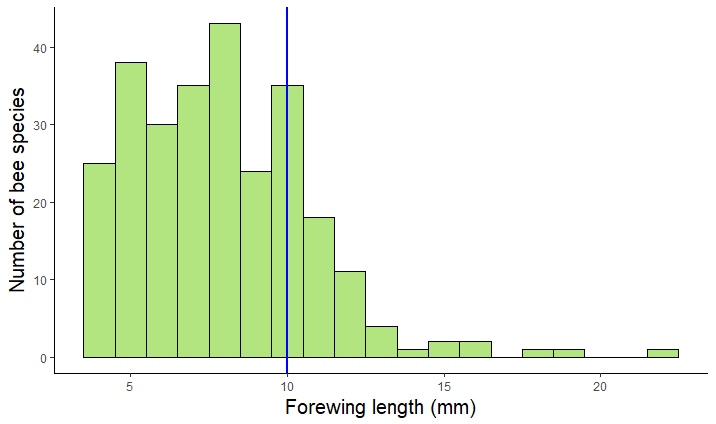
Although we often think of bees, overall, as being the most important pollinators, in fact species vary hugely in their importance. Pollinating ability depends upon factors such as abundance, hairiness, behaviour, body size, and visitation rate to flowers (Figure 2.1). Size is especially important for three reasons. First of all, larger animals can pick up more pollen on their bodies, all other things being equal. Secondly, in order to bridge the gap between picking up pollen and depositing it, flower visitors must be at least as large as the distance between anthers and stigma, unless they visit the stigma for other reasons. Finally, larger bee species tend to forage over longer distances on average (Greenleaf et al. 2007) thus increasing the movement of pollen between plants. However, most of the world’s bees are relatively small as we can see from the analysis of British bees in Figure 2.5. Many species have a maximum forewing length of only 4 or 5 mm, and the majority of species are smaller than honeybees. Remember also that these are maximum sizes measured from a sample; individual bees can vary a lot within populations and even (in the case of Bombus spp.) within nests (Goulson et al. 2002). So the assumption that all bees are good pollinators needs to be tempered by an acknowledgement that some are much better than others.
Figure 2.5: The sizes of British bees. Forewing length is a good measure of overall body size and the data are maximum lengths recorded for species, except for the social bumblebees and honeybee I have used maximum size of workers (queens are often much larger). The blue line indicates the honeybee (Apis mellifera). The biggest bee in this data set is the Violet Carpenter Bee (Xylocopa violacea) which, whilst not generally considered a native species (yet), has bred in Britain in the past. Data taken from Falk (2015).


 Prof. Jeff Ollerton - ecological scientist and author