Tag Archives: Conservation

Help to save a bee species from extinction! And watch some cool videos

It’s World Bee Day and what better way to celebrate it than to help a bee species that’s close to extinction – watch this video about Australia’s Green Carpenter Bee and please donate to the cause:

And while you’re at it, here’s another couple of recent bee-related videos to watch:

And here’s one that doesn’t seem to want to embed – it’s Kit Prendergast from Curtin University.

Sustainability and conservation podcasts: here’s some recommendations

Podcasts are an increasingly popular way of keeping up with recent developments and stories across a diverse range of topics, from music (I’ve been enjoying the David Crosby Freak Flag Flying and Robert Plant Digging Deep series) to serial killers and the machinations of the American big cat-keeping community.  Recently a call went out on the EAUC (Environmental Association for Universities and Colleges) email list for examples of sustainability and conservation podcasts.  The request came from Dr Sandra Lee who leads the Social Impact Team at the University of Leicester and she has kindly allowed me to share the set of podcasts she’s collated.  Feel free to add your own favourite examples in the comments.

Here’s the list that Sandra compiled: with the exception of In Defense of Plants (which I suggested) the accompanying text comes either from Sandra or from the original submissions by EAUC members.  I’ve not listened to all of them so can’t comment on the quality or factual accuracy of the podcasts.

General

  • Outrage and Optimism – very accessible and a great one for keeping up to date with climate policy and the global movement
  • The Sustainability Agenda with Fergal Byrne (he has had some amazing guest right at the top of the sustainability field like Naomi Klien, Jonathan Foley, Paul Hawkins, Caroline Lucas, Rob Hopkins, Kate Raworth, Tim Jackson)
  • Sustainability Defined (Spotify link) – mainly based in the US but there are some great conversations – https://sustainabilitydefined.com/  One university uses this series as the main material for seminar discussions (in this episode University Sustainability with Penn State)
  • Radio 4’s Costing the Earth
  • Mothers of invention: Climate is a man-made problem with feminist solutions with former Irish President Mary Robinson (it’s lighthearted and the co-presenter is a complete novice which makes the information very palatable)
  • Resurgence Voices – this is the Resurgence & Ecologist magazine podcast – (it’s okay not as well done as some others but worth a listen)

More specialist 

  • Vegan Vanguard – run by a Canadian political economist who shares anti-capitalist perspectives on everything from indigenous land rights to geo-engineering, gender-based violence and the alt-right. It’s very useful for learning about the underlying political structures of some of our big sustainability challenges
  • In Defense of Plants – more botanical than about sustainability per se, but plant conservation figures large in some episodes
  • Ways to Change the World with Krishnan Guru-Murthy – not always sustainability explicit but does have some great ideas on how to change the way we think, act and live
  • Making Sense with Sam Harris – looks into controversial questions about the human mind, society and current events
  • Sustainable World Radio – permaculture and ecology-based podcast
  • Next Economy Now: Business as a Force for Good – podcast is about leaders looking into regenerative, bio-regional, democratic, transparent and whole-system approaches
  • Feel Better, Live More – Dr Rangan Chattergee (not sustainability as we know it but absolutely links to Sustainable Development Goal 3)


UPDATE:  Feedspot rank and overview sustainability themed podcasts:

https://blog.feedspot.com/sustainability_podcasts/

(HT Michelle Morley, Environmental Sustainability Manager, Oxford Brookes University)

Cherishing old wood: a guitar restoration story – UPDATED

UPDATE: After I posted this piece I shared it on a couple of Facebook guitar groups.  On the Parlor Acoustic Guitar Lovers Group one of the members, Mario Burgani, suggested that in fact the guitar might be Italian, made in Catania in Sicily.  I’ve done some searching online and I think that he’s correct.  Some of the features that I am seeing on Catania guitars on various websites are identical to mine, in particular the way the back of the guitar has been shaped to cover the heel of the neck, and the shape and design of the floating bridge, with the bone side pieces.  My thanks to Mario for pointing this out.

I have now corrected the post and removed mentions of German manufacture.


This post IS about biodiversity, eventually, but I need to give some background first….

Guitar-based music is a big part of my life, and has been since my teens.  However it wasn’t until I was about 20 that I first started playing guitar.  That’s late, and I wish I’d begun earlier, but neither of my parents were musical and there wasn’t the influence or encouragement.  It wasn’t until I finally left home for university, aged 22, that I started taking it in any way seriously and bought a half decent guitar (a 1986 Washburn D-12N, if you’re interested – I still have it and I’m very fond of it).  Before I started my PhD, in 1989, I played quite a lot and was involved with the local music scene in Oxford, working stage crew for bands.  It was a lot of fun and for a while I considered dropping my PhD and doing it full time.  Some of the guys I worked with went on to become part of Radiohead’s crew and have had careers in the music industry.  But, you know, life, kids, and science got in the way, the frequency of my playing became less and less, and for a long time I hardly picked up a guitar.

But in the past couple of years I’ve started to get back into it and am enjoying playing again.  A few things have prompted this.  The kids have all left home now, so I have more time.  I’m finding it relaxes me and it’s a good way to get away from work and social media and screens.  Also, there are many short “how to play” videos on YouTube, it’s like having a whole set of guitar tutors with different styles and approaches.  It’s not just about the music though: I have a fascination with taking apart guitars and fiddling with them, which leads me on to the point of this post.

Back in late September I was looking at vintage acoustic guitars on eBay and salivating over the Martins that were for sale, when a guitar caught my eye.  It was an old “parlour” guitar in pretty poor condition, and a steal at £50. Parlour guitars are small-bodied instruments that were popular in homes in the late 19th and early 20th centuries, before the guitars with big bodies, such as the Dreadnought models, became the vogue.  They were the sorts of instruments used by early blues players – check out the photograph of Blind Lemon Jefferson on his Wikipedia page and you’ll see what I mean.

I was intrigued by the idea of having an old guitar with an authentic bluesy sound and also having a project to work on, restoring this instrument back to playable condition. The seller was based in Bedford, not far from Northampton, so Karin and I drove down there one Friday evening to pick it up.

Here’s a shot of the guitar as I bought it:

2019-10-05 10.37.31

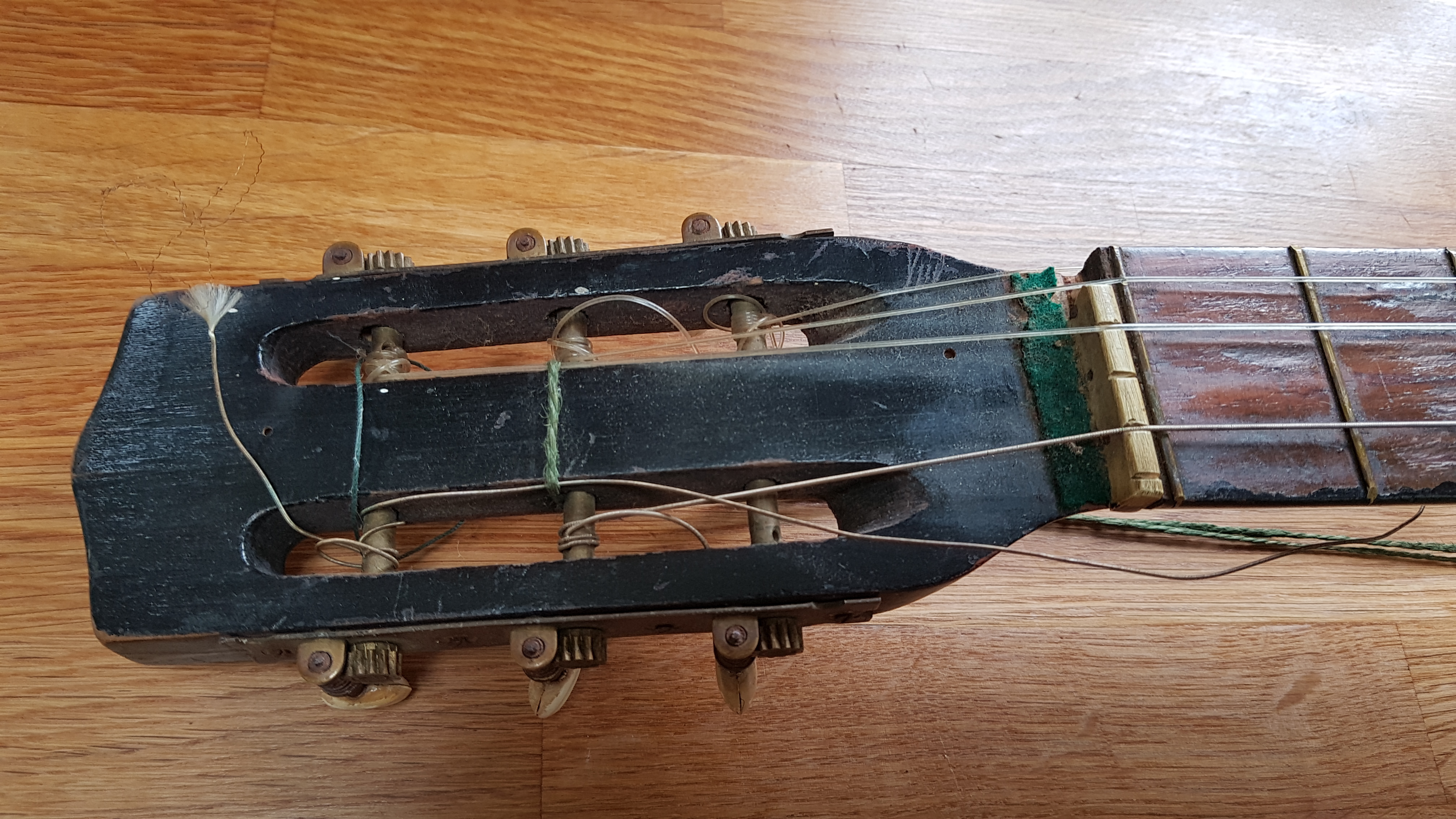
The body was sound and undamaged.  The neck had a bit of a curve to it, but the brass frets were in good condition, though due to the fret board drying out over time their ends were protruding a little either side.  However the bone nut at the top of the neck was broken, the pressed metal tailpiece was quite scratched, the tuning heads rusty and a little bent, plus there were a few other dings and dents.  Here are some close-ups:
2019-10-05 10.37.38

Someone has strung it with nylon strings which is probably not what was intended for this instrument.  The point of a metal tailpiece like this is that it allows the guitar to have metal strings, which are under greater tension, without the need for more complex x-bracing under the soundboard to prevent it from warping or cracking:

2019-10-05 10.37.50

2019-10-05 11.16.12

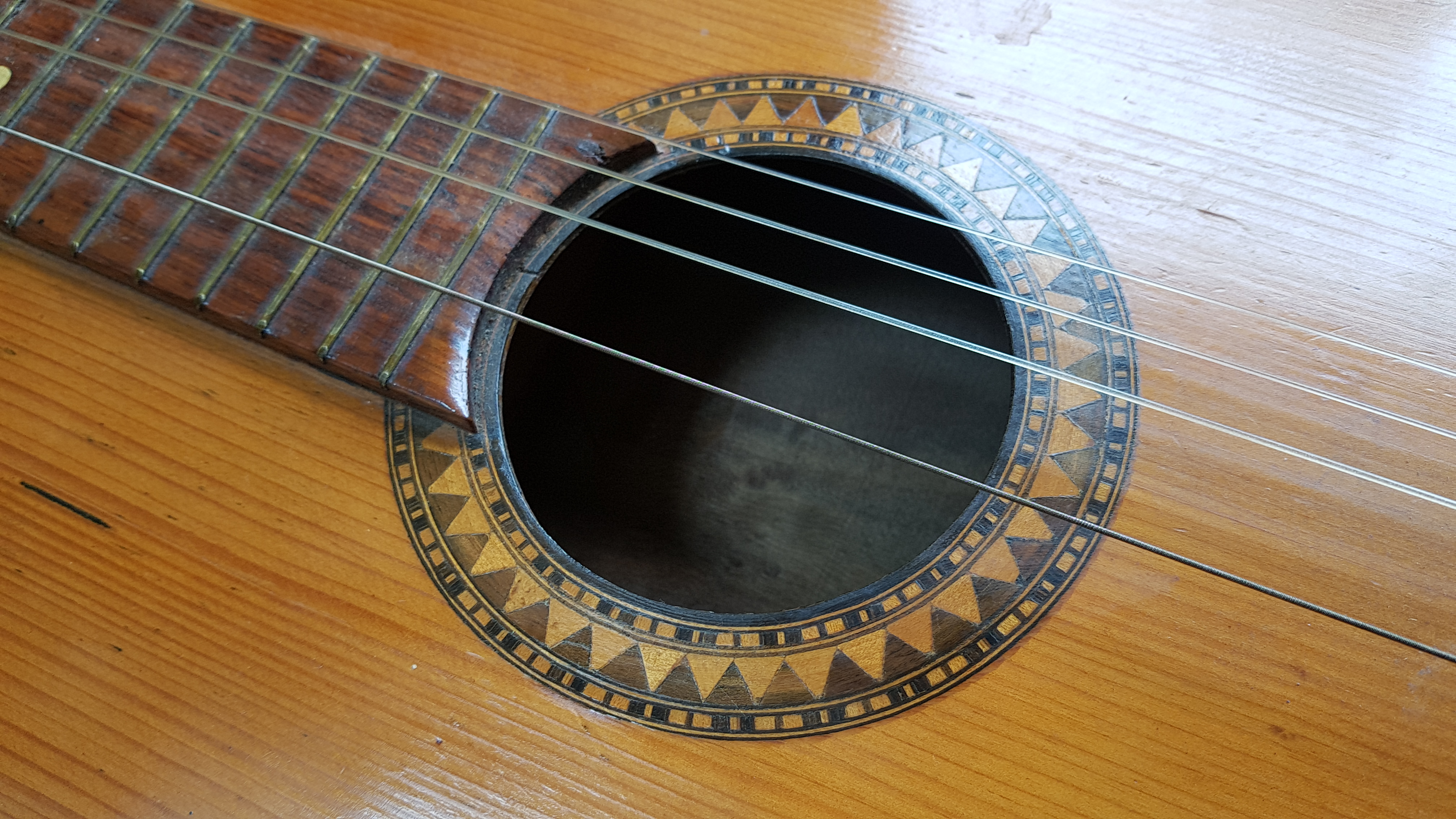
It was clearly not the most expensive of guitars when it was first made, but the marquetry around the sound hole is in perfect condition and nicely executed:
2019-10-05 10.37.54

There’s no manufacturer’s name or label in the guitar, no serial number or anything like that.  So I did a little research online.  It’s not the best quality guitar, as evidenced by the metal tailpiece which, as I mention, is designed to take the strain off the sound board when using metal strings.  The alternative is to have a fixed bridge but that requires more elaborate (= expensive) bracing under the soundboard. However it’s clear that the guitar was handmade, probably in Sicily,  by a local luthier, possibly in the 1920s, but certainly somewhere between 1900 and 1940: so it could be more than 100 years old.

The restoration of the guitar was fairly straightforward, the most complex part being the carving of a new bone nut from a blank that I bought online. The machine heads were removed, cleaned and oiled, then re-fitted; I could have replaced them but they were in decent condition given their age and I wanted to retain as much authenticity to the guitar as possible.  The frets were filed and a neighbour who is a metal worker polished up the tailpiece.  Most of the other work was fairly cosmetic – I didn’t want to touch the original finish.

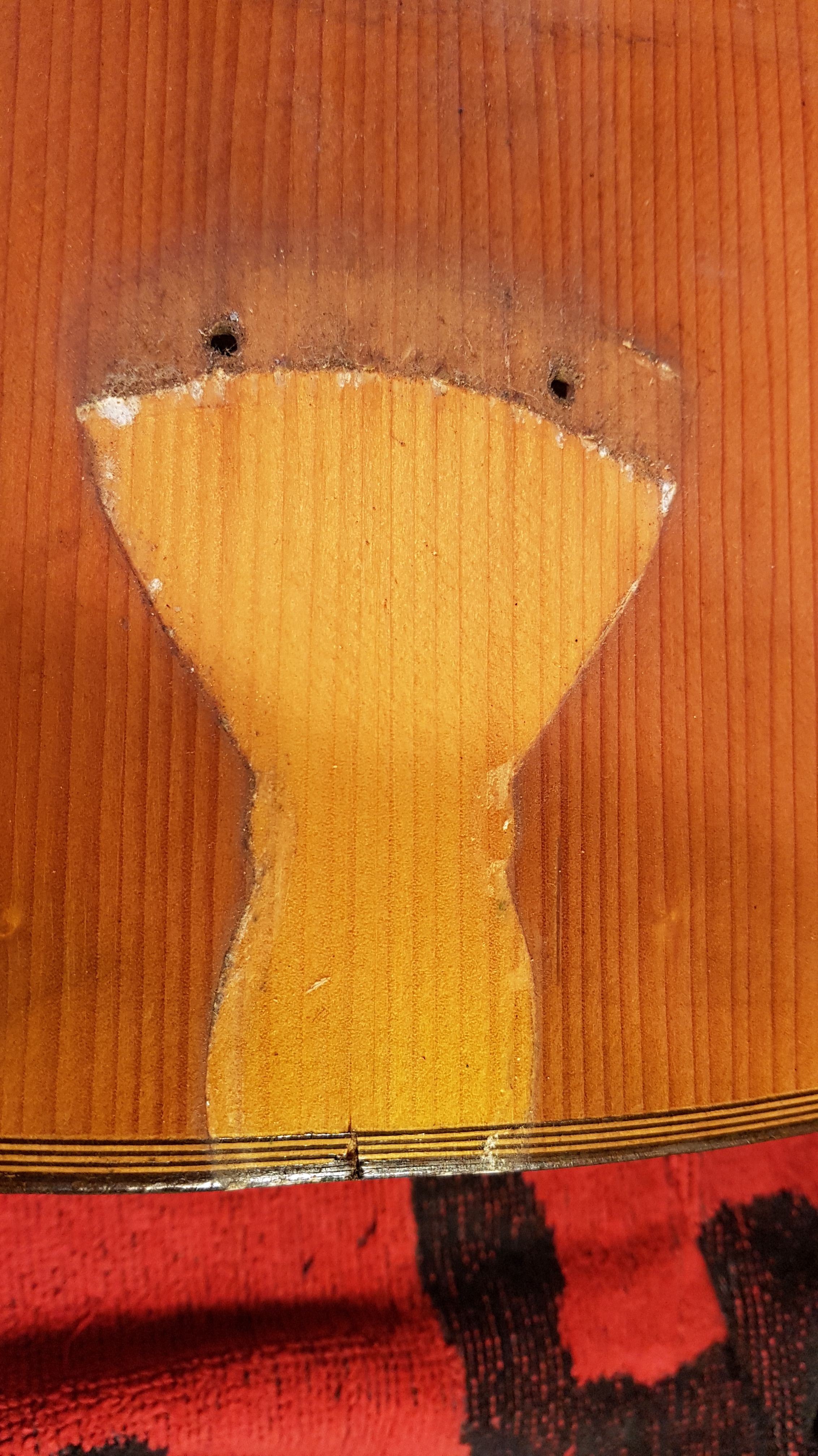
Now we get to biodiversity.  A lot of wood goes into the construction of acoustic guitars.  In the case of this instrument, the soundboard is solid European spruce (Picea abies) that has aged to a beautiful golden colour.  When I took off the tailpiece its original colour was revealed; that tailpiece has probably never been removed before:
2019-10-05 11.12.09

2019-10-05 11.12.17

That spruce top is book-matched: the two sides of the soundboard are symmetrical down the mid-line of the guitar, showing that they were split from the same board.  Book-matching is a common technique used by luthiers, both for aesthetic reasons and because it’s harder to get a single piece of tonally-acceptable wood of that width.  The tree from which it was cut was probably grown in a plantation; most old growth forest in Europe had been cut by the time this tree started growing.  If you count the number of growth lines across one half of the soundboard there’s about 60, which gives an indication of the  minimum age of the tree at harvest, i.e. it was at least 60 years old when it was felled.  If the guitar was made in around 1925, and given that the wood from the tree would have to season for at least a couple of years, perhaps longer, before it was used,  it means that the tree started growing some time in the mid-19th century.  So the tree that contributed the soundboard has lived through summers and winters of profound historical change in Europe.

The sides, back and neck of the guitar are mahogany, as is the bridge I think.  Nowadays “mahogany” can refer to a range of unrelated tropical trees – see this website for details.  But when this guitar was made, mahogany usually referred to wood from species in the genus Swietenia, which naturally grow in Central and northern South America, and the Caribbean.  So the tree that donated the wood was cut out of pristine, or at least long-established, tropical rainforest. One possible source is Belize which was exporting a lot of mahogany to Britain during this period, which may then have been exported all over Europe.

The fret board is probably Brazilian rosewood (Dalbergia nigra) judging by the black streaks or “spider webbing” in the timber. Brazil banned exports of the wood in the 1960s but there’s still much illegal harvesting going on of these and other trees.  This species, and the three in the genus Swietenia, are in the IUCN categories “Vulnerable” or “Endangered” due to their over-exploitation, and are CITES-listed.

Some other, so far unidentified, woods were used in the construction of the guitar, in the marquetry around the sound hole, in the binding around the top, and in the end strap button.  The latter may be ebony from one of several species in the genus Diospyros, which are likewise protected.

The timber used to make these old guitars is a legacy of an age when rapacious exploitation of the world’s natural resources was considered almost a public duty.  There was little or no consideration for the ecosystems that were exploited, or how deforestation affected both wildlife and indigenous peoples.  To some extent the situation has improved and there are global efforts to conserve the old growth forest that remains, albeit with variable results.  But we are far from giving these forests the protection and restoration that they deserve.   Modern guitar makers need to take responsibility for sourcing their materials ethically and sustainably, which some are and some are not.  There’s a really interesting set of articles about this in the series Building a Sustainable Guitar at the Forest Legality website.  At the other extreme the Gibson guitar company pleaded guilty in 2012 to knowingly using timber that was harvested illegally in Madagascar, a trade that Pete Lowry of the Missouri Botanical Garden is quoted as calling the “equivalent of Africa’s blood diamonds”.

Old musical instruments, furniture, and other artifacts have history as well as carbon locked into their timbers.  Therefore I think that it’s incumbent upon us to cherish and use them and not consign the wood to the bonfire or to landfill.  If that sounds too sentimental, then so be it.  But there’s a practical side to this too: they are often better quality than more modern instruments and can be much cheaper.

All of my guitars have names that reflect something of their history.  During the drive down to pick up the guitar from Bedford there was the most incredible rain storm, water lashing across the road and windscreen wipers on full blast.  So I’ve named this guitar The Rainmaker.  You can see the finished result of the restoration in the images at the top of this post.  I’m pleased with it and I hope it lasts another 100 years at least.

One final thing: how does the guitar play and sound?  Well, as I said, the neck has a bit of a curve to it and there’s no truss rod to adjust it, so re-setting it would be a major job.  This means that the action (the distance between the strings and the frets) is very high, especially close to the body.  So I’ve tuned the guitar to an open E chord, have invested in a glass bottleneck, and am using it to learn to play blues slide guitar.  And it sounds pretty good, with a warm, mellow, and (yes) bluesy sound.


Landscapes for pollinators: please take the survey!

BB on margin

One of the research projects and collaborations that I’m involved with is a BBSRC-funded project entitled “Modelling landscapes for resilient pollination services in the UK” with colleagues from the University of Reading, the University of Huddersfield, and the Natural Capital Solutions consultancy.  As part of that project we are surveying opinions on what people in the UK value as landscapes and how these landscapes contribute to supporting biodiversity.

If you are based in the UK and are interested in taking part in this short survey, please read the following text and click on the link to take the survey: 

Bees and other insect pollinators are major contributors to UK agriculture. Despite their importance for crop production, pollinator populations are threatened by many modern land management and agricultural practices. This raises questions about how secure this service may be to future changes: will we have enough pollinators where we need them? Will populations be able to withstand changes to the way we manage land? What might be the costs to us, both financially and socially, if we get it wrong?

Our research aims to address this knowledge gap. Our team of ecologist, economists and social scientists are working together to model the ecological, economic and ‘human’ costs of different land management methods.

As part of this we have designed a short online survey to capture the ways that people value and use the countryside, what features they prefer and why.

The survey takes less than 10 minutes and asks you to rate a series of images and say what you think about the landscapes that are illustrated.  It can be found here:

http://hud.ac/landscapes

For more information about the project visit:

http://www.reading.ac.uk/caer/RP/RP_index.html

Ecologists in a time of COVID-19

20200311_140421

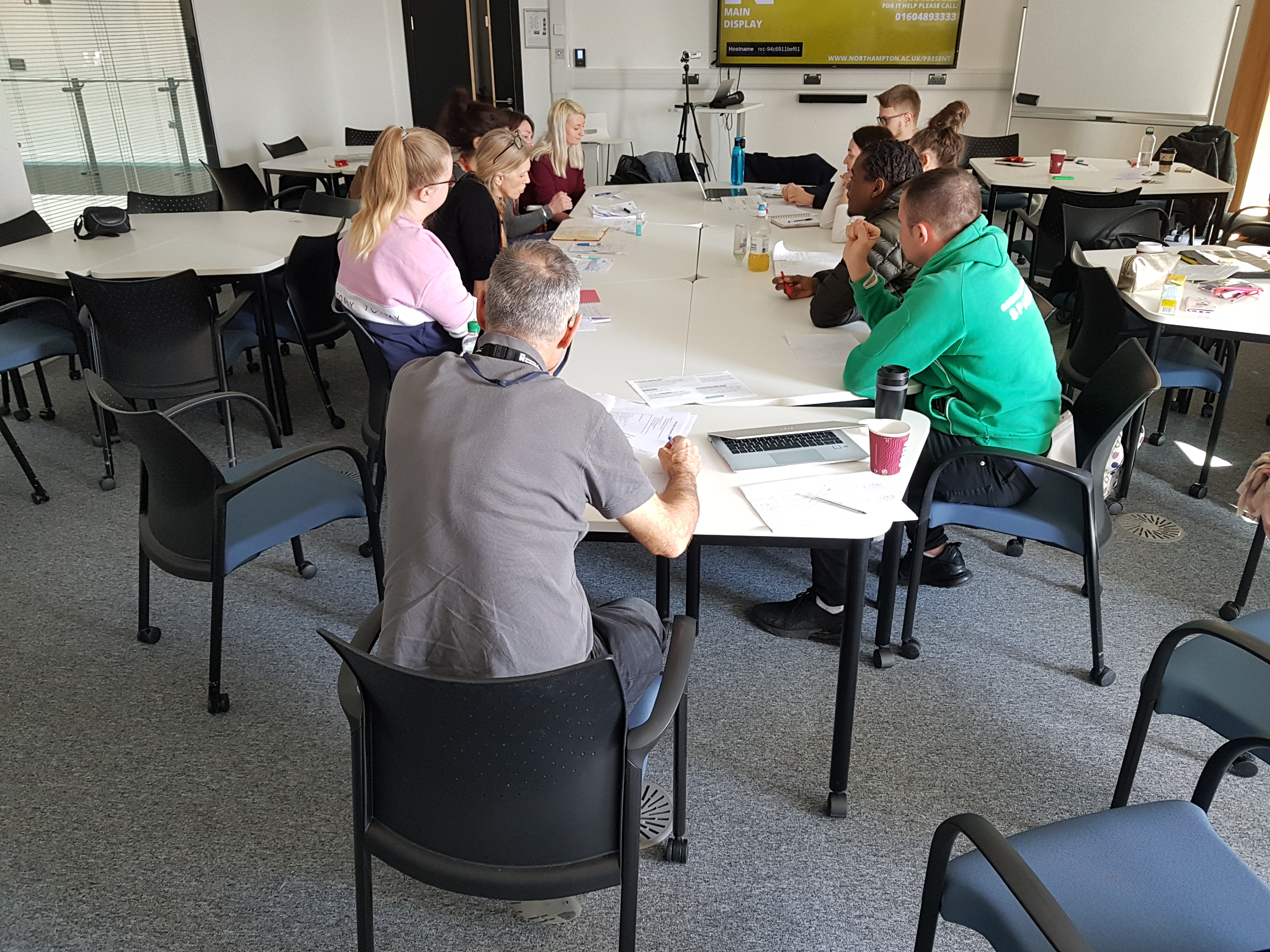
Yesterday I was involved in what’s likely to be be my last face-to-face teaching and meetings from some weeks, possibly months.  In the morning my colleague Duncan McCollin and I watched our final year students take part in an assessed debate that pitted two sides against one another to argue whether or not Brexit will have a negative effect on biodiversity.  The students did very well, they had a great grasp of the issues and the facts and figures.  The end result was very much a draw:

2020-03-16 10.35.33

Teaching at the University of Northampton will go online from the end of the week and a field trip for our first year undergraduates that we had planned for this Thursday has been pulled.  Our annual Tenerife Field Course has also been cancelled: this will be the first year since 2003 that I have not visited the island and it’s going to leave a hole in my long-term data sets.  Perhaps the universe is telling me that it’s time to write them up for publication?

Last week I did a quick vox pop on Twitter to ask how COVID-19 has affected ecology field work at other universities:

The response was interesting and it’s clear that overseas field courses have been massively impacted.  Following the UK Government’s advice yesterday about limiting social contact it seems that local field work for student groups will also be affected.  Hopefully those undertaking individual field work, especially PhD and postdoctoral researchers, will still be able to carry out their data collection.  Do let me know in the comments if it’s affecting your work.

There were also some Twitter responses from professional ecological consultants pointing out that they may not be able to carry out surveys of sites for planning and development purposes.  This is yet another way in which COVID-19 is going to impact our economy.

Following the student debate, Duncan and I headed out to catch up with a meeting of the steering group of the Chequered Skipper Reintroduction Project   We missed the morning’s presentations but arrived in time for the lunch and a short field trip:

2020-03-16 14.25.51

The location of the reintroduction is still being kept secret, as is a second site where a further reintroduction of butterflies from the Belgium population is being considered.  However there was much discussion as to whether restrictions on travel means that this would have to be delayed until next year.

On the way to that site, during a 15 minute drive, we spotted seven red kites.  They are now so common that seeing these amazing birds hardly requires comment.  But we should never forget what an incredibly successful conservation story this has been.  To cap it all, when we arrived at the site I had the pleasure of meeting Karl Ivens, one of the main drivers behind the reintroduction of red kites to Northamptonshire. He now estimates the regional population to be a couple of thousand birds.  The guy deserves a statue, or at least a blue plaque on his house!

On the way home I was thinking about my next blog post and what to write, and whether or not to bring the pandemic into it.  There’s a lot of information, and misinformation, about COVID-19 online and I’m not qualified to add to that: I’m not an epidemiologist.  However I’d like to link to a few things I think are worth reading.

Over at the Dynamic Ecology blog, Brian McGill has posted an open thread on ecologists discussing the coronavirus pandemic.  There are some interesting contributions in the comments, particularly around the response of the UK Government to the crisis.  I was struck by Jeremy Fox’s comment that Britain has some brilliant epidemiological modelers and that “even if you don’t think much of Boris Johnson or his senior advisers, the modelers who are feeding them information and advice are intellectually honest, hardworking, care deeply about protecting the public, and are as good at their jobs as anybody in the world.”  As I pointed out in a reply, this is undoubtedly true, but a lot depends on whether the government is willing to implement that advice. And its track record so far is not inspiring: for years it ignored expert advice on the effects of badger culling on the spread of bovine TB and continued to kill badgers. It’s only just reversed that decision.  Let’s hope that they have learned from that experience.

I am also hoping that there will be at least one positive outcome from the current pandemic on top of recent extreme weather patterns linked to climate change (for example the drought and fires in Australia that I blogged about in January).  I hope that it serves to  remind the public, governments and large corporations just how dependent on the environment our society is.  Despite our advanced technologies, we are incredibly sensitive to disruptions in the natural world.  As this old piece from the New York Times points out: “most epidemics — AIDS, Ebola, West Nile, SARS, Lyme disease and hundreds more that have occurred over the last several decades — don’t just happen. They are a result of things people do to nature“.   That was in 2012, long before COVID-19 was discovered.  To update this, check out the Wildlife Conservation Society’s ongoing series of articles about the relationship between our destruction of natural habitats, the trade in illegally (and legally) hunted animals, and emerging diseases such as COVID-19.

I realise that I’m fortunate and that there’s a lot that I can do by working from home.  For the next few weeks I’ll be doing just that, supporting students online, completing grant and manuscript reviews, having Zoom/Skype meetings, and completing the book that I am writing.  Stay safe everyone.

Just published: Interactions between birds and flowers of Rhododendron spp., and their implications for mountain communities in Nepal – download it for free

Figure 3

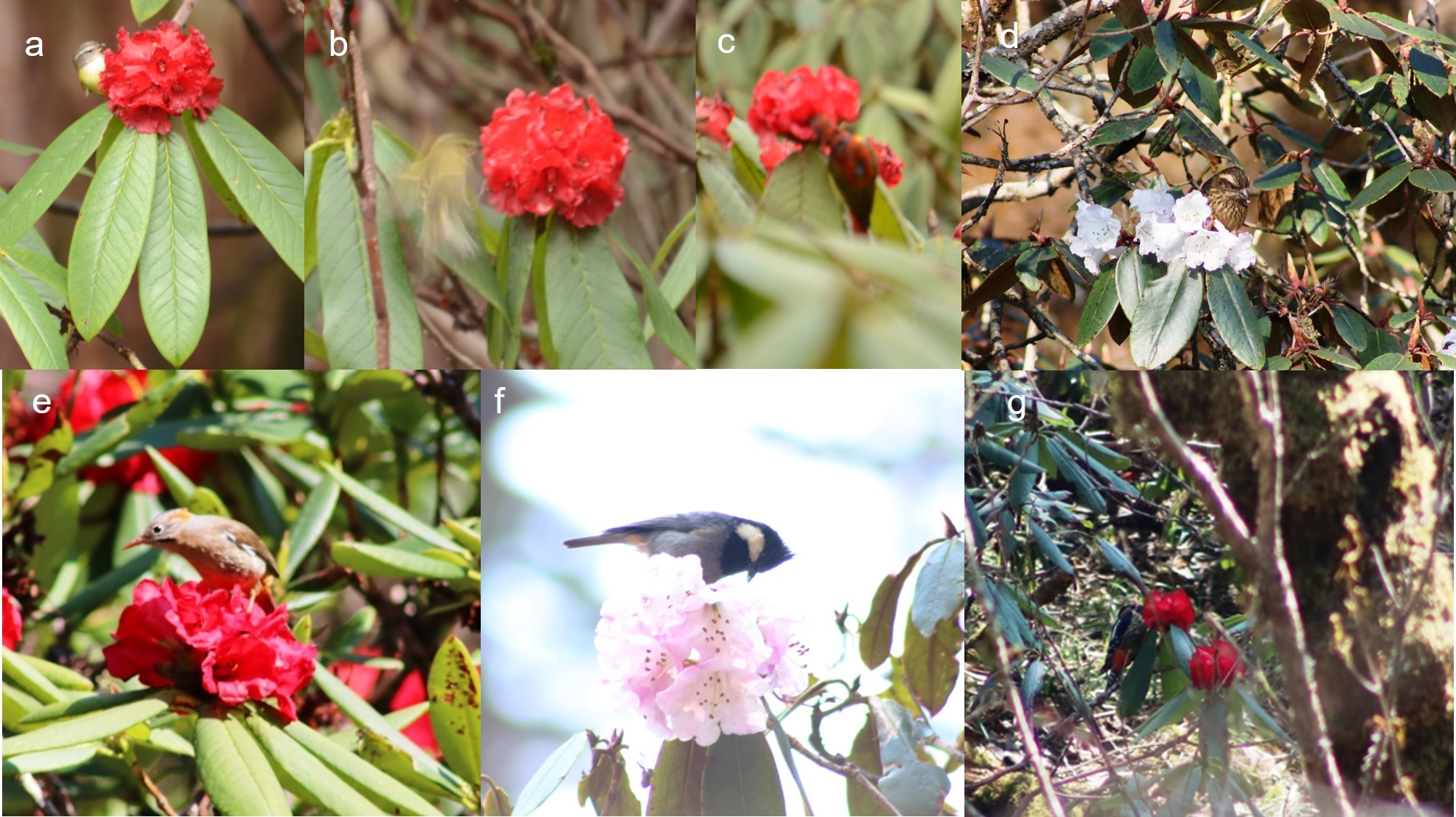
Back in April I posted a series of reports on a student field trip that I was involved with in Nepal, supporting our University of Northampton partner college NAMI in Kathmandu; the first one is here.  During that trip, my NAMI colleagues and I made some interesting observations about the role of generalist passerine birds and specialist flower-feeding sunbirds as pollinators of rhododendrons in the Himalayas.  This was subsequently followed up with another set of observations in which I didn’t take part, and then written up as a short research note.  I’m pleased to say that it has now been published in the new, open-access journal Plants, People, Planet.  Here’s a link to the paper which you can download for free:

Ollerton J., Koju N.P., Maharjan S.R. & Bashyal B. (2019) Interactions between birds and flowers of Rhododendron spp., and their implications for mountain communities in Nepal. Plants, People, Planet 00:1–6. https ://doi.org/10.1002/ppp3.10091

The report really asks more questions than it answers.  It points out how important these rhododendron forests are for the people of Nepal but that we know virtually nothing about the pollination biology of the dominant trees and therefore the long-term persistence of Rhododendron species in the face of forest exploitation and climate change.  Our hope is that it stimulates both further research on the topic and increased awareness of how important it is to protect these habitats.

Beexploitation in social media – UPDATED

2019-07-28 11.15.10

UPDATE:  I should really have linked to Charlotte de Keyzer’s “bee-washing” site – https://www.bee-washing.com/ – it’s making much the same argument in a more comprehensive and elegant way.  That’s what happens when you post blogs first thing in the morning before the (bee pollinated!) coffee has properly kicked your brain into gear…..

————————————————————

I am fond of new words – neologisms – and if pollinators can be included, so much the better.  For example see my recent post about autobeeography.  That refers to memoirs which focus around work or encounters with bees, of course.  So here’s a new one:  “beexploitation”.

Beexploitaton is a play on blaxpoitation of course, and refers to articles, campaigns, social media, etc., that seeks to make financial or reputational gain from making wild and unsubstantiated claims about pollinators, most often honeybees.  Here’s an egregious example that caught my eye this morning and stimulated this post:  https://www.boredpanda.com/influencer-bee-b-fondation-de-france/

Worryingly, this is set up by the French Government and is aimed at raising money from well meaning people to “save the bees”.  But it’s full of nonsense claims such as that bees pollinate cocoa plants to give us chocolate.  They don’t – the pollinators of cocoa are primarily, perhaps exclusively, small flies.  There are other errors too and we know that honeybees, globally, are not as important as wild pollinators for crop plants.  We need to highlight and critique this sort of rubbish because it diverts money and attention away from genuinely well thought out initiatives to conserve pollinators.

As always, I’m happy to receive comments and other examples of beexploitation.

The role of press freedom in protecting the environment

Ollerton et al Press freedom Figure 1

Recently I’ve been working with a couple of journalist colleagues at the University of Northampton on a short article exploring the relationship between press freedom and environmental protection in different countries.  That piece has just been published on the Democratic Audit website – here’s the link.

I think that the findings are really interesting, and timely in an age when press freedoms are being eroded and journalists physically attacked and even murdered.

Celebrating the environmental and historical heritage of the Nene Valley

One of the great privileges of the job I have is working with individuals and organisations across all aspects of conservation and science; people who are asking the most fundamental of ecological or evolutionary questions, through to those addressing on-the-ground questions of habitat management and restoration.  One of my current roles is as a board member for Nenescape Landscape Partnership Scheme, funded by the Heritage Lottery Fund (2016-2021) and involving multiple Northamptonshire partners, with the University of Northampton acting as the Competent Authority for the financing of the scheme.  Our students and staff are also involved in various ways, volunteering their time and expertise.

Friday and Saturday this week was taken up representing the University and the Nenescape board at events that showcased Nenescape-funded projects.  First up was the East Northants Greenway project where we admired the new benches that had been installed, the clearance of rubbish along this former railway, tree planting, the All Aboard for Rushden Art Codes project, and a new mural, and chatted with local residents who seem to be very happy with the work that’s been done.  Then it was along to Rushden Transport Museum to look at the work that’s been done on the old railway goods shed.  On Saturday I was up at Ferry Meadows near Peterborough to try out the new boardwalk that has been installed and to see the restoration of Heron Meadow as a site for overwintering wild fowl and waders.  I now have temporary tattoos of pollinators…. Later in the afternoon I headed to Stanwick Lakes for a celebration of the new barn and heritage garden that’s been created as part of the Settlers of the Nene Valley project, complete with a Viking re-enactment group.  Here are some images from the two days:

2019-09-20 11.32.31

2019-09-20 11.44.15

2019-09-20 11.49.28

2019-09-20 11.49.41

2019-09-20 11.54.50

2019-09-20 12.15.20

2019-09-20 13.04.57

2019-09-21 14.09.00

2019-09-21 14.43.51


2019-09-21 17.47.26

2019-09-21 17.38.28


Chequered skippers are back: extinct English butterfly breeds for the first time in over 40 years!

P1040409

Last year I wrote about our involvement with the chequered skipper reintroduction project that’s happening in north Northamptonshire, and specifically the work of University of Northampton postgraduate researcher Jamie Wildman.  For the past month we’ve been sitting on some news that we were not allowed reveal: the reintroduction has been a success!  That is to say, adult butterflies emerged in May this year, having overwintered as pupae, and have been seen breeding in Rockingham Forest.  The secrecy was to prevent hordes of butterfly twitchers (buttwitchers?) descending on the site and possibly doing unintentional harm as they searched for the adults.  The population just isn’t large enough to be able to withstand that sort of pressure.

The BBC has run with the story this morning – here’s the link – and we have issued a piece via the university’s press team: the link to that is here.

In a time when the media is dominated by profoundly depressing stories about wildlife and the environment it’s great to be able to end the week with some positive news.  Here’s to the long-term success of this lovely little critter!