Category Archives: Honey bees

The decline of the “humble bee” – a short follow-up from yesterday’s post

The piece I posted yesterday about whether the names two of our most well known pollinators should be spelled honey bee/honeybee or bumblebee/bumble bee generated a lot of interesting comments on Facebook, Twitter, and on the blog.  A few people pointed me to the “Snodgrass Rule” that informal names should be combined only if the species concerned are not members of that particular taxon (e.g. “butterfly” rather than “butter fly”, because they are not “flies”), in which case “honey bee” and “bumble bee” are correct.

If I was ever aware of this entomological convention I’d certainly forgotten about it, but it strikes me that there’s a lot of examples outside of entomology that break the rule, e.g. hummingbird, goldfinch, catfish, ground ivy, etc.

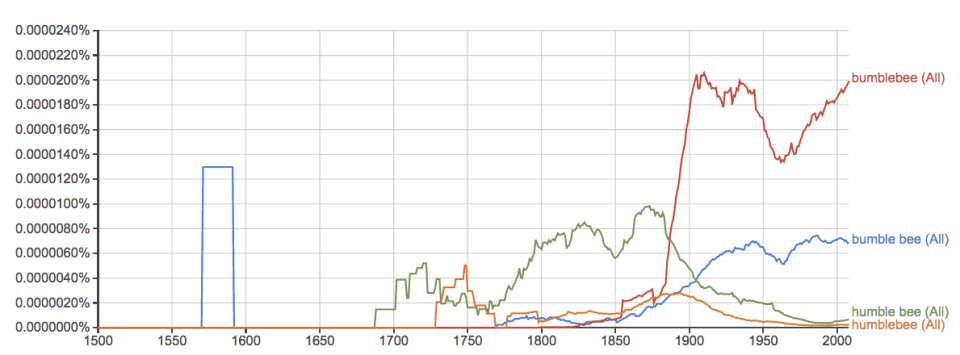
A couple of commentators also asked me about the old term “humble bee”, as used in Frederick Sladen’s 1912 book “The Humble-Bee, its Life-History and How to Domesticate It”.  So I added this to the bumblebee/bumble bee search on the Google Ngram Viewer, taking the time frame back to 1500, and the results are very intriguing:

screen-shot-2017-03-01-at-09-59-55 It would appear that “bumble bee” pre-dates “humble bee” by a considerable period, with the former being superseded by the latter from the late 1600s onwards, until “humble bee/humblebee” started to decline in use from the end of the 19th century.

I’ve also searched using the term “dumbledore”, which is an old local name, but it was also applied to other buzzing insects such as chafers, making interpretation of the results difficult.  There’s more on the etymology of bumblebees on Wikipedia if you’d care to follow it up.

Many thanks to everyone who contributed to the discussion!


Honey bee or honeybee; bumblebee or bumble bee?

screen-shot-2017-02-28-at-10-18-20

Language is fascinating, particularly the way in which it changes over time to incorporate new words, or old words used differently.  In science this has important implications for understanding: semantics matter.  With this in mind I’ve been curious about the alternative ways in which authors write the informal names of species.  Scientific names (Genus species)  should be fairly stable in their spelling and presentation (though not always, especially in the older literature); but “common” names of species vary widely geographically and temporally.

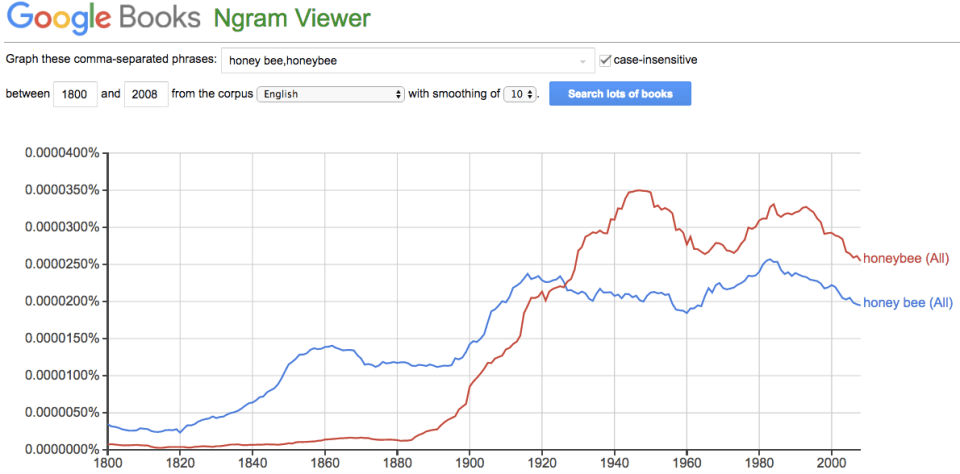
Here’s an example using Google’s Ngram Viewer which is a useful tool for tracking changes in word use over time.  Different authors currently use the terms “honey bee” and “honeybee”, sometimes in the same publication.  But as the image above shows. historical analysis suggests that “honey bee” is the more traditional term, and that “honeybee” only came into common usage from the start of the 20th century, and by the late 1920s had taken over “honey bee”.

Likewise “bumblebee” and “bumble bee”; despite “bumble bee” having a much earlier usage, “bumblebee” has dominated since the late 19th century:

screen-shot-2017-02-28-at-10-16-51It’s interesting to speculate about what might have caused these shifts in use, and it’s possible that in these examples it was the publication of especially influential books that used one term over another and influenced subsequent writers.  Could make a good project for a student studying how use of language varies in different time periods.

For my own part I tend to prefer “honey bee” and “bumblebee”, but I can’t precisely articulate why; perhaps it’s because in Europe we talk about “the honey bee” as a single species (Apis mellifera) but not “the bumblebee” because there is usually more than one co-occurring Bombus species in a particular area.  Do others have a particular preference?

Should scientists accept funding from agro-chemical companies? The devil’s in the details

Oxalis fly P1030303.png

The relationship between use of pesticides (particularly neonicotinoids) and the decline of pollinators is one that I’ve touched on a few times in this blog – see for example:  Bees and pesticides – a major new study just publishedButterflies and pesticides – a new study and a smoking gun; and Pesticides and pollinators: some new studies and contrasting conclusions.  It’s an important and controversial topic that’s unlikely to go away any time soon.  In an article in the New York Times, journalist Danny Hakim has given that particular pot a further stir by discussing Scientists Loved and Loathed by an Agrochemical Giant.

Although it’s been online since New Year’s Eve, the first I heard about the article was when an American colleague sent me a link this morning (the day it appeared in the printed version) and asked me if I had any thoughts and comments about one of the scientists featured – James Cresswell of the University of Exeter.  I’ve known and respected James for over 20 years and I think his contribution to this article provides a brave and open answer to the question I pose in the title of this post: should scientists accept funding from agro-chemical companies?

Please do read that article, it’s fascinating, if not entirely objective in its own right.  The tone and focus of the piece is best summed up by the one-sentence summary at the start, which incorporates a quote from Dave Goulson (University of Sussex):  “With corporate funding of research, “there’s no scientist who comes out of this unscathed””.  In fact that quote is taken rather out of context because Dave’s point was about perceptions of motives and biases, rather than actual corruption of the science and scientists concerned.

Having said that, the article does present a prima facie case that some scientists (though I emphasise not James himself) are playing fast-and-loose with the evidence related to pesticides and GM crops.

Back to perceptions.  Industry funding of university-led scientific research is incredibly common, far more common than the public probably realises.  There are three reasons for that.  First of all, universities are where many subject experts are based, of course.  Secondly, scientific research is expensive: it requires staff, facilities, equipment, funding for overheads, etc.  University researchers are therefore always hunting for money to enable them to carry out research (which in turn is linked to promotion success, career development, and so forth).  Thirdly, external income is an important performance indicator for universities and their constituent departments: James himself is quoted as saying “I was pressured enormously by my university to take that money”, a sentence that will resonate with many UK researchers.

In general the public’s perception (as far as I can tell) is that most of that research is not being corrupted by the industry funding that is attached to it.  In my own faculty at the University of Northampton, for instance, my colleagues have obtained industry funding for research and consultancy work in areas such as product design, lift engineering, materials science, leather processing, computer networks, app development, and so forth.  All controversy-free.

In much of the environmental sector that’s also the case: we’ve had funding from a large water utilities company to write a report on habitat management strategies for reducing rabbit densities close to water bodies, and one of my current research students is being funded by a solar farm company.  Likewise colleagues have been funded by wastes management companies to advise and research in that field.  None of this has generated any negative perceptions, with the possible exception of some aspects of wastes management where issues such as “waste-to-energy” remain controversial.

In other areas of environmental research, however, there have always been accusations of bias levelled at university researchers who are perceived to be industry shills, especially if they are not seen to be toeing a particular line.  I’m deliberately using that word – shill – because it’s something I was accused of being during a heated social media discussion of causes of pollinator declines.  A commenter claimed that I was an “industry shill” for daring to suggest that this was a complex topic, and that there were no easy answers to why (some) pollinators are declining, but that neonicotinoid pesticides were not the only cause.  “Which chemical company is funding your research?” she aggressively demanded to know.  I think I convinced her that I was not (and never have been) funded by chemical companies.  But it raised an interesting question: would I ever accept funding from such companies, if it was offered?

The simple answer is that I don’t know.  It depends what the money was for and what strings were attached in terms of non-disclosure, ownership of data, etc.  As the title of this post states, the devil’s in the details.  I know quite a number of researchers in my field who have had funding from Syngenta, Bayer, and other agro-chemical companies.  Some of these are colleagues with whom I have published research papers.  In general I have no reason to believe that the research conducted by any of these colleagues has been corrupted by their association with the funders.  However in one instance I had a disagreement with a colleague who was not (in my opinion) objective in how they wished to frame part of a paper’s discussion and who may (in my opinion) have been influenced by their association with a particular funder.  In the end this didn’t change the conclusions of the research (which was not itself industry funded) but it did make me pause to consider these subtle biases, which I’m sure could affect anyone*.  Again, perceptions are key here.

Money for the kind of research that’s done by colleagues and myself is always, always going to be in short supply and competitively pursued, and failure to obtain it will always be much more common than success.  Unless funding to address important ecological research questions from government (i.e. taxpayer money) and charities vastly increases, industry will be there to fund research in its own interests, and the perception of scientific bias will remain, whether or not it actually exists.


*I’m not prepared to say more about this particular example so please don’t ask.

Recent developments in pollinator conservation: IPBES, 10 Policies, pesticide conspiracies, and more

Bee on apple blossom - 1st May 2015

It’s been a busy week for anyone interested in pollinators and their conservation, lots of things happening that I thought I would summarise in a single post with links.

First of all IPBES (the Intergovernmental Science-Policy Platform on Biodiversity and Ecosystem Services) has finally released the full text of its Thematic Assessment on Pollinators, Pollination and Food Production  – nine months after it was discussed at the 4th IPBES Plenary Meeting, and three months after the Summary for Policymakers came out.  Even now the document is not in its ultimate state, it’s the text without its final layout or appendices (though it still runs to 868 pages!)  The preamble to the report states that:  “A full laid out colour version, including a preface and annexes will be posted here shortly”.

Sources tell me that there have been some delays while the exact style and colour scheme of the report are finalised, which, if true, is frankly not very encouraging : this is an important document that needed to made public at the earliest opportunity.  I accept that it’s got to be correct, and it’s a complex report, and this is not a criticism of the authors, rather of IPBES’s bureaucracy.  Pollination ecology and pollinator conservation is a fast moving field and there have already been significant scientific and policy developments since the text was finalised which will not be incorporated into this version.

To coincide with the release of the report comes two important articles in the two most prestigious scientific journals by some of the authors of the report.  In “Ten Policies for Pollinators” (Dicks et al. Science 354: 975-976) the authors set out a series of recommendations for politicians.  The article is paywalled so here’s their list with some annotations [in square brackets]:

1. Raise pesticide regulatory standards [to include our most important pollinators – wild bees and other insects!]
2. Promote integrated pest management (IPM) [rather than automatically feeding the profits of agrochemical companies].
3. Include indirect and sublethal effects in GM crop risk assessments.
4. Regulate movement of managed pollinators [lots of evidence that poor husbandry is a major cause of colony collapse disorder, for example].
5. Develop incentives, such as insurance schemes, to help farmers benefit from ecosystem services instead of agrochemicals.
6. Recognize pollination as an agricultural input in extension services.
7. Support diversified farming systems [does Brexit provide an opportunity to do this in the UK?]
8. Conserve and restore “green infrastructure” (a network of habitats that pollinators can move between) in agricultural and urban landscapes [already lots being done on this in urban areas but much less in rural areas].
9. Develop long-term monitoring of pollinators and pollination [there’s already been a report on this – expect more news early next year].
10. Fund participatory research on improving yields in organic, diversified, and ecologically intensified farming.

Overall it’s a sensible set of recommendations – the only ones that I would have added would be to develop education and awareness programmes of the importance of natural capital and ecosystem services, aimed at farmers, civil servants, politicians, planners, business and industry, developers, etc.  And also to build consideration of natural capital into local planning systems so that the loss of habitats, trees, ponds, etc. are properly accounted for.  I’m sure others can think of more – feel free to comment.

Getting politicians to take notice of these recommendations in an age where scientific experts are derided as no different to “soothsayers and astrologers” will be a challenge though.

Lead author Lynn Dicks discussed these recommendations on the BBC Radio 4 Farming Today programme (from about 3:27) – well worth a listen.

Following on from this some of the authors of the 10 recommendations article were also involved in a review published this week entitled “Safeguarding pollinators and their values to human well-being” (Potts et al. Nature) – hopefully that link will take you to the full text of the article which is being widely circulated for free in a read-only form (it can’t be downloaded unless you have an e-subscription to Nature).

On the subject of safeguarding pollinators (and specifically from pesticides) a video of Dave Goulson speaking at the 2015 National Honey Show appears to have been edited to remove his comments about neonicotinoid pesticides (about 34:08 to 34:28).  Dave’s not sure if this is conspiracy or cock-up, but it’s an odd coincidence that this is the only glitch in an otherwise well-produced video.

At about 39:20 Dave talks about the importance of engaging kids with nature and specifically pollinators.  I completely agree and last week did a live Q&A phone interview with Year 7 pupils at Abbeyfield School in Northampton who are doing a project on bees.   The kids asked some great questions and were very well informed – a credit to their teachers!

This week there was a lot of pollinator and pollination ecology being discussed at the Ecological Society of Australia’s annual conference – Manu Saunders has produced a Storify to summarise the talks and Twitter comments – here’s the link.

Linked to this, against my better judgement and as an experiment, I’ve finally joined Twitter.  It’s a bit of an experiment to see how I get on and so far I’m enjoying it, though I’m sticking to science and environmental news – my handle is @JeffOllerton if you want to follow or tweet at me.

Managing for Pollinators – a special issue of the Natural Areas Journal

Inula at Ravensthorpe 20160710_145426The October issue of the Natural Areas Journal is a special one devoted to the topic of “Managing for Pollinators”.  All of the papers have a North American focus but I think that they will be of general interest to anyone, anywhere in the world, who is concerned with how best to manage habitats for pollinators.  Here’s the contents page of the issue, copied and pasted from the site; I’m not sure if the full text links will work if you or your institution does not have full text access, but you should at least be able to view the abstracts:

Editorial: Pollinators are in Our Nature Full Access

Introduction by USFS Chief Tidwell – Pollinators and Pollination open access

pg(s) 361–361

Citation : Full Text : PDF (227 KB)

National Seed Strategy: Restoring Pollinator Habitat Begins with the Right Seed in the Right Place at the Right Time Full Access

Peggy Olwell and Lindsey Riibe
pg(s) 363–365

Citation : Full Text : PDF (1479 KB)

Hummingbird Conservation in Mexico: The Natural Protected Areas System Full Access

M.C. Arizmendi, H. Berlanga, C. Rodríguez-Flores, V. Vargas-Canales, L. Montes-Leyva and R. Lira
pg(s) 366–376

Abstract & References : Full Text : PDF (1302 KB)

Floral Guilds of Bees in Sagebrush Steppe: Comparing Bee Usage of Wildflowers Available for Postfire Restoration Full Access

James H. Cane and Byron Love
pg(s) 377–391

Abstract & References : Full Text : PDF (1500 KB)

The Role of Floral Density in Determining Bee Foraging Behavior: A Natural Experiment Full Access

Bethanne Bruninga-Socolar, Elizabeth E. Crone and Rachael Winfree
pg(s) 392–399

Abstract & References : Full Text : PDF (1219 KB)

Common Methods for Tallgrass Prairie Restoration and Their Potential Effects on Bee Diversity Full Access

Alexandra Harmon-Threatt and Kristen Chin
pg(s) 400–411

Abstract & References : Full Text : PDF (300 KB)

Status, Threats and Conservation Recommendations for Wild Bumble Bees (Bombus spp.) in Ontario, Canada: A Review for Policymakers and Practitioners Full Access

Sheila R. Colla
pg(s) 412–426

Abstract & References : Full Text : PDF (420 KB)

Conserving Pollinators in North American Forests: A Review Full Access

James L. Hanula, Michael D. Ulyshen and Scott Horn
pg(s) 427–439

Abstract & References : Full Text : PDF (1711 KB)

Dispersal Limitation, Climate Change, and Practical Tools for Butterfly Conservation in Intensively Used Landscapes Full Access

Laura E. Coristine, Peter Soroye, Rosana Nobre Soares, Cassandra Robillard and Jeremy T. Kerr
pg(s) 440–452

Abstract & References : Full Text : PDF (4647 KB) : Supplementary Materials

Revised State Wildlife Action Plans Offer New Opportunities for Pollinator Conservation in the USA Full Access

Jonathan R. Mawdsley and Mark Humpert
pg(s) 453–457

Abstract & References : Full Text : PDF (249 KB)

Diet Overlap of Mammalian Herbivores and Native Bees: Implications for Managing Co-occurring Grazers and Pollinators Full Access

Sandra J. DeBano, Samantha M. Roof, Mary M. Rowland and Lauren A. Smith
pg(s) 458–477

Abstract & References : Full Text : PDF (1537 KB)

The Role of Honey Bees as Pollinators in Natural Areas Full Access

Clare E. Aslan, Christina T. Liang, Ben Galindo, Hill Kimberly and Walter Topete
pg(s) 478–488

Abstract & References : Full Text : PDF (467 KB)

Food Chain Restoration for Pollinators: Regional Habitat Recovery Strategies Involving Protected Areas of the Southwest Full Access

Steve Buckley and Gary Paul Nabhan
pg(s) 489–497

Abstract & References : Full Text : PDF (732 KB)

Forbs: Foundation for Restoration of Monarch Butterflies, other Pollinators, and Greater Sage-Grouse in the Western United States Full Access

R. Kasten Dumroese, Tara Luna, Jeremiah R. Pinto and Thomas D. Landis
pg(s) 499–511

Abstract & References : Full Text : PDF (1716 KB)

Using Pollinator Seed Mixes in Landscape Restoration Boosts Bee Visitation and Reproduction in the Rare Local Endemic Santa Susana Tarweed,Deinandra minthornii Full Access

Mary B. Galea, Victoria Wojcik and Christopher Dunn
pg(s) 512–522

Abstract & References : Full Text : PDF (2880 KB)

Save Our Bats, Save Our Tequila: Industry and Science Join Forces to Help Bats and Agaves Full Access

Roberto-Emiliano Trejo-Salazar, Luis E. Eguiarte, David Suro-Piñera and Rodrigo A. Medellin
pg(s) 523–530

Abstract & References : Full Text : PDF (463 KB)

The Importance of Phenological Diversity in Seed Mixes for Pollinator Restoration Full Access

Kayri Havens and Pati Vitt
pg(s) 531–537

Abstract & References : Full Text : PDF (2208 KB) : Supplementary Materials

Stewardship in Action Full Access

Sarah Riehl
pg(s) 538–541

Citation : Full Text : PDF (595 KB)

Spiral Sunday #8 – a skep for honey bees

Co-op skep20161113_145113.png

This week’s Spiral Sunday post is appearing rather later than usual as we’ve just got back from a weekend trip to Lancaster to see my son Patrick.  It was nice to be back in the north and in the homeland of my paternal grandfather’s family: my father’s family hailed originally from Lancashire before his father migrated to the north east in about 1900.

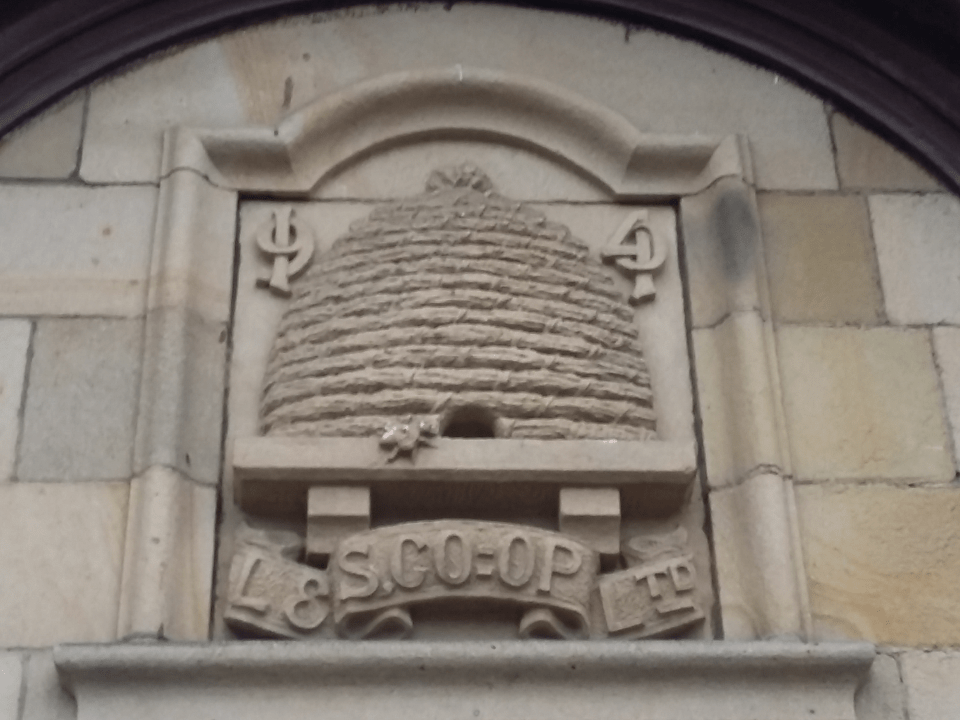
At the top of the street where Patrick’s house is located is a building that used to belong to a local Co-Operative Society store, a fine organisation with its roots in Lancashire.  Above the doorway is a beautiful stone carving of a skep, a traditional honey bee hive made by coiling straw in a spiral to form a dome shape, and the traditional symbol of the Co-Operative Society.  The spiral is not obvious from this, so you’ll just have to trust me!

Ivy pollinators citizen science project

Ivy bee 20161011_143817.png

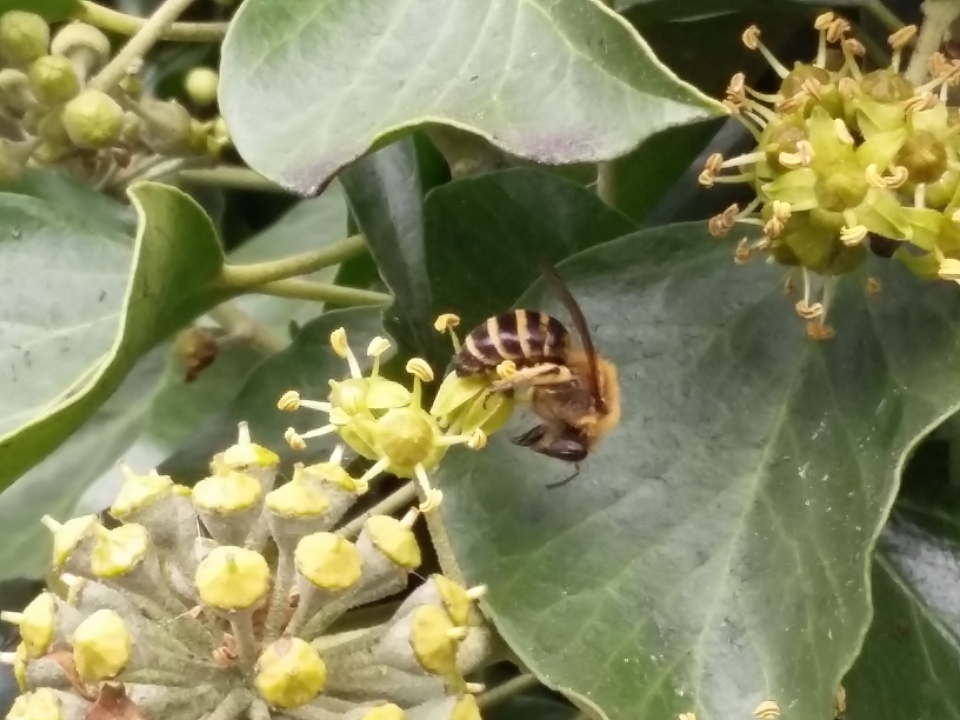
Today, finally, after several years of hunting for them in Northamptonshire, I got to see some Ivy Bees (Colletes hederae) and managed to get a couple of decent photos.  The Ivy Bee is a recent natural colonist to the British Isles, having arrived here in 2001.  The Bees, Wasps and Ants Recording Society (BWARS) is running an Ivy Bee Mapping Project and you can find out more details by following that link.

The bees we saw today were a few minutes walk from the University and were (it’s galling to admit) discovered by Fergus Chadwick, a keen young ecologist who is working with me for a couple of months to gain some postgraduate research experience.

The main thing that Fergus is going to work on is a Pollinators of Ivy Monitoring Project.  Follow that link and it will give you details of how you can provide us with data to better understand the pollination ecology of one of our most ecologically valuable and under-rated plants.  Ivy (Hedera helix) is a hugely important nectar source to a wide range of over wintering bees, flies, beetles, hoverflies, wasps, and other insects.  Not only that but its berries are a vital food source for many fruit eating birds.  Any and all help in this project is very much appreciated!

Release today of the IPBES Summary for Policymakers of the Assessment Report on Pollinators, Pollination and Food Production

Inula at Ravensthorpe 20160710_145426Following on from the press release earlier this year announcing of the Intergovernmental Science-Policy Platform on Biodiversity and Ecosystem Services (IPBES) assessment of pollinators, pollination and food production (which I reported on in February) it looks as though the full report may shortly be published.  A Summary for Policymakers has just been released by IPBES and can be downloaded by following this link.  I’ll put up a link to the full report once it becomes becomes available.

Just published: A horizon scan of future threats and opportunities for pollinators and pollination

A team of pollinator researchers from across the globe has just published an interesting new paper which looks at potential threats to pollinators and the pollination services that they provide, as well as opportunities for future conservation and agricultural gains.  The paper is open-access and free to download – here’s the reference and a link to the paper:

Brown, MJF et al. (2016) A horizon scan of future threats and opportunities for pollinators and pollination.  PeerJ

The paper has also gained some media coverage, e.g. on the BBC News website.

The influence of floral traits on specialization and modularity of plant–pollinator networks in a biodiversity hotspot in the Peruvian Andes – Watts et al. (2016)

Watts et al Figure 1

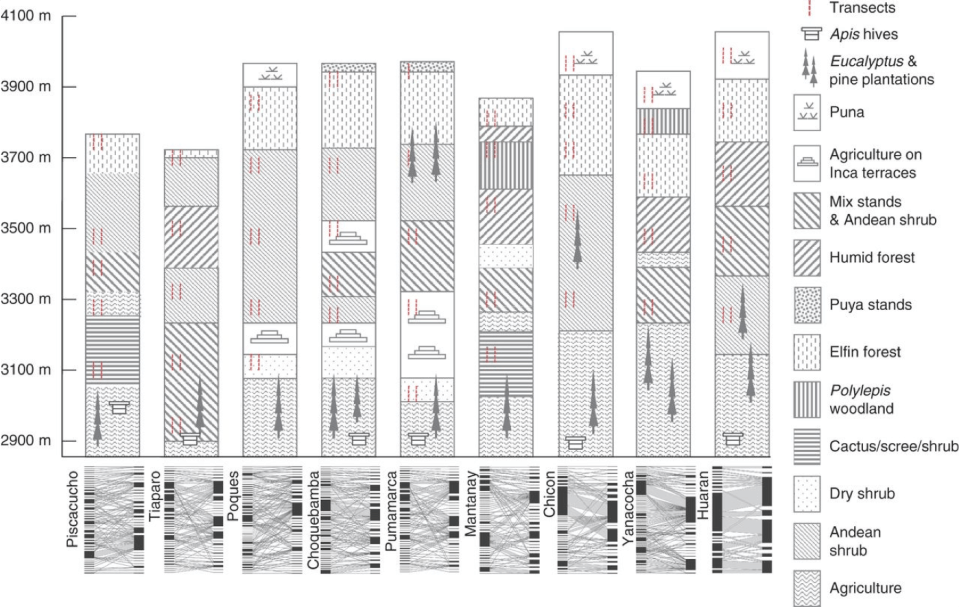
The second paper from the PhD thesis of my former student Dr Stella Watts has just been published in Annals of Botanyhere’s a link to the journal’s website.  It summarises the major findings from her field work on plant-pollinator interactions in the high Andes of Peru:

Watts, S., Dormann, C.F., Martín González, A.M. & Ollerton, J. (2016) The influence of floral traits on specialization and modularity of plant–pollinator networks in a biodiversity hotspot in the Peruvian Andes.  Annals of Botany doi: 10.1093/aob/mcw114

This paper represents a major piece of research, including extensive field data collection over multiple sites in a challenging environment at altitude; state-of-the-art data analysis; and then summarising all of this into a single, digestible paper, with some great figures.  I’m very proud to have been part of it!

Here’s the abstract; please email me or Stella if you’d like a copy of the full PDF:

Background and Aims:  Modularity is a ubiquitous and important structural property of ecological networks which describes the relative strengths of sets of interacting species and gives insights into the dynamics of ecological communities. However, this has rarely been studied in species-rich, tropical plant–pollinator networks. Working in a biodiversity hotspot in the Peruvian Andes we assessed the structure of quantitative plant–pollinator networks in nine valleys, quantifying modularity among networks, defining the topological roles of species and the influence of floral traits on specialization.

Methods: A total of 90 transects were surveyed for plants and pollinators at different altitudes and across different life zones. Quantitative modularity (QuanBiMo) was used to detect modularity and six indices were used to quantify specialization.

Key Results:  All networks were highly structured, moderately specialized and significantly modular regardless of size. The strongest hubs were Baccharis plants, Apis mellifera, Bombus funebris and Diptera spp., which were the most ubiquitous and abundant species with the longest phenologies. Species strength showed a strong association with the modular structure of plant–pollinator networks. Hubs and connectors were the most centralized participants in the networks and were ranked highest (high generalization) when quantifying specialization with most indices. However, complementary specialization d’ quantified hubs and connectors as moderately specialized. Specialization and topological roles of species were remarkably constant across some sites, but highly variable in others. Networks were dominated by ecologically and functionally generalist plant species with open access flowers which are closely related taxonomically with similar morphology and rewards. Plants associated with hummingbirds had the highest level of complementary specialization and exclusivity in modules (functional specialists) and the longest corollas.

Conclusions: We have demonstrated that the topology of networks in this tropical montane environment was non-random and highly organized. Our findings underline that specialization indices convey different concepts of specialization and hence quantify different aspects, and that measuring specialization requires careful consideration of what defines a specialist.