Over at the Ideas for Sustainability blog Joern Fischer posted a really interesting piece on 1st January called “A new kind of hope” about the current state of the world and whether, from an environmental perspective, there’s really anything to be optimistic about. If environmental collapse via climate change and over-exploitation is inevitable, the collapse of civilization is not far behind. Joern’s piece is well worth reading, lots to think about in there, and I highly recommend that you take a look.
I posted a comment there which I’m going to copy here and add to because I think it bears repeating.
Going back to at least my student days I always thought that there was only a slim chance of our civilization making it to the end of the 20th century without some kind of catastrophe wiping us out. So it was a surprise to celebrate the millennium as December 1999 segued into January 2000. Since then, whilst I think there’s lots to be optimistic about such as the increase in renewable energy, large-scale habitat restoration in some regions, and a growing recognition of the environmental damage of biocides and plastics, there’s also the nagging fear that it’s too little, too late.
These days I alternate between wild optimism and deep depression over the fate of humanity and of the planet. It’s so easy to get sucked into the vortex of negative environmental narratives and ignore the positive ones. Especially so if you actively use social media. So I try hard to be optimistic and resist the urge to just give up, but the political situation across much of the world makes that difficult. As I learn more about the natural world through my own research and that of others’, and as world events such as Brexit and the rise of the Far Right unfold, I realise how little any of us really know about anything at all. Thus I have a deep suspicion of anyone who spouts certainties, whether they be moral, philosophical, religious, scientific, political, or artistic. All we can do is feel our way into the future, cautiously.
With respect to the question that Joern poses of “If we have to re-build something after some kind of collapse … do we have ideas for what that something will be?”, this is the rationale behind the Dark Mountain Project, a loose collaboration of writers, artists, thinkers, etc., who are trying to look for new narratives for humanity and the planet we depend upon. I’ve written a couple of pieces for their journal, most recently for issue 10 where I discussed the role of poetry in science. And although I don’t buy into their certainty that there will be a collapse, I think it’s an important project for understanding where we are now, where we’ve been, and where we might be going to. Here’s a link to the project’s website.
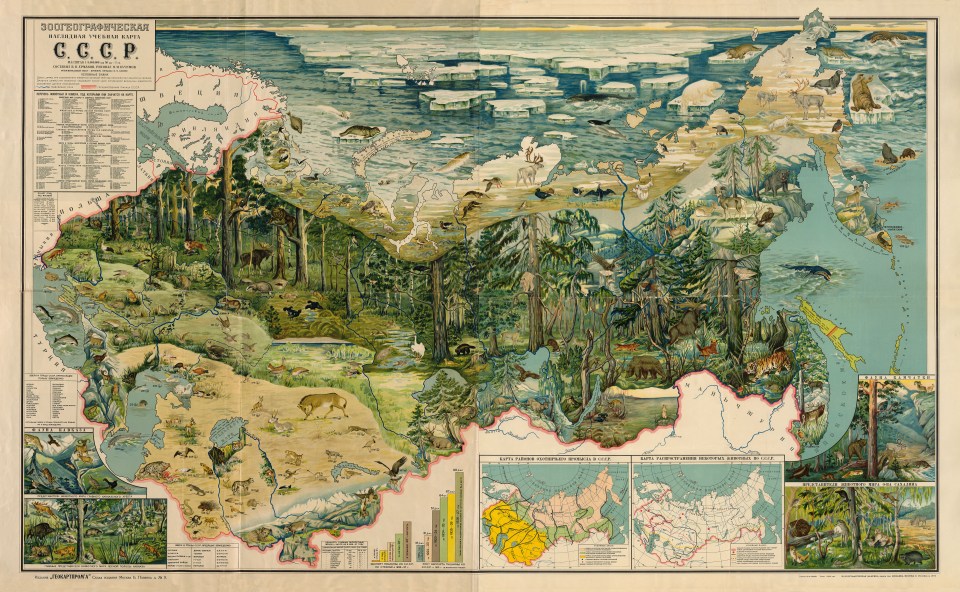
The discussion over whether we should be optimistic about the future of the planet that supports us, and how that optimism will play out, is important for scientists, and society at large, to be having. By coincidence as I was writing this post the map above started circulating on Twitter. It’s a Russian teaching aid from 1928 showing the different biomes of the USSR and can be downloaded from this site.
What really struck me about this graphic was the certainty with which it represents the natural world, as if all of this could never change. There are polar bears on ice flows and a frozen tundra in the far north; water still fills the Aral Sea, hyenas feast in the steppe, snow leopards haunt the mountains, Siberian tigers prowl the pine forests. And an optimistic looking whale heads towards Japan. Some of this is gone, some will almost certainly change, but a lot of it we could save, if we want to, saving ourselves in the process.








 Prof. Jeff Ollerton - ecological scientist and author