Category Archives: Bees

Bumblebees, ferries, and mass migrations: an update

Sejero - 20160910_113537.png

The post earlier this week on the question of “Why do bumblebees follow ferries?” generated quite a few comments, both on the blog and on Facebook.  As I’d hoped a number of people have chimed in to say that they have observed the same thing, or commented that they often see bumblebees when sailing or kayaking out at sea.

Here are the additional observations in increasing distance order to nearest larger area of land.  Distances are approximate and in some cases it’s unclear where exactly the observations were made:

Isle of Mull to the Isle of Staffa: 6.5km

Skye and the Outer Hebrides going in both directions: 24km

Ferry to Jersey: 28.4km

Estonia to Helsinki: 80km – described in a short paper by Mikkola (1984).

However this is nothing compared to evidence that queen bumblebees may engage in mass migrations (involving thousands of bees) across the North Sea from England to Holland, a distance of 165km!  See Will Hawkes’s short article “Flight of the Bumblebee“.

This idea of mass migration is new to me, though the Mikkola (1984) paper cites some earlier literature on the topic.  And this morning I had a quick phone chat with Dave Goulson who tells me that he occasionally gets people contacting him to tell him about such events.  But it’s unclear why these bees should be flying such large distances, how they coordinate their migrations, or indeed how much energy they need to store to travel that far. In addition there are implications for gene flow between British and Continental subspecies of bees such as the Buff-tailed Bumblebee (Bombus terrestris). Even a relatively well studied group of insects such as the bumblebees can continue to surprise us with new questions!

Thanks to everyone who contributed observations and ideas, it’s much appreciated.

Why do bumblebees follow ferries?

Sejero - 20160910_180359.png

A few years ago I mentioned in my post “Garlicky archipelago” that I had seen bumblebees (Bombus spp.) following the ferry from Southampton to the Isle of Wight, a distance of about 1.5km across water.  If I remember correctly it was my colleague Scott Armbruster who first mentioned this to me: he lives on the Isle of Wight and commutes regularly to the mainland.

I’ve not thought much about this since then as 1.5km is a fairly modest distance for a bumblebee to fly.  But then a few weeks ago I saw the same thing in Denmark, but this time over a much longer distance.

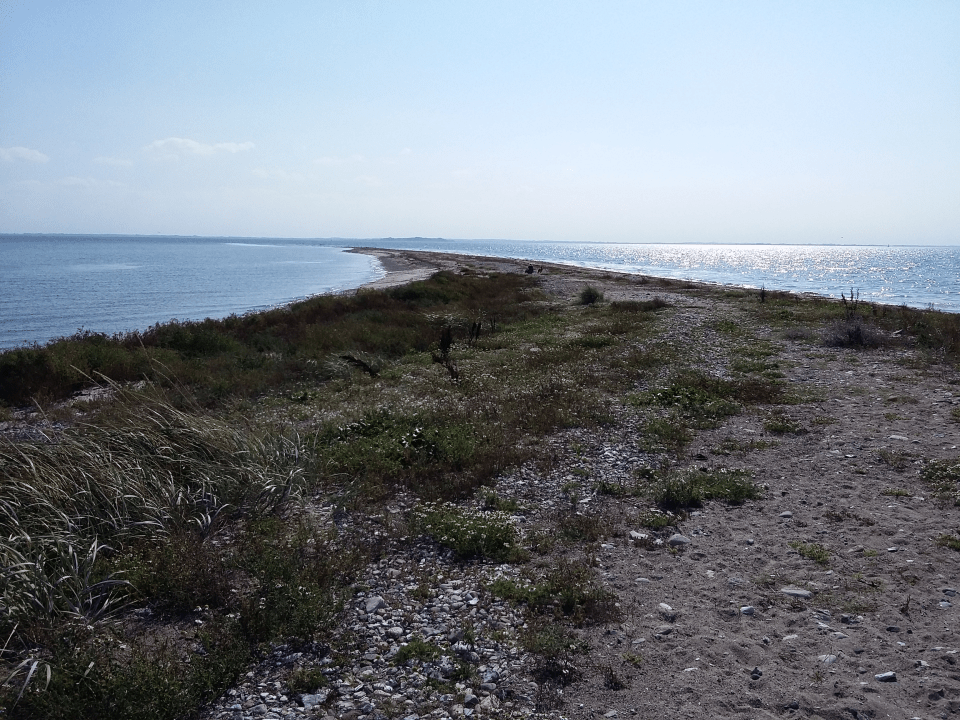
Karin and I were visiting friends on the small island of Sejerø, which (at its closest point) is about 8km from the mainland of Zealand.  To get there you have to catch a ferry which takes about an hour to cross this stretch of water.  About half-way across,  whilst looking over the stern of the ship, I spotted a bumblebee following the ferry.

So that’s twice, on two different ferries and under very different contexts, that I’ve seen this phenomenon.  A pattern is starting to form….  Has anyone else observed this?  Please do comment.

I can think of a few explanations/hypotheses for what’s going on here (some of which are not mutually exclusive):

  1.  Clearly bumblebees do fly across significant stretches of open seawater.  Perhaps all I’m seeing is bees that do this, but spotted from the only vantage point where it’s viewable (i.e. the ferry).
  2. These bumblebees are taking advantage of the slipstream created by the ferry to reduce the energy required to fly these long distances.
  3. The bees are hitching a lift on the ferry and I only observe them as they arrive or depart.
  4. The bees are following the wake of the ship to navigate between the island and the mainland, in order to exploit significant flower patches.  Work by one of my PhD students, Louise Cranmer, a few years ago showed that bumblebees follow linear features such as non-flowering hedgerows to navigate – see Cranmer et al. (2012) Oikos.  Perhaps something similar is happening here?

There’s probably other possibilities I’ve not thought of.  But whatever the explanation, it looks to me as if there’s some potential for interesting experiments marking and recapturing bees on islands/mainland, releasing bees on ferries to see if they follow the wake, etc.  If only Northampton wasn’t so far from the coast….


Urban areas as a refuge for insect pollinators: conservation for the city

Waterside - 20160527_081706.png

Urban conservation ecology is a fast growing field that has mainly focused on how towns and cities can support populations of plants, animals and fungi that may be declining or threatened in the surrounding rural environment.  That is, the city for wildlife conservation.  In a new essay in the journal Conservation Biology, written with colleagues from across the world, we argue that conservation for the city (an idea originally conceived, I believe, by Steward Pickett) should also be a focus of future research and management activities.

Conservation, or ecology, for the city in essence means that plants, animals and fungi, as well as being supported by the city (see our recent urban bees example), play a role in supporting the city itself through the provision of ecosystem services such as decomposition, flood alleviation, and crop pollination.

It’s pollinators and pollination that we particualrly focus on in this essay – here’s the abstract:

Urban ecology research is changing how we view the biological value and ecological importance of cities. Lagging behind this revised image of the city are natural resource management agencies’ urban conservation programs that historically have invested in education and outreach rather than programs designed to achieve high-priority species conservation results. This essay synthesizes research on urban bee species diversity and abundance to suggest how urban conservation can be repositioned to better align with a newly unfolding image of urban landscapes. We argue that pollinators put high-priority and high-impact urban conservation within reach. In a rapidly urbanizing world, transforming how environmental managers view the city can improve citizen engagement while exploring more sustainable practices of urbanization.

I’m happy to send the PDF to anyone who wants a copy; here’s the full citation:


Two-day Steven Falk bee ID course at Oxford University Museum 15th-16th October 2016

Male B lap on Salvia cropped P1120309

One of the most exciting, pollinator-related publishing events of last year was the publication of Steven Falk’s eagerly-anticipated Field Guide to the Bees of Britain and Ireland.  Not only does this book provide a state-of-the art account of the natural history and identification keys for all of the bees currently known from Britain (over 270 species) but it’s backed up by Steven’s own Flikr site with more photographs of the bees, including lots of close ups, and an ongoing list of updates and corrections.

But as Steven himself acknowledges, the identification of many of our bees is a challenge, even with the book and the additional imagery.  Anyone who is really keen to get to grips with bee identification is therefore recommended to book onto a hands-on identification course.  Steven has just announced that he is running a two-day course in Oxford on 15th to 16th October, at a cost of £60 per person – here’s a link to the booking page.  Seems like good value to me!

Release today of the IPBES Summary for Policymakers of the Assessment Report on Pollinators, Pollination and Food Production

Inula at Ravensthorpe 20160710_145426Following on from the press release earlier this year announcing of the Intergovernmental Science-Policy Platform on Biodiversity and Ecosystem Services (IPBES) assessment of pollinators, pollination and food production (which I reported on in February) it looks as though the full report may shortly be published.  A Summary for Policymakers has just been released by IPBES and can be downloaded by following this link.  I’ll put up a link to the full report once it becomes becomes available.
Bees and pesticides – a major new study just published – UPDATED

Male B lap on Salvia cropped P1120309

An important new study about the effects of neonicotinoid pesticides on wild bees has just been published in the journal Nature Communications – here’s the details and a link to the paper, which is open access:

Woodcock, B. A. et al. (2016) Impacts of neonicotinoid use on long-term population changes in wild bees in England. Nat. Commun. 7:12459 doi: 10.1038/ncomms12459

As I’ve previously discussed on this blog (e.g. here and here) there are widespread concerns amongst environmentalists, and some scientists, about the impact that these relatively new pesticides are having on pollinators and other biodiversity.  The Woodcock et al. paper is a major contribution to this discussion as it uses a huge dataset to model the changes in populations of 62 wild bee species that are known to forage on oilseed rape (canola) over 18 years.  These changes can be related to the spatial extent of oilseed rape cultivation and the authors found that whilst bees “….foraging on oilseed rape benefit from the…[nectar and pollen provided by]….this crop….[they]….were on average three times more negatively affected by exposure to neonicotinoids than…” bees which didn’t forage on the crop.

The authors further conclude that “This study provides the first evidence for community level national scale impacts on the persistence of wild bee populations resulting from exposure to neonicotinoid treated oilseed rape crops.”

Neonicotinoid pesticides are, of course, not the whole story when it comes to understanding declines in pollinator diversity and abundance.  But these pesticides are the latest in a long history of changes to British agriculture that have had significant consequences for the biodiversity of our country (as we showed in our study of bee and wasp extinctions).

Reactions to the study have been, well, predictable.  A long feature on the BBC News website* quoted a representative from Bayer as saying:

“we believe….[the study’s]….findings would be more correctly headlined that intensive agriculture is causing some issues with pollinators…..  Whether this is due to the use of insecticides is not clear; a lack of nesting sites and pollen and nectar sources in these areas may also be critical factors.”

Which rather ignores the fact that this was a comparative study of bees that forage on oilseed rape versus those that don’t.

Likewise the National Farmer’s Union’s position was that:

“While this study claims to provide an important contribution to the evidence base underpinning the current EU moratorium on some uses of neonicotinoids, experts reviewing all the evidence have concluded that there are still major gaps in our knowledge and a limited evidence base to guide policymakers”

Which sounds to me like a statement designed to fudge the issue: the “experts reviewing all the evidence” would not have reviewed this particular study!  And which begs the question – how much evidence and how many studies would be enough for the NFU?

The study’s authors do not make any suggestions as to what the next step should be in this continuing saga but are quoted as saying that “simplistic solutions” such as banning these pesticides are not the answer because this will encourage use of pesticides that are even more damaging.  That may be the case but it’s clear that an independent root-and-branch reassessment of the use of pesticides (and herbicides) in UK agriculture is long overdue.


*As an aside, this BBC News piece wrongly states that bumblebees were not included in the study, which is not the case.


UPDATE:  After I published this post I noticed that Manu Saunders has also written about the bee study, plus a second study that I’d not seen linking neonicotinoid use to declining butterfly populations in California.  Here’s a link to Manu’s blog.


Identifying the “Wild Bees” in John Clare’s poem – UPDATED

P1030210

John Clare is one of the most celebrated English poets of rural landscapes and nature in the 19th century. To quote his biographer, Clare was “the greatest labouring-class poet that England has ever produced. No one has ever written more powerfully of nature”.  Not only that, he was born and lived for much of his life in my adopted county, hence his epithet as “The Northamptonshire Peasant Poet”.

One of his less well-known poems is called Wild Bees and is a stunning example of Clare’s ability to make detailed observations of the natural world and to translate those observations into poetry.  So good are those observations that, as I show below, it’s possible to identify Clare’s bees from the descriptions he gives.  First of all, here’s the full poem:

Wild Bees

These children of the sun which summer brings
As pastoral minstrels in her merry train
Pipe rustic ballads upon busy wings
And glad the cotters’ quiet toils again.
The white-nosed bee that bores its little hole
In mortared walls and pipes its symphonies,
And never absent couzen, black as coal,
That Indian-like bepaints its little thighs,
With white and red bedight for holiday,
Right earlily a-morn do pipe and play
And with their legs stroke slumber from their eyes.
And aye so fond they of their singing seem
That in their holes abed at close of day
They still keep piping in their honey dreams,
And larger ones that thrum on ruder pipe
Round the sweet smelling closen and rich woods
Where tawny white and red flush clover buds
Shine bonnily and bean fields blossom ripe,
Shed dainty perfumes and give honey food
To these sweet poets of the summer fields;
Me much delighting as I stroll along
The narrow path that hay laid meadow yields,
Catching the windings of their wandering song.
The black and yellow bumble first on wing
To buzz among the sallow’s early flowers,
Hiding its nest in holes from fickle spring
Who stints his rambles with her frequent showers;
And one that may for wiser piper pass,
In livery dress half sables and half red,
Who laps a moss ball in the meadow grass
And hoards her stores when April showers have fled;
And russet commoner who knows the face
Of every blossom that the meadow brings,
Starting the traveller to a quicker pace
By threatening round his head in many rings:
These sweeten summer in their happy glee
By giving for her honey melody.


Here are the bees that I think Clare is talking about:

The white-nosed bee that bores its little hole, In mortared walls and pipes its symphonies

This is the least obvious of the bees to identify, but my best guess, due to the “little hole” and “white nose“, is one of the small Yellow-Faced Bees (Hylaeus spp.) some of which (despite the name) have white faces.  UPDATE:  following discussion with Matt Smith in the comments (below) I’m going to change my mind and suggest that Clare is referring to male Hairy-footed Flower Bee (Anthophora plumipes) – I think the “never absent couzen” part is the give-away.

And never absent couzen, black as coal, That Indian-like bepaints its little thighs

This has to be the female Hairy-footed Flower Bee (Anthophora plumipes) which is all black except for its orange pollen brush on its rear legs, and which also nests in old walls.

The black and yellow bumble first on wing, To buzz among the sallow’s early flowers, Hiding its nest in holes from fickle spring

I’m going to suggest that this is referring to the Buff-tailed Bumblebee (Bombus terrestris), the queens of which tend to emerge earlier than other, similar species, hence “first on wing“.  It also usually nests in rodent holes.

In livery dress half sables and half red, Who laps a moss ball in the meadow grass

This can only be the Red-shanked Carder Bee (Bombus ruderarius) the only red and black bee in the UK that makes a mossy nest above ground.

And russet commoner who knows the face, Of every blossom that the meadow brings

Finally, this must be one of my favourite bumblebees, the all-brown, Common Carder Bee (Bombus pascuorum), which is as common as the name suggests, and is renowned for foraging on a wider range of flowers than most others, and therefore “knows the face of every blossom“.

If you have any suggestions for alternative bee identifications, please comment below.

UPDATE:  it occurred to me after I posted this that all of the bees that Clare describes are still common in Northamptonshire with the exception of the Red-shanked Carder Bee (Bombus ruderarius) which has seen a huge decline throughout its range – see the BWARS account for this species.


Just published: A horizon scan of future threats and opportunities for pollinators and pollination

A team of pollinator researchers from across the globe has just published an interesting new paper which looks at potential threats to pollinators and the pollination services that they provide, as well as opportunities for future conservation and agricultural gains.  The paper is open-access and free to download – here’s the reference and a link to the paper:

Brown, MJF et al. (2016) A horizon scan of future threats and opportunities for pollinators and pollination.  PeerJ

The paper has also gained some media coverage, e.g. on the BBC News website.

Renovating a front garden for pollinators: because there has to be more to a scientist’s life than just…..science!

Over at the Standingoutinmyfield blog, the author has posted some “Photos from a hardwood floor“, and contrasted the satisfaction to be derived from a project such as (in this case) laying a new floor in her home (and great it looks too!) with the dissatisfaction that life as a scientist can bring.  Don’t get me wrong, I think I have the best job in the world, but I agree with her that there has to be more than science in the life of a scientist.

It’s probably not widely realised amongst non-academics, but failure and rejection are MUCH more common than success and acceptance in our professional lives.

Rejection rates for most journals are greater than 50%, and frequently as high as 80% to 90%; success rates for large grants are typically lower than 20%.  In the past seven months I’ve had one grant application and five papers rejected.  It can be very disheartening,  which is why I have to have more in my life than just science.

Of course there’s the teaching and admin that is a vital part of my job, but, like Standingoutinmyfield, other projects are important.  So Karin and I have spent part of the summer refurbishing an old summer house at the back of the garden (on-going) and renovating and planting our front garden (almost done).  As the latter project involves plants that are good nectar and pollen sources for pollinators, I thought I’d post some photographs:

P1020964

The original front wall – built in the late 1980s/early 1990s I think, and not at all in character with the late Victorian house.

The garden itself was paved and concreted over:

P1020962

Demolition in progress!  While I supervise…..:

P1020968

P1020970

We salvaged what bricks we could, for other projects, and the rubble was taken to the local recycling centre to be used as hardcore.

It’s amazing where plants will grow:

P1020971

The site is almost cleared, ready for a local semi-retired bricklayer (with 56 years of experience!) to build us a new wall using similar bricks to those of the house:

P1020982

And here it is:

P1030286

The soil in the front garden was very poor, varying from solid clay to builder’s rubble, so needed a lot of peat-free compost and sharp sand to improve it.  But finally we were ready to plant it up:

20160731_17551720160803_14024220160731_17550720160803_140249

The garden is south facing so we had to choose plants that would do well in a hot, dry summer (not that we have many of those at the moment….).  It will take a year or two for them to get established and knit into a full display.  The plants are a mixture of pollen- and nectar-sources for pollinators plus things we just like – here’s the full list:

A small scrambling rose Rosa “Warm Welcome” – a beautiful, unusual colour, a very nice scent, and appropriate name for the front garden!

Lavender “Hidcote” – planted as a low hedge along the full length – even as we were putting in the plants, worker Buff-Tailed Bumblebees were visiting the flowers.

Plectranthus argentatus –  not hardy here but a lovely foliage plant, fast growing, and with flowers that bees like.  I’ll take cuttings in the autumn to keep it going.

Wisteria – this is quite a large plant that was a birthday present for Karin.  But I’ve lost the variety name so will have to try to track it down.

A fig – Ficus “Panache” – because we like figs.  The roots have been constrained in a sunken container to encourage the plant to produce more fruit and less growth.

A self-sown privet (probably Ligustrum vulgare) that was already in the front garden; we allow it to flower (rather than treating it as a hedge) as the bees love it and the black fruit can be eaten by birds.

Potentilla “Gibson’s Scarlet and “Jean Jabber” – deep red and vivid orange, respectively.

Achillea “Fanal” – also deep red and favoured by hoverflies.

Salvia nemorosa “Caradonna” – beautiful, intense purple.

Curry plant (Helichrysum italicum) because we love the smell and hoverflies love the flowers.

Japanese Anemone x hybrida “Honorine Jobert” – pure white and late flowering.

A perennial sunflower Helianthus “Lemon Queen” – likewise a late flowering hit with the pollinators.

Lamb’s Ear – Stachys byzantina – particularly favoured by the Wool-carder bee Anthidium manicatum.

There will be more to come in the near future.  Meanwhile, here’s a before-and-after shot:


The bee that lives on a volcano!

Nature can adapt to even the most unpromising and uncompromising of physical environments, from deep oceans to arid deserts.  And now we have a bee that lives in close proximity to an active volcano!  The work is by one of my former PhD students, Dr Hilary Erenler (who is still a Visiting Researcher at the University of Northampton), and is featured in a big news story in the journal Science.

Here’s a link to the story.

The full reference for the study, with a link to the journal, is:

Hilary E. Erenler, Michael C. Orr, Michael P. Gillman, Bethan R. B. Parkes, Hazel Rymer and Jean-Michel Maes (2016) Persistent nesting by Anthophora Latreille, 1803 (Hymenoptera: Apidae) bees in ash adjacent to an active volcano. Pan-Pacific Entomologist 92:67-78.

Well done Hils, it’s a great study!