
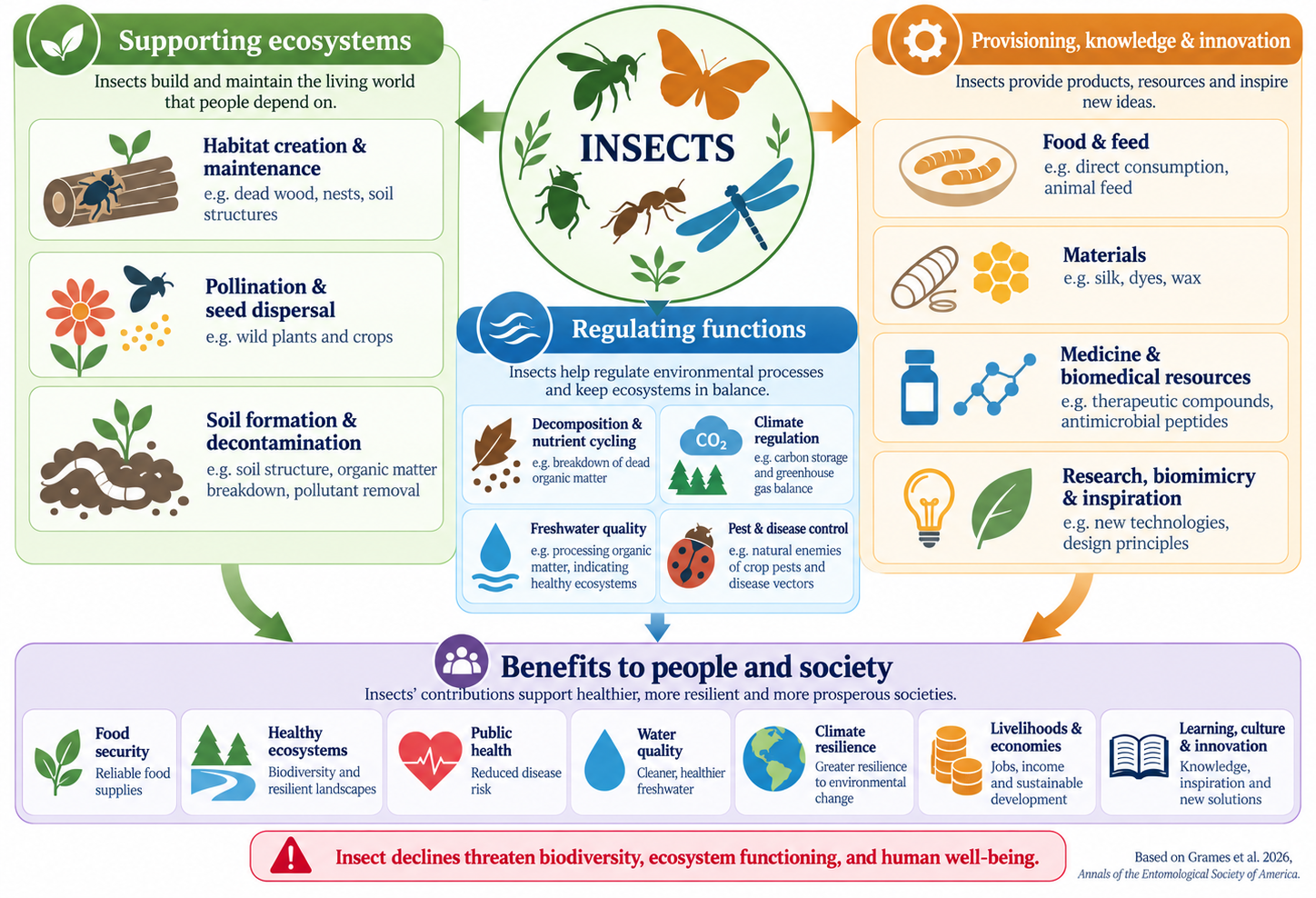
When we talk about the importance of insects to human societies, the conversation often turns quickly to pollination, particularly the role of bees and other insects in producing the food that we eat. As someone who has spent much of his career studying pollination, I’m probably partly responsible for that emphasis!
But insects do an enormous amount more than move pollen between flowers. A new review that I’ve co-authored with Eliza Grames and a large international group of colleagues, published in the Annals of the Entomological Society of America, explores the extraordinary range of ecosystem functions and services that insects provide.
And some of these are rather surprising. Of course, pollination is an important part of the story. An estimated 80–90% of flowering plants depend on animals for pollination, overwhelmingly insects. But consider some of the other contributions that our review brings together:
- Dung beetles remove animal faeces, recycle nutrients, improve soil structure and reduce the abundance of livestock parasites. One study estimated that their activities could be worth around £367 million annually to the British livestock industry.
- Carrion-feeding flies and beetles help dispose of dead animals and recycle their nutrients.
- Termites and ants are major ecosystem engineers, creating habitats used by numerous other species and influencing the structure of plant communities.
- Aquatic insects help maintain water quality, transfer nutrients between freshwater and terrestrial ecosystems, and provide food for fishes and other animals.
- Then there are the more direct contributions to human societies. Insects provide silk, dyes, medicines and materials for industry. The use of fly larvae to clean wounds is a particularly striking example of something that might initially seem rather unpleasant but is medically valuable!
What I particularly like about this review is that we don’t simply catalogue these contributions. We also assess the strength of the scientific evidence supporting them, using the framework developed by the Intergovernmental Science-Policy Platform on Biodiversity and Ecosystem Services (IPBES). Some services, including pollination, decomposition and biological pest control, are very well established. Others, such as the potential for insects to remove environmental contaminants, remain much less understood.
There’s a connection here to our recent review of the importance of insects to vertebrates, which I wrote about last month. Both papers emerged from the international Status of Insects Research Coordination Network, and both emphasise how deeply insects are embedded in the ecological processes that sustain life.
It also connects with something I’ve discussed in relation to plant–pollinator interactions: we need to look beyond the familiar species and interactions if we want to understand how ecosystems really work.
One important message from the new review is that the value of insects cannot be captured simply by attaching monetary figures to the services they provide. Some of their contributions are extraordinarily difficult to quantify, and many are essential to the functioning of ecosystems regardless of whether humans benefit from them directly.
E.O. Wilson famously described insects and other invertebrates as “the little things that run the world”. Almost forty years later, we’re still discovering just how accurate that observation was.
The paper is open access and can be read here:
Grames, E.M., Noriega, J.A., Sanchez Herrera, M. et al. (2026) Insects’ contributions to people: ecosystem services and functions provided by insects. Annals of the Entomological Society of America. https://doi.org/10.1093/aesa/saag038
My thanks to Eliza and all the other colleagues involved in bringing together such a wide-ranging review.

