
Back in 2022 I wrote about a project in which I’d been involved with colleagues at the Natural History Museum, Imperial College London and several regional museums. We were using preserved bumblebees to ask a deceptively simple question: what can insects collected decades ago tell us about the environmental changes that their populations have experienced?
The first papers from that project showed two important things. One found increasing signs of developmental stress in the wings of museum bumblebees over the course of the 20th century, associated particularly with hotter and wetter conditions. The other demonstrated that it was possible to recover and sequence surprisingly good-quality DNA from insects collected more than a century ago, in some cases using just a single leg.
At the time I wrote that this opened up the possibility of looking at how the genomes of bee populations had changed through time. Well, we’ve now done it.
Published this week in Molecular Biology and Evolution, our new study focuses on the Moss Carder Bumblebee (Bombus muscorum), a beautiful species of flower-rich grasslands, heaths, marshes and coastal habitats. Once much more widespread across Britain, it is now largely concentrated in Scotland and the Scottish islands, with scattered populations surviving around the coasts of England and Wales.
Led by Victoria Mullin, the team generated whole-genome data from museum specimens collected between 1894 and 2019. The results provide a rather sobering picture of what has happened inside these bee populations as their geographical distribution has contracted.
Comparing bees collected before 1926 with those collected after 1975, we found about a 25% reduction in genome-wide genetic diversity. Looking at the full time series gives the same basic message: heterozygosity declined progressively through the 20th century, with no obvious sign of recovery.
That matters because losing a species is not the only way that biodiversity can decline. Long before extinction, populations can become smaller and more isolated and begin to lose genetic variation. That variation is part of the raw material that allows populations to respond to environmental change, disease and other challenges.
There was also a striking geographical pattern. In England and Wales, the amount of the genome occurring in long stretches of homozygosity increased by about 186% – in other words, almost threefold. These “runs of homozygosity” are consistent with populations becoming smaller, more fragmented and increasingly isolated from one another. Scotland showed a much weaker change, reflecting the fact that B. muscorum remains considerably more widespread there.
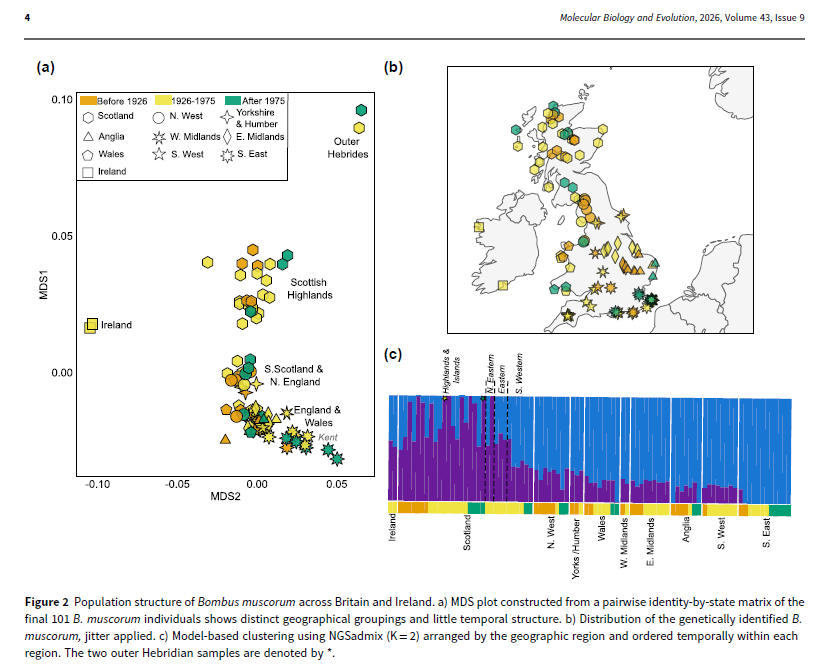
Importantly, however, the population structure is not simply “Scottish bees versus English bees”. The genomic data reveal a broad north-to-south gradient across Britain – what population geneticists call isolation by distance – rather than a set of sharply separated populations. That has implications for conservation because fragmentation may be breaking what was once a more continuously connected population into increasingly isolated regional groups.
There’s another interesting connection here with work that I published with colleagues more than a decade ago. In our 2014 Science paper we used historical records to show that Britain had lost 23 species of bees and flower-visiting wasps, with the fastest rate of extinction occurring from roughly the late 1920s to the late 1950s. We argued that large-scale changes in British agriculture, beginning just after the First World War, were an important part of that story.
The new study is looking at genetic change within a surviving species rather than the disappearance of whole species and it cannot pin that change on a single cause. But the parallels are difficult to ignore. The loss and fragmentation of flower-rich habitats associated with agricultural intensification is a likely contributor, alongside pesticides, climate change and other environmental pressures. The genomic erosion appears to have accumulated progressively across much of the same century in which Britain’s pollinator landscapes were being radically transformed.
One unexpected finding was also a useful warning about museum data. Of the 130 specimens originally labelled as Bombus muscorum, genetic analysis showed that 29 (almost a quarter) were actually two other, morphologically similar bumblebee species. Museum collections are extraordinarily valuable, but identifications cannot always simply be taken at face value, particularly for difficult groups. Genomics provides both a historical record and a way of checking the identity of the specimens supplying that record.
And that brings me back to what I think is one of the wider messages of this whole project: natural history collections are not dusty archives of dead organisms, they are biological time series.
A pinned bumblebee collected more than a century ago preserves information about where a species occurred, what environmental stresses it experienced, and, as we can now show, the genetic diversity of the population from which it came. Combined with modern genomic techniques, the millions of insects sitting in museum drawers around the world represent an extraordinary resource for understanding biological change.
The conservation message for the Moss Carder Bumblebee itself is fairly straightforward. Protecting the remaining populations is not enough if they become progressively smaller and more isolated. Restoring large areas of suitable, flower-rich habitat and reconnecting populations should help maintain population sizes and gene flow. More interventionist approaches such as translocation or assisted gene flow may eventually have a role, but would need careful assessment because of issues such as local genetic structure and disease transmission.
Four years ago, when I blogged about the first papers from this project, I finished with the idea that museum genomics might allow us to understand how insect populations had adapted, or failed to adapt, to a century of environmental change. We now have part of that answer. And it shows that beneath the visible contraction of a species’ range, another quieter form of biodiversity loss can be taking place: the erosion of diversity within its genome.
The paper is open access and you can download a copy here:

