Tag Archives: Science

More on historical honey bee numbers in Britain

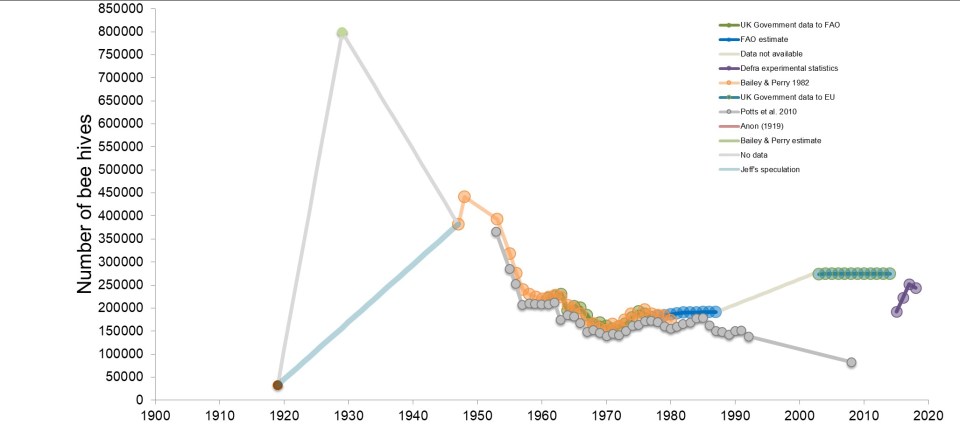
Bees hives with earlier data points - 18th Nov

Following on from my post last week on historical changes in honey bee numbers in Britain, I decided to add the two extra, earlier data points to the graph just to illustrate what they mean for our understanding in how honey bee numbers may (or may not) have changed over the last 100 years.

The first data point is the Bailey & Perry (1982) estimate of 800,000 hives in the 1920s (which I’ve placed at 1929) that, as I mentioned, I think is wrong in terms of how they did the calculation.

The second data point is of 32,500 hives in 1919.  It’s from the article that Andrew Hubbard drew my attention to, which seems to be a fairly solid government statistic, or at least no less solid that much of the other government stats (unless anyone knows any better).

If we accept the 800,000 figure at face value then we see a massive increase in number of hives of over 76,000 new hives per year between 1919 and 1929.  And remember that’s being conservative as to what “the 1920s” meant to Bailey & Perry; if we peg the date at 1925 then we’re talking more than 127,000 hives being added to the British stock every year.  In my opinion that’s not a feasible proposition.

A much more likely scenario is that the number of hives grew during the second quarter of the 20th century and reached a peak in numbers at some point between the 1940s and 1950s.  That’s an increase of around 13,000 hives per year.  It’s still a lot, but is not unreasonable in light of post-World War 1, and subsequently World War 2, agricultural reforms that I highlighted in my post about British bee and flower-visiting wasp extinctions.   I’ve termed that “Jeff’s speculation” in the figure above because, in the absence of hard data, that’s all it can be.

As always, I welcome your comments.


Two bee species new to science named in honour of pollination ecologists

New Eucera species

Last week the Israeli bee taxonomist Achik Dorchin published a new paper entitled “Taxonomic revision of the aequata-group of the subgenus Eucera s. str (Hymenoptera, Apidae, Eucerini)” .  The paper focuses on a little-known group of “longhorn” bees from the Eastern Mediterranean region, a part of the world with an extraordinarily high bee diversity.  In this taxonomic account, Achik has named two bees new to science in honour of two pollination biologists:

Eucera dafnii is named by Achik for Prof. Amots Dafni, whom he describes as his “teacher and friend…a pioneer pollination ecologist of the Mediterranean region, who has led the research project during which much of the type series was discovered”.  Amots is almost legendary in the field, he’s been conducting research on the flora, fauna, and pollination ecology of the region since the late 1960s, and remains a productive and influential scientist.
Eucera wattsi is named in honour of Dr Stella Watts, “a talented pollination ecologist, who collected much of the type series and contributed important floral observation and palynological data for this study”.  Stella completed her PhD at the University of Northampton in 2008, with a thesis on “Plant-flower visitor interactions in the Sacred Valley of Peru”, and then went on to do a post doc with Amots in Israel.
It’s fitting that these bees are named in their honour: congratulations Amots and Stella!

Are you ready for SCAPE 2019?

SCAPE logo

Later this week the 33rd annual meeting of the Scandinavian Association for Pollination Ecology (SCAPE) takes place at a venue near Lund in Sweden.  Here’s a link to the conference website on which you can find the programme and the abstracts.

SCAPE is the longest running such conference in the world and this year’s meeting promises to be a bumper one, with at least 130 delegates and two great keynote speakers: Prof. Rachael Winfree and Prof. Sharon Strauss.

For the first time I’m giving a short “flash talk” of just four minutes which will be interesting…..will I be able to stick to time?

I will try to post some thoughts from the meeting on the blog but to be honest I’m more likely to tweet using the hash tag #SCAPE2019 and the account @SCAPE_Poll_Ecol.  Watch out for those if you’re on Twitter.

The role of press freedom in protecting the environment

Ollerton et al Press freedom Figure 1

Recently I’ve been working with a couple of journalist colleagues at the University of Northampton on a short article exploring the relationship between press freedom and environmental protection in different countries.  That piece has just been published on the Democratic Audit website – here’s the link.

I think that the findings are really interesting, and timely in an age when press freedoms are being eroded and journalists physically attacked and even murdered.

What exactly is a “pollination system”?

Pollination systems

This is a post I’ve been meaning to write for some time, but have never got round to.  What’s catalysed me is an email this morning from Casper van der Kooi asking me about how I define the term “pollination system”, as he’d had some discussions about its use with his colleagues in The Netherlands.

“Pollination system” is one of those terms that seems to mean different things to different people. The way I use it, and I think the way we meant it in the 1996 paper Generalization in pollination systems and why it matters, is that the pollination system = floral phenotype + pollinators.  That is to say, the colour, shape, size, odour, rewards, etc. produced by a flower (or an inflorescence functioning as a single reproductive unit) plus the animals that effectively transfer pollen.

To me this is distinct from a “pollination syndrome” which refers only to the floral phenotype, or “pollinator guild/functional group” which refers only to the flower visitors.  However I have seen “pollination syndrome” used to include floral phenotype + pollinators.  But to my mind they are distinct things.

I have also seen other authors use “pollination system” to mean the community of plants and pollinators in an area, or as analogous to the breeding system, but neither of those are the way that I use it.  I decided to look at the history of the term on Web of Science and the earliest use on there is a paper by Levin & Berube (1972): Phlox and Colias – efficiency of a pollination system.  There were a few other papers from the same decade and all were using pollination system in the way I described above, i.e. floral phenotype + pollinators.

To look for earlier usage of pollination system I searched the Google Ngram Viewer; as you can see in the image above, I found examples of the term back as far as the 1940s in which the pollination system of grasses is referred to as being “cross pollination” (i.e. what we would now refer to as the breeding system).  There’s also texts from the 1950s referring to artificial wind pollination of date palms as a “helicopter pollination system”.

Does it matter how “pollination system” is used, or that it varies in meaning according to the author?  Probably not as long as the meaning is defined in the text.  Ecology is replete with terminology that has slightly different usage according to the researcher (“biodiversity” being an obvious example) and I don’t get a sense that this has held back the field.  Or is that too optimistic a conclusion?  Do you use the term in a different way to me?  As always, your comments are welcomed.

“Weighted” nestedness and “classical” nestedness analyses do not measure the same thing in species interaction networks

This post resulted from a question I posed on Twitter last week and hopefully summarises the issue as I see it and the results of the discussion with colleagues that followed.  Let me know if you disagree or if I have missed anything.


The use of network approaches to understanding how plants and their flower visitors interact has revolutionised the study of these and other mutualistic assemblages of species.  It’s a subject I’ve discussed on the blog before, highlighting some of the work we have published – for instance, see Plant-pollinator networks in the tropics: a new review just published and Local and regional specialization in plant–pollinator networks: a new study just published as two recent examples.

One of the recurring patterns that we see in mutualistic species networks (but not in antagonistic ones such as host-parasite and predator prey) is “nestedness”.  In a nested assemblage of species, generalists with lots of links to other species interact with other generalists and with specialists (those species which have few links to other species)Conversely, specialists tend only to link to generalists: specialist-specialist interactions are rare.  In nature, when we rank species in a network from most to least generalised, this sort of relationship looks like this:

South Africa nested

The rows are plants and the columns are pollinators, in this case from an assemblage of asclepiads and their pollinators we studied in South Africa.  A filled cell in the matrix indicates an interaction between that particular plant-pollinator combination.  It’s not perfectly nested by any means, but statistically this is not a random pattern and it comes out as nested when analysed.  There are a few ways of doing this but the most commonly used is the Nestedness metric based on Overlap and Decreasing Fill (NODF) developed by Almeida-Neto et al. (2008).

I first saw nestedness discussed in relation to plant-pollinator interactions in a presentation by Yoko Dupont of her PhD research at a SCAPE meeting in Sweden in 2001.  It was one of those “A-HA!” moments in science when the light bulb switches on and you realise that you are seeing an important new development which adds significant understanding to a field.  Yoko subsequently published her work as Structure of a plant–flower‐visitor network in the high‐altitude sub‐alpine desert of Tenerife, Canary Islands.

The nested pattern of interactions is conceptually derived from earlier work on island biogeography and species-area relationships and was initially developed to apply to interaction networks by Jordi Bascompte and colleagues in Spain and Denmark – see: The nested assembly of plant-animal mutualistic networks.

What was so exciting about this idea to me was that it provided a way to formally analyse what many of us had been observing and discussing for some time: that mutually specialised plant-pollinator interactions between species are rather rare, and that specialists tend to exploit generalists.  This makes perfect sense because specialist-specialist interactions may be more likely to go extinct, though why it does not also apply to host-parasite interactions is far from clear (and in fact the best known specialist-specialist interactions tend to derive from seed parasitism interactions such as fig-fig wasp and yucca-yucca moth relationships).

Fast forward 20 years and the plant-pollinator networks literature has exploded and our methods of analysis are much more sophisticated than they were in the late 1990s and early 2000s.  Every few months researchers are coming up with new ways in which to analyse these networks, mainly using the R environment for statistics and graphing.  Anyone entering the field would be forgiven for being bewildered as to which approaches to use: it’s bewildering enough for those of us who have been following it from the start!

One thing has been particularly bewildering me for a few years now, and that’s the introduction of “weighted” nestedness.  “Weighted” in this sense means that the abundance or interaction frequencies of the species in the network is taken into account in the analyses.  Visually it could look something like this if we code the cells in the network above to represent abundance or frequency (the darker the cell, the more abundant or frequent):

South Africa nested weighted

I’ve just mocked up the network above, it’s not the actual data.  But quite often networks look like this when we weight them: generalist interactions and/or species tend to be more frequent than specialist.  So far, so obvious.  But here’s the thing: networks that are statistically significantly nested when analysed by NODF tend to be not significantly nested when analysed by a new set of weighted metrics such as wNODF or WINE – see the documentation for the bipartite package for details.   And I don’t understand why.  Or rather I don’t understand why we should be using weights in an analysis of nestedness which is, at its heart, an analysis of presence-absence.  Species are either there or they are not, they are either interacting or they are not.  Their frequency or abundance is immaterial to whether a network is nested.  Indeed, assessing frequency of interactions in plant-pollinator networks is fraught with difficulties because (a) there are so many ways in which to do it; and (b) interactions between plants and pollinators in a community can vary HUGELY between years and across the geographical ranges of the species involved.

This should concern the interaction network community because recently I’ve had reviewers and co-authors saying things like: “don’t analyse for nestedness using NODF because wNODF/WINE is The Latest Thing, use that instead”.  But as far as I and the colleagues who commented on Twitter can tell, nestedness and weighted nestedness are different concepts and are not inter-changeable.  Indeed, many of us are struggling to really define exactly what weighted nestedness analyses are actually measuring.  I can define nestedness in simple terms as a verbal concept, without using the word “nested”, as you saw above.  I can’t do that with weighted nestedness, and I have yet to encounter anyone who can.

So the consensus from the Twitter discussion seems to be that:

  • for any study we should use only those analyses that are relevant to the questions we are asking rather than simply running every available analysis because there are lots to choose from.
  • weighted interaction networks that include abundance or frequency are not necessarily superior to binary presence-absence networks.  Again, it depends on the question being asked.
  • we should not treat weighted nestedness as an upgraded or superior version of classical nestedness.  If you are interested in nestedness, use a binary analysis like NODF.

My thanks to the colleagues who contributed to the Twitter discussion:  Nacho Bartomeus, Pedro Jordano, Pedro Luna, Marco Mello, Chris Moore, Timothée Poisot, and Kit Prendergast.  If you want to follow the Twitter discussion, start here:  https://twitter.com/JeffOllerton/status/1159377089319047168


Websites about bees and other pollinators that are not in English – can you add to my list?

2019-05-20 15.22.16

The book I’m currently completing is going to have a list of useful websites with information about bees and other pollinators, and pollination itself, that are not written in English.  Following a shout-out on Twitter I’ve come up with the following list – can anyone add to it?  There’s a lot of countries/languages missing.  Please respond in the comments section or send me an email:


Belgian:

https://www.wildbnb.brussels/


Brazilian:

https://www.semabelhasemalimento.com.br/home/polinizacao/

https://abelha.org.br/


Chilean:

https://www.abejasdechile.com/


Dutch:

http://sapoll.eu/nl/  

http://www.bestuivers.nl/ 

https://www.nederlandzoemt.nl/


French:

https://www.pollinis.org/ 

http://www.florabeilles.org/


French Canadian:

http://m.espacepourlavie.ca/des-pollinisateurs


German:

http://wildbienen.info

http://wildbienen.de 

http://wildbiene.com


Norwegian:

https://snl.no/honningbie

https://www.lahumlasuse.no/humlens-liv/


Portuguese:  

http://www.cienciaviva.pt/aprenderforadasaladeaula/index.asp?accao=showobj&id_obj=1532


Spanish:

http://www.abejassilvestres.es/index2.html

http://apolo.entomologica.es/

http://www.rjb.csic.es/jardinbotanico/jardin/index.php?Pag=697&len=


With thanks to everyone on Twitter who responded.

Last year’s mother, this year’s child: cinnabar moths in the garden

2019-07-06 11.48.35

Most summers we have a small colony of cinnabar moths (Tyria jacobaeae) reproducing in the garden.  The garish yellow-and-black caterpillars feed on species of ragwort and we leave a patch of common ragwort (Jacobaea vulgaris) to grow in the lawn.  The caterpillars eat for a few weeks, virtually destroy the ragwort, and in the process accumulate alkaloids from the host plant into their bodies.  This renders them toxic in much the same way as monarch butterflies accumulate toxins from their Asclepias food plants – see my recent post about the Monarchs and Milkweeds workshop.  Hence the stripes to warn birds of their unpalatability.

Ragwort is a much-maligned plant, hated by those with horses and livestock, and subject to a largely hysterical campaign of eradication – see here for example.   However John Clare clearly appreciated its virtues in a poem dedicated to the plant:

Ragwort, thou humble flower with tattered leaves
I love to see thee come & litter gold,
What time the summer binds her russet sheaves;
Decking rude spots in beauties manifold,
That without thee were dreary to behold.

The full text of the poem can be found here.

Once they have fed their fill, the caterpillars dig themselves into the soil to spend twelve months or so underground as pupae, before emerging as gorgeous adult moths, advertising their toxicity with a different colour scheme.

The adults live for a few weeks at most, during which time they feed on nectar, mate, lay eggs and die.  This (unposed) photograph that I snapped on my phone in the garden yesterday just about sums it up: an exhausted mother has laid her last batch of eggs then died, while a nearby young caterpillar munches away on the ragwort.  And so the generations pass.

Cinnabar caterpillars on ragwort

Chequered skippers are back: extinct English butterfly breeds for the first time in over 40 years!

P1040409

Last year I wrote about our involvement with the chequered skipper reintroduction project that’s happening in north Northamptonshire, and specifically the work of University of Northampton postgraduate researcher Jamie Wildman.  For the past month we’ve been sitting on some news that we were not allowed reveal: the reintroduction has been a success!  That is to say, adult butterflies emerged in May this year, having overwintered as pupae, and have been seen breeding in Rockingham Forest.  The secrecy was to prevent hordes of butterfly twitchers (buttwitchers?) descending on the site and possibly doing unintentional harm as they searched for the adults.  The population just isn’t large enough to be able to withstand that sort of pressure.

The BBC has run with the story this morning – here’s the link – and we have issued a piece via the university’s press team: the link to that is here.

In a time when the media is dominated by profoundly depressing stories about wildlife and the environment it’s great to be able to end the week with some positive news.  Here’s to the long-term success of this lovely little critter!


Recent reviews in pollination biology: an annotated list: UPDATED x 3

2019-02-09 13.47.49

As it’s my birthday today, I thought I’d reward myself by completing a blog post that I started just after Christmas and never got round to finishing.  Review articles that summarise recent developments in a field are an important contribution to the scientific literature that allow us to pause and reflect on where a topic has been and where it is headed.  Having recently (co)authored a couple of reviews I can attest that they are useful in this respect for both the writers and for the readers.

In the past couple of years quite a number of critical and timely reviews have been published which are proving very useful to me: I’m currently writing a book and these reviews have been invaluable in summarising aspects of a field that is currently publishing in excess of 1000 research papers per year. So I thought I’d bring them together into a single listing with a short commentary on each.  No doubt I have missed many other reviews so please feel free to point out any gaps and I will update the list as I go along.

Each review is hot linked to the source; a good proportion of the reviews are open access, notably those from the recent special issue of Annals of Botany devoted to the ecology and evolution of plant reproduction.  Some reviews are very focused, but most are quite broad.  Several of these complement one another.  I hope you find them interesting and useful.

Barrett, S. & Harder, L. (2017) The ecology of mating and its evolutionary consequences in seed plants. Annual Review of Ecology, Evolution and Systematics 48: 135-157

Mating systems, i.e. who breeds with whom, are just as complex in plants as they are in animals.  However some features of seed plants, such as the fact that they don’t move, that most species have both male and female functions, and that their growth is modular and often indeterminate, represent significant challenges that have been overcome in a bewildering variety of ways.


Braun, J. & Lortie, C.J. (2018)  Finding the bees knees: A conceptual framework and systematic review of the mechanisms of pollinator-mediated facilitation.  Perspectives in Plant Ecology, Evolution and Systematics 36: 33-40

In a community, if one plant species positively affects another, we term this “facilitation”.  It can occur at a variety of life stages, including reproduction whereby the presence of one species increase the likelihood of another species being pollinated.  This review shows that it occurs fairly frequently at a variety of spatial scales, but there are still significant gaps in our understanding of the phenomenon.


Fuster, F., Kaiser‐Bunbury, C., Olesen, J.M. & Traveset, A. (2018) Global patterns of the double mutualism phenomenon. Ecography https://doi.org/10.1111/ecog.04008

When species provide benefits to one another in two different ways, for example an animal is both a pollinator and a seed disperser of a plant species, we refer to it as a “double mutualism”.  As this fascinating review shows, double mutualisms are very uncommon, but they are widespread, and probably under-recorded.


Minnaar, C., Anderson, B., de Jager, M.L. & Karron, J.D. (2019) Plant–pollinator interactions along the pathway to paternity. Annals of Botany 123: 225-245 

The male aspect of plant reproduction, i.e. pollen donation, is often neglected when we consider how pollination systems evolve.  This review provides as up to date account of where we are in understanding how paternity influences floral characters such as shape and colour.


Ollerton, J. (2017) Pollinator diversity: distribution, ecological function, and conservation. Annual Review of Ecology, Evolution and Systematics 48: 353-376

A very broad over view of our current understanding of the biodiversity of pollinators, taking a deep time and a wide spatial perspective to put current concerns about loss of pollinators into a wider perspective.


Parachnowitsch, A.L., Manson, J.S. & Sletvold, N. (2019) Evolutionary ecology of nectar. Annals of Botany 123: 247–261 

We often take nectar for granted – it’s just sugar and water, isn’t it?  As this review shows, nectar is dynamic and complex, and affects a range of ecological functions beyond just providing pollinators with a reward.  However there’s still a huge amount we don’t understand about how nectar traits evolve.


Toledo-Hernández, M., Wangera, T.C. & Tscharntke, T. (2017) Neglected pollinators: Can enhanced pollination services improve cocoa yields? A review.  Agriculture, Ecosystems and Environment 247: 137-148

Chocolate is most people’s favourite confectionery and is famously pollinated only by small midges.  Or is it? As this review shows, lots of other insects visit cocoa flowers, but their role as pollinators has not been well studied.


Vizentin-Bugoni J, PKM Maruyama, CS Souza, J Ollerton, AR Rech, M Sazima. (2018) Plant-pollinator networks in the tropics: a review. pp 73-91 In Dáttilo W & V. Rico-Gray. Ecological networks in the Tropics. Springer.

This book chapter that I co-authored with some very energetic and creative young Brazilian researchers summarises what’s currently known about plant-pollinator interaction networks in tropical communities.  One of the conclusions is that they are really not so different to those in temperate and subtropical biomes.


Wright, G.A., Nicolson, S.W. & Shafir, S. (2018) Nutritional Physiology and Ecology of Honey Bees. Annual Review Entomology 63:327-344

A review of how bees use nectar and pollen at the level of both the individual and the colony, focused on the most widespread of pollinator species.

UPDATE 1:

As expected, several people have told me about reviews I’d missed, and in some cases ones that I had read but forgotten about!  I’ll list them below, though without annotations:

Bennett, J. et al. (2018) A review of European studies on pollination networks and pollen limitation, and a case study designed to fill in a gap, AoB Plants 10:  https://doi.org/10.1093/aobpla/ply068

Knight, T. et al. (2018) Reflections on, and visions for, the changing field of pollination ecology. Ecology Letters 21: 1282-1295

Vallejo-Marin, M. (2018) Buzz pollination: studying bee vibrations on flowers. New Phytologist https://doi.org/10.1111/nph.15666


UPDATE: 2

I had deliberately restricted the reviews to 2017 onwards, but via email David Inouye kindly sent a few older ones through which are equally useful:

Brosi, B. J. (2016) Pollinator specialization: from the individual to the community. New Phytologist: 210: 1190–1194

Hahn, M. and C. A. Brühl (2016) The secret pollinators: an overview of moth pollination with a focus on Europe and North America. Arthropod-Plant Interactions: 1-8

Inouye, D. W., et al. (2015) Flies and flowers III: Ecology of foraging and pollination. Journal of Pollination Ecology 16


UPDATE 3:

A more recent addition to this set of reviews was sent to me by Anne-Laure Jacquemart.  Although it’s focused just on one (rather variable) crop, I think it will be really useful for anyone interested in the pollination biology of crop plants:

Ouvrard, P. & Jacquemart, A.-L. (2019) Review of methods to investigate pollinator dependency in oilseed rape (Brassica napus).  Field Crops Research 231: 18-29