Tag Archives: Pollination

Was this the first online database of plant-pollinator interactions?

Over the past few years, the ways in which we collate and use large databases of plant-pollinator interactions, and make them publicly available according to FAIR data principles, has been much on my mind. These were and are important considerations for several projects, including the Pollinators of Apocynaceae Database; the pandemic garden pollinators initiative that I coordinated during lock-down; the WorldFAIR project; and, most recently, an EU-funded project called BUTTERFLY that launches in April and involves both the DoPI and GloBI databases.

The latter are just two of a growing number of databases making information about plant-pollinator interactions in wild and agricultural settings freely available to other scientists and to wider stakeholders. An intriguing question to those of us interested in the history of pollination ecology as a science is: what was the first such online database? I think that I have the answer, but I’m happy to be corrected. But first some background.

Since returning to Britain from Denmark in March, Karin and I have been renting a house from some friends as a temporary measure before we found somewhere else to live. A really nice property became available late last year and we decided to move in on 18th December. Then last week the final consignment of boxes and furniture that we’d had in storage arrived at our new home and we’ve been spending time deciding what we want to keep and what needs disposing of.

I’d be the first to admit that I’ve always been something of a hoarder when it comes to books and paperwork, so one of my priorities has been thinning out the contents of old folders and box files. Yesterday I opened one that contained a sheaf of papers related to the study that Sigrid Liede-Schumann and I published on pollination systems in the family Asclepiadaceae (now subsumed into Apocynaceae). One of the items I found is, I think, a fascinating piece of history with regard to online interaction databases.

As you can see in the image above, it’s a print-out* of an email that I received on 31st December 1995 from Mark Fishbein. If I recall correctly, I’d met Mark at a conference and he’d mentioned that he’d been compiling published and unpublished records of pollinators of North American Asclepiadaceae into a database. In this email he tells me that:

“I now have my data base accessible (primitively) on the World Wide Web. It would be easiest for me if you accessed the data base this way…Here’s what to do (if you have access to a web browser)…”

As we complete the first quarter of the 21st century it’s difficult to conceive that, less than 30 years ago, people were saying things like “if you have access to a web browser”! But the World Wide Web was only opened to public use in 1991 and even by the mid-90s, was not being widely used even in academia. Note also that Mark’s database was not password protected – it was freely (FAIRly?) available to anyone who could access it. In this regard Mark was certainly ahead of his time and, as far as I know, “pollrec” was the first online database of plant-pollinator interactions.

After we published our paper in 1997, Sigrid and I made what was then termed ASCLEPOL (including Mark’s and our own records) available online, and this was later merged with APOPOL to form the basis of the Pollinators of Apocynaceae Database. The latter is not formally available online, but it is available as supplementary information in the paper and has been merged into GloBI.

Thirty years is not a long time in real terms, but over that period there’s been huge cultural changes as far as society is concerned, and we take for granted things like online access to information that were hardly conceived of back then. But in 1995, Mark’s approach was revolutionary, even if we didn’t appreciate it at the time. When I emailed him about it yesterday he told me that he was “comfortable with my new role of being someone of historical interest”, followed by a smiley face emoji (another late 20th century development). So thank you Mark, this blog post is for you!

—————————————————————————————————

*Yes kids, back in the day grandpa printed out some important emails so as not to lose them.
Seminar: ecology and botanical history of the Himalayas – online on 11th September

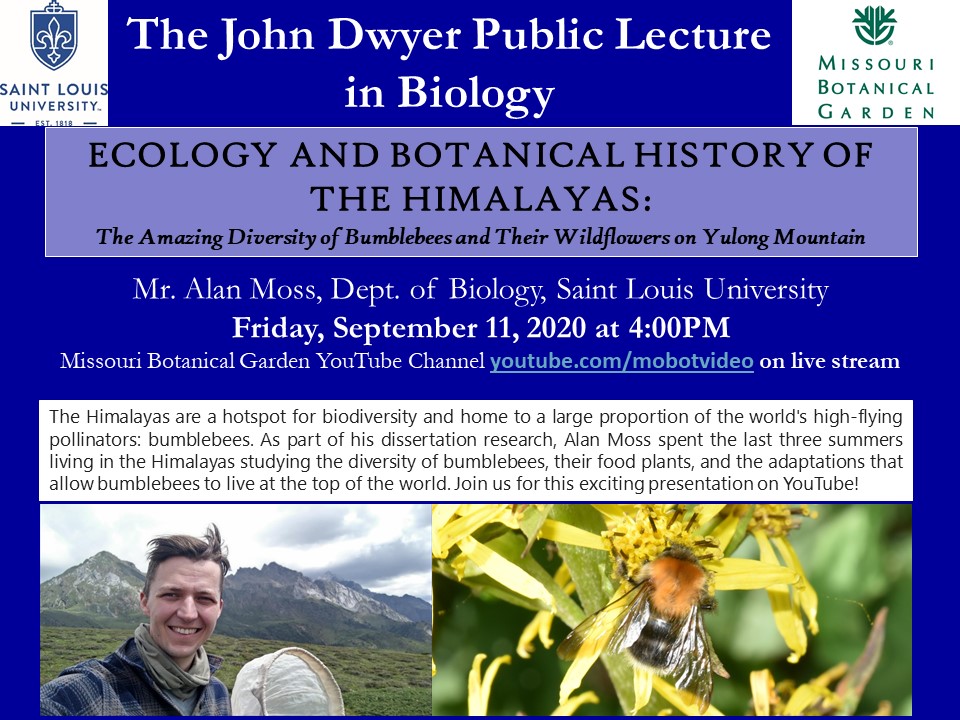
Dwyer Lecture Flyer 2020

This year’s Missouri Botanical Garden/St Louis University John Dwyer Public Lecture in Biology will be given by Alan Moss who researches Himalayan bumblebees and their interactions with flowers.  The lecture is being live-streamed on YouTube – details are in the flyer above.

Pollinators, flowers, natural selection and speciation: a virtual conference

Ashy Mining Bee 2017-06-17 10.55.45

It’s been a couple of years since I posted my previous “virtual conferences” on Pollinators, Pollination and Flowers and Ecology and Climate Change, a lapse that has largely been due to lack of time (my default excuse for most things these days….).  However Judith Trunschke at Uppsala University in Sweden has risen to the challenge of guest-curating her own virtual conference*.  The theme here is how pollinators impose (or sometimes don’t impose) natural selection on flowers that results in the formation of new plant species:

Timo van der Niet (IIASA 2010): Plant-diversification through pollinator shifts

Timo van der Niet (Congresos UCA 2014): Disentangling the contribution of pollinators in shaping angiosperm orchid genus Satyrium

Anne Royer (Evolution 2016): Plant-pollinator association doesn’t explain disruptive selection & reproductive isolation

Brandon Campitelli (Evolution 2016): Pollinator-mediated selection and quantitative genetics

Yuval Sapir (Evolution 2016): Rethinking flower evolution in irises: are pollinators the agents of selection?

Ruth Rivken (Evolution 2014): The mechanisms of frequency-dependent selection in gynodiocious Lobelia siphilitica

Gonzalo Bilbao (Botany 2017): Pollinator-mediated convergent shape evolution in tropical legumes

My grateful thanks to Judith for curating this great set of talks; if anyone else would like to do the same, please get in touch.

Feel free to discuss the talks in the comments section and to post links to other talks on the same topic.


*I’m assuming that, as all of these videos are in the public domain, none of the presenters or copyright owners objects to them being presented here.  If you do, please get in touch and I’ll remove it.

Fly pollination in the trap flower genus Ceropegia: a new study just published

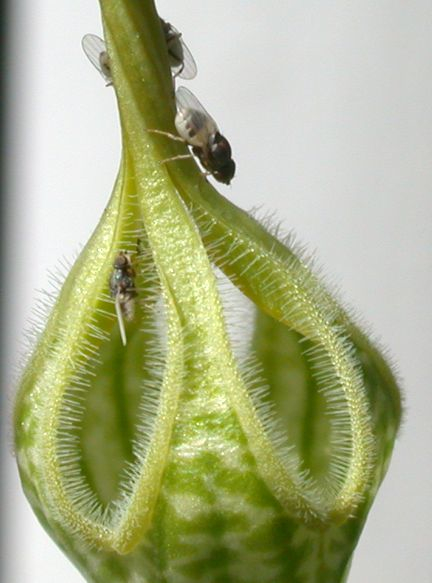
Flies on C. arabica from Sage Reynolds

Pollination of flowers by flies (the insect order Diptera) has long fascinated me, in part because it often subverts the idea of what “normal” flowers should look like, but also because it is much less well studied, and appreciated, compared to bee pollination.  This is despite the fact that fly pollinated flowers are at least as frequent as bee pollinated flowers in many plant communities, as I show in a forthcoming review in the journal  Annual Review of Ecology, Evolution and Systematics (more on that in November when it’s published).

Over the past decade I’ve been studying the large plant genus Ceropegia in the family Apocynaceae (subfamily Asclepiadoideae).  The flowers of these species temporarily trap their fly pollinators, releasing them after a period, during which pollination takes place and/or pollen is picked up.  The latest study from this work has just been published in the journal Flora, in collaboration with colleagues from eight different countries.  The title is:

Diversity of Diptera families that pollinate Ceropegia (Apocynaceae) trap flowers: an update in light of new data and phylogenetic analyses

If you follow that link you can download the PDF for free for the next 50 days.

One of the main findings from this new study is that the diversity of fly families that pollinate Ceropegia spp. is much greater than we had previously realised.  The total now stands at 16 different families, including some that rarely, if ever, pollinate other plants (as far as we yet know).

Another important finding is that this clade, which may contain as many as 1000 species in total, seems to have diversified despite that fact that all species are apparently fly pollinated.  This is unusual: diversification of plant clades often involves shifts to very different groups of pollinators, e.g. bee to bird or bat pollination.

There’s still lots to discover about this group of plants and this is just the latest output from what is an ongoing project focused on Ceropegia and the Apocynaceae more generally.

Here’s the abstract:

“Pollination by flies (Diptera) has been important to the diversification and ecology of the flowering plants, but is poorly understood in contrast to pollination by other groups such as bees, butterflies and birds. Within the Apocynaceae the genera Ceropegia and Riocreuxia temporarily trap flies, releasing them after a fixed, species-specific period of time, during which pollination and/or pollen removal occurs. This “trap flower” pollination system shows convergent evolution with unrelated species in other families and fascinated Stefan Vogel for much of his career, leading to ground-breaking work on floral function in Ceropegia (Apocynaceae). In this new study we extend the work of the latest broad analysis published by some of the authors (Ollerton et al., 2009 − Annals of Botany). This incorporates previously unpublished data from India and Africa, as well as recently published information, on the diversity of pollinators exploited by Ceropegia. The analyses are based on a more accurate phylogenetic understanding of the relationships between the major groups, and significantly widens the biogeographic scope of our understanding of fly pollination within Ceropegia. Information about the pollinators of 69 taxa (species, subspecies and natural varieties) of Ceropegia is now available. Twenty five families of Diptera are known to visit the flowers of Ceropegia, of which sixteen are confirmed as pollinators. Most taxa are pollinated by species from a single family. Overall, there were no major biogeographic differences in the types of Diptera that were used in particular regions, though some subtle differences were apparent. Likewise there were no differences between the two major clades of Ceropegia, but clear differences when comparing the range of Diptera exploited by Ceropegia with that of the stapeliads. This clade, one of the largest in the Asclepiadoideae, is a fascinating example of a species radiation driven by an apparently relatively uniform set of pollinators.”

Photo credit: flies on flowers of Ceropegia arabica in cultivation by Sage Reynolds.