
Back in January I wrote a post entitled Pollination as a matter of national security, prompted by the UK Government’s rather extraordinary publication of this report: Global biodiversity loss, ecosystem collapse and national security: a national security assessment. My argument was that although pollination is obviously not a national security issue in the traditional sense of defending a country against hostile states or terrorist attacks, the loss of pollinators threatens food production, supply chains and the functioning of ecosystems upon which societies ultimately depend. In other words, it is a threat to national resilience, which we can define a country’s capacity to anticipate, withstand, adapt to, and recover from major shocks or long-term pressures while maintaining the essential functions of society, the economy, government, and critical infrastructure. I’ll come back to this national-level framing at the end.
I concluded that post by suggesting that the real question was not whether pollination could be regarded as a national security issue, but whether national security thinking had fully adapted to the biological foundations on which societies depend.
Since January, several reports, papers and policy developments have convinced me that this is becoming a much wider and more serious discussion. Pollination is only one component of it. What is emerging is a view of nature itself as part of the infrastructure that makes societies secure.
Nature as infrastructure
Perhaps the clearest expression of this idea comes from a paper by Bradley Cardinale, Emmett Duffy and Rod Schoonover entitled Nature’s role in national security, published this summer in the journal Nature-Based Solutions.
The authors consider five areas where ecological disruption can generate national security risks: food security, water scarcity, health security, protection from natural disasters, and environmental crime. In each case, environmental degradation can create or amplify economic and social pressures which, under some circumstances, translate into political instability and security problems.
What I particularly like about the paper is its use of the term “natural infrastructure”. Functioning ecosystems, the authors argue, operate rather like electricity grids, communications systems and transport networks. They provide services and, crucially, buffer societies against shocks.
This is an important shift in emphasis. We usually talk about the benefits or ecosystem services that nature provides. Both are perfectly useful concepts, but describing ecosystems as infrastructure changes how we think about their loss. A degraded wetland is then not simply a conservation problem. It may represent the deterioration of flood-control infrastructure. Similarly, a damaged watershed is a weakening of water-security infrastructure, whilst a decline in pollinators can be understood as damage to parts of our food-production infrastructure.
Seen in that way, restoring ecosystems begins to look less like discretionary environmental spending and more like preventive investment in resilience.
Rewilding as defence
An even more striking example appeared in April in The RUSI Journal, published by the Royal United Services Institute, one of the world’s oldest defence and security think tanks.
Sam Jelliman, Brian Schmidt and Alan Chandler propose the concept of “defensive rewilding”: strategically restoring forests, wetlands, peatlands and other ecosystems in locations where they could also impede, divert or slow an invading military force. This infographic from the paper outlines their argument quite persuasively:
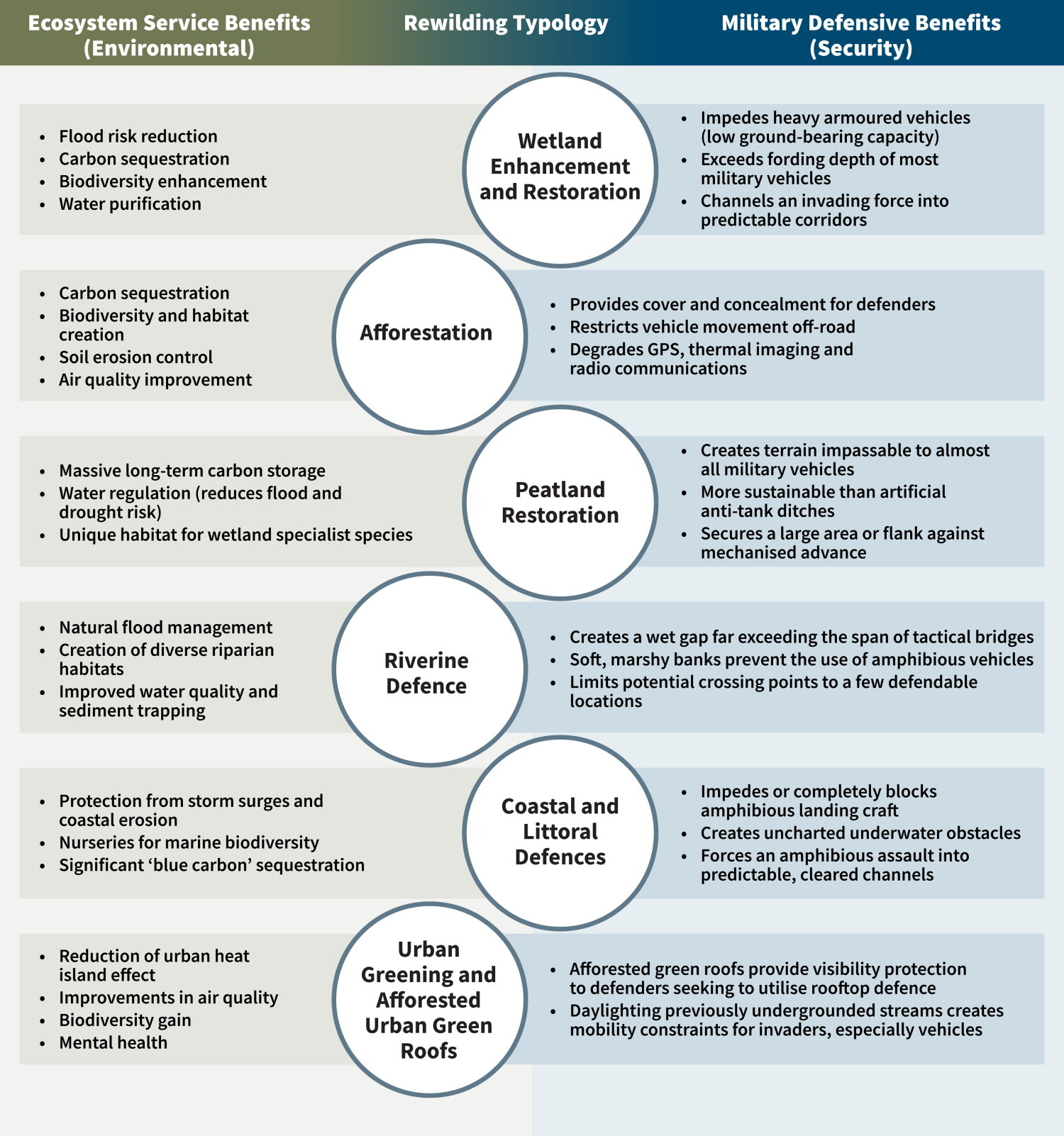
At first sight this sounds rather eccentric, but the logic is straightforward. Military planners since at least the time of Alexander the Great have always understood that terrain matters. At the Battle of Issus in 333 BCE, for example, Alexander fought the much larger Persian army on a narrow strip of land between the sea and the mountains, restricting its ability to manoeuvre and helping to neutralise its numerical advantage. Wetlands, forests, rivers, hedgerows and boggy ground can also provide advantage by restricting visibility and movement and make the passage of vehicles and troops much more difficult. We have seen examples of this during the war in Ukraine, just as we did in numerous earlier conflicts.
What Jelliman and colleagues suggest is that this defensive function could sometimes be deliberately combined with ecological restoration. Rewetting peatlands or restoring floodplains near vulnerable borders might simultaneously enhance biodiversity, store carbon, reduce flooding and create terrain that is difficult for armoured vehicles to cross. A win-win for both national defence and this wider concept of national security.
Clearly this is a concept that requires much more testing, and ecological restoration should not be distorted into a military land-management programme. There would also be difficult questions about land ownership, farming and the ecological appropriateness of particular interventions. But that is almost beside the point. The fact that rewilding is now being seriously discussed in a defence journal as potential security infrastructure is itself significant.
It challenges the assumption that spending on defence and spending on nature necessarily compete with one another, though we’ve long known that some areas of the UK than are used by the military are also important wildlife sites, Salisbury Plain being an obvious example, the largest known expanse of unimproved chalk grassland in north-west Europe precisely because it is used for military purposes rather than being converted to agriculture.
Losing nature can make countries poorer and less financially secure
Another recent study extends the argument into the financial system. Matthew Agarwala and colleagues published a paper in Nature Ecology & Evolution examining how losses of ecosystem services might affect the creditworthiness of nations, which is the degree to which lenders and investors judge that a country’s government can reliably meet its debt obligations in full and on time. Their model incorporated scenarios involving the deterioration of three services – wild pollination, marine fisheries and tropical timber – into sovereign credit assessments for 23 countries containing about 5.5 billion people.
The numbers produced by their scenarios are striking. Under partial ecosystem collapse, additional annual sovereign interest payments across the countries studied could reach around US$162 billion. India and China alone could experience tens of billions of dollars in increased annual debt-servicing costs. Some countries could suffer very large reductions in GDP.
These are modelled scenarios rather than predictions, of course, and the ecological assumptions that sit beneath such economic modelling need careful scrutiny. But the basic mechanism is compelling.
Governments depend upon functioning economies to raise taxes, borrow money and respond to crises. If ecological degradation reduces agricultural output, fisheries production and other forms of economic activity, the fiscal position of a country deteriorates. Borrowing becomes more expensive precisely when governments may need to spend more money adapting to environmental change.
This summer’s record breaking drought and wildfires in the UK, and the promise of further disruption due to a mega El Nino event, make such adaptation all the more urgent. Nature loss can create a nasty feedback loop: ecological degradation weakens economies, weaker economies have less capacity to invest in resilience and restoration, and that in turn increases their vulnerability to further ecological degradation.
All of this moves biodiversity loss well beyond the conventional environmental policy box and there are positive signs that these ideas are becoming embedded in government.
The UK security machinery is beginning to respond
In June the UK Government established its first Climate Security Taskforce, bringing together experts from the security, military, academic and environmental communities. Significantly, its remit explicitly encompasses not only climate change but nature loss. This is important as many of us have been arguing for years that you cannot disentangle the two and they should not be treated as separate domains of environmental concern. The Government’s announcement stated that climate change and nature loss are drivers of instability, economic disruption and security risk, and linked the Taskforce to the broader approach set out in the UK’s National Security Strategy.
That matters because one of the perennial problems with biodiversity has been institutional fragmentation. Nature tends to be dealt with by environment ministries, while finance ministries think about economic stability, agriculture departments think about food production, health ministries think about disease, and defence and intelligence agencies think about security. But ecological risks do not respect departmental boundaries.
A collapsing ecosystem can simultaneously affect food prices, water availability, infectious disease risks, migration, trade, government finances and geopolitical stability. Treating each of these consequences separately misses the common ecological cause.
China, where I’ve been spending quite a bit of time in recent years, provides an interesting comparison with the UK. Whereas the explicit framing of biodiversity loss as a national-security risk is relatively new in Britain, China has for some years incorporated “ecological security” into its much broader concept of national security. Its first national-security white paper, published in 2025, explicitly listed ecological security alongside military, economic, food, resource, biological and other forms of security. This has been reinforced in 2026 by China’s new Five-Year Plans for ecological protection and the construction of a “Beautiful China”, both of which link biodiversity conservation, ecosystem restoration and resilience to national ecological security. Chinese researchers have meanwhile developed an extensive literature on “ecological security patterns”, identifying the habitats, corridors and ecosystem services required to maintain resilient landscapes. The Chinese use of the term is not identical to the emerging British idea of “nature security”, but the overlap is striking: both ultimately recognise that the security of a state rests partly upon the ecological systems that support it.
From an intelligence assessment to Parliament
The UK Government’s January assessment has continued to reverberate through Westminster. On 2 September, the House of Commons Library published a new briefing ahead of a parliamentary debate on the assessment. The briefing does not constitute a new security assessment, but usefully brings together the original findings with subsequent parliamentary scrutiny, stakeholder responses and government action, including the creation of the Climate Security Taskforce and a new three-year Nature Security R&D Programme.
The briefing rightly emphasises an important point about the original security assessment. It is based on a reasonable worst-case scenario. It is not predicting that these ecosystems will suddenly collapse tomorrow. National security planning routinely explores high-impact possibilities precisely because governments need to understand what would happen if severe events occurred.
On 3 September the subject was then debated in Westminster Hall, following a cross-party initiative led by Adrian Ramsay MP. Whatever ultimately comes from that debate, this represents an interesting political transition. In January, biodiversity loss appeared in a national security assessment, and eight months later it had become the subject of a dedicated parliamentary research briefing and debate. That does not mean that nature has suddenly moved to the centre of British security policy. Far from it. But it suggests that the language of nature security is beginning to acquire institutional traction.
And then there is food
As if to underline the point, today (4 September) the National Audit Office has published a report on the Resilience of the food supply chain to disruptions. This is not primarily a biodiversity report. It examines the resilience of the UK food system to a much wider range of threats, including extreme weather, energy disruption, cyber-attacks, pandemics and animal and plant diseases. But there is a direct connection with the nature-security debate.
Food is one of the UK’s 13 designated Critical National Infrastructure sectors. The NAO concludes that although the food system has proved resilient to previous disruptions, the ability of the sector to withstand catastrophic events has not been tested and that Defra’s actions have not yet been sufficient to ensure resilience to such events.
This brings us back to where I started in January with pollination. Food security is not simply about having enough farms. It depends on soils, water, climatic stability, pollinators, pest regulation, genetic diversity, functioning supply chains, energy, transport and international trade. Pull at enough of those threads simultaneously and resilience begins to unravel.
So where does this leave us?
What interests me most about these developments is that they come from very different intellectual and institutional directions. Ecologists are describing ecosystems as natural infrastructure. Economists are beginning to incorporate biodiversity into sovereign financial risk. Defence researchers are thinking about restored landscapes as strategic assets. Government has created a taskforce dealing with climate and nature security. Parliament is discussing ecosystem collapse as a national security problem. And the National Audit Office is warning that one of the country’s most fundamental pieces of critical infrastructure, its food system, needs greater resilience.
These are not separate conversations, they are pieces of the same emerging picture.
There is, of course, a danger in pushing the national-security framing too far. Nature deserves protection for many reasons that have nothing to do with its usefulness to states, economies or human societies. I would be very uncomfortable with biodiversity conservation being justified solely because it makes Britain, or any other country, more secure.
But that is not the argument I am making. Rather, I think we have systematically underestimated the extent to which national security is built upon ecological stability. Forests, soils, rivers, wetlands, oceans, pollinators and the millions of other species that make ecosystems function are not scenery surrounding the human economy, they are part of its physical foundations.
Earlier this year I argued that conserving pollinators could be regarded as a form of preventive security investment. The developments since then suggest that the same argument can be made much more broadly: Protecting and restoring nature is not an alternative to investing in national resilience. It is one of the ways in which we invest in national resilience.
That feels like an idea whose time has arrived.
There is, however, an obvious limitation to framing all of this in purely national terms. Modern states are embedded in a globalised economy in which food, energy, raw materials, finance, manufactured goods and ecological impacts cross borders continuously. A country may strengthen the resilience of its own landscapes and infrastructure yet remain highly vulnerable to ecosystem degradation, crop failures or political instability elsewhere. In that sense, “national resilience” is also dependent on international ecological resilience: security at home increasingly rests on the stability of environmental and economic systems far beyond national borders. Just as individual trees in a forest are dependent upon one another to create the conditions in which all can thrive, regardless of species, so the too are countries mutually dependent. The leaders of the world’s nations would do well to remember that.

