Tag Archives: Data

Reusing Plant-Pollinator Datasets – a free WorldFAIR webinar on 18th April

A message from Dr Debora Drucker, WorldFAIR Agricultural Biodiversity Case Study Lead:

Registration is open to our contribution to the WorldFAIR webinar series – “Reusing Plant-Pollinator Datasets: a Global Perspective with Guidelines and Recommendations inspired by Pilot Studies from Africa, the Americas and Europe”.

It will be held on April 18 at 2:00 pm – 3:00 pm (Times in UTC) – https://worldfair-project.eu/event/the-worldfair-webinar-series-reusing-plant-pollinator-datasets-a-global-perspective-with-guidelines-and-recommendations-inspired-by-pilot-studies-from-africa-the-americas-and-europe/

We will present results from Deliverables 10.2 & 10.3, with focus on our pilot studies:

Drucker, D., Salim, J. A., Poelen, J., Soares, F. M., Gonzalez-Vaquero, R. A., Ollerton, J., Devoto, M., Rünzel, M., Robinson, D., Kasina, M., Taliga, C., Parr, C., Cox-Foster, D., Hill, E., Maues, M. M., Saraiva, A. M., Agostini, K., Carvalheiro, L. G., Bergamo, P., Varassin, I.; Alves, D. A., Marques, B., Tinoco, F. C., Rech, A. R., Cardona-Duque, J., Idárraga, M., Agudelo-Zapata, M. C., Marentes Herrera, E. Trekels, M. (2024). WorldFAIR (D10.2) Agricultural Biodiversity Standards, Best Practices and Guidelines Recommendations (Version 1). Zenodo. https://doi.org/10.5281/zenodo.10666593

Drucker, D. P., Salim, J. A., Poelen, J., Soares, F. M., Gonzalez-Vaquero, R. A., Devoto, M., Ollerton, J., Kasina, M., Carvalheiro, L. G., Bergamo, P. J., Alves, D. A., Varassin, I., Tinoco, F. C., Rünzel, M., Robinson, D., Cardona-Duque, J., Idárraga, M., Agudelo-Zapata, M. C., Marentes Herrera, E., Taliga, C., Parr, C.S., Cox-Foster, D., Hill, E., Maués, M.M. Agostini, K. Rech, A.R., Saraiva, A. (2024). WorldFAIR (D10.3) Agricultural biodiversity FAIR data assessment rubrics (Version 1). Zenodo. https://doi.org/10.5281/zenodo.10719265

We reserved a good amount of time for Q&A – I hope to see you there and have a nice discussion!

Making plant-pollinator interaction data FAIR – a new draft report just published

One of the projects in which I’m currently involved is the WorldFAIR project. Funded by the European Commission, WorldFAIR is exploring how to make data FAIR – Findable, Accessible, Interoperable and Reusable – across a range of different disciplines in the sciences and humanities.

My involvement is specifically with Work Package 10, which is focused on data standards for plant-pollinator interactions, particularly as they relate to pollination of agricultural crops. After a year of hard work, I’m delighted to announce that our interim draft report from this Work Package has just been published! You can read the summary and download the report from Zenodo – here’s the link: https://zenodo.org/record/8176978

In addition there’s an associated webinar taking place on August 22nd – more details here: https://worldfair-project.eu/event/rescheduled-worldfair-rdas-10-year-anniversary-the-worldfair-case-study-on-plant-pollinator-interactions-wp10/

There’s more to come over the next twelve months and I’ll post updates as and when they appear. In the meantime, do check out the WorldFAIR website for information about the other Work Packages, their webinar series, FAIR data standards, and so forth.

Data I’ll never publish 1: flower production and plant size in Lotus corniculatus

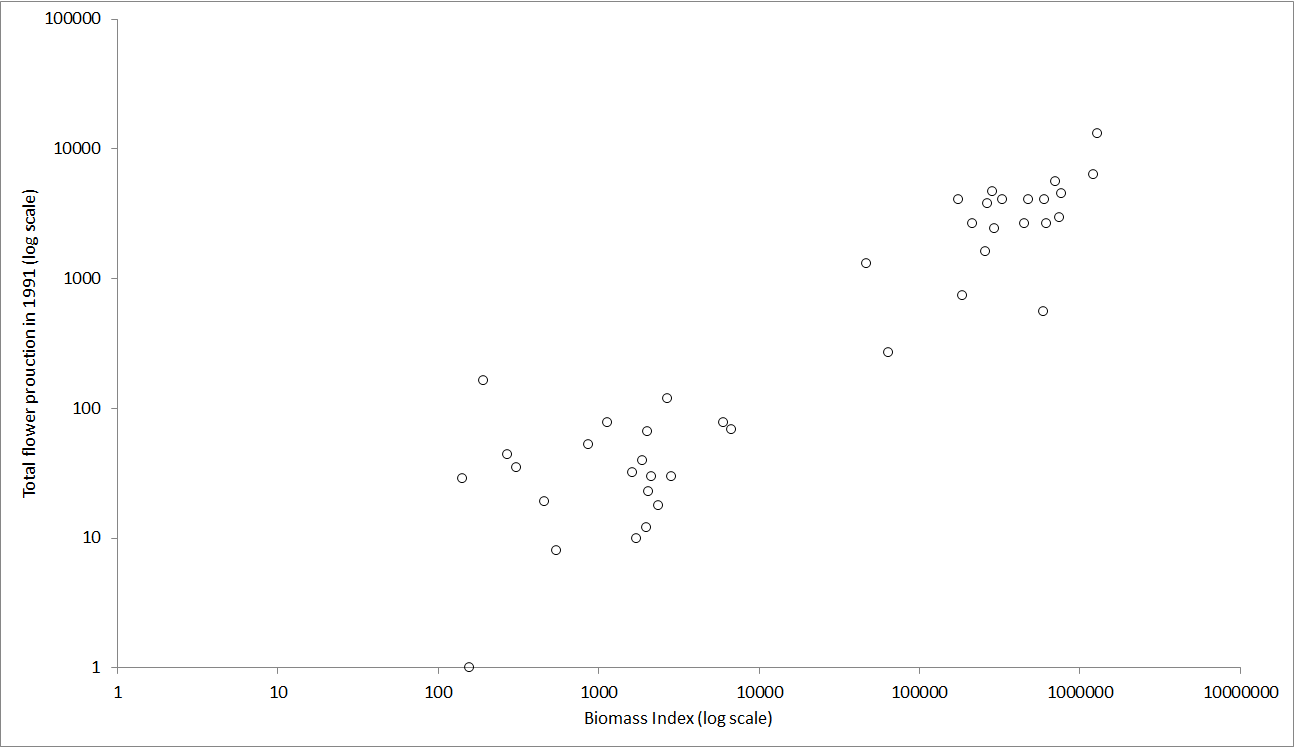
Lotus flower production graph 1991

For reasons that will become obvious next week, I’ve been in a reflective mood recently and this first in an occasional series of posts about “data I will never publish” is one of the results of that reflection.

When scientists have been doing research for a few years, most of them start accumulating a back-log of data.  In some cases this is data that may be published in the future (for ecologists that means long-term data sets, which I’ve talked about before) but other data may be fragmentary or simply too limited to be publishable.  Good data are hard won and I never, ever discard data: you never know when it may come in useful.  So in this series I will present such scraps of data that I know I’ll (probably) never publish.  Their purpose is to illustrate interesting points, to stimulate discussion and ideas, and hopefully they might even be of use to other researchers in one way or another (I’m happy to share the raw data, just drop me a line).

This first data set was collected in the grasslands of Wytham Woods in 1991 when I was a research student.  It subsequently ended up being used in my PhD thesis and in one of the papers that resulted from it (Ollerton & Lack 1998) but not quite in this form, rather embedded within larger analyses.  The graph above (click on it for a more detailed view) shows the relationship between individual plant size (measured using a calibrated non-destructive biomass index that I developed) and total flower production for that year, in the plant species Lotus corniculatus (Fabaceae), commonly known as bird’s-foot trefoil.

This plant is a herbaceous perennial grassland species which can live for quite a long time (at least 50 years).   The data show that plant size and flower production can span 5 orders of magnitude – the maximum number of flowers produced in one year by a single plant in this population was over 13,000, which is astonishing for a low-growing grassland species!

I’ve used this figure in undergraduate lectures as it illustrates several important points about many plants:

  • in theory, there is no upper limit to the potential maximum size of plants.  As long as they have appropriate growing conditions and are not limited by weather or disease or herbivory, they will continue growing.  That’s because they are modular, constructed of iterations of basic units of the plant “body”, and show indeterminate growth.
  • likewise, there is no upper limit to the number of flowers that can be produced because each modular unit can itself produce one or more flowers.
  • plants can be very plastic in their response to the environment.  The data form two clusters; the lower one (smaller plants) is from a sub-population that grew in a grassland that had never been fertilised.  The upper cluster (larger plants) grew in an adjacent area that had previously been an arable field and in which there were still fertiliser residues present in the soil.  The smaller plants are likely to have been older than the larger plants, but the latter had more soil nutrients on which to draw.

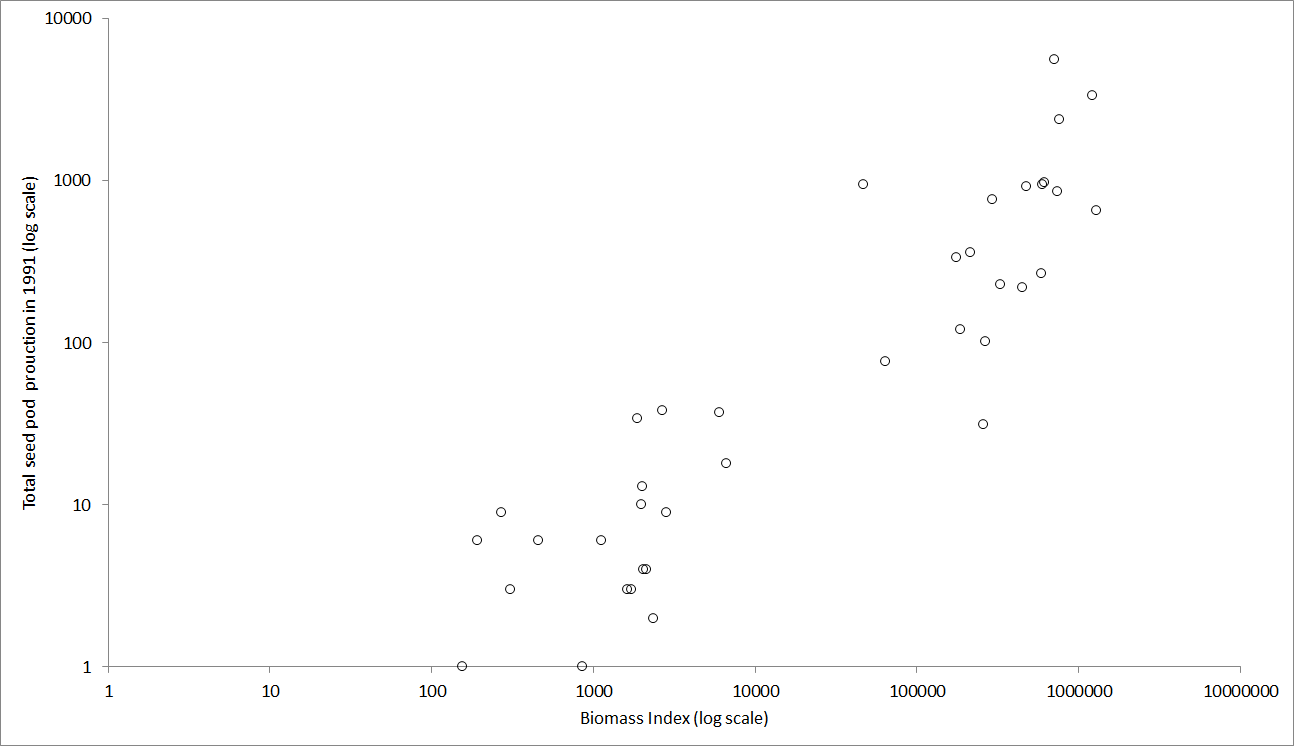
The following graph illustrates the same plants but this time it’s the relationship between biomass and number of seed pods produced.  Still a linear relationship with no sign of a plateau; female reproduction in these plants just goes on and on (as, of course, does male function via pollen dispersal.

Lotus seed pod production graph 1991

This is one of the things that I love about plants: they are so flexible in their response to growing conditions!