Tag Archives: Conservation

Pollinators, yeast, and the BES at RHS Chelsea – official press release

P1030210

The official press release for this week’s British Ecological Society display at the RHS Chelsea Flower Show, which I talked about last week, was embargoed until this morning; here’s the full text that’s been tailored by the University of Northampton press office:


Scent, colour and form all shape the choices we make about what to plant in our gardens. Gardeners know that flowers produce nectar and scent to attract the birds, bats, insects and other animals they rely on as pollinators, but few realise that organisms too small to see with the naked eye also play a vital role in this process.

Ecologists have discovered that a yeast called Metschnikowia plays a key part in the pollination story and next week, for the first time, visitors to the RHS Chelsea Flower Show will be able to get a sniff of it and see how it looks under the scanning electron microscope.

The yeast forms part of the British Ecological Society‘s Animal Attraction: The garden and beyond display, which focuses on the relationships between plants and their pollinators – relationships that are amazing in their diversity as well as crucial to global food security. The University of Northampton’s Professor of Biodiversity, Jeff Ollerton, has been advising the British Ecological Society on the project.

Metschnikowia is ubiquitous, present in most flowers in most gardens, yet ecologists are only just beginning to uncover its mysterious role in pollination. The yeast is studied in only four laboratories in the world and Dr Manpreet Dhami from Stanford University has donated the yeast for the British Ecological Society’s garden.

Like other yeasts, Metschnikowia may produce volatile chemicals that mimic the scent flowers use to attract pollinators, thus helping the flower to attract more pollinators and therefore set more seed. In return, the yeast becomes attached to birds, insects and other pollinators, which it relies on for dispersal.

Professor Ollerton explained: “It was a pleasure to work with the British Ecological Society on this project as it highlights two important points about the natural world: that pollinators other than bees are just as important to both wild plants and crops, and that the diversity and abundance of many of these groups is declining worldwide.” Professor Ollerton’s recent study, published in Science, found that 23 species of British bees and flower-visiting wasps have gone extinct since the 19th century.

According to Jessica Bays of the British Ecological Society: “To tackle this decline, we need to understand its causes, including climate change, habitat loss and pesticide use, and we also need to understand the role played by yeasts such as Metschnikowia, which is why we decided to bring it to Chelsea this year.”

Tickets are still available for the RHS Chelsea Flower Show 2016 – for more information click here.

Pollinators at RHS Chelsea Flower Show

20160518_114732

Pollinators, as regular readers of this blog will know, are diverse and important, both ecologically and agriculturally.  But that diversity is declining and it’s an issue that deserves greater publicity and action.

To that end, for the past eight months I’ve been advising a team from the British Ecological Society (BES) on the content for a display at the RHS Chelsea Flower Show which is running all next week.  The display is called “Animal Attraction: The Garden and Beyond” – if you follow that link you’ll get a sense of what the display is all about, but in essence there are three key messages that the BES is trying to get across:

  • Celebrating the diversity of pollinators (not just bees!) both in the UK and globally.
  • Flowers have evolved many different ways of attracting and rewarding pollinators, leading to the fantastic diversity of floral form that gardeners appreciate.
  • Planting a diversity of flowers in your garden can only be a good thing for helping conserve pollinator populations.

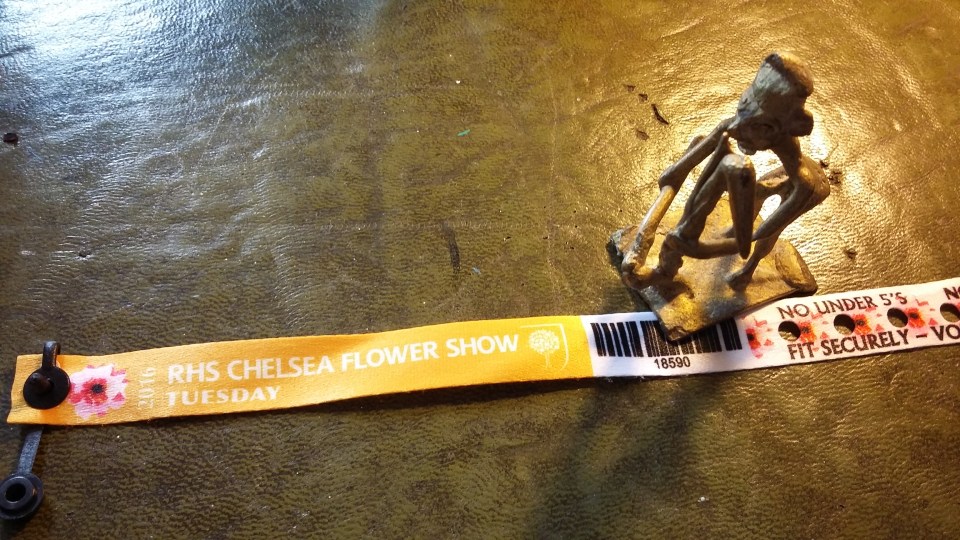
As you can see from my wristband, I’ll be helping to staff the stand all day Tuesday 24th May, so if you’re at the show come and say hello and take a look at what the BES team has produced.

Tributes to Sir David – and he finds time to write to one of our students!

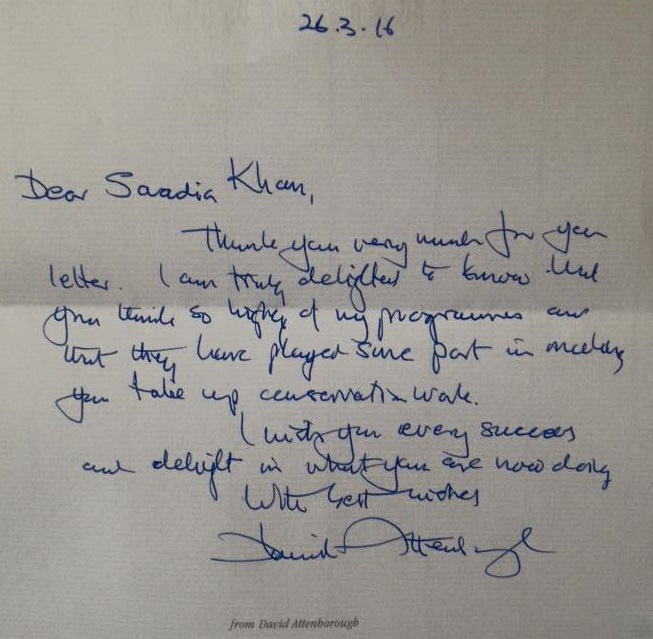
Saadias letter from Sir DavidThere can’t be many people currently working or studying in ecology, conservation, or the environmental sciences who were not in some way inspired by the programmes presented by Sir David Attenborough during his long career.  I certainly was, and I can trace my interest in the richness of our planet’s biodiversity right back to watching his ground-breaking series Life on Earth as a young teenager, and then reading the book, bought for me by my parents.
As you are probably aware, yesterday was Sir David’s 90th birthday, and the tributes to his iconic status as part of the scientific and cultural fabric of our nation, and his international standing, have been extensive and heartfelt. My personal favourites include naming the new NERC research vessel the RSS Sir David Attenborough and having a Madagascan dragonfly named after him by my friend and colleague KD Dijkstra, whose work I’ve highlighted previously on this blog.

But in the midst of all of these tributes and celebrations of a spectacular career, the measure of the man can be summed up by his taking the time to send a hand-written letter to one of our undergraduate students (see photograph).  The story of how Saadia Khan received Sir David’s letter can be read in full on the University of Northampton’s website.

All I can offer by way of my own tribute is to say thank you, Sir David,  for continuing to be such an inspiration, and may you have many more birthdays to come.

Design and Testing of a National Pollinator and Pollination Monitoring Framework – report published today

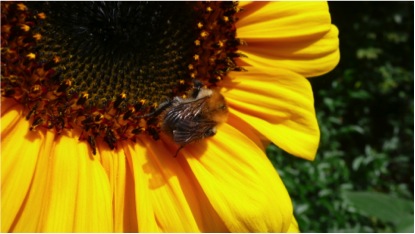
B pasc on sunflower

This morning there were swifts flying above the garden – summer’s [almost] here!  As if on cue, the eagerly anticipated report on “Design and Testing of a National Pollinator and Pollination Monitoring Framework“, one of the key recommendations of the National Pollinator Strategy, has been published today by Defra.  Here’s a link to the report and its annexes.

I’ve not had time to read the full report, and even the Executive Summary (ES) is quite long and detailed, but the Conclusion to the ES captures the key points (emphases in bold are mine):

“…there is considerable scope to enhance monitoring of pollinators and pollination services to ensure a robust and rigorous evidence-base to support the needs of policy, however this project has demonstrated clear trade-offs between likely cost and data quality, especially in terms of the taxonomic resolution and accuracy of species identifications. Currently the volunteer sector, namely the NSS*, provides the expertise to deliver monitoring of changes in species occurrence or distributions at a national scale for many, but not all, species. Indeed the total value of voluntary work provided by BWARS and HRS….is estimated, based on current levels, to reach in excess of £5M over ten years. Repeated systematic sampling from a stratified network of sites not typically covered by the NSS has the potential to add considerable value, providing data on pollinator abundance that may link with provision of pollination services and filling gaps in the spatial extent and species coverage. Enhancements to improve the range and accuracy of monitoring pollinators and pollination services over large spatial and temporal scales will depend on adequate resources to support capacity building, coordination and implementation.”

In summary, the volunteer schemes are a hugely valuable asset that need to be enhanced by funding from the public purse in order to set up a pollinator and pollinator monitoring scheme that will be fit for purpose.  Will the current Government show the necessary vision and leadership to provide that funding?  Watch this space….

* NSS = National Recording Schemes and Societies, e.g. Bees Wasps and Ants Recording Society (BWARS), Hoverfly Recording Scheme (HRS), etc.

Six bees, one stone: recent pollinator-related talks and workshops

BBKA lecture April 2016As I write this I’m painfully conscious that (a) it’s a couple of weeks since I last posted on the blog; and (b) I have a long list of things to complete before I head off to Tenerife for ten days of field work on Friday.  The absence of posting has been due to my current work load, including the number of conferences, talks and workshops I’ve been involved with in the past month, which seems to have taken up a disproportionate amount of my time.  It’s all been interesting and useful, however, and reflects the rising activity stemming from the National Pollinator Strategy, and increasing interest in pollinators more broadly.  I’ve certainly learned a lot and hopefully my own expertise contributed to the success of these events.
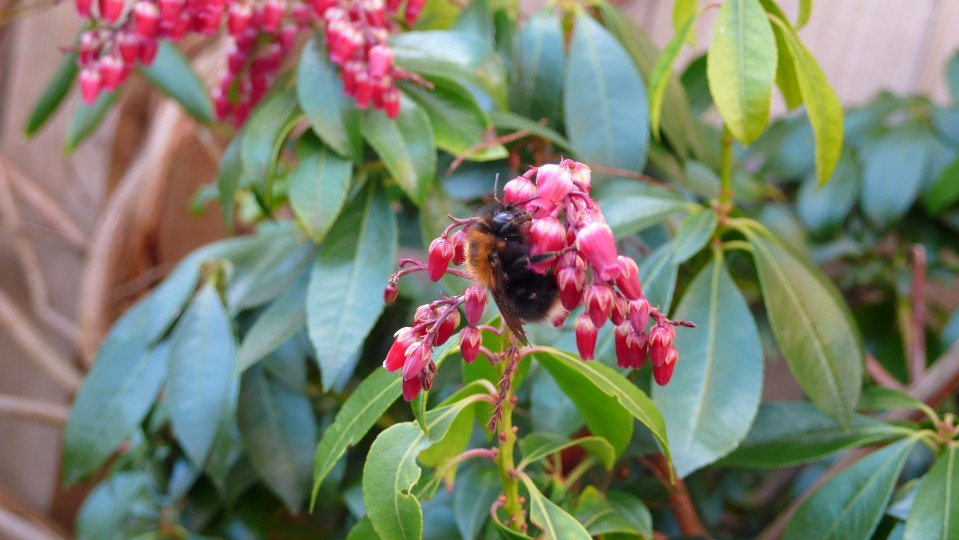
In this post I thought I’d briefly summarise what I’ve been up to recently, in the process expanding the numerical and phylogenetic parameters of “killing two birds with one stone“:

16th March – took part in a workshop to map the latest phase of Buglife’s B-Lines across Bedfordshire, Northamptonshire, Buckinghamshire and Oxfordshire.  This was a really interesting exercise and I felt that we’d actually achieved rather a lot by the end of the day.  Once the final maps are completed I’ll post a link so you can see where the routes go through these counties and how they meet up.

23rd March – spoke at a one-day conference on “delivering biodiversity” organised by the Environmental Association of Universities and Colleges at the University of Worcester.  Although I was talking about our bird surveys on the University of Northampton’s new Waterside Campus, pollinators did receive some attention during a workshop on creating wildflower meadows.  I’ll post an update on the Waterside work once we’ve completed the next set of spring surveys.

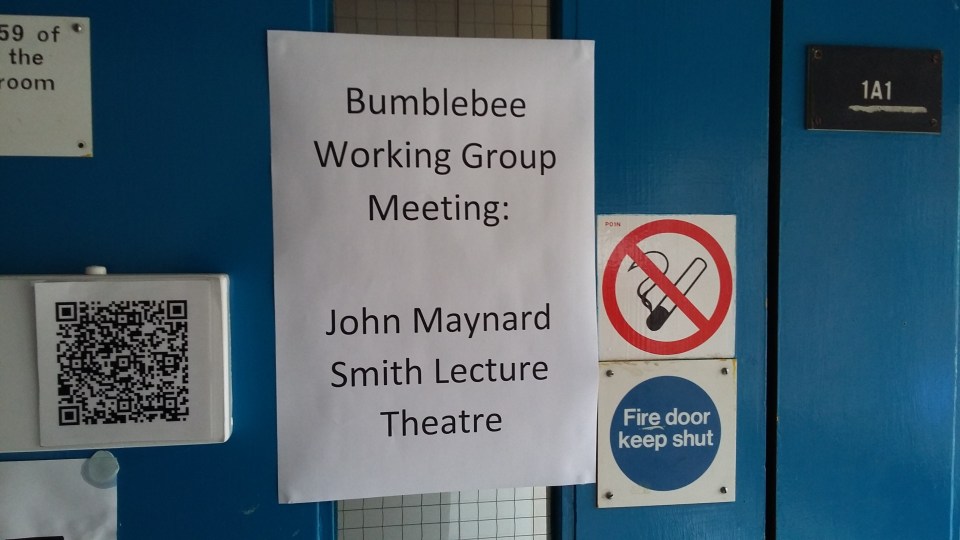
30th March – spoke at the Bumblebee Working Group at the University of Sussex – have already posted an account of that.

6th April – took part in a”Pollinator Experts Elicitation” workshop at the University of Warwick, along with a group of nine other academics, and members of stakeholder groups such as FERA and the NFU.  Run as part of Warwick’s Food and Behavioural Science Global Research priority groups, the organisers, from the university’s Department of Statistics, used the Delphi Method to assess the likelihood of sustaining pollinator populations under different scenarios of disease, climate change, and habitat degradation.  It was a fascinating process and interesting to see how often experts’ views converged on the same opinion.  Also rather humbling to see the degree of our uncertainty in our forecasts.  The workshop garnered quite a bit of media attention including pieces on the BBC’s Midlands Today and the Farming Today programmes.

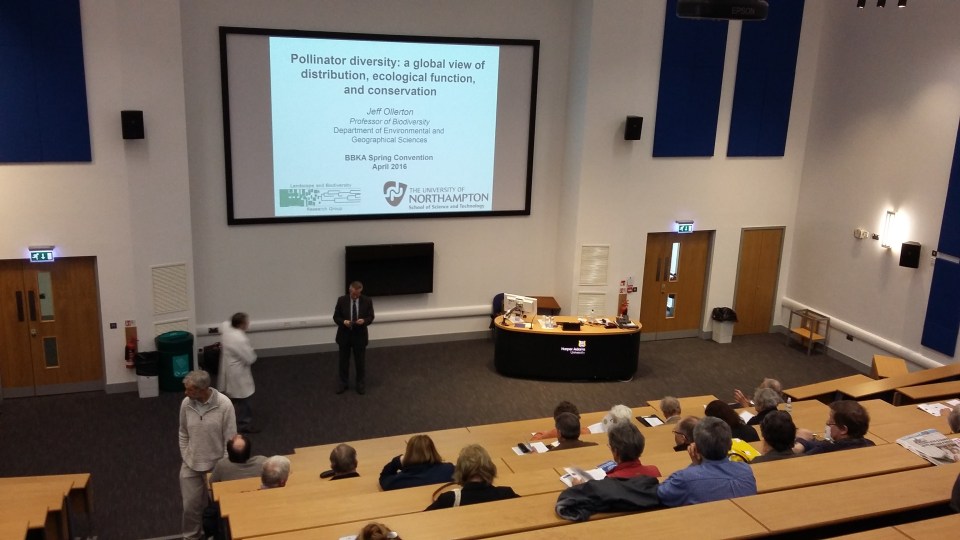
8th-9th April – delivered two lectures at the British Beekeepers Association’s Spring Convention at Harper Adams University.  Rather disconcerting to be the least-informed person in the room, given my limited knowledge of bee keeping, but they were a friendly and curious lot with good-sized audiences for my talks on the diversity of bees to be found in urban settings, and the global diversity and functional importance of pollinators.

13th April – spoke to a very receptive audience at the Friends of Linford Lakes Nature Reserve near Milton Keynes, on the topic of “Bees for dinner?  The importance of pollinators in a changing world“.  Great evening and lots of interesting questions afterwards, though my talk was a bit too long (must cut it for next time).

That’s it for now, hope to do some posts from Tenerife while we are there.


IUCN Bumblebee Specialist Group annual report 2015

Bombus hypnorum March 2010

The International Union for Conservation of Nature (IUCN) has a Bumblebee Specialist Group which is focused on assessing the conservation status of the c. 260 species within the genus Bombus.  If you follow the link above you can find out more information about the group and a PDF of the most recent annual report for 2015, plus past reports for 2012-2014.

The work of specialist groups such as this is vital for providing evidence as to the true picture of how the world’s pollinators are faring, and what can be done to reverse local and regional declines in their diversity and abundance.

What I learned at the Bumblebee Working Group Meeting

20160330_171209Earlier this week I attended the Bumblebee Working Group Meeting at the University of Sussex, a one day event that takes place every two or three years.  It was a very stimulating day with some really interesting work being showcased; here are some examples of things that I learned that day, some questions that these findings have prompted (and the people presenting):

  • High arctic/montane bumblebees have undergone (and survived) periods of severe climate change in the past – does this mean they are less sensitive than temperate species to future climate change? (Paul Williams).
  • Bumblebees foraging closer to honey bee apiaries are more likely to be infected with a range of bee diseases – presumably picked up from the honey bees, but what is the route of transmission?  (Samantha Alger).
  • Queen Buff-tailed Bumblebees exposed to neonicotinoid pesticides have a 26% reduction in the probability of founding a colony, and the effects vary for other species – are the most sensitive species the ones that have declined the most since the mid-90s? (Gemma Baron).
  • Simulating bumblebee colony dynamics with the Bumble BeeHave model is producing comparable results to field data on male and queen production (Matthias Becher).
  • Environmental Stewardship Schemes appear to enhance bee nest densities on farms where they are situated – but are some species already at saturation point on those farms? (Tom Wood).
  • New, tougher EU guidelines for risk assessment of effects of pesticides on bees have been developed and are being tested at the moment (James Cresswell).
  • The annual spread of the Tree Bumblebee, Britain’s newest bumblebee species, is about 35km per year (Liam Crowther).
  • The equivalent of 737,914 bramble flowers are needed to provide the resources support a single colony of Buff-tailed Bumblebees for one year (Ellie Rotheray).
  • The moratorium on neonicotinoids seems to have had the desired effect of reducing the amount of these pesticides being taken up by bumblebee colonies in pollen and nectar (Beth Nicholls).
  • There have been significant range extensions of some of our rarer bumblebee species in Essex over the last 15 years or so – has this also been happening in other counties? (Ted Benton).
  • Sites with greater levels of radioactive contamination at Chernobyl have fewer older bees – does this mean that the radiation is affecting their lifespans?  (Katherine Raines).
  • Buglife’s B-Lines project continues to develop and gain momentum (Laurie Jackson).
  • The Short-haired Bumblebee reintroduction project has recorded workers every year since 2013.  However there have also been reintroductions of queens from Sweden every year – so are the queens surviving over-winter and founding new colonies? Or are the workers just from the new queens each year? (Nikki Gammans).

Thanks to all the speakers, it was a great meeting, and special thanks for Dave Goulson for his hospitality and for organising the event.

A number of people were tweeting from the event using the hashtag #BBWG16 – follow the link for more comments and some images, including a couple of yours truly in action – one of which I’ve stolen (below).

Jeff at BBWG 2016

Special issue of Leaf Litter devoted to pollinators

Leaf Litter

A short while ago I was interviewed by an American journalist as part of a special issue of the online newsletter Leaf Litter devoted to pollinators.  Produced by a conservation planning and ecological restoration organisation called Biohabitats, this special issue includes:

» Thoughts on Pollinators
» Expert Q&A: Jeff Ollerton
» Expert Q&A: Jerome Rozen
» Expert Q&A: Eugenie Regan
» Inspiration: Promising Progress With Pollinator Habitat
» Non-Profit Spotlight: The Xerces Society
» Video: An ecological planner walks into a cider mill…
» How Saving Pollinators Can Save Water and Fish Resources
» Biohabitats Projects, Places, and People

Here’s a link to Leaf Litter.

Urban Pollinator Knowledge Exchange summary – Bristol 22nd February

P1110838The importance of urban environments for supporting pollinator populations is a topic that I’ve covered several times on the blog, for example: “Urban pollinators for urban agriculture” and “Urban bee diversity – a new study“.  It’s a subject that’s generating a lot of interest at the moment with some really exciting research being published and conservation practice taking place.  However there’s clearly a lot to do if we are really to understand where pollinators are distributed across out townscapes, and how we can best manage urban habitats to support this diversity and increase their numbers – here’s a link to an interesting round table discussion on this very topic.

Recently I was invited to take part in a workshop event co-organised by Defra, NERC, and Dr Kath Baldock from Bristol University entitled: Knowledge Exchange: urban grassland management and creating space for pollinators.  As well as doing a short talk which contextualised the current scientific knowledge on urban pollinators, I facilitated one of the breakout discussion sessions.

The workshop was very well attended with some 50 delegates from a wide range of organisations, including local and national authorities, businesses, NGOs, and universities.  Feedback from those delegates was generally positive and most people learned something about managing urban settings for pollinators, and made some useful connections.  I certainly learned a lot: it’s good to get out of academia sometimes and talk with practitioners.

If you follow this link you’ll find a PDF of the summary from the facilitated sessions, covering topics such as grassland and verge management, the urban edgeland, innovative projects, and green infrastructure.

Over at the Bumblebee Conservation Trust’s blog, Sam Page has a very nice summary of the whole day which is also worth reading:  Trials and tribulations of managing urban grasslands for pollinators.

Many thanks to all of the organisers for their work in putting on this event.

Bumblebee Working Group meeting – University of Sussex – 30th March

Bombus hypnorum

It’s been three years since the last meeting of the semi-formal Bumblebee Working Group, which I hosted at the University of Northampton, and British Bombus researchers  are eagerly looking forward to the next one which is being organised by Professor Dave Goulson at the University of Sussex on 30th March.  There is no charge and if anyone with an interest in bumblebees wishes to attend, please contact Dave.

Here’s the programme for the day, which starts at 10am and finishes at 4.30pm:

Goulson, Dave – Welcome

Williams, Paul  – Bumblebees of extreme environments

Alger, Samantha – RNA viruses in Vermont bumblebees

COFFEE BREAK

Baron, Gemma – Impacts of a neonicotinoid pesticide on colony founding bumblebee queens

Becher, Matthias Bumble – BEEHAVE: using bumblebee colony models as a conservation management tool in agricultural landscapes

Breeze, Tom – Knowledge gaps for effectively valuing pollination services

Cresswell, James – New European Union protocols for testing the toxicological impacts of agro-chemicals on bees

Crowther, Liam – Inferring invertebrate dispersal distances from biological records

LUNCH

Rotheray, Ellie – Quantification of the floral landscape in agro-ecosystems and its effect on bumblebee colonies

Nicholls, Beth – Pesticides in rural and urban bumblebee nests

Benton, Ted – Status of the BAP carders in Essex

Ollerton, Jeff – Exceptional urban nest density of the Tree Bumblebee Bombus hypnorum during summer 2014

SHORT BREAK

Raine, Katherine – Chernobyl bumblebees: Understanding fitness consequences of living in the exclusion zone

Jackson, Laurie  – B-lines

Gammans, Nikki – An update on the progress of reintroducing the short-haired bumblebee, Bombus subterraneus 

CLOSE