Tag Archives: Coffee

Can coffee plantation design boost both productivity and sustainability? A new study says YES!

One of the most productive research collaborations in which I’ve had the pleasure to be involved has been with André Rodrigo Rech in Brazil. It started when he was a postgrad working on his PhD, and has now continued as André has developed into fully-fledged academic with his own research group. That productivity has been fueled by a lot of coffee, of course, as you’ll know if you’ve read my book Pollinators & Pollination: Nature and Society!

Our most recent paper concerns coffee production in Brazil and how the design and management of plantations can both support wild bee populations AND increase the quality and quantity of the crop. One of the lead authors Gudryan Baronio has written a post about the work over on The Applied Ecologist blog – here’s the link: https://appliedecologistsblog.com/2024/02/26/can-coffee-plantation-design-boost-both-productivity-and-sustainability/

Here’s the reference – if you want a PDF of the paper, please send me a message via my Contact page:

Pereira Machado, A.C., Baronio, G., Soares Novaes, C., Ollerton, J., Wolowski, M., Natalina Silva Lopes, D. & Rech, A. (2024) Optimizing coffee production: Increased floral visitation and bean quality at plantation edges with wild pollinators and natural vegetation. Journal of Applied Ecology (in press)

Here’s the abstract:

  1. Animal pollination is important for more than 75% of agricultural crops, including coffee, whose productivity can increase with adequate pollination. Bees, including many solitary species, are diverse pollinators, with around 85% of them considered more effective than honeybees in pollen transfer. We assessed the coffee plantation and its surrounding vegetation for solitary bee nesting throughout the coffee flowering season and measured their impact on coffee productivity.
  2. We installed collection stations with trap nests inside a coffee plantation, on the border and inside the native vegetation in a farm in Diamantina, MG, Brazil. We used 10 weekly monitored replicates at least 1 km apart. We evaluated fruiting by autogamy in relation to natural pollination and used the increase in fruit set from pollinators to calculate the farmer’s monetary gain. We recorded bee visits to the exposed flowers during coffee flowering considering both on the edge and inside the coffee plantation. Ripe fruits were dried, counted and weighed.
  3. We discovered 132 solitary bee nests outside the plantation, with 54% containing coffee pollen grains, indicating coffee as an essential resource for bees even outside the crop area. More bee visits occurred at the coffee plantation’s edge, resulting in increased fruit production, denser fruits, and rounder fruits in that area. Bagged flowers produced consistent seeds in all locations. The farmer could earn an extra US$1736.37 per hectare if the entire area received the same level of pollination contribution from bees as observed at the coffee border.
  4. Synthesis and applications. Our study emphasises the key role of pollinators in coffee production and their impact on fruit and seed characteristics. Bee visits were more frequent on border areas, emphasising their reliance on natural nesting sites. Bee-mediated pollination positively affected fruit traits and self-pollinated fruits in plantation borders had reduced mass. Solitary bee nesting was primarily observed in native vegetation, underlining its importance for bee populations. Pollen composition in nests varied with proximity to coffee plantations, indicating landscape vegetation influences pollinator foraging. These findings support optimising coffee plantation design by preserving native vegetation to increase coffee yields and conserve biodiversity.

Image © Ana Carolina Pereira Machado
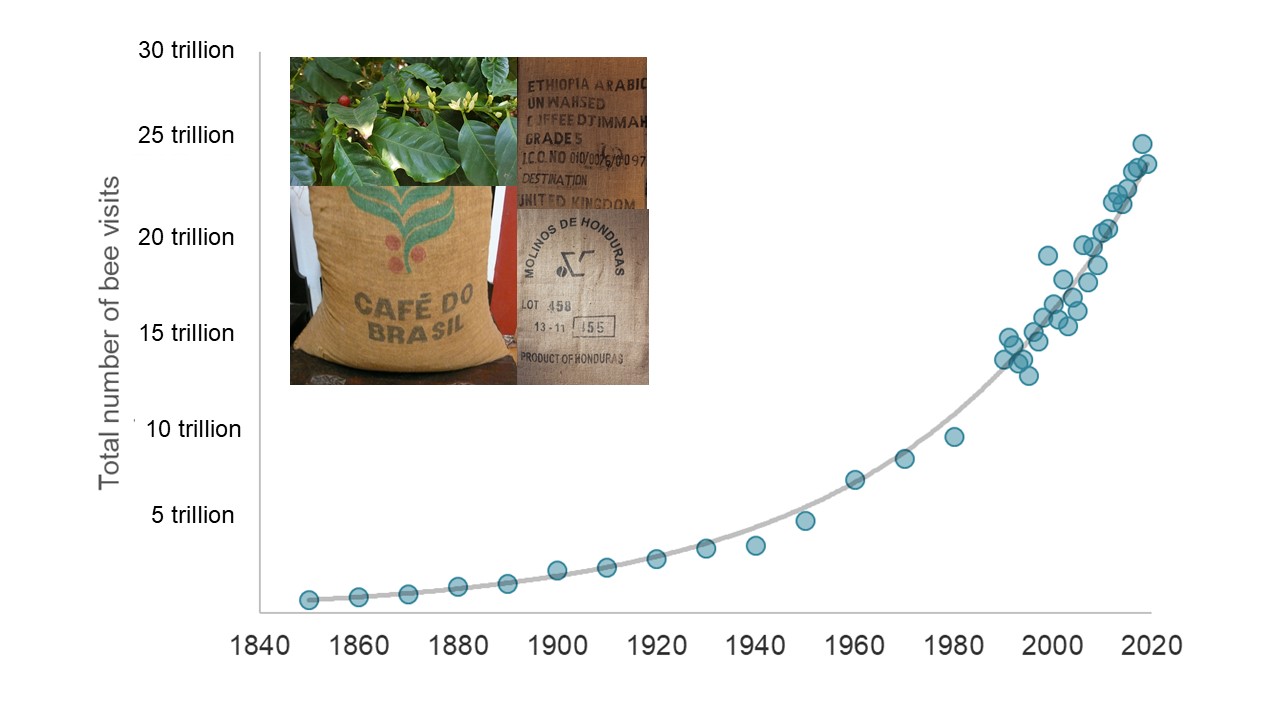
For World Bee Day 2021: an update of the coffee-bee visits figure from my book

Today is World Bee Day 2021! To celebrate it, here’s an update of a figure that appears in my book Pollinators & Pollination: Nature and Society. It’s reminder of just how important bees are as the main pollinators of coffee, one of the world’s major crops. The new figure adds another two years of data and also improves the accuracy of some of the statistics for the previous decade. The coffee production data are from the International Coffee Organization.

Bottom line is that the global coffee production in 2019/20 was the result of 24 TRILLION flower visits by bees! That’s down a little from the previous year, but it’s still a LOT of visits by a HELL of a lot bees!

If you want to know more about how this was calculated and what it means for both coffee production and bee conservation, I discuss it with Dr Kirsten Traynor in this recent podcast for the magazine 2 Million Blossoms.

Happy World Bee Day everyone!

When scientists get things wrong: is coffee the second most valuable global commodity?

2018-12-22 13.12.38

If this blog has a purpose beyond highlighting the importance of biodiversity, and recent developments in the field of pollination biology in particular, it’s to demystify science and the scientists who produce new knowledge.  Hopefully my posts over the past seven years have shown that scientists can have all kinds of backgrounds, even northern English working class, and need not have attended the most prestigious universities.  I’d also hope that what I write about my own research gives some insights into how new knowledge is generated and how it can be communicated to both specialist and non-specialist audiences.

Something should be clear from all of this: scientists are human just like everyone else, with the same foibles, foolish notions, prejudices, passions, and blind spots.  And they make errors.  Just like everyone else.

This is by way of an introduction to admitting that I made a mistake in one of my recent papers.  Not a massive mistake, and not one that requires me to retract the paper, but one which bugs me and which I need to correct for the sake of accuracy.  Hopefully it will stop others repeating the same error.

In “Pollinator Diversity: Distribution, Ecological Function and Conservation” (Annual Review of Ecology, Evolution and Systematics 2017) I stated that:

“Coffee…is second only to oil in terms of its value as a commodity”.

That’s a “fact” that I’ve heard repeated for years, in lots of different places, so I didn’t bother citing a source because, well, it’s just true, isn’t it?  Only trouble is, it’s not true.  It’s been debunked several times over the years, as discussed in this summary on the Politifact.com website:  No, coffee is not the second-most traded commodity after oil.

Mea culpa.  I should have done due diligence and checked my facts, especially as I’ve posted before about how many of the “facts” concerning bees as pollinators are incorrect – see Who is feeding the honey bee bullshit machine?   

But, we all get stuff wrong.  I’m sure I’ve made other errors in the past and not spotted them, and I bet there’s not a published scientist who hasn’t made some kind of mistake in their writing.  We may all be standing on the shoulders of giants, but even giants have their flaws….  That doesn’t make me feel any better though.

There ain’t no b(ee) in Starbucks

20180906_180451

I do love a road trip.  Karin and I are just back from a drive too and from her homeland of Denmark, via ferry from Harwich to Hook of Holland, in order to pick up a porcelain dinner service that belonged to her grandparents.  It was a great trip and I hope to put up some photos from that shortly.  But before then I thought I’d write a short post about a key element of any good road trip:  coffee.

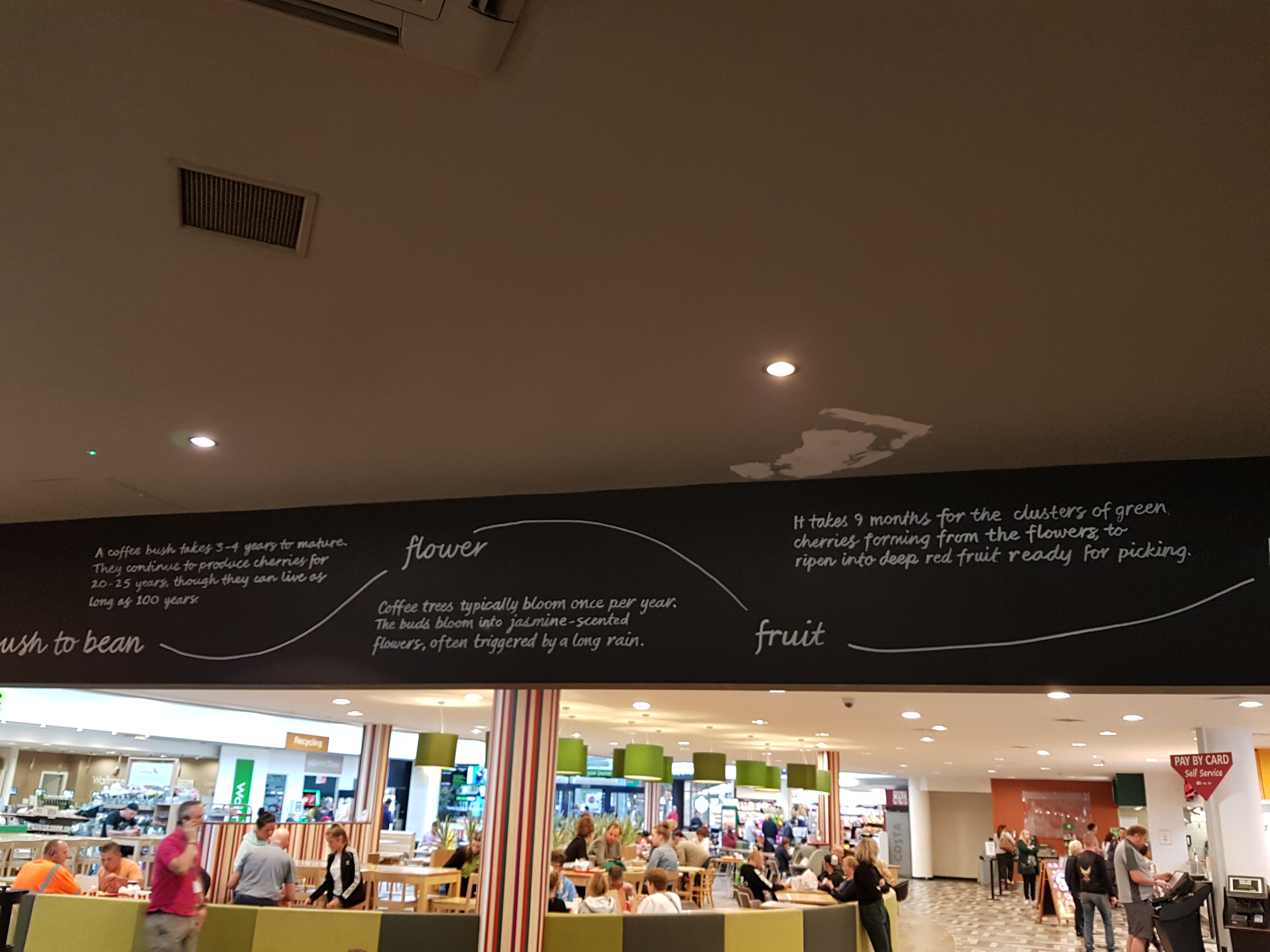
If I drive for two hours or so I have to take a break and top up with at least a coffee, possibly also a snack, certainly lunch at the appropriate time.  Last Friday, en route to Harwich, we stopped off at a motorway service station that had a Starbucks.  Whilst waiting for my coffee (Americano, no milk, thank you very much) I noticed that there was quite a lot of text on the walls all about where and how coffee grows, its cultivation and harvesting, and so forth.  Being the sort of ecologist who is interested in how plants flower and set fruit I focused on the relevant text (see the photo above).  It’s a little indistinct but, in essence, this is what it says:

“Coffee plants flower once a year…..the flowers are jasmine scented….and then some magic happens….and nine months later you get coffee fruit”

Okay, I made up the bit about “magic” but, seriously, that’s what is implied by this text: that by some hocus pocus, coffee flowers turn into the coffee fruit that contain the beans.  No mention made of the fact that pollinators (mainly wild and managed bees) are important in this process.  Although coffee can self pollinate (which is fairly magical I suppose) without the pollinators we would have much less coffee of poorer quality.

In my recent review of pollinator diversity and conservation I did some back-of-the-envelope calculations of coffee production to illustrate the dependence of modern human society on animal pollination. Here’s what I wrote:

“Coffee is pollinated by a range of wild insects (mainly bees) and managed honeybees (Ngo et al. 2011), is second only to oil in terms of its value as a commodity [turns out this is not true – see below*], and supports millions of subsistence farmers. Global coffee production in 2016 amounted to 151.624 million bags, each weighing 60kg (International Coffee Organisation 2017). One coffee bean is the product of a single fertilisation event following the deposition of at least one pollen grain on a flower’s stigma. The mean weight of a single coffee bean is about 0.1g which means there are approximately 600,000 beans in a 60kg bag. The total number of coffee beans produced in 2016 is therefore 151.624 million bags multiplied by 600,000 beans per bag, which equals 90,974,400,000,000, or >90 trillion coffee beans. However coffee is on average 50% self pollinating (Klein et al. 2003) and a single bee visit may pollinate both ovules in each coffee flower, so we can divide that figure by four: nonetheless global coffee production requires at least 22 trillion pollinator visits to flowers. Clearly the global coffee market is supported by many billions of bees that require semi-natural habitat as well as coffee plantations in order to survive”.

I don’t want to pick on Starbucks, it just so happens that that’s where we stopped, and I have certainly seen similar displays in Costa, for instance, with again no mention of bees.  Apparently Starbucks et al. don’t want to acknowledge the role of these bees in supporting their (very lucrative) industry, at least not in the cafes themselves.  If you Google “Starbucks pollinators” then you find some information online about how the company values bees, etc. etc.  But come on coffee sellers, you’re better than this, let the public know in the places where the public goes!  If you need advice from an expert, someone to write some text for you, I’m more than happy to act as a consultant.


*Even careful scientists get things wrong sometimes – this is a myth as you can read if you follow this link.


References

International Coffee Organisation. 2017. Coffee production statistics for 2016. http://www.ico.org/prices/po-production.pdf Accessed 20th June 2017

Klein AM, Steffan-Dewenter I, Tscharntke T. 2003. Fruit set of highland coffee increases with the diversity of pollinating bees. Proc. R. Soc. B. 270: 955–961

Ngo HT, Mojica AC, Packer L. 2007. Coffee plant – pollinator interactions: a review. Can. J. Zool. 89:647–660