Category Archives: University of Northampton

Academics from less privileged backgrounds share their stories

2015-02-18 10.00.04

Early summer 1995 and I’m in Northampton for the first time in my life, being interviewed for the post of Lecturer in Ecology at what was then Nene College*, the institution that evolved into the University of Northampton a decade later.  The interview went well, as I was offered the job, but I was very irritated by one of the comments made by a senior member of the panel (now retired).  He asked me about my background and how I came to this point in my career, and whether my parents had been to university.

This had no relevance to the job I’d applied for as far as I could see, but I responded that my father had originally been a coal miner, then subsequently had worked in construction, my mother a housewife with occasional part-time cleaning jobs.  I’d attended a large local comprehensive school in the North East and achieved terrible grades at A-level, and had eventually got to university by a rather circuitous route.

“Oh” said the panel member superciliously “You’ve done very well for yourself, haven’t you?”

My initial reaction was that I wanted to say: “Yes, with a good first degree and a PhD, I have done very well for myself, thank you very much, but I don’t need you to tell me that so fuck off and stop being such a patronising prick”.  But I needed a job and figured that this response was unlikely to go in my favour.  So I quietly agreed and seethed on the train home.

Why am I telling you this story?  Because there’s a great article over at the Times Higher’s website by Caroline Magennis, who asked a question on Twitter about how academics from less privileged backgrounds felt about their current roles and some of the barriers they had had to face.  It’s well worth reading; a bit of clueless condescension in a job interview is at the low end of a spectrum of experiences that people have shared with her.

*NEN College, not NEEN College

The uneasy academic and the importance of dipping outside your discipline: reflections on The Urban University conference

Uneasy Academic 20141011_144756

It’s important for academics to occasionally move out of their disciplinary comfort zones and to interact with academics and practitioners from beyond their own silos, experiencing approaches that are alien and hearing voices that are not repeating the normative values of their own subject area.  Time spent in this way can be both stimulating and mundane, enlightening and boring, exciting and frustrating.  Above all, unpredictable.  At an ecological conference I know what I will experience; drop me into one devoted to the arts or social sciences, and anything can happen.  It’s an uneasy experience.

With that in mind I spent the end of last week attending a conference at which I was the lone scientist speaker, and indeed one of the very few people with a science background in the audience, as far as I could tell. The Urban University was sub-titled “Universities as place makers and agents of civic success in medium sized towns and cities” and was largely aimed at urban planners, architects, policy makers, and social geographers.  Not muddy boots ecologists.  However I’d offered the organisers (the University of Northampton’s Collaborative Centre for the Built Environment) a 30 minute talk about the monitoring work we’ve been doing on the bird assemblage at Northampton’s new Waterside Campus, which I discussed in an earlier post. The abstract for my talk is below, co-authored with my colleagues Janet Jackson and Duncan McCollin, plus two of our undergraduate students, Jo Underwood and Charlie Baker.

I had hoped that providing a very different perspective on the role of an urban campus, one focussed on the biodiversity it can potentially support and the ecosystem services that stem from it, might be of interest to this broad-based audience.  In the back of my mind I also thought it might be fun to reverse roles and, for 30 minutes, make them the uneasy ones.  It’s always hard to judge but I got the impression afterwards that the talk was well received and it elicited some discussion and questions.

Overall it was a stimulating couple of days and (I think) I’ve learned a lot, or at least learned more about the approaches and priorities of academics and practitioners beyond my immediate field. The talks ranged from the rather abstract to the very practical, from theoretical discussions to local activism. Particular highlights for me were:

John Goddard‘s overview of the relationship between the university and the city, and the fact that many academics don’t feel a personal link, or responsibility, to the urban centre in which they work.

Allan Cochrane discussing the unintended consequences of a university’s economic and social power, including gentrification and studentification of local residential areas.

Robin Hambleton on universities as a corrective to “placeless power”, i.e. multinational firms that can facilitate enormous social and economic change in an area despite having no geographic connection to the place.  Of course the internationalisation agenda of most UK universities means that they may themselves be in danger of wielding placeless power overseas.

Michael Edwards recounting how UCL academics and students have engaged in local activism in North London, for example fighting destructive planning applications, and sometimes positioned on the opposing side to the university itself.

Wendy Cukier on the experience of her Canadian university’s role as a “changemaker”, and the value of the Ashoka U Changemaker Campus programme, to which the University of Northampton is committed.

Cathy Smith on the medieval origins of the original University of Northampton, which was dissolved in 1265.  By happy coincidence 2015 is both the 750th anniversary of that dissolution and the 10th anniversary of the current University of Northampton’s full upgrade to university status in 2005.

The conference strongly impressed upon me the fact that academics sometimes take their institutions for granted in the sense that they don’t reflect on, or even challenge, the role of higher education within their geographical location. There may even be a danger of this becoming more pronounced as, in the rush to internationalise and chase overseas student fees, we in fact forget the physical and historical roots of our institutions.

Above all the two days I spent trying to navigate these unfamiliar waters reinforced my belief that it can be very dangerous for academics to isolate themselves within their disciplines, no matter how comforting and familiar that may be.  If the only voices that you are hearing (audibly and on the page) are the ones that are telling you stories that you already know and understand (even if you don’t agree with them) then it can be very easy to drift into a kind of disciplinary complacency in which you take the (self) importance and role of your own subject area for granted, without any external perspective on how it might be perceived by those beyond your academic boundaries.

Taking the occasional disciplinary leap could involve as little as going to a seminar in another department, or widening your reading to include areas beyond your subject.  Attending and presenting at a two day conference involves a greater commitment of time and energy, but it’s worth the effort.  It’s an approach to academia that I’ve tried to follow over the past 25 years and I’d recommend it as a way of broadening perspectives.  Sometimes it’s good to feel uneasy.

Many thanks to the organisers of The Urban University conference, particualrly Sabine Coady Schaebitz and Bob Colenutt, for their hard work in putting together such a great couple of days.  Here’s the details of my talk:

Biodiversity monitoring on urban university campuses

Jeff Ollerton, Joanne Underwood, Janet Jackson, Charles Baker & Duncan McCollin

Biodiversity, the variety of species and habitats to be found in a defined area, is a critical component of the natural world, and the ecosystem services that it provides supports modern society in economically tangible ways.  Urban campuses have long been acknowledged as supporting significant biodiversity, as evidenced by the many universities that have written biodiversity action plans.  However there has been relatively little quantitative research published on the biodiversity of British urban campuses, and how that diversity changes over time, particularly with respect to large-scale infrastructure development.  Academics and students in the Department of Environmental and Geographical Sciences have been collecting data on the biodiversity of Park and Avenue Campuses for more than 20 years, including plants, invertebrates, mammals, and birds.  This talk focuses on bird diversity as birds are an indicator group for assessing ecosystems, and are arguably the best understood group of species in the UK.  We present data on the birds that have been recorded on these campuses from 1993 to 2015, assessed in terms of their UK conservation status.  We then discuss the potential impact of the new Waterside Campus on the existing bird assemblage of the site, and present preliminary data showing how bird diversity has changed since building work began.  We end by discussing whether it is possible to maintain or even enhance bird diversity and abundance at the new campus.   The location of Waterside Campus, within the Nene Valley Nature Improvement Area and in close proximity to internationally important wetland bird sites, means that the University of Northampton has a civic duty to maintain the biodiversity of its campuses.

Note: in the end I actually didn’t include the data from Park and Avenue campuses, there wasn’t time to fit everything in!

Some basic tips for PhD students for giving effective conference presentations

One of the advantages of working in a relatively small, non-research intensive institution such as the University of Northampton is that events such as yesterday’s Annual Postgraduate Research Conference expose staff and research students to a diversity of topics and approaches, beyond the narrow silos of our own disciplines.  I spent the day listening to talks as varied as 21st century Gothic fiction, sediment sources in an English river; automating traffic control systems; and the role of younger grandmothers in raising their grandchildren.

It was a great day, very stimulating. However it struck me that whilst the research was sound, in some cases (certainly not all) the presentation of the research could have been improved.  I’m writing this in the spirit of a recent discussion over at Dynamic Ecology about the “advice” posts that they present and why they are so popular.  It seems like the consensus in the discussion is that often supervisors (or advisors as they are called in North America) often neglect to give some basic advice to their graduate students, assuming that they already know those “basics”, and focus instead on very detailed, technical advice.

Conference presentation skills are one such set of basics which, although covered by many universities in their training programmes (Northampton included) need to be reinforced by supervisors and by practice.  In my opinion, the following advice applies to all disciplines, not just the sciences:

1.  Always use a visual aid, such as PowerPoint, even if you think you don’t need it. Even a single slide with your name and the title of your presentation provides a context and focus for your talk.  Better still would be some information about the structure of your talk  on a second slide – “free-form” talks rarely work unless you’re an exceptional presenter.

2.  On PowerPoint, etc. use an absolute minimum text size of 18pt, preferably larger.  This includes graphs, tables, figure legends, screen shots, etc.  Anything smaller is not going to be visible beyond the third row of the audience unless you’re projecting onto a giant screen.  And do you know for certain that the venue has a big screen?

3.  Related to that, use the full width and height of your slides, don’t cram text and figures into the middle.

4.  Keep text to a minimum – just bullet points to give you a prompt as to what you’re going to say.  These bullet points don’t need to make complete sense to the audience as long as they give you that prompt: you’re talking, not reading.

5.  Ask someone (a friend, your supervisor) to double-check all your spelling, grammar, spacing, formatting, etc.  It’s well known that we read what we think is there, not what is actually there.

6.  A good rule of thumb for most presentations is to use more-or-less one slide per minute.  So if your allotted time is 10 minutes, use about 10 slides; if it’s 30 minutes, use about 30 (not including introduction and acknowledgements slides).  Do not try to fit 15 minutes worth of material into a 10 minute talk, it will irritate your audience and your conclusions at the end will be garbled and unclear as you rush to finish.  You can ALWAYS effectively summarise your research into the time allotted – don’t complain that you can’t.

7.  PowerPoint etc. provide all sorts of fancy backgrounds for slides, wonderful fonts, including shading and 3D, tricksy text animations, etc.  Don’t use any of them.  Keep your backgrounds a plain neutral colour, your font a basic sans serif (Trebuchet is my personal favourite), and don’t use animations unless they are really adding to what you’re saying, or building suspense by introducing elements one at a time.

8.  Tell a story.  Start with a broad introduction, take the audience on a journey through your work in logical order, and sum up at the end.  Then let your audience know that you’ve finished by saying something like: “Thanks for your attention, I’d be happy to answer any questions”.  Don’t just stop talking and stare at the audience.

9.  Stay focused and relevant to what you’re presenting.

10.  Enjoy yourself.  It’s hard the first few times but it gets easier.

Finally I should add that I’ve seen mid- and late-career researchers make these kinds of errors, it’s not just PhD students! Feel free to share your own tips, or to disagree with any of these.

A University of Northampton student interview about bees and pollinator declines

A few weeks ago I was approached by Kady Middleton, a first year undergraduate student studying journalism at the University of Northampton, to be interviewed for a short radio-interview style report that she was putting together as one of her assignments.

The topic was urban bee diversity and pollinators declines – Kady had seen my blog post about urban bees in Northampton.  I was very happy to oblige and I think that Kady’s done a great job; it’s a nice example of how very different university departments can cooperate and collaborate.  You can listen to Kady’s report here:

A plant-pollinator walk-and-talk, Bradlaugh Fields, 14th June

bradlaugh-fields-walk-in-the-meadows-14th-june-2015-007

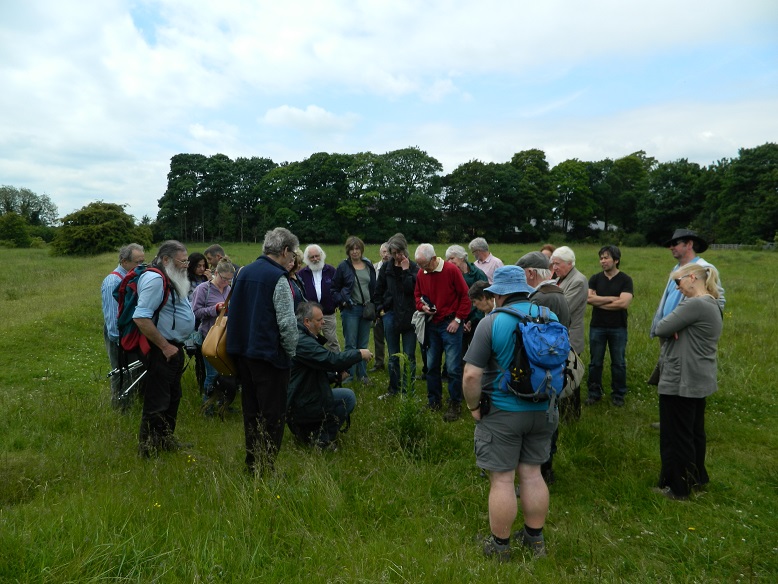
Yesterday afternoon I spent an enjoyable couple of hours leading a group of over 30 people around the nature reserves of Bradlaugh Fields in the centre of Northampton.  The participants were a combination of members of the Northants Natural History Society and local residents who regularly use the park.

We discussed the ecology of the area, focussing on the plants and how they are pollinated.  It was great to see such a range of ages on the walk, and a pleasure to tell them some interesting stories and answer their questions.  Over at the Bradlaugh Fields Visitor blog, Serena (who took the picture above and who organised the event) has a fuller account of the day.

How does a scientist’s h-index change over time?

Since its introduction a decade ago the h-index has rapidly become the most frequently used measure of research productivity and citation impact amongst scientists.  It’s far from perfect and has been criticised from a number of perspectives, particularly when used as a blunt tool for assessing a scientist’s “quality”.  Nonetheless it’s a useful measure that allows some comparison within research fields and (I think more importantly) gives individuals one method, amongst any number, of assessing the influence their work is having on their discipline.

Put simply, an individual’s h-index is calculated by ranking their publications by number of citations; the point at which the rank position of a publication is at least equal to the number of citations for that publication is the h-index.  For example, if a scientist has 18 papers all with at least 18 citations, their h-index is 18.  As soon as another publication reaches 19 citations, their h-index will go up to 19, and so forth.

That’s an important point about the h-index (and indeed all other measures of success/impact/whatever) – they are not static and they change over time.  As the Wikipedia entry that I linked to above notes, the originator of the index, Jorge Hirsch, suggested that 20 years after their first publication the h-index of a “successful scientist” will be 20; that of an “outstanding scientist” would be 40; and a “truly unique” scientist would have an h-index of 60. However, this will vary between different fields, so any comparisons are best done within a discipline.

One question that I’ve not seen widely discussed is how an individual’s h-index changes over time (though see Alex Bateman’s old blog post about “Why I love the h-index“, where he refers to the “h-trajectory”).  Does the “successful scientist” typically accrue those 20 h-index points regularly, 1 point per year, over the 20 years?  Or are there years when the h-index remains static and others when it increases by more than the average of 1 point per year?  If the latter, what’s the largest annual leap in an h-index that one could reasonably expect?  Finally, if we were to plot up the h-index over time, what shape curve can we expect from the graph? [2026 UPDATE: see the comments below about the fact that an h-index can, in rare circumstances, go down].

On one level these are purely academic questions, the result of some musing and window gazing during a bus ride between campuses a couple of weeks ago.  But there’s also a practical aspect to it, if scientists wish to track this measure of their career progression.  For an early career scientist starting out with their first few publications, it’s easy to record their h-index as it changes over time from this point forward.  But what about a mid- or late-career scientist who started publishing long before the h-index was even thought of?  How do they reconstruct the way in which their h-index has evolved over time, should they be so inclined?

As far as I know there’s no simple, automatic way to do it (but please correct me if I’m wrong).  Indexing and citation systems such as Web of Science and Google Scholar give the current h-index and no indication of past history, you have to work it out for yourself.  Which is what I’ve done, and the procedure below is (I think) the most straightforward* way of reconstructing the evolution of an h-index.

So, pour yourself a cup of coffee** and settle in for a bit of academic archaeology.

I’m going to demonstrate the process using Web of Science (WoS)***, but it should be identical in overall procedure, if not in detail, in Google Scholar, Scopus, etc.  However be aware that Google Scholar is much less conservative in what it counts as a citation, hence h-indexes from that source are typically significantly higher than from others.

The first thing to do after you’ve logged on to WoS is to perform a Basic Search by author name, across all years; I’ve done this for All Databases as some of my**** publications (specifically peer-reviewed book chapters) are not listed in the WoS Core Collection database (the default selection):

Screen Shot 1 2015-05-10 at 08.03.59 copy

Perform the search then select Create Citation Report.  This will return a pair of graphs showing number of publications per year and number of citations per year, plus a table with some metrics about average citations per year, etc., and a value for the current h-index of that author:

Screen Shot 2 2015-05-10 at 08.12.12 copy

Below that is a list of publications for Ollerton, J ranked by number of times cited:

Screen Shot 3 2015-05-10 at 08.31.13 copy

As you can see, WoS indicates that the h-index of Ollerton, J is 23.  That’s incorrect, it’s actually 22 (i.e. a not-quite-successful scientist) because despite having a relatively uncommon name, there are other people called Ollerton, J who publish (including my cousin Janice).  However it’s a simple matter to remove any publications that are not your own using the check boxes against each publication and the “Go” button.  Ignore any publications that are ranked lower than your h-index.

Once you have a clean list, use the drop-down menu underneath the page to save your list as either a text or Excel file; again, just save the publications that are contributing to your h-index by choosing the number of records that corresponds to your h-index [UPDATE: however see Vera van Noort’s comment below about the possible influence of early publications that were only cited once or twice on your early h-index.  UPDATE x 2:  see also the later comments by Alex Bateman and Vera – later publications can drop out of the h-index list too.  This wasn’t an issue for my set of publications, but it’s worth checking if you’re following this procedure].

The Excel***** file is easiest to work with: it provides you with the two graphs shown on the WoS citation report plus details of the publications, average citations and so forth, and all the raw data on number of citations per year back to 1950 (click on each image for a larger view):

Screen Shot 4 2015-05-12 at 16.22.15 copy

To make the spreadsheet easier to work with I advise deleting all the stuff you don’t need, including the figures and the columns from 1950 up to the date of your first publication.

You now have to calculate cumulative number of citations over time for each publication using the Sum function (I’ll not go into details, should be straightforward if you know your way around Excel).

Next, copy all of the data and paste-special onto another sheet, selecting “values” (to just paste the data, not the formulae) and “transpose” (to turn the data 90 degrees) from the paste-special options.  Remove the original data to just leave the cumulative citations and then select all of the data and use the Custom Sort function to order the rows by by date of publication:

Screen Shot 4 2015-05-14 at 09.24.38 copy

Now it’s a matter of going along the columns and recording the number of publications that exceed the h-index for the previous column; I’ve colour-coded this below to make it easier to see:

Screen Shot 6 2015-05-14 at 08.37.38 copy

Finally, graph up the data:

Screen Shot 7 2015-05-14 at 09.05.41 copy

The results are interesting (or at least I think so).  In relation to the questions I posed above its clear that there are periods when the h-index doesn’t increase for a couple of years; more periods when the h-index increases by one each year; and a couple of years when the h-index increases by 2 points.  But that’s the maximum and I suspect that increasing by 3 or more index points in a year would be very unusual indeed (though see my second point below).

Although there’s a clear “lag phase” in the first five years when the h-index hardly changes, there are also periods when there’s no increase in h-index much later, e.g. 2013/14, so this stasis is not restricted to the beginning of my career.

Some final points:

1.  Make sure your citation data on Web of Science is accurate.  I have found LOTS of mis-citations of my publications over the years, by  authors who include incorrect dates, volume numbers, page numbers, even authors, in the references they cite.  WoS has a facility for correcting these mis-citations, but you have to let them know, it’s not automatic.

2.  How representative are my results for the population of ecologists or scientists more generally?  I have no idea but I hope others go through the same procedure so that we can begin to build up a picture of how the h-index evolves.

*No doubt this could be automated in some way and perhaps this will stimulate some competent programmer or app developer to do so, but doing it by hand is so straightforward that I’m not sure it’s worth the effort of constructing a working system.  Certainly the Excel part of the procedure could be done more elegantly in R.

**Other beverages are available.

***Other indexing and citation systems are available.

****Other scientists are available 🙂  But it doesn’t seem fair to use someone else as an example.  In any case, consider this another post reflecting on my life and career in my 50th year on this planet!

*****Other spreadsheets are available.  That’s the last one, promise.

Urban bee diversity – a new study

Bee on apple blossom 2 - 1st May 2015

Over the past couple of years I’ve mentioned urban pollinators, and specifically the work of my PhD student Muzafar Hussain Sirohi, several times; for example here and here.  Muzafar is currently finishing off the writing of his thesis, and during that time he’s also managed to publish the first paper from the study.

We are really pleased with this paper because not only is it the product of a lot of hard work to systematically sample and identify the bees, but the results are really exciting: Muzafar has shown that the centre of Northampton is home to a more diverse set of bee species than expected. In fact at least 50 species of bees are thought to live within a 500m radius of All Saints Church, which is significantly more than are found in the nature reserves at the edge of the town.

Muzafar’s work involved surveying the small gardens, road verges, traffic islands, and other patches of plants in the urban centre of Northampton.  These areas provide important nectar and pollen sources for the bees, whilst old stone walls and bare soil offer opportunities for nesting sites. This community of bees includes one nationally rare Red Data Book species called Coelioxys quadridentata that is known from rather few sites.

Our estimate of about 50 species of bees is certainly too low because we focussed on the more neglected groups of bees and didn’t include the social bumblebees. The true figure is likely to be over 60 species, a remarkable number given the small area surveyed.

As I’ve discussed many times on this blog, pollinators such as bees are hugely important both ecologically (most plants require them for reproduction) and economically (much of our food production relies directly or indirectly on pollination by animals). However a significant proportion of bee species in the UK are declining in abundance, and some have gone extinct. Understanding how these bees are distributed across the landscape, including urban areas, is crucial to the conservation of such pollinators in a rapidly changing world. The project therefore has implications not only for conservation of biodiversity, but also food security, given the number of urban gardeners who grow their own food, and the ability of many bees to travel significant distance from urban to rural areas.

The research is published in the international, peer-reviewed Journal of Insect Conservation. The full reference (with a link to the abstract) is:

Sirohi, M.H., Jackson, J., Edwards, M. & Ollerton, J. (2015) Diversity and abundance of solitary and primitively eusocial bees in an urban centre: a case study from Northampton (England). Journal of Insect Conservation DOI 10.1007/s10841-015-9769-2

If anyone would like to receive a PDF of the paper, please leave a comment below or drop me an email: jeff.ollerton[at]northampton.ac.uk

How do animals respond to solar eclipses? Please share your observations.

P1120154

If you have been anywhere in the Palearctic during the past 48 hours then you can’t have missed the fact that we experienced that most rare of astronomical phenomena, a solar eclipse.  The eclipse was total only as far north as the Faroe Islands and Svalbard; further south it was partial and here in Northampton the eclipse was perhaps 80-90% total.

It’s been big news with lots of public interest.  As well as explaining the astronomy of eclipses, various commentators on current affairs and science programmes have talked about how animals respond to eclipses.  This is a topic that’s intrigued me ever since the August 1999 eclipse.  During that event I was carrying out field work in a Northampton grassland and as the eclipse reached its maximum the bumblebees and butterflies on the site stopped flying and foraging, and settled into the grass.  Once the eclipse had passed they carried on as before.  I don’t have any hard data to demonstrate the effect, it was purely an observation of what was happening around me.

Since then I’ve waited over 15 years for the next opportunity to observe how solar eclipses affect animal behaviour.  Unfortunately there are few pollinators flying at the moment so I had to content myself with watching the gulls, woodpigeons, carrion crows and other birds on the Racecourse park adjacent to the university.

P1120144

This time I took some video footage before, during and after the eclipse, noted the birds’ behaviour, flying, calls and singing.  And guess what? As far as I could tell the eclipse had no effect on the birds!  They behaved as if nothing was happening.  Even a mistle thrush than had been singing all morning from a perch in one of the boundary lime trees continued its song as the moon passed in front of the sun.

That really surprised me!  I was expecting the birds to at least reduce their activity as has been noted in previous eclipses.  But they didn’t as far as I could tell.  Perhaps it was the type of birds I was observing?  Or the time of year?  Or the fact that the eclipse was only partial?  Lots of questions but it’s difficult to do repeat observations for this kind of science – the next British total eclipse is not until 2090!

What did you see?  Did you notice any effect of the eclipse on animal behaviour?  Or did you, like me, see no effect of the eclipse.  I’d be interested to hear your observations.

P1120136

Something for the weekend #3

The latest in a regular series of posts to biodiversity-related* items that have caught my attention during the week:


  • A new report by WWF documents over 1000 new species discovered in Papua New Guinea between 1998 and 2008, and the risks to their survival from logging and other human activities.


  • How does history inform ecological restoration?  Ian Lunt has a great post on this topic.


  • In the latest in a series of high-profile rewilding initiatives, the conservation charity Lynx UK Trust has launched a survey to elicit public views on their proposal to reintroduce these large cats – make your views known here.


  • The University of Northampton’s annual Images of Research exhibition is available to view online and you can vote for your favourite three images.  Now I’m not saying that you should vote for “An ecosystem in a cup”.  But you could.  If you wanted to.


  • Staying with the University of Northampton, the Press Office has made me the first Staff Blogger of the Month.  Which is nice.  Not sure exactly how many other staff blog, but my impression is that it’s not many so it may be only a matter of time before I’m honoured again.  I thought I’d share what I wrote when asked about why I blog:

“Why do I blog? The main aim is to communicate the science relating to the importance of biodiversity and ecosystem services (and therefore why we need to conserve species and habitats) to as wide an audience as possible, including the general public, students, non-governmental organisations, businesses, and policy makers, as well as other academics.  Some of that communication relates to examples from our own research, and I also draw on the work of others in the field.  A secondary aim is to give my students a flavour of what it is that I actually do in the rest of my job: teaching is only part of the story!”


  • All of which links nicely to the recent post by Jeremy Fox, and subsequent discussion, over at Dynamic Ecology about whether science blogging (and specifically “ecology” blogs, whatever they might be) is on the decline.  For what it’s worth, I don’t think it is and I also think that the definition of what “ecology” blogging actually covers is much wider than the discussion suggests.


Feel free to recommend links that have caught your eye.

*Disclaimer: may sometimes contain non-biodiversity-related links.

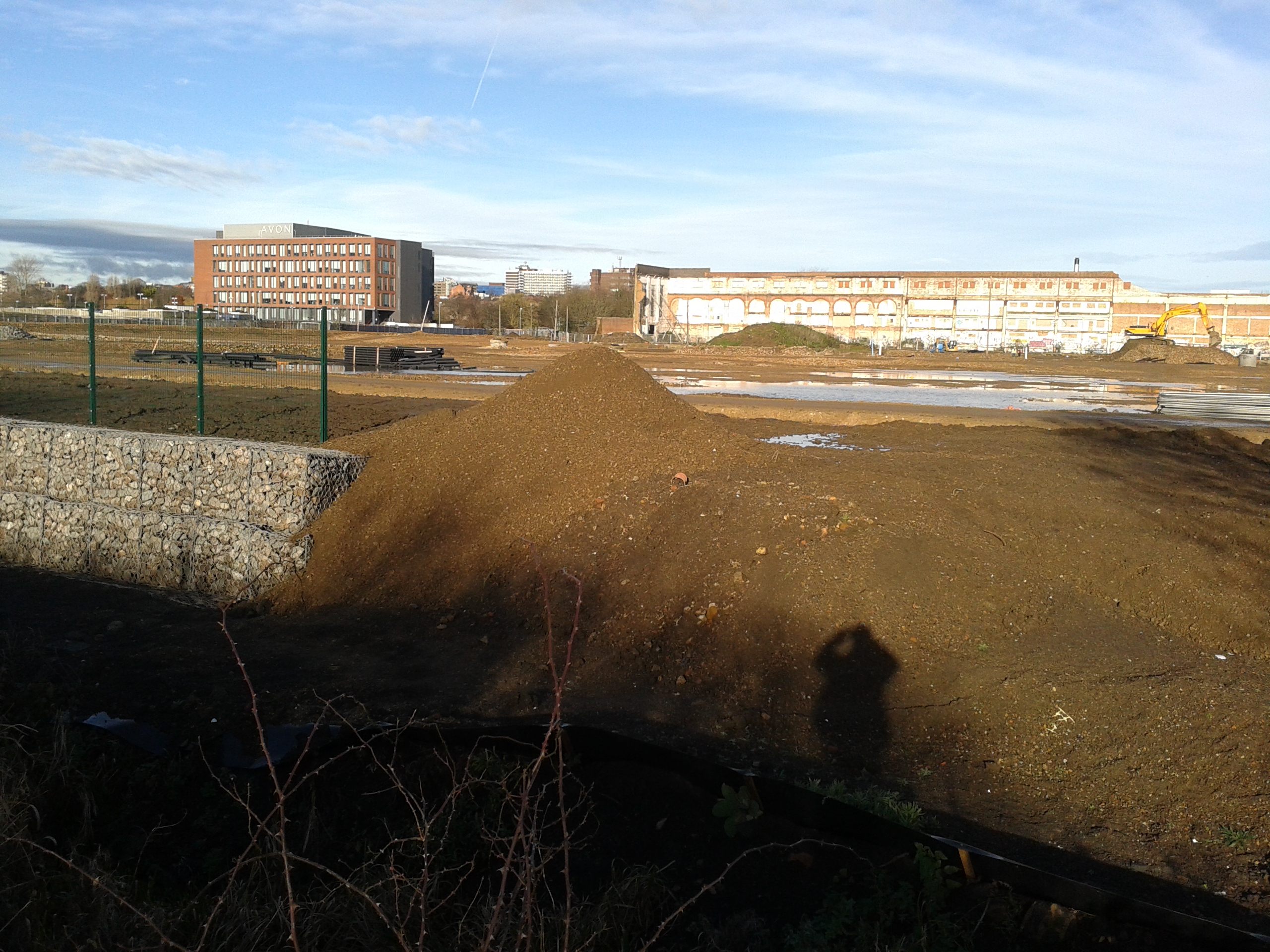
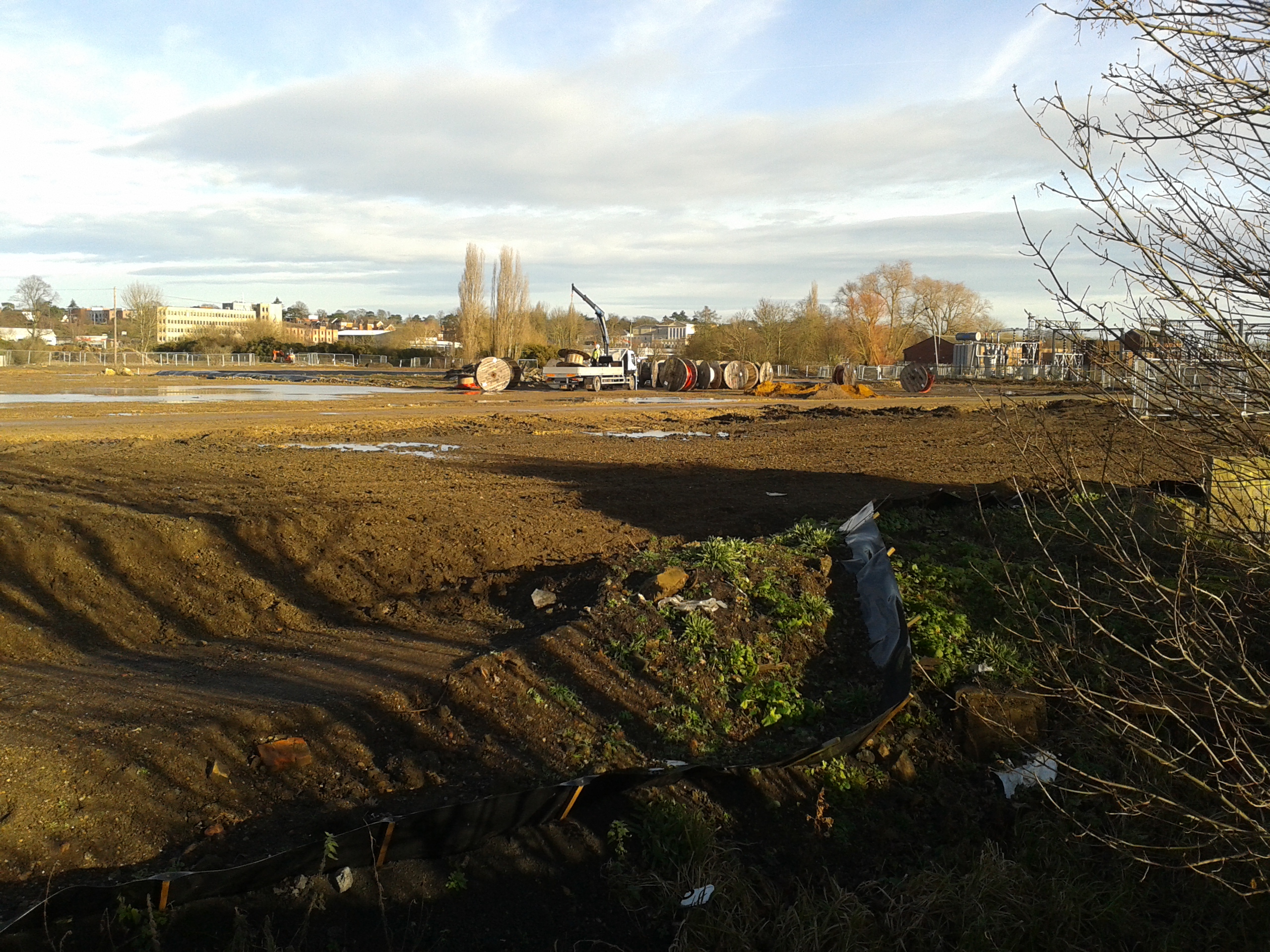
Monitoring the biodiversity impact of the new Waterside Campus

Waterside winter 2014-15 - 2

All human activities can potentially have an impact on the biodiversity of the local environment in which they occur.  That impact can be positive or negative, depending upon how the activity is managed, how impact is mitigated, and the metrics that we use to measure the effects that are occurring.  This is particularly true of large infrastructure developments such as big buildings,  housing developments, roads, and, a category close to home for me at the moment, new university campuses.

I’ve written before about the University of Northampton’s plans to build the new Waterside Campus on brownfield land close to the River Nene, here and here.  It’s a huge project, likely to cost in excess of £330 million on a site covering about 20 hectares.

As you might imagine, such an ambitious scheme has not been without its controversies and there is much debate within the university about changes to how we work and interact with colleagues and students, provision of teaching and research spaces, etc.  There’s also been much discussion within the town, though the general feeling amongst the public (as far as I perceive it) is that bringing the university closer to the centre of Northampton will provide a much-needed economic boost and add significantly to the town’s life.

But what effect will such a development have on the wildlife in and around this peri-urban site, given that it’s in the middle of the Nene Valley Nature Improvement Area and very close to internationally important bird sites?

Over the past few months, together with my colleague Dr Janet Jackson, I’ve been taking part in meetings with the Waterside project’s landscape architects (LUC), other partners from the NIA project board, and the local Wildlife Trust. We’ve been discussing the current plans for the green infrastructure of the campus and thinking about how these can be enhanced.  It’s been a fascinating process as initial disagreements have been negotiated towards compromises and additions that everyone is happy with, balancing budgetary, function and space restrictions with habitat creation and landscape enhancement.

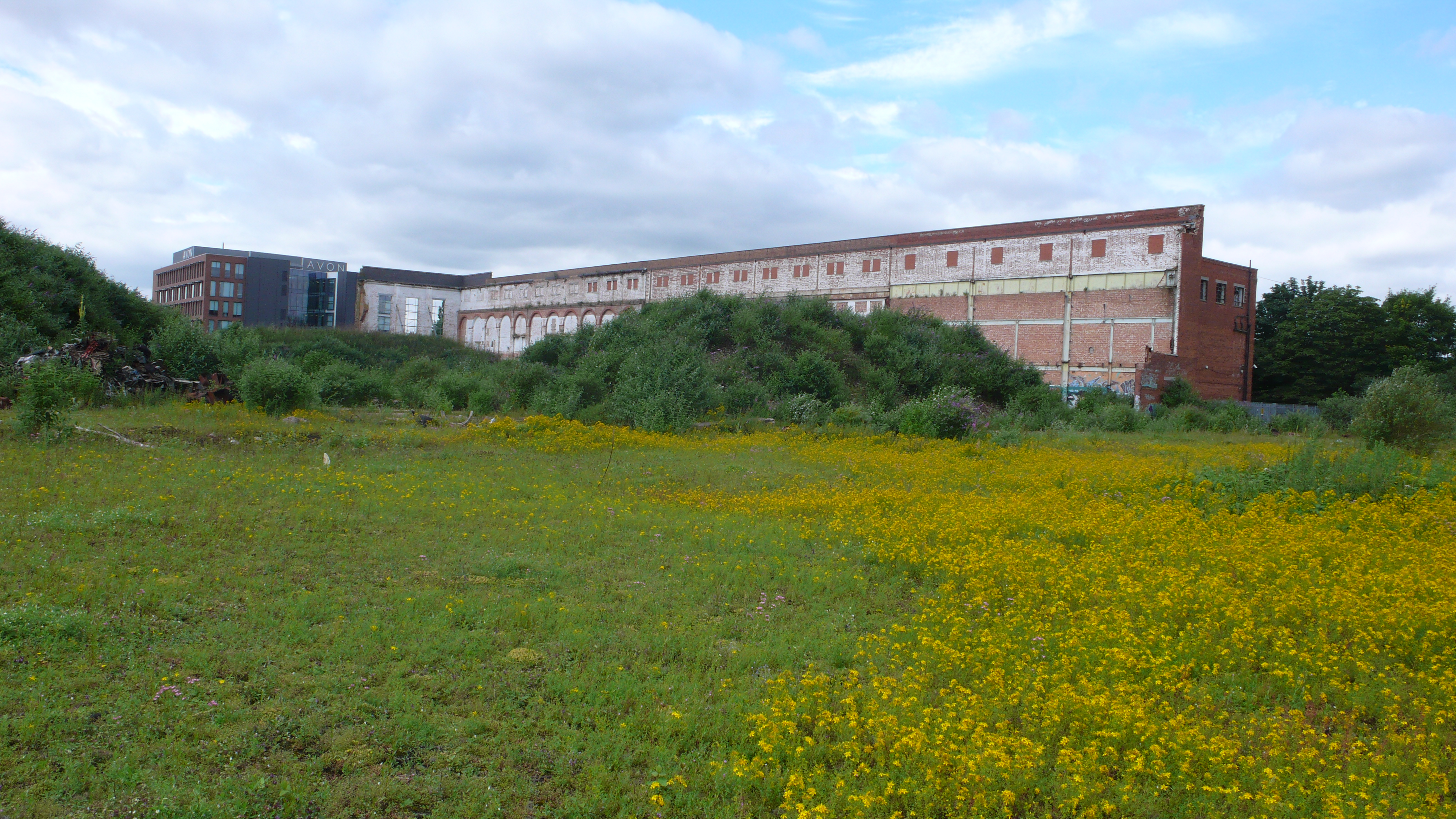
There’s too much been discussed to give a full account at this stage, and it’s possible that some details will change over time, but  the current Ecology Strategy document produced by LUC shows that there will be more than 10 hectares of habitat creation on the site, including species-rich grassland, woodland patches, brown and green roofs, swales and damp areas, and recreated brownfield habitat.  The latter is particularly exciting and something of an experiment, as much of the (albeit limited) current wildlife interest on the site relates to the brownfield element, including the “urban tundra“.

P1100110

To put the 10 hectares into perspective, the adjacent Wildlife Trust Local Nature Reserve of Barnes Meadow is only 20 hectares in area, so it’s potentially increasing that site by 50%.  It’s rare for academic ecologists such as Janet and myself to be able to influence large building developments, so this has been an exciting opportunity for us to make a contribution that (if all goes to plan) will have a positive effect on biodiversity conservation in the Nene Valley.

But how will we know if the Great Waterside Experiment has been a success and that the biodiversity of the new campus is at least as rich, and preferably richer, in species than it was before building took place?

Monitoring of the wildlife is key to this.  Fortunately we have some base-line surveys of birds, plants and invertebrates (including bees and butterflies) from before building started that we can compare with later surveys during and after the campus build.  That process has already started, and with my colleague Dr Duncan McCollin and with two keen second-year students, Jo and Charlie, we have already completed three winter bird surveys to get a sense of how the current site clearance and ground works is affecting the presence of birds in and around the development, including those using the River Nene.  The plan is to continue these surveys up to and after the campus opens in 2018, to give us a data series showing the influence of the campus on bird diversity and numbers.

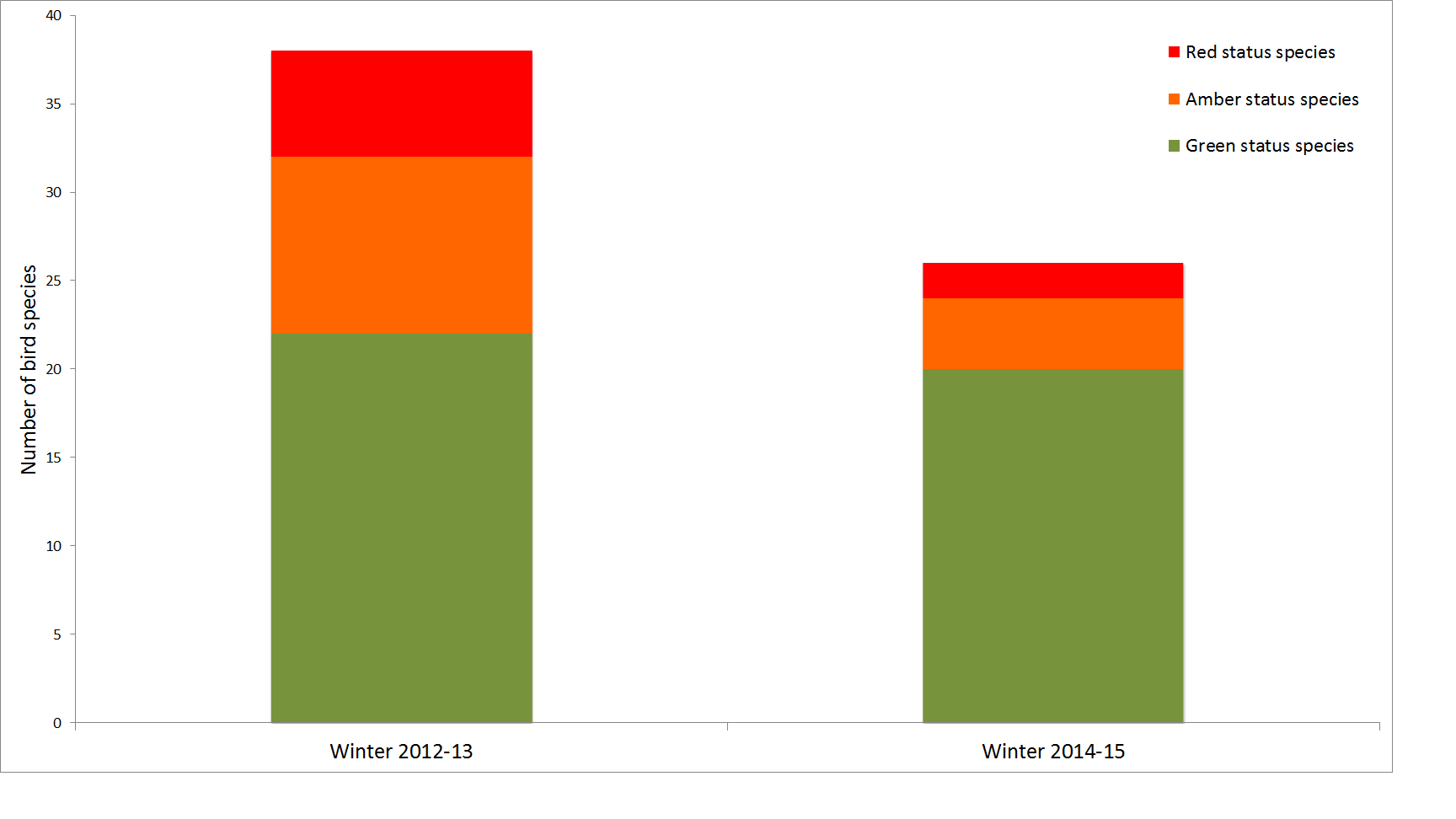
The initial results are currently being analysed and it appears that the current phase of building has reduced overall bird diversity by about 30%, and that red and amber status birds (of most conservation concern) have been affected more than green status birds, as this figure demonstrates (click on it for a closer view):

Waterside bird surveys

These rough figures hide a lot of detail, however.  For example, there has been some addition of species in 2014-15 that were not recorded in 2012-13, including Coot, Treecreeper and the amber-status Stock dove.  More importantly, some of the amber status birds that we didn’t record on site in 2014-15, we know from additional surveys are still present in habitats within 500 metres of the development, for example Dunnock, Green woodpecker, and Bullfinch.  Similarly, red status birds such as resident Starling, and winter migrant Fieldfare and Redwing occur within at least one kilometre of the site.  Hopefully as the building work progresses towards completion these (and other) species will return, so at the moment we’re not too concerned by their disappearance from the site.

Later in the spring we will conduct a couple of breeding bird surveys, and continue surveying for the next few years until the campus opens in 2018.  Only then will we see exactly how successful our influence has been.  In the mean time I’ll report back as and when we have more data to share.

Waterside winter 2014-15