Category Archives: History of science

Travelling west to go north (BES Macroecology meeting day 1)

2014-06-24 08.00.19

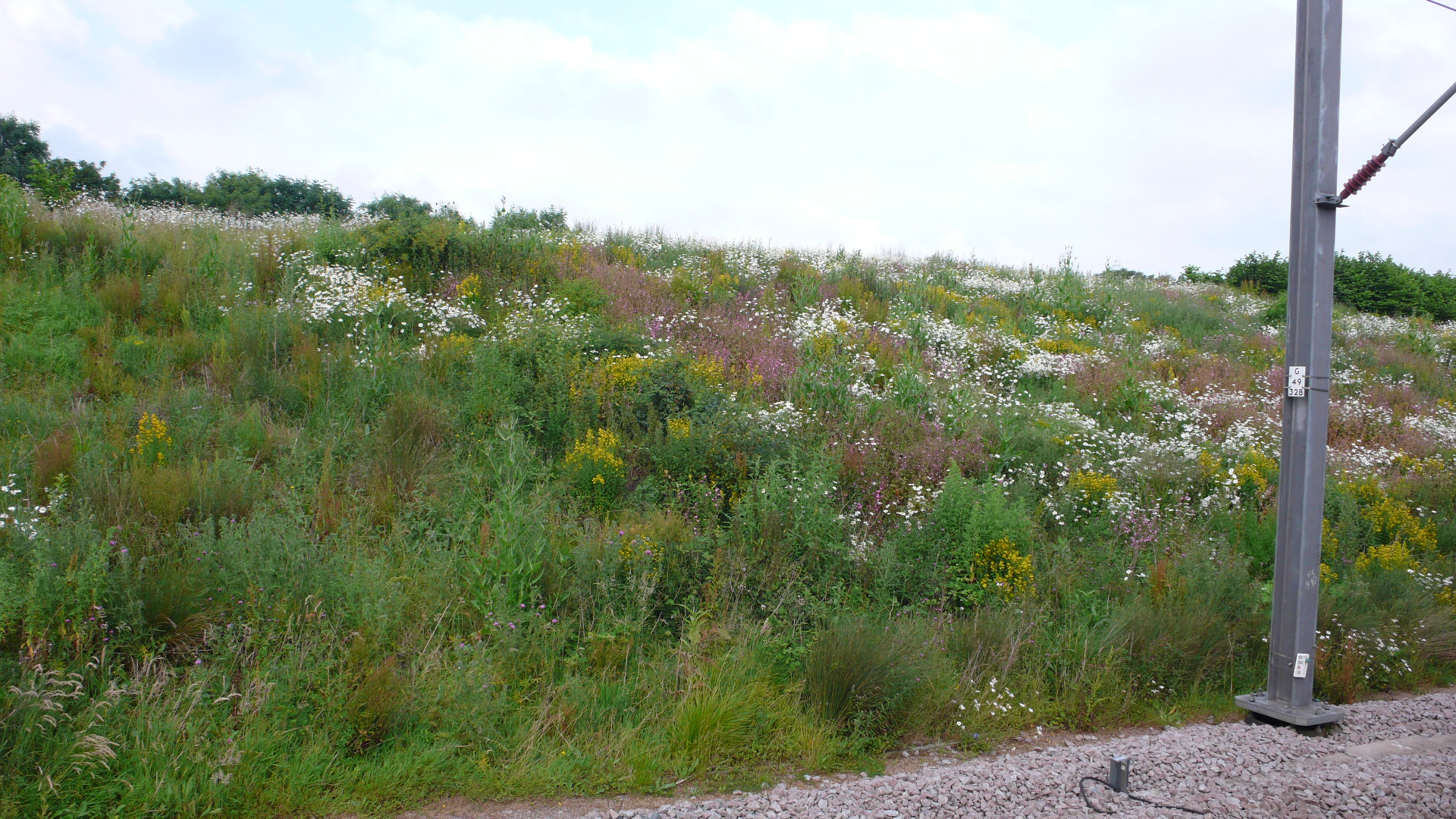
Birmingham New Street, with its subterranean platforms accessed by narrow concrete gullets, must be one of the ugliest and most unpleasant major railway stations in Britain.  It’s also, thanks to the redevelopment work currently being carried out, one of the most confusing for the traveller who only occasionally passes through.  Ugly and unpleasant I can handle if it functions well: but ugly and unpleasant AND confusing is not good.  It’s a huge contrast to Milton Keynes station which I went through last week on the way to Chester, where the open, airy platforms look out onto embankments covered in wild flowers (see the photo above).  While waiting for the train at Milton Keynes I spotted butterflies and bees visiting flowers only feet from passing high-speed engines.

As I start this post I’m sitting on Platform 9A at Birmingham waiting for a train at 0949 to Nottingham where I’m attending the British Ecological Society’s Macroecology Special Interest Group’s annual conference.  In fact I should be on the train which left platform 12A at 0919, but trying to find the unsignposted 12A, followed by a detour to pick up a coffee, meant that I missed the train by about a minute.  Not to worry, gives me an opportunity to rant about Birmingham New Street station.

The BES Macroecology SIG has been established for three years and I blogged about the inaugural meeting in London back in 2012.  I missed last year’s meeting in Sheffield so thought I’d make a special effort to get to the Nottingham event this year, even though it involves heading west (to Birmingham) to travel north (to Nottingham).

Day 1 of the meeting started with the first of two keynote addresses by Catherine Graham from Stony Brook University.  Cathy focused on her work on that most charismatic of flower visitors, the hummingbirds.  In the first talk she dealt with the importance of thinking about phylogenetic scale when conducting analyses.  Lots of thought provoking ideas and a huge amount of information to digest.

As I’m speaking on the second day I could relax and listen to some interesting talks by established and early career researchers, and PhD students, most of whom have been given 7 minutes (!) to present their work.  It’s been a challenge to whittle the final part of the talk I gave in Copenhagen last week into such a short format, but we’ll see how I get on tomorrow.  Highlights of day 1 for me included Joe Bailey talking about urbanisation, climate and alien vascular plants in the UK; Nova Mieszkowska’s work on inter-tidal species; Sive Finaly on whether Madagascan tenrecs are an example of an adaptive radiation (answer = “maybe”); and Guy Harrington on studying fossils in a macroecological manner.  But really but all the talks were good and I learned something from each of them.

As I mentioned in that post back in 2012, defining “macroecology” is problematic and there are still those who see it as synonymous with biogeography.  Perhaps one difference is that biogeography has traditionally tended to focus on patterns (e.g. how species richness changes as one moves form the poles to the tropics) whereas macroecology also seeks to explain those patterns in terms of processes, using very sophisticated statistical and mapping approaches.  But even that fails to fully appreciate biogeography which has a tradition of also trying to infer processes (for example Joseph Hooker’s 19th century work on the distribution of plants included hypothetical explanations), though without the modern analytical tools that are available to the macroecologist.  It’s a debate that will no doubt go on, though perhaps it’s a sterile one.  Does it matter what we call it as long as the science is sound?
 

Does GAad exist? UPDATE – turns out that he does!

2013-11-26 18.16.12

UPDATE:  Hypotheses are there to be tested and if you read the comments below you’ll see that my hypothesis “G. Aad does not exist and is a clever, made-up first author by the ATLAS team at CERN” has been falsified.  Such is the way of science, it was a nice idea but we have to move on to new challenges:  over at the Dynamic Ecology blog, Brian McGill is fairly certain that Dr Van in the paper Vincent, Van & Goh (1996) is made up…..


Original post:

Dublin.  Guinness.  Science.  It’s a heady mix and invariably under such circumstances, scientists turn their conversation to the big questions that matter, including the use of surreptitious humour in scientific publications.

In the bar at University College Dublin this evening, where I’m currently external examiner for their BSc Environmental Biology course, a small group of us traded examples that we knew of: barmen and vineyard owners named in the acknowledgements; pet dogs as co-authors; unwitting funders thanked; hidden references to hard drugs; made-up ecology listed in book indices and on Wikipedia; kids thanked for field assistance; camouflaged side swipes at rivals.

There’s a long list, but the biggest question for me, and one which I’ve wanted to write about for a while, is: does G. Aad exist?

A certain G. Aad is listed as the first author on many of the scientific papers being published by the ATLAS group at CERN – for example here:

http://iopscience.iop.org/1748-0221/3/08/S08003

Indeed, G. Aad is first author on (quite literally) hundreds of papers* from this group:

http://www.physics.ox.ac.uk/Users/vickey/About_Me_files/tvickey_pub_a4.pdf

Clearly the ATLAS team has listed the collaborators on each paper alphabetically, beginning with G. Aad, and with the UK’s most high-profile physicist, B.E. Cox, part-way down.  But whilst Professor Brian Cox certainly exists, G. Aad just seems a little too convenient, akin to Aadvark Electricians in printed phone book listings, when such things mattered.

Too convenient and too……clever:  G. Aad…..GAad…..Gaad…..God…..geddit?

An appropriate first author for publications from the team that has been searching for the God Particle.  But Dr Aad does not appear as a bona fide member of staff on the websites of any of the institutions where he is credited as working and I suspect that he is fictitious.  So unless someone knows different, I’d like to suggest this as one of the best examples of hidden humour in the science literature.


*Web of Knowledge lists 305 papers with G. Aad as first author, giving him an h-index of 34.  All since 2008……

It’s called rainforest for a reason, right? Brazil Diary 6

2013-11-24 14.01.20

Tropical rainforest is not glamorous.  The sanitised, technicolour, televisual view of rainforest that we see in nature documentaries, of whizzing butterflies, flash-dancing birds, and flamboyant flowers, presents only part of the story.  Rainforest is dirty, wet, and it smells, of mould and mud, and dead leaves and flowers, and rotting wood.  By day it hums and chimes and fizzes with a thousand animal conversations, and green dominates all: colour is as rare as it is welcome.  By night those conversations, of insects, frogs, mammals, and birds, increase one hundred-fold.  With the night come also the insects (silent or whining) that bite and suck your blood, while above your head in the roof space of your bedroom, bats awaken and chirp and scuttle, flitting out to hunt.

Always, day and night, there is water in the form of rivers, streams, ponds, and pools.  And rain; or the threat of rain; or the aftermath of rain.  For the four days we have spent in Santa Virginia field station in the Serra do Mar state park it has rained every day, all day, all night.  It’s called rainforest for a reason, right?

For the persistent habitué of the rainforest, nothing remains dry for long, clothes and bedding are constantly damp, wood and leather obtains a greyish grape-bloom.  It is a difficult environment in which to live and work, particularly for a European used to a particular climate and situation.  No, rainforest is not glamorous.  But it has a glamor, in the old English sense of casting a spell over those it has charmed into visiting its depths and trying to know its ways.  The visitor to tropical rainforest who appreciates its biological richness and functioning is always charmed, and returning to it feels like a return to something very special indeed.

Although I have conducted field work in tropical rainforests in Africa, Australia and other parts of South America, one reason why I have long wished to visit the Atlantic Rainforests of Brazil is that John Tweedie, whose life and career I am researching,  wrote frequently in his letters to William Hooker about his love of the forest in South Brazil.  And the forest has not disappointed me: it is beautiful and wonderful, even if wet and, because of its altitude of around 1000 metres a.s.l., quite cold.

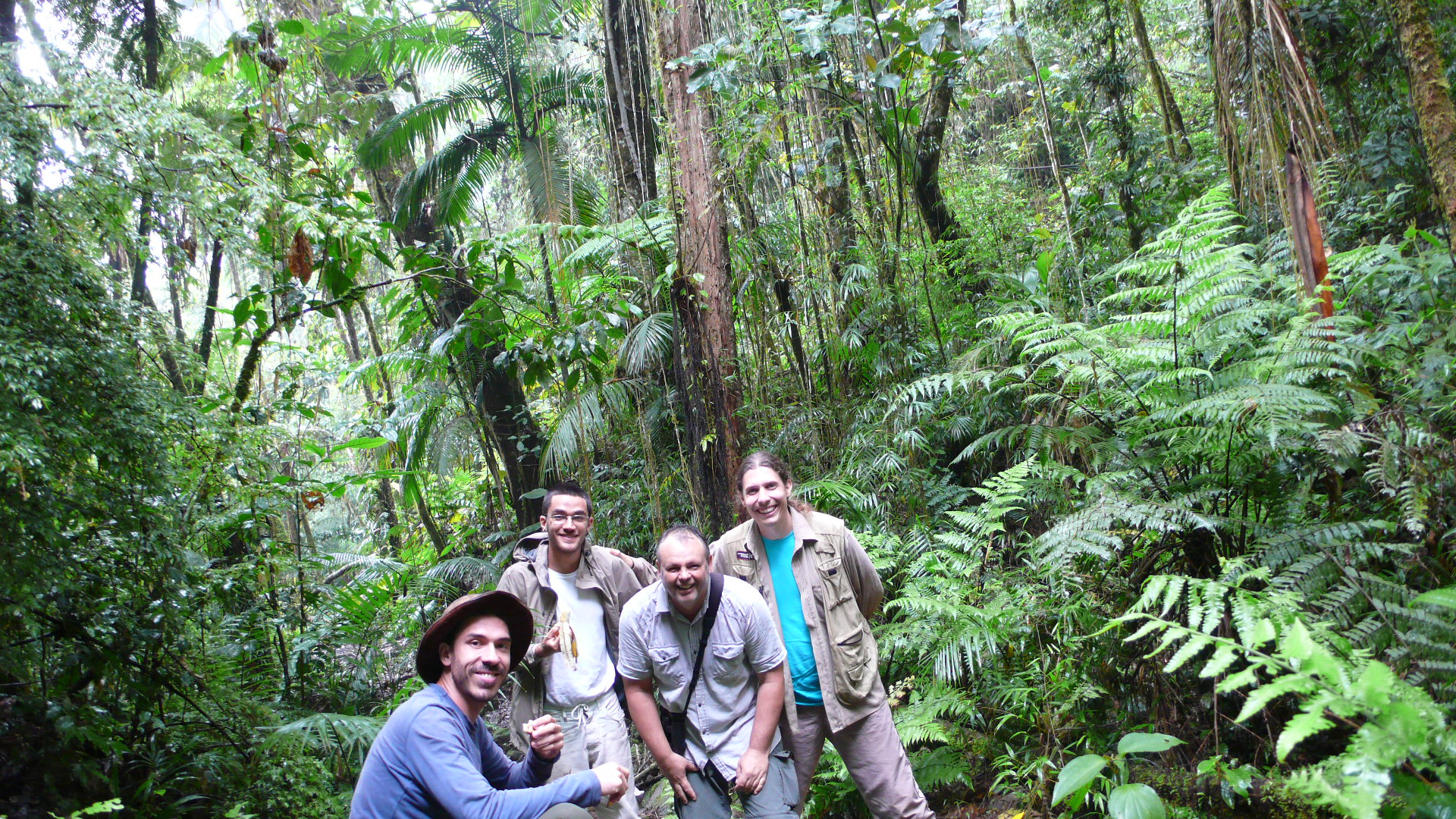
One of the most spectacular aspects of the Atlantic Rainforest is the sheer abundance and diversity of epiphytic plants, a sub-type of rainforest communities that can only be supported in areas of high rainfall such as this.   Over the last couple of days, Andre, Coquinho, Vini and I have hiked a couple of forest trails despite the rain, and orchids and ferns, bromeliads and forest cacti were more abundant than I’ve ever previously seen.  These plants are generally thick and complex in form, as they store water internally in leaves and stems, or within tanks formed of overlapping leaf bases.  On one short section of trunk, up to waist height, we counted six different orchid species mixed together, and saw at least 20 species along a 3km trail on Sunday.  Coquinho has been putting together a checklist of the orchids around the field station and it currently numbers 130 species.  Astounding diversity!

As we walked and slid and macheted our way through a 9km trail on Sunday, the ringing calls of male Bare-throated bellbirds (Procnias nudicollis) were resounding through the forest, whilst smaller birds played hide and seek from our binoculars.  Still scoring plants for wind and animal pollination, as I previously described, we recorded 75 plant species in flower along the trail, but most of them we encountered only once or twice.  Diversity and rarity go together in these plant communities.  No wonder Tweedie loved the Atlantic Rainforest; there is always something new to collect and the climate under the trees is cooler than in the open pampas grasslands of Argentina, where he was based.  Perhaps the rain made him think of his home in Scotland?  It’s called rainforest for a reason, right?

2013-11-24 15.44.01

Game of three halves – Brazil Diary 3

2013-11-13 18.47.49

Karl Marx famously said that religion is the opium of the masses.  Nowadays I think that role has been usurped by soccer; or at least it has here in the city of Belo Horizonte.  For two nights (Sunday and Wednesday) the streets around my hotel have been full of fans of the local team, Cruzeiro Esporte Clube, which seems to have won at least one Brazilian championship title or other, possibly two (my grasp of football being almost as tenuous as my understanding of Portuguese).  The symbol of the team is the Southern Cross, a great song by Crosby, Stills & Nash, providing a likewise tenuous link back to a recent post of mine.

Both nights I suffered from lack of sleep, but last night was particularly bad. I had hoped that by 2am the fans would have run out of fireworks, voice and energy; but no, they were still going strong at 3.30am as I drifted into restless sleep. Today the city has been punctuated by the sound of contagious car horns; as soon as one person starts parping away, it’s followed by the rest of the poor bastards stuck in another of this city’s many traffic jams.  They remind me of the cicadas I’ve been hearing during the more suburban legs of my journey – once one starts, the others follow; a species at FUNCAMP sounds like it’s having the best insect orgasm ever as it delivers a high-pitched “yesyesyesyesyesyesyesyesyesyesyesyesyesyesyesyes”!

The contrast between the urban, suburban and rural aspects of this trip so far has resulted in different joys and excitements, and has provided the title of this post, an almost fitting soccer idiom.  The Botanical Congress here in Belo Horizonte has been a very urban experience, being based in the centre of the city, over the road to the central covered market, a dense and diverse shopping experience.  On Tuesday I delivered my conference lecture which seemed to go down well with the audience, though it was hard to follow two talks on hummingbird pollinated flowers (by Leandro Freitas and Paulo Eugênio Oliveira) with a lecture on Ceropegia, the flowers of which are bizarre and pollinated by flies that are less than 2mm in length on average.  But I did my best, though it was noticeable that the audience dropped from about 250 to 150 during my talk, however that may have been due to the fact that I delivered it in English.  Maybe…..

The conference has been an opportunity to catch up with Sandy Knapp, a Solanum taxonomist from the Natural History Museum in London.  Sandy delivered two thought-provoking talks in one day, an impressive feat, and has been blogging about her field work in Brazil.  This has whetted my desire to get out of the city and start seeing more of this country’s biodiversity.  So yesterday I travelled with Andre and some of the other Unicamp postgrads to the pretty and historic town of Ouro Preto, then on to a protected State Park at Itacolomi.

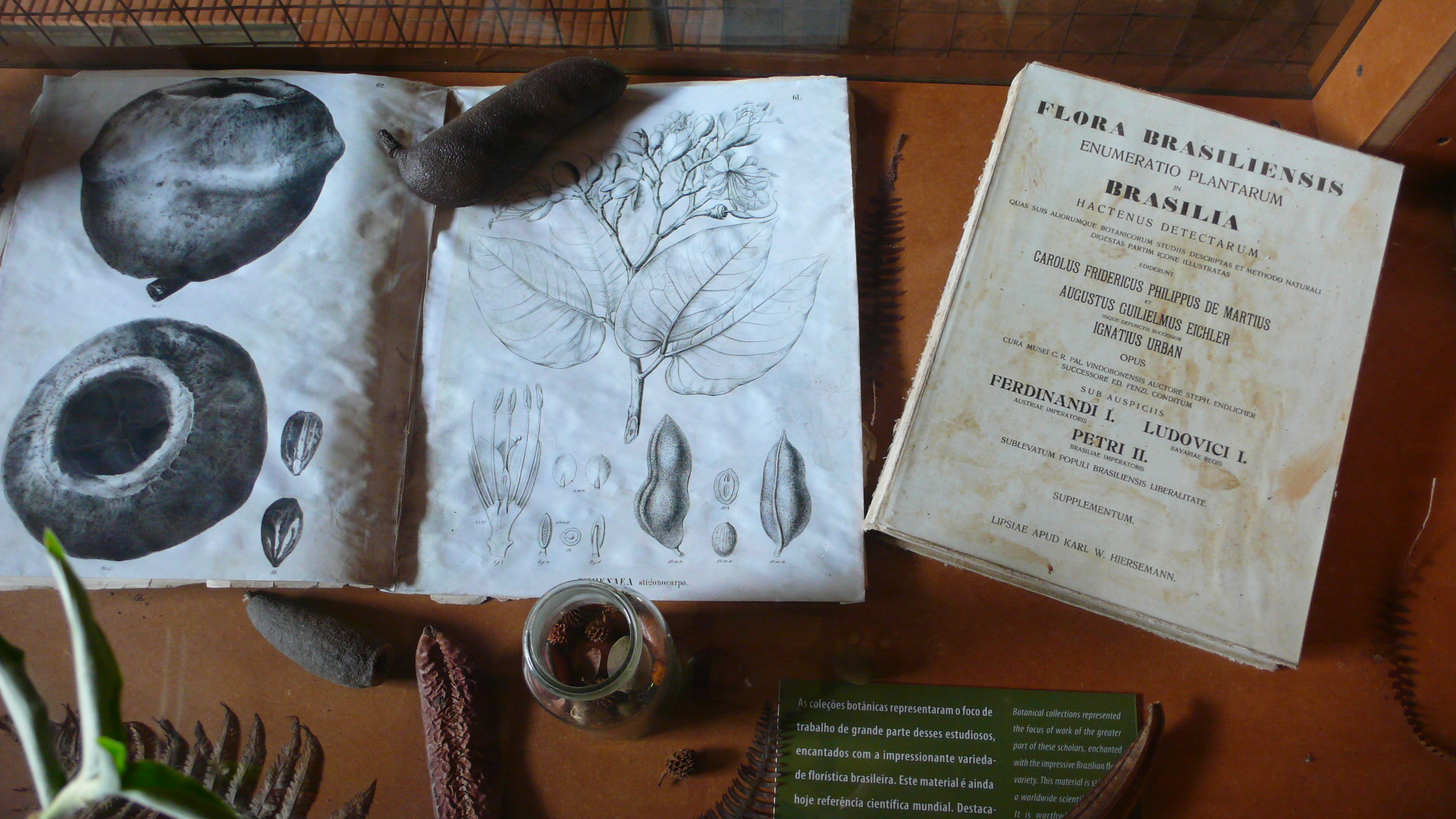
At the visitors centre we looked at a small exhibition on the early natural history explorers of the region who followed the Estrada Real (“Royal Road”) into the hinterland of this part of Brazil.  Then we walked a little in the cerrado vegetation, admiring the diversity of plants in flower and talking about their pollination systems.  In an hour we had also spotted 20 bird species, including lekking males of the lovely little White-bearded manakin, which make a very distinct snapping sound with their wings.  The cerrado is a fabulously rich biome and I enjoyed discussing its formation and definition with the postgrads, and look forward to exploring it further in the next few days, as we head out of the city and on to some field work.

Today I headed up to UFMG at the invitation of Marco Mello to give a talk to students and colleagues in his department about our research on pollinator conservation in the UK.  An interesting contrast of perspectives was apparent in the discussion that followed.   The afternoon ended with a walk around the campus nature reserve; few birds, perhaps because of the noise of the nearby traffic and military shooting range in the area where we strolled, but some interesting plants including at least four Piperaceae, a favourite family of mine.

Back home the news is that our Biodiversity Index has picked up a “Highly Commended” citation in the annual Green Gown Awards, another accolade to add to the one we won earlier this year.  I’m glad my colleagues were there to pick it up and look forward to hearing more about it when I return.  It’s now 11pm and the city is quieter than it was last night; time for bed and hopefully sleep, as long as there are no more football prizes to be won.

Conservation: from CSN to CSR

P1100235

The history of what might be loosely called “the conservation movement” is a complex one with roots that are both deep and ramified.  In the west, direct antecedents can be found in the work of 19th century pro-environmental writers such as Henry David Thoreau  and George Perkins Marsh, but there are arguably also more subtle influences from other sources, for example the “Northamptonshire Peasant Poet” John Clare  whose natural history inspired verse captured a rural way of life and a landscape that was rapidly disappearing:

All nature has a feeling: woods, fields, brooks
Are life eternal: and in silence they
Speak happiness beyond the reach of books

The later foundation of organisations such as the RSPB, the Audubon Society, and the precursors of the Wildlife Trusts gave impetus to environmental campaigns focused on specific issues such as species extinctions and destruction of important wildlife sites.  But it was in the 1960s that nature conservation, and environmentalism more generally, began to become of wider concern.  Again the influences were broad but certainly included both popular science writing such as Rachel Carson’s Silent Spring, and  the attitudes and campaigning of the counter-culture.   Yet a generation later, as a student studying the subject in the 1980s, it was clear to me that the mainstream had not fully engaged with what was still considered hippy, tree-hugging notions of saving the planet/whale/rainforest/ [delete as appropriate].

Having always been a fan of vintage West Coast rock,  these hippy ideals were on my mind at the start of last week when I travelled to the BBC’s Maida Vale studios to attend a recording of Radio 4’s Mastertapes featuring David Crosby and his band.  As well as playing music from his first solo album, the haunting and majestic If Only I Could Remember My Name, Crosby talked about his life and political activism.  The following evening Karin and I were back in London, this time at the Royal Albert Hall to see Crosby with his compadres Steven Stills and Graham Nash, performing as the incomparable CSN.  A number of songs from their back catalogue feature environmentalism in one form or another and, despite their vintage, they are as in touch with the political scene as ever.

Now, in the first decades of the 21st century, the green agenda has gone mainstream and it seems that every large business discusses the environment in their Corporate Social Responsibility statements.  So with only a few hours sleep I jumped from CSN to CSR, a theme that recurred during  the first Northamptonshire Local Nature Partnership conference held at the University the next day.  One hundred and twenty delegates heard talks that presented environmentalism and nature conservation from the perspectives of citizen health and well being, Christianity, on-the-ground conservation activities, and the needs of business and enterprise.  In the afternoon there were smaller showcase sessions and I presented an overview of pollination as an ecosystem service.  

Every organisation (public and private sector) wants to be “green” these days, which is a good thing of course if it’s genuine and well conceived.  But as David Rolton pointed out in his talk, businesses were few and far between at this event.  During the question-and-answer session I followed up David’s comment with a description of our experiences with the Biodiversity Index.  Despite winning a Green Apple Award, and having lots of verbal encouragement from the private sector, as soon as we explain to businesses that they have to pay to use the Index, all interest dissipates.  These are the same businesses who are willing to invest in green initiatives such as recycling and energy efficiency, presumably because it saves them money as well: it seems that CSR for most businesses does not extend beyond paying lip service to biodiversity, despite an economic input of over £30 billion that the UK receives  from the natural environment every year.  

It took time for businesses and other organisations to acknowledge their responsibilities to the environment, and to develop policies relating to recycling, non-pollution and resource efficiency.  It seems that businesses are only just beginning to acknowledge their societal (rather than corporate) responsibilities with regard to conservation, and it’s an ongoing process that exercises government.  But conservation of biodiversity has got to become a priority; once a species is lost it’s lost forever, and we erode not only a natural heritage that has evolved over billions of years, but also the direct and tangible benefits biodiversity gives us.  In the words of CSN: “It’s been a long time coming; it’s going to be a long time gone.

The Cliff

Tenerife 2008 057 - students on the Aeonium field

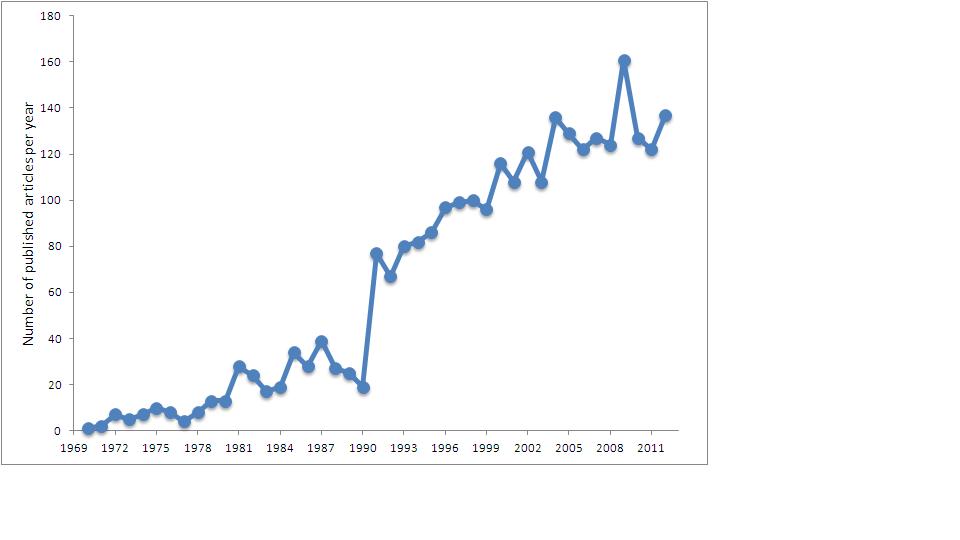
UPDATE: Late conversations with colleagues has convinced me that this “cliff” is an artefact. Web of Science started to include search abstracts around 1990, making it much more likely that specific search terms would appear.

Over the past few months I’ve been thinking a lot about PhDs and doctoral students, and our expectations of them, specifically in contributing to cutting edge biodiversity science.  In part this is because August 2013 will mark the 20th anniversary of the oral examination (“viva”) of my PhD at Oxford Brookes University.  The viva (short for the Latin phrase viva voce or “living voice”) is a peculiarly British method of examining PhD students that differs significantly from its (often public) counterpart in the rest of Europe and Scandinavia, and even more so from its equivalent in North America and the rest of the world.

For those of you unfamiliar with the viva process, I can recommend Simon Leather’s recent posting on the topic.

Since 1993 I’ve had the honour of acting as an examiner for 22PhD theses (4 at the University of Northampton, 18 externally) including two so far this year;  I’ve yet to turn down an opportunity to examine a PhD as it’s flattering to be asked and (more importantly) a great opportunity to see new ideas and data being generated by minds younger than mine.

One of the things that has exercised me recently is how much knowledge the average PhD student in my main discipline of pollination ecology actually has to get to grips with while doing the background research for their topic.  I wondered how this had changed since my time as a postgrad in the 1990s, and how the expectations of my own PhD examiners had changed since the 1970s.  So, using the wildcard term “pollinat*” in Web of Science I searched the contents of seven journals (Oecologia, Ecology, Journal of Ecology, Oikos, Annals of Botany, American Journal of Botany, & American Naturalist) that have published a significant proportion of the literature on pollination ecology over the past forty-odd years.

Of course I expected to see an increase in the number of papers on this topic being published per year over that time period, but not the two orders of magnitude difference that I found.  A PhD student studying pollination ecology in the early 1970s would be confronted with fewer than 10 papers on the topic coming from these seven journals whilst at the present time it’s averaging around 130 per year:

Pollination papers line graph

So it’s no wonder that PhD theses are tending to become more focussed as topics become more specialised.  So far, so expected.  But what I think is more interesting is the shape of the graph; why is there such a steep increase in the number of published papers in 1991?  I’ve nicknamed this point “The Cliff” because of its shape, and also because it seems to symbolise an intellectual barrier to be surmointed: an ability to read and synthesise a lot more information than was available prior to the early 1990s.  What is the reason for The Cliff?  Do other areas of ecology and evolution demonstrate a similar pattern in their historical rates of publication?  I see a link here to a discussion going on over at the Dynamic Ecology blog about the most cited ecology papers of the past few decades, and particularly the fact that “big ideas” papers are becoming less cited than review papers.  Perhaps it’s because we need these reviews to keep on top of literature that we’ve not got round to reading!

But that doesn’t explain why 1991 represents a step change for publishing in the field.  I’d be interested to hear the views of others working in pollination ecology.  What happened in the late 1980s to stimulate such an interest in doing research into plant-pollinator interactions?  Was it the publication of some key papers or books?  Did more funding become available specifically for work in this area?

When is a yucca not a Yucca?

Notice the difference?  The italicisation and capital initial of the second Yucca.  That’s how the genus name of a species should be formally presented in a scientific paper, or in a newspaper article, or wherever.  Like Homo – the genus in which our own species (Homo sapiens) sits.

It might seem like a narrow and pedantic point, but it’s important.  Accurate and descriptive naming of species, genera, families and other taxonomic ranks is crucial to those of us who study biodiversity and is at the core of our science: without names for species, for example, we cannot make informed conservation judgements or comparisons between habitats in relation to which species are present or absent.  Names matter.

But it’s not just the names themselves, it’s also how they are presented which is important:  when I see the words yucca and Yucca in print, they signify two different things to me.  The word “yucca” is an informal name for a group of plants that is widely applied by gardeners and has no formal scientific status.  Yucca on the other hand refers to a very specific group of plants and has a clear meaning to a biologist.

To give you an example of this I’ll first have to introduce you to the Northamptonshire Natural History Society (NNHS) which was founded in 1876 and must be one of the oldest surviving local natural history societies in the country.  Some important 19th Century scientists were honorary members, including Charles Darwin, Thomas Huxley and Joseph Hooker.  This perhaps reflects Northampton’s proximity to London though there may be other factors: one could compile quite a long list of scientists with links to Northamptonshire.

The Journal of the Northamptonshire Natural History Society was first published in 1880 and continues to the present day.  Which brings us back to yuccas.  Last year a short article by a NNHS  member summarised the local weather conditions in Northampton for each month of 2010 (J. Northants Nat. Hist. Soc. vol. 45, no. 1).  December of that year was a particularly cold month and the author notes that “the species of Yucca trees planted in Northampton, which although thriving in recent years, were killed by the cold period”.

Strictly speaking Yucca refers to plants of a particular group which are endemic (i.e. only naturally occurring) to the New World.  The genus Yucca is a member of the asparagus family (Asparagaceae), subfamily Agavoideae.  The plants which suffered so much in the cold winter of 2010 are in fact New Zealand Cabbage Trees (Cordyline australis) which, as the name suggests, are endemic to New Zealand.  The genus Cordyline is also a member of the family Asparagaceae but belongs to the subfamily Lomandroideae and is therefore only distantly related to Yucca.

The leaves and stems of Cordyline and Yucca do look very similar, hence gardeners tend to use yucca as an informal name for both.  However when these plants flower it is clear that they are very different.  Flowers of the various species of Yucca are typically quite large and are adapted to pollination by a very specialised group of moths which lay their eggs within the flowers.  The reward for these moth pollinators is a brood site for their caterpillars, which feed on a proportion of the developing seeds of the Yucca plant.  In contrast the flowers of Cordyline australis are small and produced in very large numbers in dense inflorescences.  They are also highly fragrant, to which anyone who has grown one of these plants to maturity in their garden can testify.  The fragrance attracts a range of insects which feed on the nectar produced by the flowers and so pollinate them in the process.  It is these differences in flower structure, more than characters of stems and leaves, which taxonomists use to classify such plants.

Until recently large New Zealand Cabbage Trees were a feature of many front gardens across Northampton.  Some particularly fine examples were to be found along the Kingsthorpe Road between Osborne Road and Balmoral Road.  I suspect that the largest Northampton specimens were planted in the 1970s, perhaps because people wished to recreate something of the exotic feel of package holidays to Spain and Portugal.  Following the freezing weather of December 2010, the growing tips of most of Northampton’s New Zealand Cabbage Trees were killed and the top growth gradually withered and died.  I was sad to see this happen to my own plant, a medium-sized specimen that I had rescued from a skip at the University several years ago, and which had become well established in my garden.  However later in 2011 my plant, and those in neighbouring gardens, re-sprouted from its deep tap root and started to produce multiple rosettes of leaves around the base of its dead trunk.  Give it a few years and Northampton gardens will once again be crowned by these exotic imports from the Southern Hemisphere.  I moved house in early 2012 and wasn’t able to take my rescued plant with me, but I have a feeling it will survive many more cold winters to come.

Names matter to biologists, indeed to scientists of all types.  They signify and tell us things beyond just the words themselves.  To give a very personal example, a few people have asked me why I chose the title “Professor of Biodiversity” rather than “Ecology” (my main area of training, though confused in some peoples’ minds with New Age philosophies); or “Biology” (a much broader designation than I feel comfortable with); or even “Pollination Ecology” (narrow, to the point, but too restrictive).  After a LOT of thought I chose “Biodiversity” because it very broadly reflects my interests in the whole of Earth’s life forms, the interactions between these species, and how they come together as assemblages, communities and ecosystems.   But I’m also interested in the history of our understanding of biological diversity and this title gives me scope to pursue those interests too.

It’s all in the name.

Flattery Gets You Nowhere (reduce, reuse, recycle part 1)

It was always my intention, when I began this blog, to use it as a vehicle to rework and reuse scraps of writing I’ve done over the years that had no real “official” outlet .  Hence the subtitle of this posting.  The following is a book review I wrote on the Amazon website in 2007, after I had read Christine Garwood’s book Flat Earth: The History of an Infamous Idea.  It’s a really interesting and well written piece of science history that gives a perspective to science that goes far beyond the immediate topic area of cranky ideas.  I have to confess to a potential bias: the author is a friend of mine.  But that doesn’t make the review any less genuine: if I’d not enjoyed the book I’d have kept quiet!

The pathways through which the history of scientific progress can be mapped are strewn with the remains of overturned ideas and outdated pronouncements, some cranky and (with hindsight) nonsensical, others perfectly reasonable given the state of knowledge at the time. Newtonian physics, though sensible at the human scale, suddenly fails to convince at a subatomic level, not because of any failings on the part of Newton, but because technological and mathematical advances have allowed modern physicists to probe closer and deeper.

Similarly, in biology, many established taxonomic ideas concerning the evolutionary relationships between major groups of flowering plants, mammals and other large clades are, thanks to molecular phylogenetics, shown to be erroneous. And so science advances, from the clearly wrong to the (probably) correct, leaving in its wake the cast off ideas of previous generations.  Except sometimes, when science (or at least fringe perceptions of scientific understanding) takes a backwards stride of such length that one begins to question whether scientific “facts” mean the same thing to everyone.

The concept of the Flat Earth may be a unique example of how a fact (the globularity of the Earth) could be established very early in the development of the rational analysis of nature, only to be rejected by a minor, but vociferous, cohort of “true believers”.  As this fascinating book by Christine Garwood relates, observations by Aristotle confirmed the true shape of the world, and there were no serious challenges to this idea until the 19th century.  Mediaeval scholars accepted a spherical Earth (disc-shaped mappae mundi, I was interested to learn, were symbolic, not cartographic, in intention) and the fears raised by the prospect of Columbus plunging over the edge of the world were a nineteenth century fiction concocted by the author Washington Irving.

The emergence of Flat Earth views in Victorian England as a serious (at least to their promoters) attack on received scientific wisdom has to be seen as an unusual reverse in thinking, not least because the “Zetetic” Flat Earthers sought to use science against itself to accumulate evidence to support the idea of the Earth as a plane, not a planet. In this vivid and well researched account, Christine Garwood moves easily between historical scholarship and popular science to follow the development of Flat Earth thinking from its rejection by the Ancient Greeks through to its Victorian revival, when learned men as distinguished as Alfred Russell Wallace could be convinced to take part in parochial experiments along England’s canal system to try to prove that the Earth was a globe. Darwin, Huxley and others saw little value in rising to the Zetetics’ bait, and Wallace himself regretted his involvement in later years (but seems to have needed the cash at the time).

As the author demonstrates, the death of the early major movers in the sphere of Flat Earth promotion was followed by the emergence of other, equally committed and frequently just as eccentric personalities, until eventually popular support for the notion of a Flat Earth ebbed away with the first manned space flights, and the photographs and experiences which were returned to Earth. Flat Earthism did not entirely die, however, and no amount of “proof” could dissuade the opinion of zealots such as Samuel Shenton, founder of the International Flat Earth Research Society. Like fundamentalists of all persuasions, he had an answer for everything, however contrived and paranoid.

In Garwood’s thought provoking book our understanding of the development of fringe ideas in the history of science is advanced through an analysis of the primary sources relating to an intriguing subject. The book is scholarly but accessible, at once entertaining and authoritative, and also topical in the context of the increasingly widespread anti-evolutionary views promoted by some religious groups. Unsurprisingly Garwood finds parallels between Creationism and Flat Earth thinking, not least because until recently they were promoted by groups with similar world views and memberships.

Flat Earth ideas continued to be advanced in the late 1960s and early 1970s, as both an academic jest with serious anti-establishment overtones by the International Flat Earth Society of Canada, and as a continuation of Zetetic thinking by other groups. Currently these ideas are defunct and even the most literal of Biblical literalists reject the notion, making it unlikely to re-emerge. Even if it did, no modern scientist would risk credibility by debating it.

Creationism is a different matter entirely and some professional scientists (myself included) have opted to debate with Creationists despite the views of (amongst others) Steve Jones and Richard Dawkins that such exposure only provides oxygen for their cause. Unlike the Flat Earth theorists, however, anti-evolutionists are not simply going to fade away and their influence is now felt in American classrooms and textbooks. How should scientists respond? With reasoned arguments that convince the public and politicians (if not the fundamentalists, who can believe what the hell they like as far as we’re concerned) or by ignoring them and hoping they might disappear in their own infighting?

Both Flat Earthism and Creationism reflect wider social and attitudinal differences regarding the role of Homo sapiens in nature: as rapacious exploiter; or careful steward of the Earth; or as an ecosystem component in its own right. Science can provide data and theories and models, but it is up to individuals how they choose to interpret and act on such information, or whether they decide to deride or ignore it. Christine Garwood’s first book is a marvellous insight into just how deeply self-delusional beliefs can become embedded in the minds of intelligent, but blinkered, individuals, and it is hoped that her subsequent books examine these themes in more detail. Perhaps her successors 200 years in the future will be similarly taken to write about the incredulous movement that denied that Earth’s climate was changing and that the human species was fundamentally altering the biosphere through pollution and over-exploitation of resources, despite the weight of data. And let us hope that we still have a society that can appreciate the irony.