Category Archives: Ecosystem services

Recent developments in pollinator conservation: IPBES, 10 Policies, pesticide conspiracies, and more

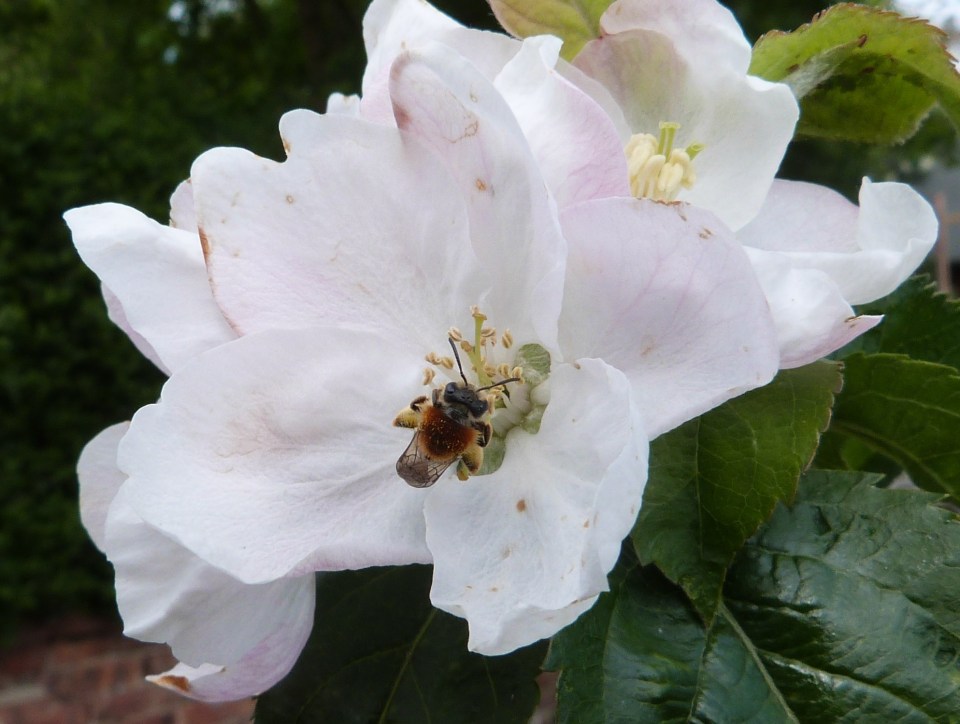
Bee on apple blossom - 1st May 2015

It’s been a busy week for anyone interested in pollinators and their conservation, lots of things happening that I thought I would summarise in a single post with links.

First of all IPBES (the Intergovernmental Science-Policy Platform on Biodiversity and Ecosystem Services) has finally released the full text of its Thematic Assessment on Pollinators, Pollination and Food Production  – nine months after it was discussed at the 4th IPBES Plenary Meeting, and three months after the Summary for Policymakers came out.  Even now the document is not in its ultimate state, it’s the text without its final layout or appendices (though it still runs to 868 pages!)  The preamble to the report states that:  “A full laid out colour version, including a preface and annexes will be posted here shortly”.

Sources tell me that there have been some delays while the exact style and colour scheme of the report are finalised, which, if true, is frankly not very encouraging : this is an important document that needed to made public at the earliest opportunity.  I accept that it’s got to be correct, and it’s a complex report, and this is not a criticism of the authors, rather of IPBES’s bureaucracy.  Pollination ecology and pollinator conservation is a fast moving field and there have already been significant scientific and policy developments since the text was finalised which will not be incorporated into this version.

To coincide with the release of the report comes two important articles in the two most prestigious scientific journals by some of the authors of the report.  In “Ten Policies for Pollinators” (Dicks et al. Science 354: 975-976) the authors set out a series of recommendations for politicians.  The article is paywalled so here’s their list with some annotations [in square brackets]:

1. Raise pesticide regulatory standards [to include our most important pollinators – wild bees and other insects!]
2. Promote integrated pest management (IPM) [rather than automatically feeding the profits of agrochemical companies].
3. Include indirect and sublethal effects in GM crop risk assessments.
4. Regulate movement of managed pollinators [lots of evidence that poor husbandry is a major cause of colony collapse disorder, for example].
5. Develop incentives, such as insurance schemes, to help farmers benefit from ecosystem services instead of agrochemicals.
6. Recognize pollination as an agricultural input in extension services.
7. Support diversified farming systems [does Brexit provide an opportunity to do this in the UK?]
8. Conserve and restore “green infrastructure” (a network of habitats that pollinators can move between) in agricultural and urban landscapes [already lots being done on this in urban areas but much less in rural areas].
9. Develop long-term monitoring of pollinators and pollination [there’s already been a report on this – expect more news early next year].
10. Fund participatory research on improving yields in organic, diversified, and ecologically intensified farming.

Overall it’s a sensible set of recommendations – the only ones that I would have added would be to develop education and awareness programmes of the importance of natural capital and ecosystem services, aimed at farmers, civil servants, politicians, planners, business and industry, developers, etc.  And also to build consideration of natural capital into local planning systems so that the loss of habitats, trees, ponds, etc. are properly accounted for.  I’m sure others can think of more – feel free to comment.

Getting politicians to take notice of these recommendations in an age where scientific experts are derided as no different to “soothsayers and astrologers” will be a challenge though.

Lead author Lynn Dicks discussed these recommendations on the BBC Radio 4 Farming Today programme (from about 3:27) – well worth a listen.

Following on from this some of the authors of the 10 recommendations article were also involved in a review published this week entitled “Safeguarding pollinators and their values to human well-being” (Potts et al. Nature) – hopefully that link will take you to the full text of the article which is being widely circulated for free in a read-only form (it can’t be downloaded unless you have an e-subscription to Nature).

On the subject of safeguarding pollinators (and specifically from pesticides) a video of Dave Goulson speaking at the 2015 National Honey Show appears to have been edited to remove his comments about neonicotinoid pesticides (about 34:08 to 34:28).  Dave’s not sure if this is conspiracy or cock-up, but it’s an odd coincidence that this is the only glitch in an otherwise well-produced video.

At about 39:20 Dave talks about the importance of engaging kids with nature and specifically pollinators.  I completely agree and last week did a live Q&A phone interview with Year 7 pupils at Abbeyfield School in Northampton who are doing a project on bees.   The kids asked some great questions and were very well informed – a credit to their teachers!

This week there was a lot of pollinator and pollination ecology being discussed at the Ecological Society of Australia’s annual conference – Manu Saunders has produced a Storify to summarise the talks and Twitter comments – here’s the link.

Linked to this, against my better judgement and as an experiment, I’ve finally joined Twitter.  It’s a bit of an experiment to see how I get on and so far I’m enjoying it, though I’m sticking to science and environmental news – my handle is @JeffOllerton if you want to follow or tweet at me.

Urban areas as a refuge for insect pollinators: conservation for the city

Waterside - 20160527_081706.png

Urban conservation ecology is a fast growing field that has mainly focused on how towns and cities can support populations of plants, animals and fungi that may be declining or threatened in the surrounding rural environment.  That is, the city for wildlife conservation.  In a new essay in the journal Conservation Biology, written with colleagues from across the world, we argue that conservation for the city (an idea originally conceived, I believe, by Steward Pickett) should also be a focus of future research and management activities.

Conservation, or ecology, for the city in essence means that plants, animals and fungi, as well as being supported by the city (see our recent urban bees example), play a role in supporting the city itself through the provision of ecosystem services such as decomposition, flood alleviation, and crop pollination.

It’s pollinators and pollination that we particualrly focus on in this essay – here’s the abstract:

Urban ecology research is changing how we view the biological value and ecological importance of cities. Lagging behind this revised image of the city are natural resource management agencies’ urban conservation programs that historically have invested in education and outreach rather than programs designed to achieve high-priority species conservation results. This essay synthesizes research on urban bee species diversity and abundance to suggest how urban conservation can be repositioned to better align with a newly unfolding image of urban landscapes. We argue that pollinators put high-priority and high-impact urban conservation within reach. In a rapidly urbanizing world, transforming how environmental managers view the city can improve citizen engagement while exploring more sustainable practices of urbanization.

I’m happy to send the PDF to anyone who wants a copy; here’s the full citation:


Release today of the IPBES Summary for Policymakers of the Assessment Report on Pollinators, Pollination and Food Production

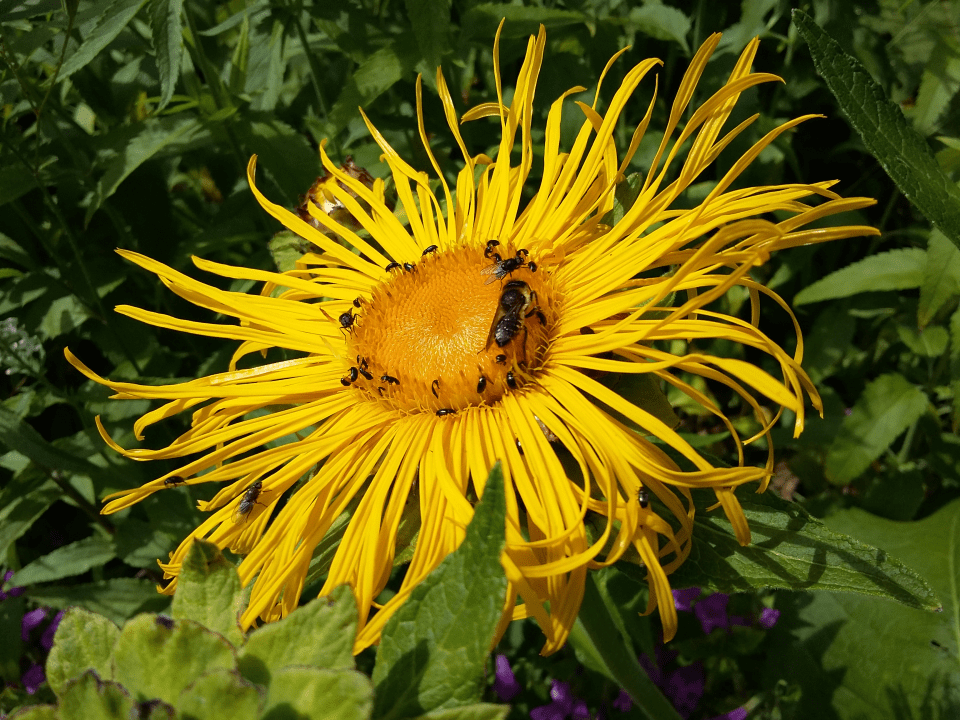
Inula at Ravensthorpe 20160710_145426Following on from the press release earlier this year announcing of the Intergovernmental Science-Policy Platform on Biodiversity and Ecosystem Services (IPBES) assessment of pollinators, pollination and food production (which I reported on in February) it looks as though the full report may shortly be published.  A Summary for Policymakers has just been released by IPBES and can be downloaded by following this link.  I’ll put up a link to the full report once it becomes becomes available.
Bees and pesticides – a major new study just published – UPDATED

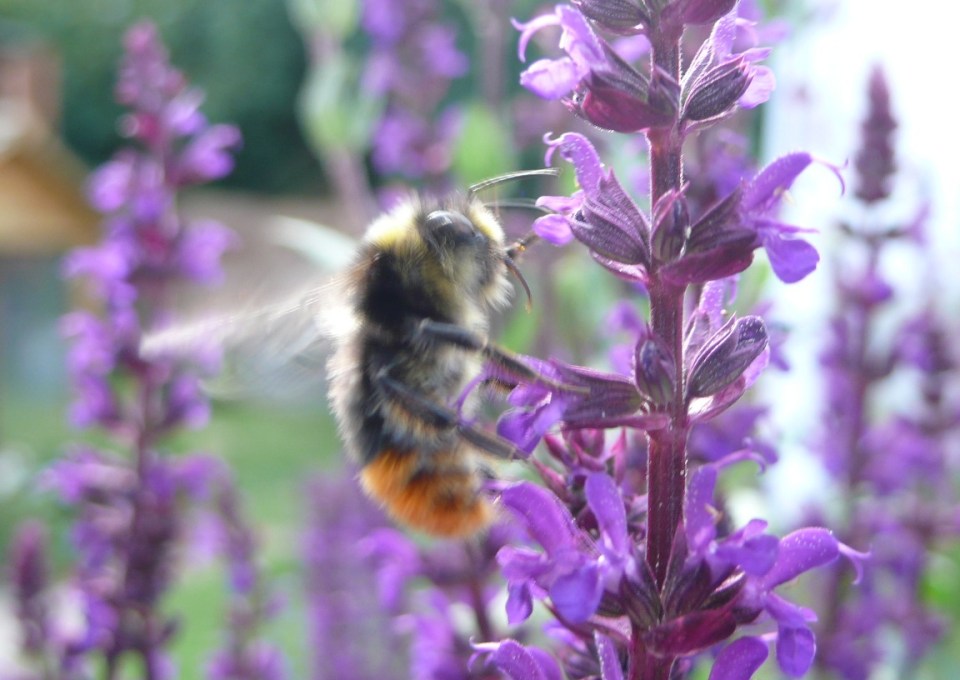
Male B lap on Salvia cropped P1120309

An important new study about the effects of neonicotinoid pesticides on wild bees has just been published in the journal Nature Communications – here’s the details and a link to the paper, which is open access:

Woodcock, B. A. et al. (2016) Impacts of neonicotinoid use on long-term population changes in wild bees in England. Nat. Commun. 7:12459 doi: 10.1038/ncomms12459

As I’ve previously discussed on this blog (e.g. here and here) there are widespread concerns amongst environmentalists, and some scientists, about the impact that these relatively new pesticides are having on pollinators and other biodiversity.  The Woodcock et al. paper is a major contribution to this discussion as it uses a huge dataset to model the changes in populations of 62 wild bee species that are known to forage on oilseed rape (canola) over 18 years.  These changes can be related to the spatial extent of oilseed rape cultivation and the authors found that whilst bees “….foraging on oilseed rape benefit from the…[nectar and pollen provided by]….this crop….[they]….were on average three times more negatively affected by exposure to neonicotinoids than…” bees which didn’t forage on the crop.

The authors further conclude that “This study provides the first evidence for community level national scale impacts on the persistence of wild bee populations resulting from exposure to neonicotinoid treated oilseed rape crops.”

Neonicotinoid pesticides are, of course, not the whole story when it comes to understanding declines in pollinator diversity and abundance.  But these pesticides are the latest in a long history of changes to British agriculture that have had significant consequences for the biodiversity of our country (as we showed in our study of bee and wasp extinctions).

Reactions to the study have been, well, predictable.  A long feature on the BBC News website* quoted a representative from Bayer as saying:

“we believe….[the study’s]….findings would be more correctly headlined that intensive agriculture is causing some issues with pollinators…..  Whether this is due to the use of insecticides is not clear; a lack of nesting sites and pollen and nectar sources in these areas may also be critical factors.”

Which rather ignores the fact that this was a comparative study of bees that forage on oilseed rape versus those that don’t.

Likewise the National Farmer’s Union’s position was that:

“While this study claims to provide an important contribution to the evidence base underpinning the current EU moratorium on some uses of neonicotinoids, experts reviewing all the evidence have concluded that there are still major gaps in our knowledge and a limited evidence base to guide policymakers”

Which sounds to me like a statement designed to fudge the issue: the “experts reviewing all the evidence” would not have reviewed this particular study!  And which begs the question – how much evidence and how many studies would be enough for the NFU?

The study’s authors do not make any suggestions as to what the next step should be in this continuing saga but are quoted as saying that “simplistic solutions” such as banning these pesticides are not the answer because this will encourage use of pesticides that are even more damaging.  That may be the case but it’s clear that an independent root-and-branch reassessment of the use of pesticides (and herbicides) in UK agriculture is long overdue.


*As an aside, this BBC News piece wrongly states that bumblebees were not included in the study, which is not the case.


UPDATE:  After I published this post I noticed that Manu Saunders has also written about the bee study, plus a second study that I’d not seen linking neonicotinoid use to declining butterfly populations in California.  Here’s a link to Manu’s blog.


Just published: A horizon scan of future threats and opportunities for pollinators and pollination

A team of pollinator researchers from across the globe has just published an interesting new paper which looks at potential threats to pollinators and the pollination services that they provide, as well as opportunities for future conservation and agricultural gains.  The paper is open-access and free to download – here’s the reference and a link to the paper:

Brown, MJF et al. (2016) A horizon scan of future threats and opportunities for pollinators and pollination.  PeerJ

The paper has also gained some media coverage, e.g. on the BBC News website.

Third International Conference on Pollinator Biology, Health and Policy – Pennsylvania – 18-20 July, 2016

P1030210

Keeping with the theme of Bees’ Needs Week, and the importance of pollinators to natural and agricultural ecosystems*, the Third International Conference on Pollinator Biology, Health and Policy takes place at Penn State University, USA,  from the 18th to 20th July.

Here’s a link to the PDF of the programme with the abstracts, speakers’ details, etc.  I won’t be attending** but I am involved as a collaborator*** in one of the talks being presented – Luísa Carvalheiro’s project on “Direct and indirect effects of soil eutrophication on pollination services“.

Best of luck to all the speakers and attendees, looks like it’s going to be a great conference.


*Wednesday’s grumpiness has almost disappeared, though it reached a new peak yesterday when we had a paper rejected by a journal after 10 months.  There was one positive review, one middling review, and then a third in which the reviewer provided no comments – just “reject”!  I was not happy about that and made my feelings known to the editor…..

**I’m actually in the Azores next week attending the Island Biology 2016 conference.  More about that at the weekend.

***With about a gazillion other people!  Luisa has pulled together an amazing data set.


“Insect pollinated” crops that don’t actually require insect pollination

Cucumber fruit 20160713_103558

Yesterday evening I learned that a large grant application that I’d submitted earlier this year had failed to secure funding.  Statistically there was a high likelihood of this happening but that doesn’t make it feel any better: weeks and weeks of work have come to nothing.

So in a mood of bloody-minded contrariness and general displeasure at the unfairness of the world I thought I’d provide an alternative to the Bees’ Needs week I mentioned yesterday by focusing on food crops that look as though they should be insect pollinated (and their ancestors certainly were) but which don’t actually require pollinators.

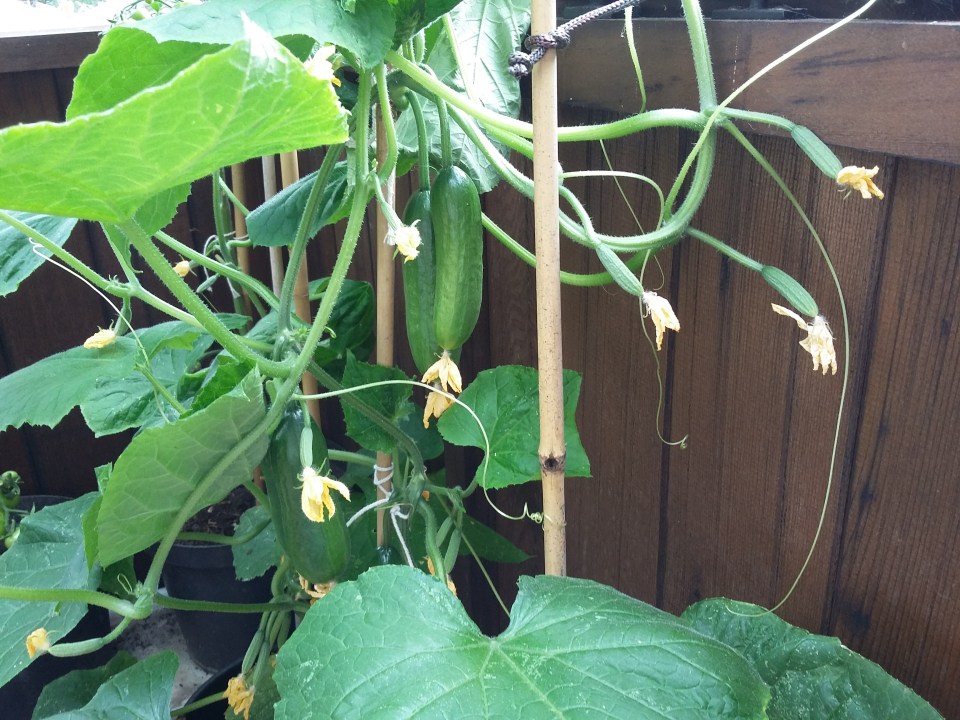
The example pictured above is an F1 hybrid cucumber (Cucumis sativus) variety called “Mini Munch”, kindly grown from seed and given to me by my friend and colleague Dr Janet Jackson.  Many cucumbers don’t need insect pollination, despite their large, colourful flowers, and the fact that related crops (melons, courgettes, squashes, etc.) generally do require pollinators.  Indeed some varieties taste bitter if they are pollinated.  I can recommend this web page on how to grow cucumbers for further advice.

As I was taking that photograph, and in another demonstration of how the world is against me at the moment, I spotted a bee feeding on one of the all-female flowers of this variety.

Megachile on cucumber 20160713_103627

It spent some time there probing the centre with its tongue, so I think these flowers still produce nectar despite them not needing pollinators, a hang-over from their ancestry.  Plants have a whole range of mechanisms that ensure reproduction without the agency of insects and other animal pollinators, and this has been exploited by crop breeders who have selected crop varieties for their ability to self pollinate or to reproduce asexually via apomixis (as in the case of this cucumber).

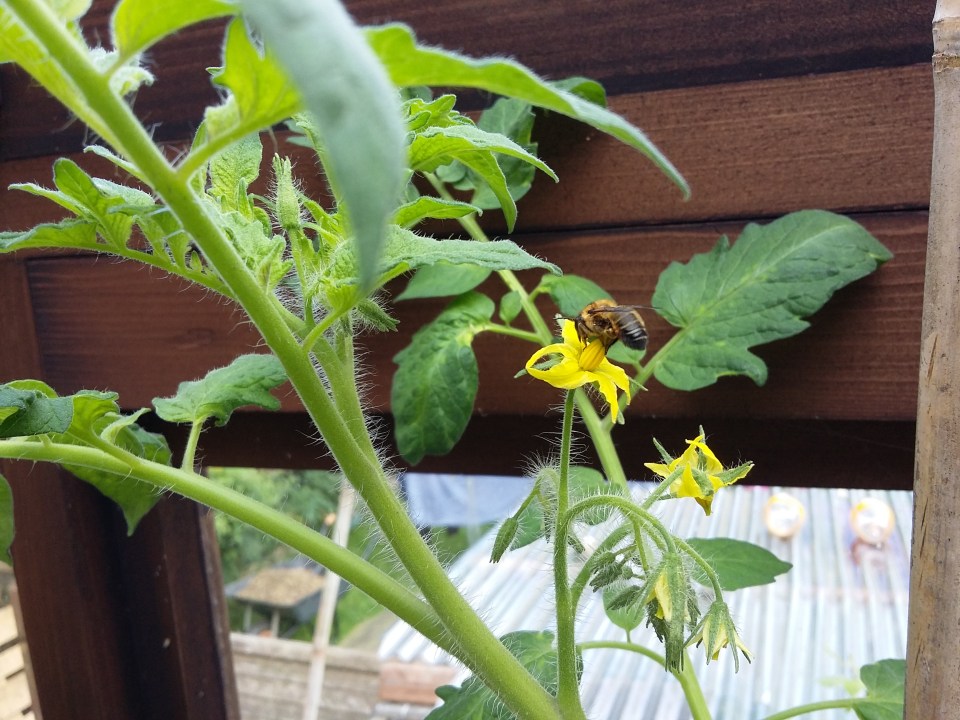
The same bee then flew onto a tomato (Solanum lycopersicum) flower (another group which varies in its demands for pollination) and I got a better look – seems to be a Leaf-cutter Bee of the genus Megachile.

Megachile on tomato 20160713_103712

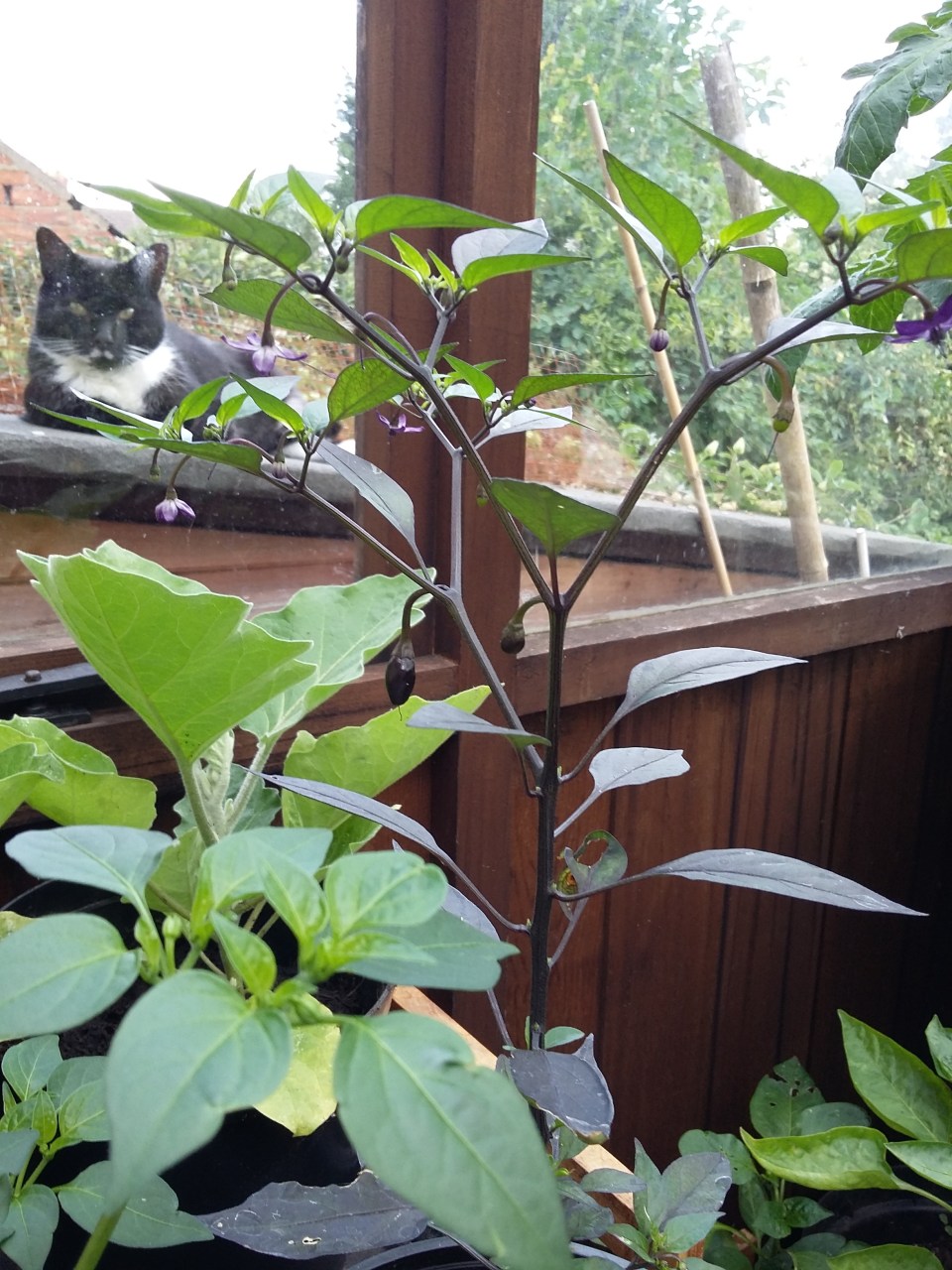
The final example of a crop which requires little or no insect pollination are the chillies (Capsicum spp.) all of which are self-pollinating, I believe.  This variety is a scrambling purple type called Orzoco*.

Orzoco chilli 20160713_102213

So, crops vary hugely in their need for pollinators and the presence of certain traits of animal pollination, such as large, brightly coloured flowers and nectar, is no guarantee that the crop really does have to be serviced by pollinators.  The only way to be certain is to experimentally test the plants, a topic I hope to come back to later in the summer.

Don’t worry, this grumpiness won’t last long, in no time at all I’ll be back to banging on about the importance of pollinators.  At least Monty, one of our two cats, still loves me.


*At least, that’s what it said on the seed packet; I’ve also seen it referred to as Orozco – does anyone know which name is correct?

Bees’ Needs week (9th to 17th July) #BeesNeeds

Inula at Ravensthorpe 20160710_145426.png

In the current political turmoil around the Chilcot Enquiry, Brexit, leadership challenges and a change of Prime Minister you’d be forgiven for having missed the fact that 9th to 17th July 2016 has been designated “Bees’ Knees” week, as a follow on to the Pollinator Awareness Week of 2015.

Here’s the link to the Defra press release.

Unlike last year I’ve no specific plans to do any regular posts on the topic, but I will provide links to relevant items as and when I see them, starting with these two:

Why insects are declining globally, and why it matters.

Dave Goulson is trying to crowdfund a project to look at pesticides in plants from garden centres.


How to deal with bumblebees in your roof [UPDATED]

Bombus hypnorum

This week I’ve had two enquiries from colleagues at the University of Northampton asking advice on what to do about colonies of bumblebees that have set up home in their roofs.  In both cases these were nests of the Tree Bumblebee (Bombus hypnorum), a species that only colonised the British Isles in 2001 and has since spread rapidly (see this post from last year for a more detailed account).  Because of their association with human settlements they are significant pollinators of garden produce: over the past few weeks I’ve been watching them pollinating the raspberries in our garden and we now have a large crop.

But having a bee nest in your home is, for many people, a real concern.  I thought it might be useful to discuss the issue by quoting from the email correspondence I had with my first colleague, Paul.


Paul wrote:   I wonder if you can give me some advice. I returned home from holiday on Saturday to find that a colony of bees had taken up residence in a roof space above my front porch. The bees are not domestic honey bees but large bumblebees with white rears. I am not sure how many there are, they buzz furiously when I close the door…..  They are not in the house and I cannot see them from my loft…..so they are not causing a problem at the moment other than a moderate dead rabbit smell in the porch.

I am considering contacting the local council pest controllers, but fear they may just gas and kill them as they are not honey bees. What would your advice be, would it be safe to leave them alone, if so how long are they likely to stay, how large is the colony likely to become, are they likely to cause any damage or mess?

Here’s my response:   From your description they are almost certainly Tree Bumblebees which often use loft spaces, bird boxes, etc. As the name suggests they naturally nest in holes in trees. The colony is not likely to get much bigger though over the next few weeks you may find males patrolling the front of the nest, waiting for the virgin females to emerge so that they can mate. That sometimes makes the colony seem larger than it actually is – there are not likely to be more than about 150 bees in there.

I’ve had Tree Bumblebees in my roof a few times and they’ve never caused any damage. All bumblebee colonies die over the winter and the newly-mated females fly off and hibernate. So by late August or September (perhaps earlier if the weather ever gets warmer….) the bees should have gone. At that time you could seal the entrance to the roof space, though they are unlikely to return next year (although it’s not unknown).

Yes, a pest controller would kill the colony. But they are unlikely to be aggressive unless you stick your fingers in the nest hole! My advice is to let them be and take pride in your own bee colony – they are very discerning and don’t nest just anywhere 🙂


So there you have it: my advice is, leave them alone.  Of course if you or your family have a particular sensitivity to bee stings you may need to think carefully about this advice, but in my experience bumblebees are only aggressive if they feel directly threatened.  In over 25 years of field work focused on bees and other pollinators, I’ve only ever been stung a few times, and mainly by honey bees.

UPDATE: A commenter on Facebook had a great suggestion, that I provide a link to Dave Goulson’s nice little video showing what the inside of a bumblebee nest looks like – so here it is.


The environmental argument for the UK remaining in the European Union

Every week I receive an email bulletin called Science for Environment Policy, sent out by the Directorate-General for Environment, which is the European Commission department that sets and monitors European Union policies relating to the environment, for example pollution levels, conservation of biodiversity, etc.  Anyone can subscribe to these bulletins and they provide useful, lay-person summaries of recent research findings that have a direct or indirect bearing on how we manage and protect Europe’s environment.

A scan through the latest few bulletins reveals article titles such as:

  • Atlantic beaches of Europe reshaped in stormy winter of 2013–2014
  • Water management: five policy conditions to help overcome the challenges of an uncertain future
  • Climate change threatens early-flowering plants due to lack of snow
  • Black carbon emissions of individual cars measured under real conditions
  • Are endocrine disrupting chemicals responsible for downward trends in male fertility?
  • Environmental performance of construction and demolition waste management
  • Golden jackal should not be treated as an alien species in Europe
  • Environmental taxation in the right place can increase business productivity 

This set of topics is fairly typical, and demonstrates the complexity and breadth of the environmental issues facing the European Union.  All of these issues, however, share one feature: they do not respect political boundaries and are cross-border in scope.  Species, rivers, air masses, sea currents, economic resources, waste products: all of them can (and do) move through the different countries of Europe and beyond.

What this means is that the policies, laws and regulations that govern the behaviour of individuals and organisations towards the environment, and ultimately protect it, must also be cross-border in scope.  That’s where the European Union comes in, because it is largely EU directives that currently protect our environment.  Some examples of these directives, and some of their achievements, include:

  • Birds Directive which has helped to coordinate action plans for endangered resident and migratory birds.
  • Habitats Directive that relates to the conservation of natural habitats and the fauna and flora they contain, including setting up the Natura 2000 network that currently covers more that 18% of the EU’s land area and almost 6% of its marine territory, making it the world’s largest coordinated network of protected areas.
  • Water Framework Directive that determines action in the area of water policy.
  • Waste Framework Directive likewise determines action in the area of wastes policy and which, together with the Landfill Directive and the Waste Electrical and Electronic Equipment Directive, has been responsible for significantly reducing the amount of waste going into landfill, increased the amount being recycled, and placed pressure on manufacturers to take responsibility for packaging and end-of-life goods and materials.

There are many others, and you can find a list here.  It’s worth pointing out that these directives were not “imposed” on the UK by faceless bureaucrats in Brussels: the UK took an active role in their development and drafting.  In fact Boris Johnson’s father, Stanley Johnson, was one of the original authors of the Habitats Directive and is a prominent advocate of remaining in the EU.

Of course, no one is arguing that these directives are the only mechanism for protecting the environment, there are local regulations too, plus the work of NGOs such as the RSPB and the Wildlife Trusts.  Nor am I arguing that they have been wholly effective: there’s still a long way to go in many of these areas.  But they have had a demonstrably positive impact on the quality and protection of the UK’s environment that could be halted, or even reversed, if the UK was to leave the EU.

This last point is an important one to make and it’s not an example of the fear-mongering that has marked the EU Referendum debate on both sides.  Here is how I see it:  we cannot trust the UK government (whatever its political flavour) to safeguard our environment.

This is because, despite the best efforts of genuinely committed and environmentally savvy politicians, the political parties to which they belong are too focused on short-term goals of winning the next election to really consider the 20, 50, or 100 year perspectives that are required for environmental legislation.  This inevitably means that the environment is low on the list of priorities for most ministers, and environmental policy is subject to undue influence by special interest groups.  For example look at how easily Defra was persuaded to allow exceptions to the EU moratorium on neonicotinoid pesticides.  Likewise the HS2 project which ministers seem determined to keep going despite serious concerns about the environmental impact of the project (see my post “Ordinary by Choice“).

When considering whether or not to vote to remain in the EU, most people (understandably) are focused on the social and economic arguments: the impacts on jobs, standards of living, resources for health, etc.  But in part the environmental argument is a social and economic argument, because the natural environment underpins many jobs, our standards of living (who doesn’t want to live near unpolluted green space that is protected for future generations?), and plays an important part in the nation’s health and wellbeing.  The provision of these “ecosystem services” were clearly spelled out last year in Tony Juniper’s book What Nature Does for Britain, which I reviewed on this blog.

I’m not arguing that everything in the European Union is perfect, or even that the environment of the UK and the rest of the EU is as good as it ought to be, or could be.  But for every statistic about declining species and poor environments, it’s possible to quote figures for the success of other species and improvements in quality.  For example our major rivers such as the Thames, Tees, Mersey and Avon are now swimming with fish where once they were swimming with excrement, as I’ve previously discussed in relation to the River Wear.  Our membership of the European Union is, at least in part, responsible for these positive trends and I hope that they continue.  Please consider this when you’re deciding how to vote on 23rd June.


Postscript: much of what I’ve discussed above is being widely talked about amongst environmentalists, and I don’t know of any major environmental organisation that is in favour of the UK leaving the EU.  In fact a large number have publicly come out in favour of staying, including:

Chartered Institute of Ecology and Environmental Management

The Wildlife Trusts

Greenpeace

The RSPB and WWF-UK, who have produced a joint statement.

Friends of the Earth

Buglife

There is also a group called Environmentalists For Europe

So don’t just take my word for it.