Author Archives: Jeff Ollerton

Unknown's avatar

About Jeff Ollerton

Independent consulting scientist and author, working on understanding and conserving biodiversity

Advice for senior scientists and the importance of first-author publications

The internet is awash with bloggers and dedicated sites giving advice to early-career scientists and graduate research students (what I’ll collectively refer to as ECRs).  Much of it is very good (see for example The Thesis Whisperer, any number of posts over at Dynamic Ecology and Small Pond Science, and the University of Northampton’s own Research Support Hub), though sometimes it’s contradictory and comes down to matters of taste and opinion (see for example the differing comments on a post of mine about giving effective conference presentations).

There are also any number of books, including Peter Medawar’s Advice to a Young Scientist and James Watson’s Avoid Boring People (hopefully to be followed up with a sequel entitled Avoid Alienating People With Crass Statements)*.

But there is very little guidance and advice out there for more senior scientists who are mid- to late-career.  I did a quick search and found only one article that mentioned this topic, specifically about mid-career mentoring, and that was from 2012.

Why is this?  Is it because (as I suspect) more senior scientists are assumed to have their careers sorted out, they “know the ropes”, they are networked and publish, and have only a bright sunny future in academia to look forward to?  Clearly this is nonsense; as that article I linked to stated:

Do complicated career issues evaporate after tenure** and/or do we all magically know how to deal with everything that academe throws at us? No, and no

So I’d be interested in hearing any bits of advice or guidance, or links to useful resources, and would encourage new posts by other bloggers, related specifically to more senior scientists in academia.  To get the ball rolling, my contribution would be: make sure you keep publishing as a first-author (and preferably single-author) throughout your career.

In academia it’s easy to get lost as to what it actually is to be a scientist (idea generator/data collector/analyser/writer) in amongst all of the other requirements and pressures of the job at a senior level (grant writing/committee memberships/teaching/administration and paperwork/manuscript and grant reviewing/editorial duties/ECR supervision and line management/external meetings and advisory groups/etc.)

As a senior scientist it’s possible to publish good papers frequently as last author (indicating seniority as head of the research group and/or ECR supervisor), and as mid author in amongst tens or hundreds of other scientists with whom you are collaborating on some level.  In these papers other people are conducting the bulk of the “science”, and that’s fine, I publish in both of these ways myself.  But the question then arises, that if this is all that a senior scientist is currently doing, have they lost something of themselves as scientists?  Have they become something more akin to a science-manager than a “real” scientist (whatever that actually means)?

Personally, I try to publish at least one first-author output (not necessarily a peer-reviewed paper, could be a commentary or a popular article) each year, and have succeeded in most years.  I believe (though I may be fooling myself) that it keeps me in touch with what it is to be a scientist and why I became one in the first place.  For reasons I can’t fully articulate it feels important to me to be involved in research and writing in which I do the bulk of the data collection, analysis, and/or writing myself, and to see an output through the editorial process from manuscript preparation to submission, dealing with reviewers’ comments, and to final publication.

Is this a reasonable goal/expectation for a senior scientist?  It’s important for me but I can well understand that other scientists will have other priorities, different things that they focus on.

Coincidentally, as I was finishing off writing this post, Dr Kath Baldock drew my attention to this short piece by Kaushal et al. entitled Avoiding an Ecological Midlife Crisis that’s just been published in the January issue of the Bulletin of the Ecological Society of America.  Although specifically focused on professional ecologists, their advice to “nurture the original connection to nature” will surely resonate with scientists from all fields if we substitute “nature” for other, discipline-specific words and phrases.


*This is all very positive and as it should be: ECRs need advice and guidance as to how to navigate their profession, and that needs to come from multiple sources because sometimes (often?) their own institution doesn’t give adequate guidance.  However I do have some misgivings about more senior scientists advising their more junior colleagues based on their own experiences: the world of academia is a fasting-moving place and what applied to a previous generation may not necessarily apply to the current one.

**It’s an American article: British universities don’t even know how to spell “tenure”.

SCAPE 2016 – the 30th anniversary meeting

SCAPE logo
As regular readers of this blog are aware, the annual SCAPE conference is one of my favourite scientific meetings, and for the last few years I’ve published live blogs of the conference as it happens (for example, here, here, here).  SCAPE 2016 will be a very special one – it’s the 30th anniversary of the meeting – and is taking place in a very special place.  Initial details have recently been circulated by Professor Jon Ågren (Uppsala University) on behalf of the organising committee, as follows:
 
The meeting will take place at Abisko, northernmost Sweden 13-16 October. More information will be published in late spring, but mark these days in your calendar already now!
 
Information about the premises of the meeting:
 
Some info about Abisko National Park:
 
And about the nearby Abisko Scientific Research Station:
 
 Anyone wishing to receive the next SCAPE circular, send an email to Jon:   jon.agren@ebc.uu.se

Biodiversity rocks: a spider named in honour David Bowie, and a worm for Lemmy

With the death of David Bowie yesterday the world of music and art and fashion lost a cultural icon.  As well as remembering his incredible music and ground-breaking visual and social statements, the great man is immortalised in the name of a huntsman spider: Heteropoda davidbowie.  

I’ve not seen the original paper that named it, but it was presumably because the bright orange hair that covers the spider’s body reminded the author of Bowie’s Ziggy Stardust period in the early 70s, and the name of Ziggy’s band – The Spiders From Mars.

That other recently deceased rock icon, Lemmy Kilmister, also has a species named for him – an extinct polychaete worm called Kalloprion kilmisteri – apparently named “in honor of Lemmy of Motörhead, for musical inspiration during the course of [studying the fossil]”.

I’ll miss them both: biodiversity rocks!

——————————–

With thanks to my friend and colleague Professor Stewart Thompson for bringing the spider to my attention. 

Protecting an ecosystem service: approaches to understanding and mitigating threats to wild insect pollinators

Bee on apple blossom 2 - 1st May 2015Back in April 2015 I attended a two day meeting at Imperial College’s Silwood Park campus to discuss initial project ideas to address evidence gaps in the recent National Pollinator Strategy.  I mentioned the meeting in passing in a post at the time concerned with whether biodiversity scientists should also be campaigners, but didn’t say a lot about what conclusions we came to and what the next steps would be because at the time I was unclear on both of those counts: it was a very wide ranging meeting with a lot of participants coming at the question of pollinator conservation from different perspectives.  As well as academics there were representatives from the agrochemical industry, government research organisations, and  the National Farmers Union.
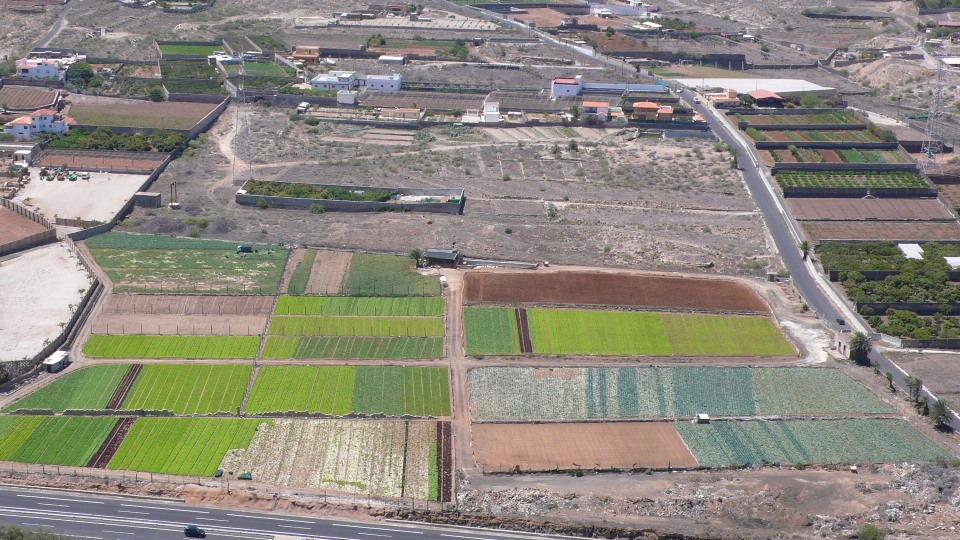
During summer 2015 one of the conveners of the meeting, Dr Richard Gillherded cats organised colleagues, pulled together all of the text and ideas that were generated, and took on the task of seeing a summary of the meeting through from initial draft to publication.  It was a monumental effort, involving 27 authors and 86 manuscript pages, and Richard did a sterling job.  Entitled “Protecting an ecosystem service: approaches to understanding and mitigating threats to wild insect pollinators” it will appear as a chapter in the next volume of Advances in Ecological Researchwhich should be published later this month.

The abstract and contents for the chapter are below; if anyone wants a copy of the full chapter, please let me know.

Abstract

Insect pollination constitutes an ecosystem service of global importance, providing significant economic and aesthetic benefits as well as cultural value to human society, alongside vital ecological processes in terrestrial ecosystems. It is therefore important to understand how insect pollinator populations and communities respond to rapidly changing environments if we are to maintain healthy and effective pollinator services. This paper considers the importance of conserving pollinator diversity to maintain a suite of functional traits to provide a diverse set of pollinator services. We explore how we can better understand and mitigate the factors that threaten insect pollinator richness, placing our discussion within the context of populations in predominantly agricultural landscapes in addition to urban environments. We highlight a selection of important evidence gaps, with a number of complementary research steps that can be taken to better understand: i) the stability of pollinator communities in different landscapes in order to provide diverse pollinator services; ii) how we can study the drivers of population change to mitigate the effects and support stable sources of pollinator services; and, iii) how we can manage habitats in complex landscapes to support insect pollinators and provide sustainable pollinator services for the
future. We advocate a collaborative effort to gain higher quality abundance data to understand the stability of pollinator populations and predict future trends. In addition, for effective mitigation strategies to be adopted, researchers need to conduct rigorous field- testing of outcomes under different landscape settings, acknowledge the needs of end-users when developing research proposals and consider effective methods of knowledge transfer to ensure effective uptake of actions.

Contents
1. Importance of Insect Pollination
1.1 Providing an Ecosystem Service
1.2 Brief Introduction to Pollination Ecology and the Importance of Wild
Pollinators
2. Major Threats to the Pollination Service Provided by Insects
3. Steps in the Right Direction to Protect Insect Pollinator Services: Policy Actions
4. Understanding and Mitigating Specific Threats to Wild Insect Pollinators to Protect Pollinator Services
4.1 Understanding the Stability of Insect Pollinator Communities
4.2 Using Molecular Approaches to Monitor Insect Pollinators
4.3 How Do Parasites Shape Wild Insect Pollinator Populations?
4.4 Understanding Insect Pollinator Population Responses to Resource Availability
4.5 Engineering Flowering Field Margins as Habitats to Attract Insect Pollinators
4.6 How Might We Improve the Wider Countryside to Support Insect Pollinators
4.7 Insect Pollinators in Urban Areas
5. Considerations When Developing Future Research and Mitigation Strategies
Acknowledgements
Appendix
References

Building a blog readership takes time revisited; and seven good reasons for academic blogging

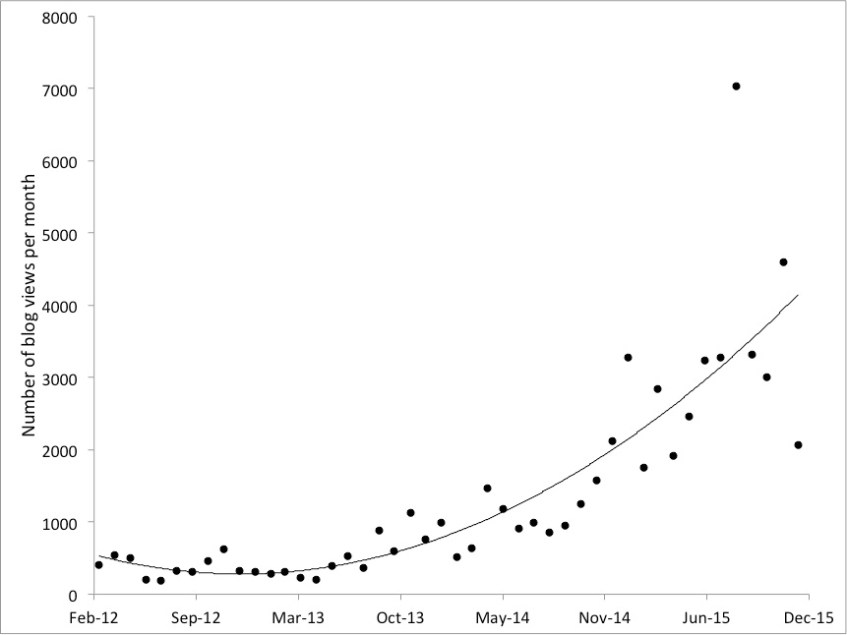
Almost 12 months ago I wrote a post entitled “Building a blog readership takes time” and summarised how the audience for my own blog had increased slowly at first and then seemed to rapidly take off after about 18 months.  The post received a lot of interest and more comments/pingbacks than usual, including a comparison with the first year of posting by the Ülo Niinemets’ Lab blog.  So I thought I’d update the figure to look at what has happened in the intervening 11 months; here it is:

Blog stats - January 2016

As you can see the upward course of monthly views has continued, increasing from 1000-2000 on average in autumn/winter 2014 to 3000-4000 on average at the moment.  However the variance has also increased and over this time scale has become less predictable; for example, views for December 2015 were actually lower than for the same month in the previous year.  The >7000 views for August 2015 is clearly an outlier, an anomaly caused by a deliberately provocative post entitled “Who is feeding the honey bee bullshit machine?”  It will be interesting to see if this variability continues and I’ll report back in another year (!)

Meanwhile over at the Times Higher Prof. Pat Thomson from the School of Education at the University of Nottingham, has written a piece on “Seven reasons why blogging can make you a better academic writer“.  The seven reasons are:

Blogging can help you to establish writing as a routine*

Blogging allows you to experiment with your writing “voice”

Blogging helps you to get to the point

Blogging points you to your reader*

Blogging requires you to be concise*

Blogging allows you to experiment with forms of writing

Blogging helps you to become a more confident writer

Those I’ve marked with an asterisk* are the ones that chime most with my experience, but this is clearly very personal and it’s worth reading the whole piece for yourself.  Happy Blogging in 2016!


Biodiversity Blog – 2015 in review

The WordPress.com stats helper monkeys prepared a 2015 annual report for this blog.

Here’s an excerpt:

The concert hall at the Sydney Opera House holds 2,700 people. This blog was viewed about 39,000 times in 2015. If it were a concert at Sydney Opera House, it would take about 14 sold-out performances for that many people to see it.

Click here to see the complete report.

Six Kingdoms for Christmas: the cultural biodiversity of a winter festival

P1120504

Since beginning this blog in 2012 I’ve traditionally posted one or two Christmas-themed items around this time of year, including a piece on “Thanking the pollinators for Christmas” and a true story from 2013, “A Christmas vignette“.  The role of pollinators in producing much of the traditional Christmas fare has subsequently been picked up by others (last year the University of Bristol, this year a blog from Trinity College Dublin) so I’ve decided to break with tradition and consider the ways in which biodiversity (both wild and farmed, though the latter of course originated as the former) adds to the cultural experience of Christmas through its traditions and rituals.

In this regard I’m coming at the topic as a north-European agnostic who values Christmas as an opportunity to relax and unwind at the darkest, coldest* part of the year, rather than as a Christian.  And because I’m a British scientist much of what I say relates to British customs, though I’ve tried to include non-British examples where I’m aware of them – feel free to let me know about examples I’ve missed by commenting below.

I’ve decided to structure this post taxonomically and focus on a Six Kingdom Classification** of life on Earth as that’s been the theme of my first year undergraduate teaching since October.  Four of the six Kingdoms can be dealt with fairly quickly as their significance to Christmas is marginal or non-existent.  The two “bacterial” Kingdoms (Archaea and Eubacteria) contribute little to Christmas other than providing much of the gut flora that’s going to help us digest our Christmas dinner. Important but not specifically festive.  Likewise the protists and algae (Kingdom Protoctista) add nothing specific to Christmas unless there are traditions associated with seaweed of which I am unaware.

The other three Kingdoms are the ones where cultural biodiversity associations are more apparent.  The Kingdom Fungi (yeasts, mushrooms and moulds) provides us with several Christmas traditions including (in Germany) hanging mushrooms on the Christmas tree for good luck, and in parts of Scandinavia hanging strings of dried mushrooms around the house as decorations and as a source of winter food.  There is also the association between the red-and-white colour scheme of fly agaric magic mushrooms (Amanita muscaria) and the robes of Santa Claus, though I’ve seen that idea debunked in a few places and it appears that the “traditional” interpretation of Santa’s suit originated in the USA in the 19th century.

The Kingdom Animalia (both invertebrates and vertebrates) affords us a host of cultural connections to Christmas.  Birds include the turkey (Meleagris gallopavo) which in times past were famously walked to London from Norfolk; the domestic goose (Anser anser domesticus); and much of the song Twelve Days of Christmas refers to birds, including the turtle dove (Streptopelia turtur) one of the UK’s most declining and threatened bird species.  Mammals we associate with Christmas include of course reindeer (Rangifer tarandus) pulling Santa’s sleigh, led by the nasally-advantaged Rudolph, but also domesticated farm animals.  For example in Denmark in osme households it’s more traditional to eat pork (Sus scrofa domesticus) for Christmas dinner than goose.

Staying with the vertebrates, in our house it’s traditional to have smoked salmon (Salmo salar) with scrambled eggs for breakfast on Christmas Day, and (again in Denmark) sild (Clupea harengus) is also traditionally served as a starter, but I don’t know of other fish traditions.  Likewise I’m unaware of any invertebrates that are specifically associated with Christmas, though there have been recent reports of sustainably-sourced lobsters (Homarus americanus and H. gammarus)  becoming “traditional” in Europe.  There are also some local traditions such as honey bees singing in their hives on Christmas Eve.

The last of the Six Kingdoms is the Plantae, which, whilst the least taxonomically diverse, provides us with a wealth of cultural associations to Christmas.  These traditionally include evergreen plants that have been used to decorate homes, probably since the earliest pagan Yuletide festivals, such as: Christmas trees (various conifers in the genera Picea, Abies and Pinus); European ivy (Hedera helix); holly (Ilex aquifolium); and mistletoe (Viscum album).  However such traditions evolve and adapt to local needs and availability of plants.  For example in North and South America other genera of conifers not found in europe, such as Pseudotsuga and  Araucaria, may be used as Christmas trees***.  Likewise the absence of European mistletoe in North America means that people have adopted native mistletoes in the related genus Phoradendron for decorating and snogging traditions.  Over at her blog, ecologist Manu Saunders has recently discussed how native Australian species can substitute European plants for Christmas decorations.

The final example from the Plantae is the poinsettia (Euphorbia pulcherrima) which I’ve pictured above.  In many ways this is an unusual plant to have such a strong cultural association with Christmas: it’s a mildly toxic species of spurge from tropical Mexico that was introduced to North America in the 19th century, then subsequently to Europe.  However its festive connotations date back to the earliest period of Spanish colonisation in the 16th century, so it’s older than some of the other Christmasy traditions I’ve discussed.

Of course biodiversity is about more than just species and taxonomic diversity, it also encompasses the diversity of habitats in which that life is found.  Here too we see strong influences of the natural world on the culture of Christmas, including festive scenes of snow-bound boreal conifer forest.  As our planet warms, however, that might be a view that is found only on Christmas cards and old movies, rather than directly experienced*.

And on that sobering note, I wish all of my readers and restful and biodiverse holiday: have a great Christmas everyone!


*Ha!  It’s looking to be the warmest December on record, and at times has felt more like early summer than mid-winter.

**I’m aware that there are other Kingdom-level classifications out there which could be used, but the Six Kingdom approach is a good starting point.

***Closer to home, colleagues in the office adjacent to mine have adorned their large weeping fig (Ficus benjamina) with home-made Christmas decorations.  Looks good.

Biodiversity lost and found: extinct island birds and living African dragonflies

Two newly published studies have caught my eye this week as exemplifying two important aspects of biodiversity research: describing new species and understanding which species we’ve recently lost due to human activities.

Researchers working in the Macaronesian islands of the Azores and Madeira have described five new species of endemic water rails (genus Rallus) that are thought to have gone extinct within the period when humans colonised the islands.  One species may even have hung on into historic times.  All of the species were either flightless or had reduced capacity for flying, making them vulnerable to over-exploitation by humans.  That’s a common phenomenon on oceanic islands, with the dodo being the archetypical example.

What’s particularly remarkable is that these five new species increases the known recent diversity of the genus Rallus by about one third!  The reference for the paper, and a link to the pdf, is:

Alcover et al. (2015) Five new extinct species of rails (Aves: Gruiformes: Rallidae) from the Macaronesian Islands (North Atlantic Ocean) Zootaxa 4057: 151–190

The second paper is a mass-naming of 60 (!) new African dragonfly and damselfly species by a team led by KD Dijkstra, a Dutch entomologist whose work I’ve mentioned previously.  I had the pleasure of teaching with KD on a Tropical Biology Association field course in Tanzania a few years ago and his knowledge of African natural history is astounding.

To put these 60 new species into context, it increases the known diversity of African dragonflies and damselflies by almost 10%.  The reference and a link to the paper follows:

Dijkstra et al. (2015) Sixty new dragonfly and damselfly species from Africa (Odonata). Odonatologica 44: 447-678

Finding appropriate names for all of these insect species has required a degree of ingenuity from the authors and a quote from the paper demonstrates how memorable and creative some of them are:

“The Peace Sprite Pseudagrion pacale was discovered on the Moa River near Sierra Leone’s diamond capital Kenema. Twenty years earlier villagers trapped between rebel and government forces on opposite banks drowned in these tranquil waters. Two years later Kenema became the national epicentre of the Ebola outbreak…… The horntail Tragogomphus grogonfla evokes a Liberian pronunciation of ‘dragonfly’, the sparklewing Umma gumma a classic Pink Floyd album…… and the claspertail Onychogomphus undecim simply its date of discovery, 11/11/11.”

One of the things that I’ve tried to impress upon my final year undergraduate students this term during our Monday morning biodiversity seminars is just how little we still don’t understand about life on our planet.  Discoveries of new species are a regular occurrence, and for most we know nothing about their life histories or their interactions with other species (the aspect of biodiversity that particularly interests me).  In other cases (as with the Macaronesian water rails) the species were gone before we knew that they even existed.  I wish that I could be sure that this won’t happen in the future, but it will, until we (and the future generations that we are teaching) do something to address the problems of habitat destruction and inappropriate exploitation of biodiversity.

8 things I learned from the Parliamentary Pollinators Update seminar – UPDATED

POST event December 2015

As I advertised a couple of weeks ago, last Wednesday I was in London to take part in a Pollinators Update seminar at the Houses of Parliament organised by the Parliamentary Office for Science and Technology (POST).  It was a very interesting event and good to catch up with some of the latest ideas about pollinators and their conservation.  However it’s been a busy week since then and I’ve not had time to post a full account of the seminar, which was attended by over 40 people.  So I’ve decided to write a brief summary of eight things I learned that day from my fellow speakers* and from the day in general; in some cases I’ve linked to the original sources where available:

1.  About 46% of Europe’s bumblebees have declining populations (see the European Red List for Bees that I highlighted in an earlier post)

2.  Around 2% of the world’s bee species do 80% of the crop pollination (Kleijn et al. (2015) Nature Communications)

3.  Pollinators other than bees perform 39% of the flower visits to crops (Rader et al. (2015) Proceedings of the National Academy of Sciences)

4.  By 2100 the Red-tailed Bumblebee (Bombus lapidarius), one of the commonest species in Europe, may be extinct across most of the continent due to climate change (Rasmont et al. (2015) Climatic Risk and Distribution Atlas of European Bumblebees)

5.  Only 6.6% of Entry Level Stewardship agreements by farmers across England included plans to grow nectar- and pollen-rich flower mixes.

6.  Criticism of laboratory studies of the effects of neonicotinoid pesticides are just as illogical as criticisms of field studies: both have their limitations and advantages, and both are needed.

7.  A panel of four experts on pollinators and pollination will largely agree about the answers to most questions an audience asks.

8.  A Westminster seminar such as this will attract very few MPs if it clashes with an important debate in the House of Commons, in this case about future military action in Syria.

UPDATE: here’s a number 9 suggested by Simon Potts: we all strongly support and encourage the setup of an All Party Parliamentary Group on “Pollinators” not just “honeybees” or “bees”.


*With thanks to my fellow panelists Simon Potts, Claire Carvell and Richard Gill, and to Kirsten Miller and the POST team for organising the event, and for the photograph of the panel in action.


Virtual Conference on Ecology and Climate Change

Following on from what seemed to be a quite popular Virtual Conference on Pollinators, Pollination and Flowers I thought I’d mark this week’s Paris talks on tackling climate change with a second  “virtual conference” on the topic of climate change and how it may affect (and be affected by) natural and agricultural ecological systems.

This is a great set of talks* with some very thought-provoking ideas.  Hope you enjoy them.

Douglas Sheil  (Norwegian University of Life Sciences)

Do forests attract rain?


Hans Joosten (University of Griefswald)

For peat’s sake – bogs and climate change


Nicola Di Cosmo (Institute for Advanced Study)

Climate, conflict, and historical method


Ben Beard (NCEZID Centers for Disease Control)

Climate change, ecology, and disease emergence


Jennifer Cartwright and Bill Wolfe (USGS Tennessee Water Science Center)

Climate-sensitive, insular ecosystems of the Southeast U.S.


Nabil Nemer (American University of Beirut)

Are changes in insect patterns in the Lebanese Mountains evidence of climate change?


Lini Wollenberg (University of Vermont)

Climate Change Mitigation on Agriculture-Forest Landscapes


Tim Benton (University of Leeds)

Food and the future: climate and resilience


Feel free to discuss the talks in the comments section and to post links to other talks on the same topic.


*I’m assuming that, as all of these videos are in the public domain, none of the presenters or copyright owners objects to them being presented here.  If you do, please get in touch and I’ll remove it.