Category Archives: Urban biodiversity

Urban Pollinator Knowledge Exchange summary – Bristol 22nd February

P1110838The importance of urban environments for supporting pollinator populations is a topic that I’ve covered several times on the blog, for example: “Urban pollinators for urban agriculture” and “Urban bee diversity – a new study“.  It’s a subject that’s generating a lot of interest at the moment with some really exciting research being published and conservation practice taking place.  However there’s clearly a lot to do if we are really to understand where pollinators are distributed across out townscapes, and how we can best manage urban habitats to support this diversity and increase their numbers – here’s a link to an interesting round table discussion on this very topic.

Recently I was invited to take part in a workshop event co-organised by Defra, NERC, and Dr Kath Baldock from Bristol University entitled: Knowledge Exchange: urban grassland management and creating space for pollinators.  As well as doing a short talk which contextualised the current scientific knowledge on urban pollinators, I facilitated one of the breakout discussion sessions.

The workshop was very well attended with some 50 delegates from a wide range of organisations, including local and national authorities, businesses, NGOs, and universities.  Feedback from those delegates was generally positive and most people learned something about managing urban settings for pollinators, and made some useful connections.  I certainly learned a lot: it’s good to get out of academia sometimes and talk with practitioners.

If you follow this link you’ll find a PDF of the summary from the facilitated sessions, covering topics such as grassland and verge management, the urban edgeland, innovative projects, and green infrastructure.

Over at the Bumblebee Conservation Trust’s blog, Sam Page has a very nice summary of the whole day which is also worth reading:  Trials and tribulations of managing urban grasslands for pollinators.

Many thanks to all of the organisers for their work in putting on this event.

Protecting an ecosystem service: approaches to understanding and mitigating threats to wild insect pollinators

Bee on apple blossom 2 - 1st May 2015Back in April 2015 I attended a two day meeting at Imperial College’s Silwood Park campus to discuss initial project ideas to address evidence gaps in the recent National Pollinator Strategy.  I mentioned the meeting in passing in a post at the time concerned with whether biodiversity scientists should also be campaigners, but didn’t say a lot about what conclusions we came to and what the next steps would be because at the time I was unclear on both of those counts: it was a very wide ranging meeting with a lot of participants coming at the question of pollinator conservation from different perspectives.  As well as academics there were representatives from the agrochemical industry, government research organisations, and  the National Farmers Union.
During summer 2015 one of the conveners of the meeting, Dr Richard Gillherded cats organised colleagues, pulled together all of the text and ideas that were generated, and took on the task of seeing a summary of the meeting through from initial draft to publication.  It was a monumental effort, involving 27 authors and 86 manuscript pages, and Richard did a sterling job.  Entitled “Protecting an ecosystem service: approaches to understanding and mitigating threats to wild insect pollinators” it will appear as a chapter in the next volume of Advances in Ecological Researchwhich should be published later this month.

The abstract and contents for the chapter are below; if anyone wants a copy of the full chapter, please let me know.

Abstract

Insect pollination constitutes an ecosystem service of global importance, providing significant economic and aesthetic benefits as well as cultural value to human society, alongside vital ecological processes in terrestrial ecosystems. It is therefore important to understand how insect pollinator populations and communities respond to rapidly changing environments if we are to maintain healthy and effective pollinator services. This paper considers the importance of conserving pollinator diversity to maintain a suite of functional traits to provide a diverse set of pollinator services. We explore how we can better understand and mitigate the factors that threaten insect pollinator richness, placing our discussion within the context of populations in predominantly agricultural landscapes in addition to urban environments. We highlight a selection of important evidence gaps, with a number of complementary research steps that can be taken to better understand: i) the stability of pollinator communities in different landscapes in order to provide diverse pollinator services; ii) how we can study the drivers of population change to mitigate the effects and support stable sources of pollinator services; and, iii) how we can manage habitats in complex landscapes to support insect pollinators and provide sustainable pollinator services for the
future. We advocate a collaborative effort to gain higher quality abundance data to understand the stability of pollinator populations and predict future trends. In addition, for effective mitigation strategies to be adopted, researchers need to conduct rigorous field- testing of outcomes under different landscape settings, acknowledge the needs of end-users when developing research proposals and consider effective methods of knowledge transfer to ensure effective uptake of actions.

Contents
1. Importance of Insect Pollination
1.1 Providing an Ecosystem Service
1.2 Brief Introduction to Pollination Ecology and the Importance of Wild
Pollinators
2. Major Threats to the Pollination Service Provided by Insects
3. Steps in the Right Direction to Protect Insect Pollinator Services: Policy Actions
4. Understanding and Mitigating Specific Threats to Wild Insect Pollinators to Protect Pollinator Services
4.1 Understanding the Stability of Insect Pollinator Communities
4.2 Using Molecular Approaches to Monitor Insect Pollinators
4.3 How Do Parasites Shape Wild Insect Pollinator Populations?
4.4 Understanding Insect Pollinator Population Responses to Resource Availability
4.5 Engineering Flowering Field Margins as Habitats to Attract Insect Pollinators
4.6 How Might We Improve the Wider Countryside to Support Insect Pollinators
4.7 Insect Pollinators in Urban Areas
5. Considerations When Developing Future Research and Mitigation Strategies
Acknowledgements
Appendix
References

A new bee for Northamptonshire!

Anthophora bimaculata 2 cropped P1120172 copy

Back in the summer I produced a series of posts for Pollinator Awareness Week highlighting the pollinators to be found in our own urban garden in Northampton.  One of those posts was of what I believed to be the Little flower bee (Anthophora bimaculata), a species which at the time I’d never previously seen.  I noted that this was a new urban record for Northampton as my PhD student Muzafar Sirohi had not recorded it during his bee surveys, which I discussed earlier this year.

Some time later I checked the bee records on the National Biodiversity Network (NBN) Gateway site and realised that not only was this the first urban record of the species in Northampton, it was actually the first record for the county of Northamptonshire as a whole!  The record has recently been accepted on iRecord and will be added to the NBN records.

Of course this is personally exciting (a new record for a large county found in our back garden) and it adds a significant regional record to the currently known distribution of the species.  The map on the BWARS account of Anthophora bimaculata shows that the species is predominantly southern in its distribution, with a few eastern and western outliers.  This new record places the species firmly in the centre of England, confirming that it is more widespread than previously assumed.

There are two possible explanations for the discovery of this bee in Northamptonshire.  One is that it’s a very recent range expansion and the species is becoming more common and widespread, perhaps as a result of climate change.  The second is that it’s always been present in Northamptonshire, but just never recorded.  At the moment it’s impossible to decide between these two possibilities as there’s evidence to support both.  Not only did Muzafar not record A. bimaculata in his surveys in 2012, neither did Dr Hilary ErenlerDr Sam Tarrant or Kathryn Harrold in their pollinator surveys in the region between 2007 and 2015. Having said that, we do know that Northamptonshire is a historically under-recorded county for bees as it has no County Recorder for Hymenoptera, and both Hilary and Muzafar recorded species new to Northamptonshire, which I hope to report on at a later stage.

Differentiating between these two scenarios will be difficult and may be impossible unless we can discover previously unknown historical specimens of this bee that were collected in the county, or the species continues to expand in its range.

Understanding the distribution of pollinators such as bees is a key component of initiatives such as the National Pollinator Strategy – if we don’t know where the things we are trying to conserve actually are, how can we conserve them?  So it’s very pleasing to be able to make a small contribution to that process from the comfort of our own garden!

Anthophora bimaculata 1 P1120172

Gull use of urban parks in winter – data I’ll never publish (2)

P1120146

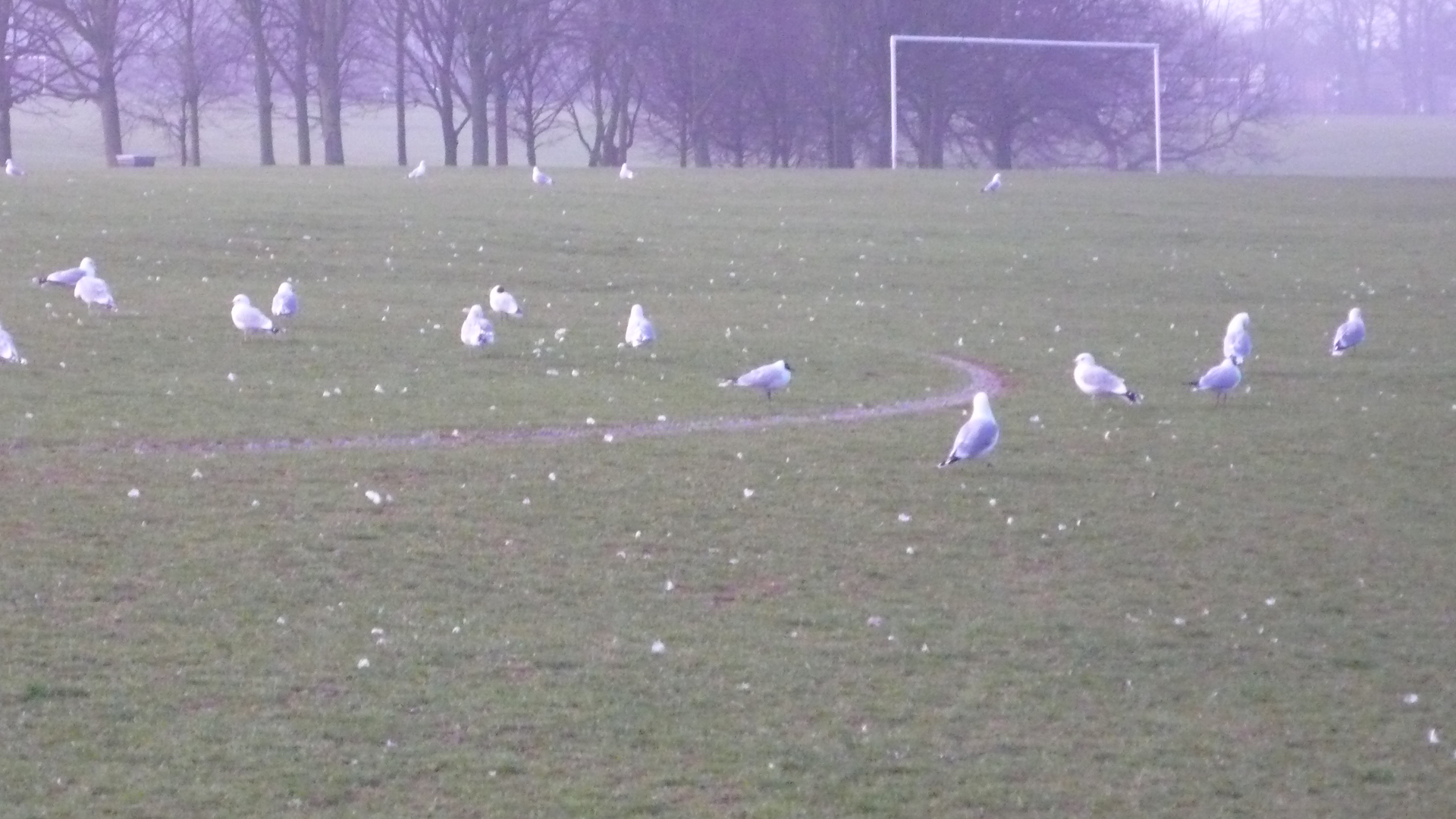
For the second in my occasional series of “data I’ll never publish” I want to present a short post about how two species of gulls use an urban Northampton park in the winter.  The park is called the Racecourse (I’ve mentioned it before) and is en route to the campus on which I work.  It’s long been apparent that the numbers of gulls using the park increases from autumn into winter and declines to zero in the spring and summer, when they head off to breed in and around Northamptonshire’s reservoirs and gravel pits, and further afield. During the winter they spend their time feeding on earthworms, squabbling, chasing crows, and generally relaxing prior to the next breeding season.

What I was interested in knowing was just how quickly the numbers built up, whether it was a slow, steady build-up or a rapid influx of birds, and also the relative numbers of the two commonest species to be found there, Black-headed gull (Chroicocephalus ridibundus) and Common gull (Larus canus).

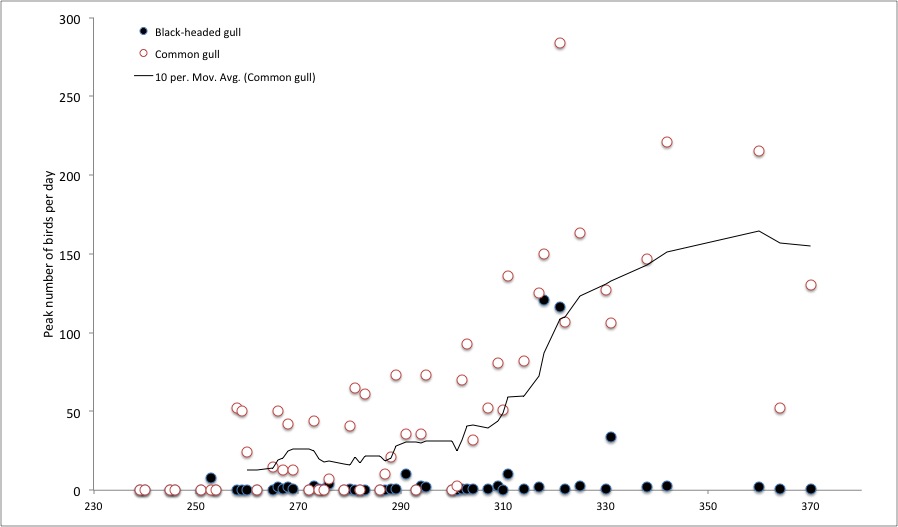
So during my walks to work between late August 2014 and early January 2015 I simply counted the numbers of birds I saw in the quadrant of the park that I passed.  Certainly not the most onerous data collection I’ve ever carried out, and done purely because it interested me, not with any view to conducting a serious study.  Here’s the data plotted up as peak birds seen per day, with day of the year on the x-axis, running from 27th August to 5th January:

Gulls on Racecourse 2014

A few things intrigue me about this.  First of all, Common gulls are much more, er, “common”, on the park than Black-headed gulls, despite the fact that Black-headed gulls are far more abundant in the UK during the winter (estimated as 2.2 million versus 710,000 birds).  However anecdotally I’ve observed that other parks in Northampton appear to have more Black-headed gulls, suggesting that the two species are to some extent dividing up the urban parks and other grasslands between themselves, like rival gangs with different local patches.

That’s purely speculative and would be worth pursuing as a student project, to test if (a) this hypothesis is correct; and (b) whether that division of the parks is stable between years.

The other thing that’s of interest from these data is that, as you can see from the 10-day moving average, the Common gulls suddenly increase in numbers around the middle of November.  I wonder whether this is due to an influx of migrant birds coming in from further north and east in Europe and Scandinavia?  At the same time I recorded an unusually large flock of Black-headed gulls: were these also migrants just passing through?

Urban gulls have been getting some bad press recently; but they really are fascinating birds that add a lot to the biodiversity interest of our parks and playing fields.  They deserve further study because we take them for granted and there’s really not much published on their urban ecology.

Something for the weekend #8 – the microclimatic value of planting our cities, one Buddhist view of environmentalism, and orchids. Oh, and we got married.

The latest in a regular series of posts to biodiversity-related* items that have caught my attention recently:

  • One of the best environmental writers around at the moment, Paul Kingsnorth, had an interesting essay on how Buddhism is helping him to come to terms with the current environmental crisis.  It was published earlier this year but I’ve only just seen it.  Paul is one of the founders of the Dark Mountain project, which I’ve mentioned before.
  • Here’s a piece about a fascinating study of how different types of vegetation can alter the average temperatures of our cities.
  • Finally, regular readers of this blog know that I often mix some personal stories with my professional reflections, so the Big News of Summer 2015 is that, on the 15th of August, Karin and I were married at The Guildhall, Northampton, accompanied by our family and friends.  We had an incredibly happy day, and I wore a very biodiverse shirt, as you can see:

Karin&Jeff (73 of 477)

Feel free to recommend links that have caught your eye.

*Disclaimer: may sometimes contain non-biodiversity-related items.

Garden pollinators for PAW no. 7 – Tree bumblebee (Bombus hypnorum)

Bombus hypnorum

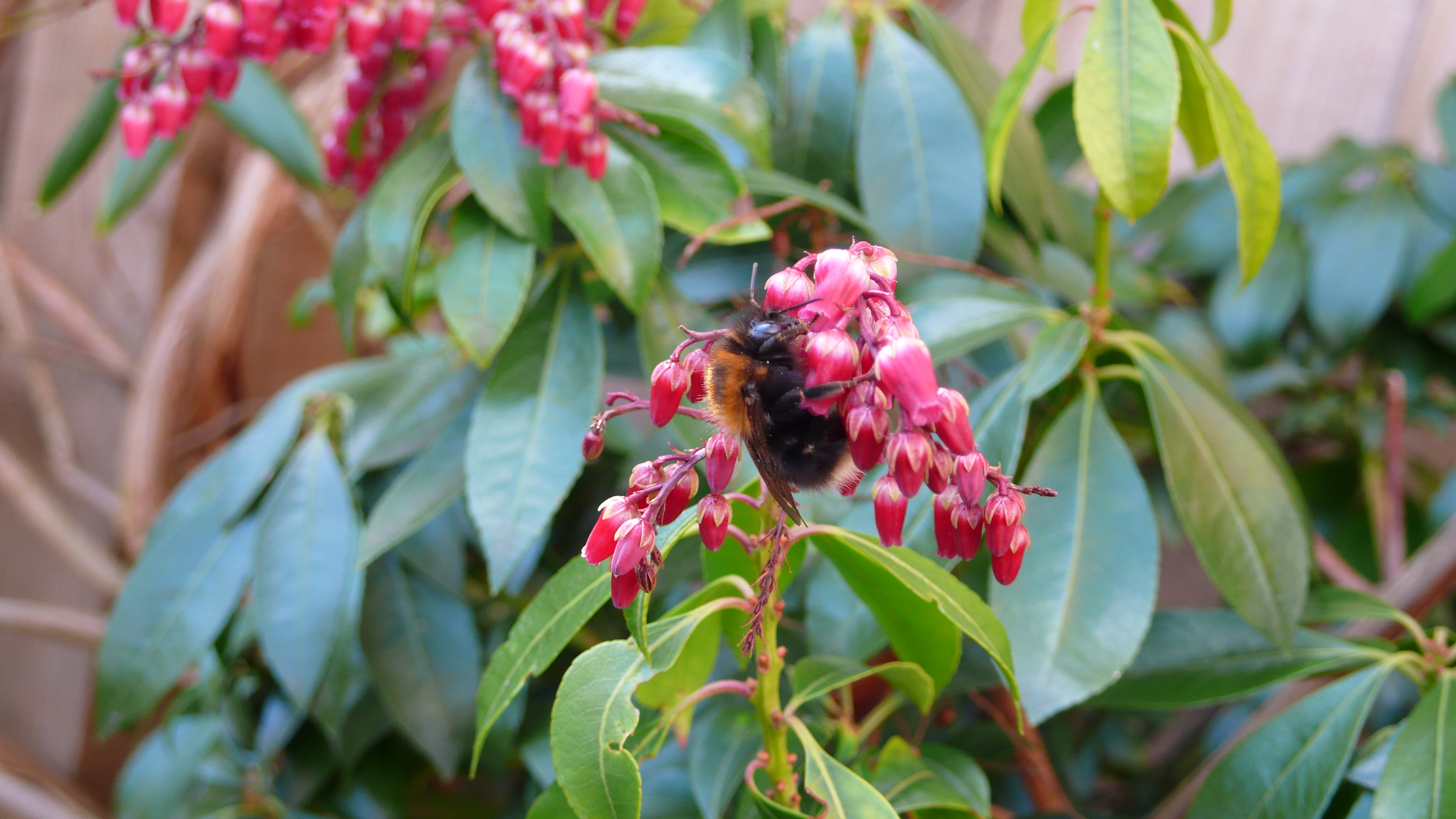
For my final post for Pollinator Awareness Week I’ve chosen another bumblebee, one with a fascinating history and ecology. The Tree bumblebee (Bombus hypnorum) is a relatively new arrival on our shores.  It was first discovered near Southampton by Dave Goulson in 2001; since then has spread out through the country, as far north (currently) as central Scotland, and has recently been recorded from Ireland.  It arrived in Northamptonshire in 2006. The Bees, Wasps and Ants Recording Society (BWARS) has been tracking its spread through a recording scheme: it’s very distinctive being the only one of our 25 bumblebees to have a ginger thorax, black abdomen and white tail.

All the evidence suggests that this was a natural range expansion for the species rather than a deliberate or accidental introduction by people.  It’s what species do, they move around and change their distribution over timescales of decades to hundreds of years (there are lots of bird examples of this, including the Collared dove in the UK).  There’s no suggestion that this was due to climate change, however: Bombus hypnorum has long been present in colder parts of Europe and Scandinavia.

That said, there is probably a human influence to its spread as the species is closely associated with houses and gardens, often nesting in bird boxes or roof spaces (we had one in our roof for three years running).  The natural nesting habit for this bee is tree holes (hence the common name) which is why they are usually found in cavities above the ground.  However, like the Buff-tailed bumblebee, they can also be found in compost heaps, as a recent posting on the Bees Knees Facebook group showed (if you’re not a member of that group I can recommend it as it’s full of friendly, practical gardening advice for those interested in how their garden can be beautiful, productive and wildlife-friendly).

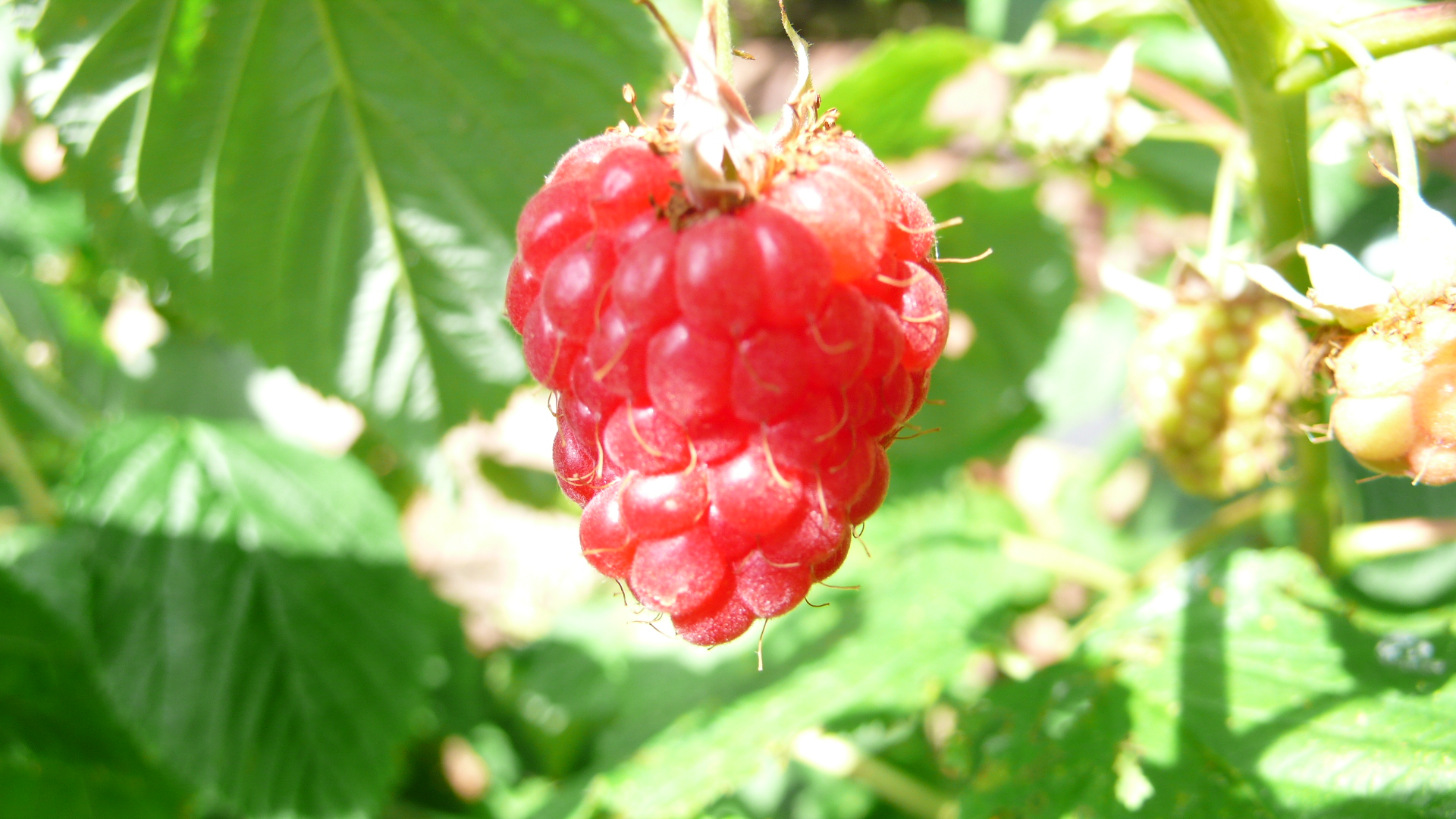
Although the Tree bumblebee will take nectar and pollen from an assortment of garden plants it seems to be particularly associated with members of the rose family (Rosaceae) and is a frequent pollinator of rosaceous soft fruit such as raspberries and blackberries.  I tried and failed yesterday to photograph the bee on our raspberries, so here’s a photograph of the outcome of that pollination.

P1120302

The Tree bumblebee is rapidly becoming one of the commonest garden bumblebees.  Is this likely to cause problems for our other bumblebees, by out-competing them for nectar and pollen, or even nesting sites?  It’s too early to tell but I’d be surprised if it does.

Bombus hypnorum March 2010

Phew!  That’s it!  It’s been a bit of marathon preparing these posts on top of writing a large grant application and a thousand other jobs, but it’s been a lot of fun.  Thanks to everyone who has viewed my posts For Pollinator Awareness Week and commented on them, either on the site or on Facebook.  Hopefully they have raised a broader awareness of our amazing native pollinators.

Garden pollinators for PAW no. 6 – Buff-tailed bumblebee (Bombus terrestris)

P1010430

It would be impossible to write a series of blog posts about garden pollinators for Pollinator Awareness Week without considering the bumblebees (genus Bombus) and I intend to devote the last two posts to that group of bees.  The bumblebees are arguably the UK’s most important pollinators of both wild and crop plants, certainly later in the season when colony numbers have increased. Earlier in the season it’s the solitary bees such as the Orange-tailed mining bee that are predominant.

Although common and widespread in gardens, the Buff-tailed bumblebee (Bombus terrestris) belongs to a group of bees in which the workers are rather variable in appearance and can be very difficult to distinguish from those in the Bombus lucorum group, which includes two other species (B. cryptarum and B. magnus).

This is a truly social species with an annual nest comprising workers and a queen.  Nests are founded by queens that have mated the previous year and hibernated.  They usually choose old rodent nests in which to begin their colonies, which is why they are sometimes found in garden compost bins.  An interesting question that I’ve not seen answered is whether the queens actively displace mice or voles from such nests: does anyone know?  This association between bumblebees and mice led Charles Darwin and Thomas Huxley into some speculation as to the role of spinsters in the British Empire.

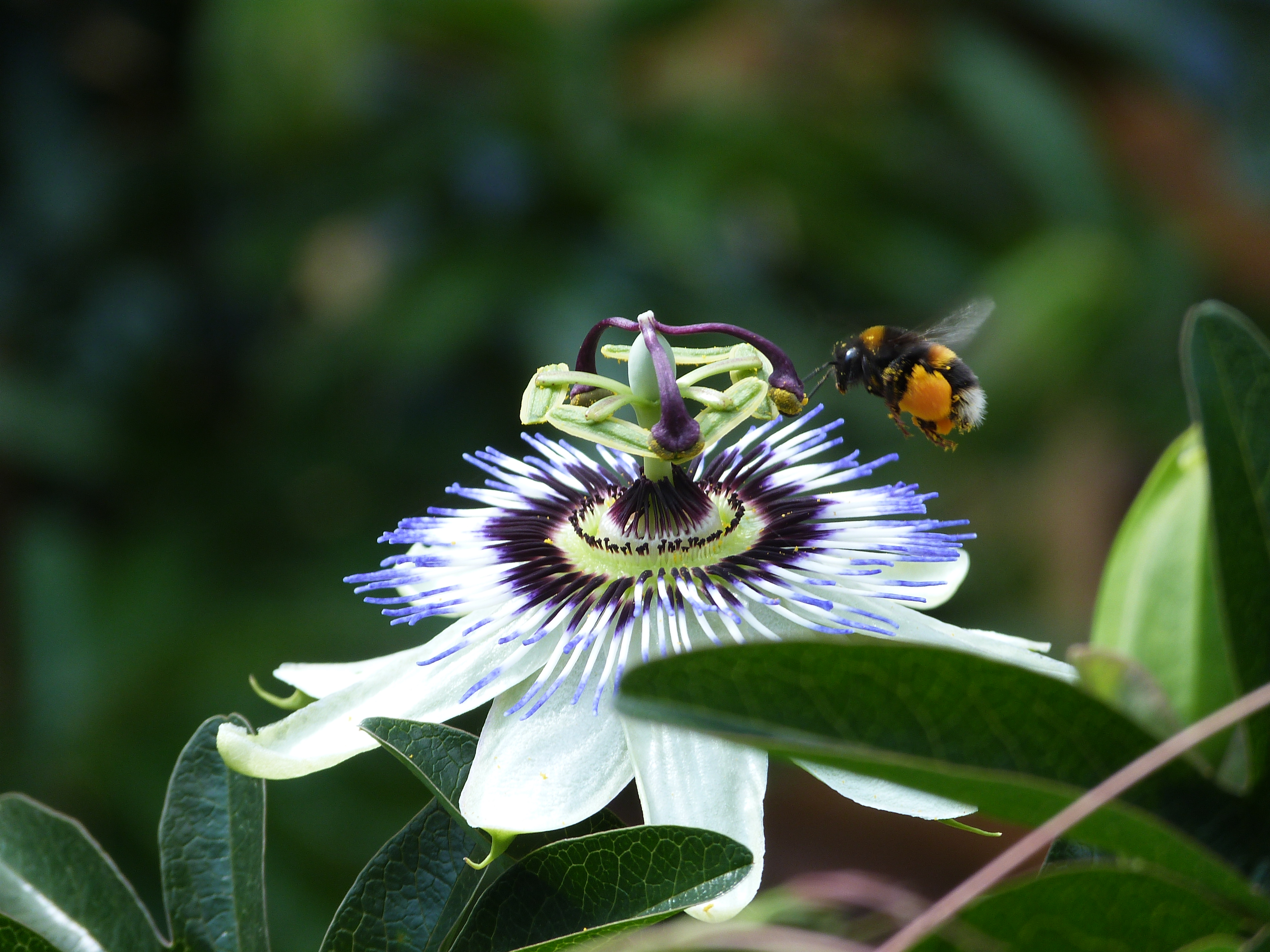
In my garden the Buff-tailed bumblebee pollinates a range of crops including strawberries, squashes, courgettes, blackberries, runner beans, french beans, tomatoes, and raspberries.  As the photo above shows they also visit the flowers of passion fruit, where they seem to be more effective than the smaller honey bees and solitary bees.

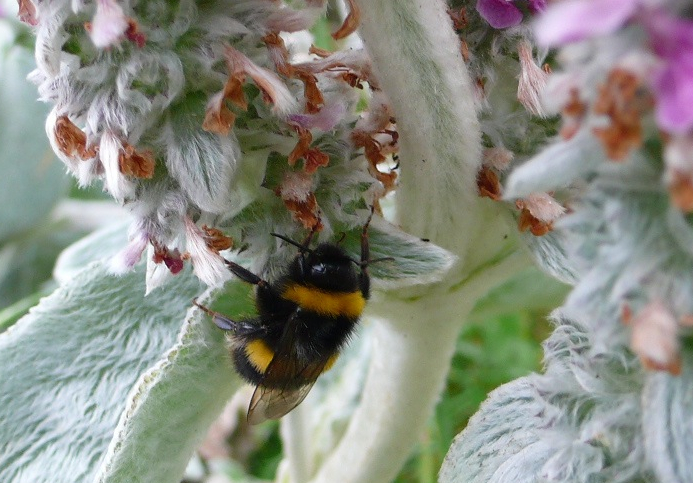
Buff atil on Lambs ear cropped July 2015 P1120289 copy

Garden pollinators for PAW no. 5 – Orange-tailed mining bee (Andrena haemorrhoa)

Bee on apple blossom 2 - 1st May 2015

The Orange-tailed mining bee (Andrena haemorrhoa) is also referred to as the Early mining bee due to its habit of emerging from over-wintered nests as early in the year as March.  In truth, however, many Andrena species put in an early appearance, making them important pollinators of orchard fruit such as apples, which you can see from the photograph above, taken in my urban garden earlier this year.  So “Orange-tailed” is a more descriptive name.

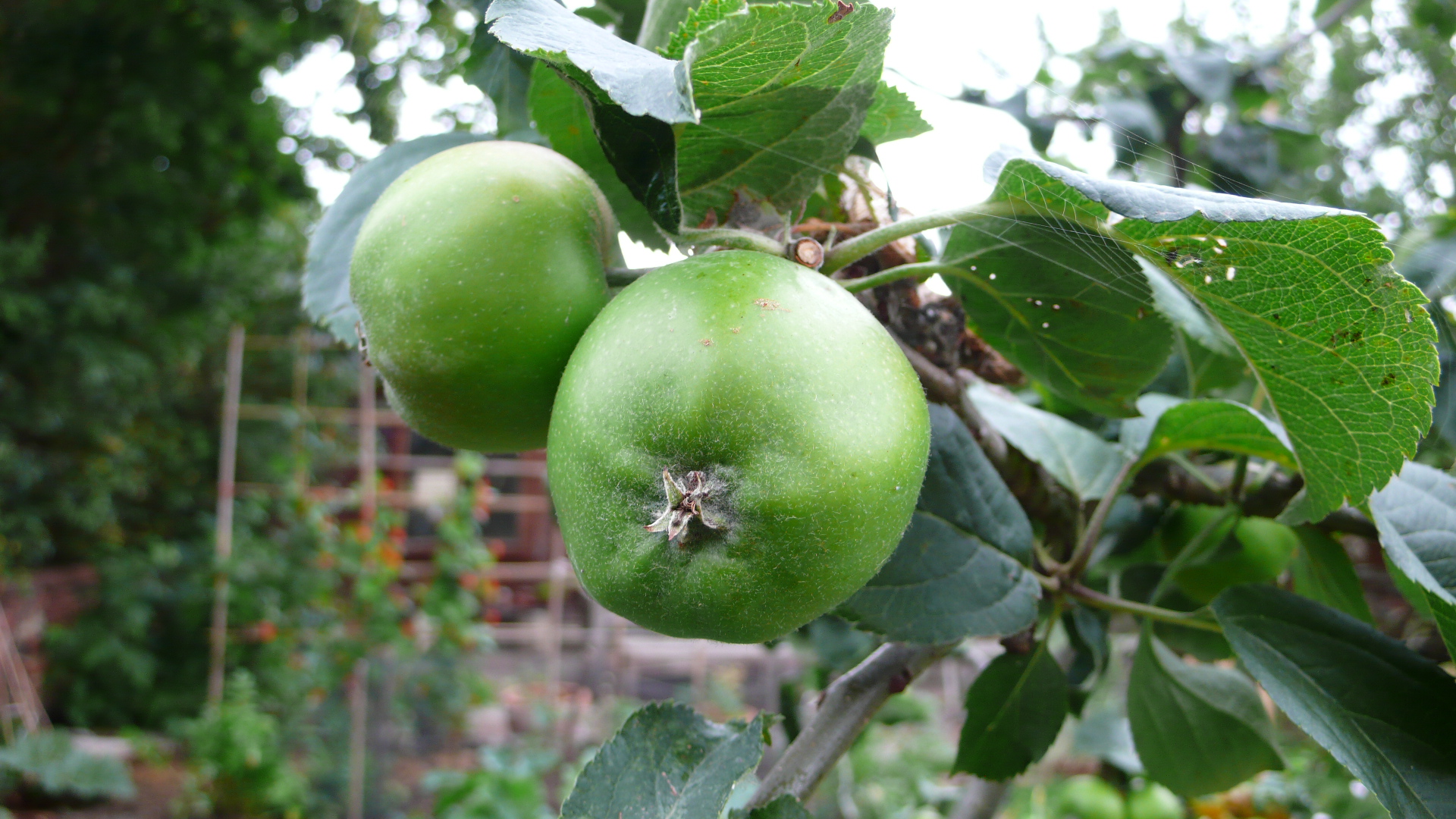
Thanks to the Orange-tailed mining bee and other early bees, this unnamed apple variety (which Karin and I rescued from the bargain area of a local garden centre) has gone on to produce a heavy crop of eating apples (see below). There’s considerable interest in the role of wild bees such as these as pollinators of fruit in commercial orchards, not just in Europe but in the USA too, where other Andrena spp. also pollinate apples.

The epithet “Mining bees” refers to the fact that these solitary species of the genus Andrena usually make their nests in soil, excavating deep tunnels in which to construct individual cells.  It’s another generalist, taking pollen and nectar from a wide variety of garden and wild flowers.  Dandelions are particularly important early in the year – so don’t over-manage your lawn and allow some to flower!

P1120277

Garden pollinators for PAW no. 4 – Gatekeeper butterfly (Pyronia tithonus)

Gatekeeper 3 - summer 2014

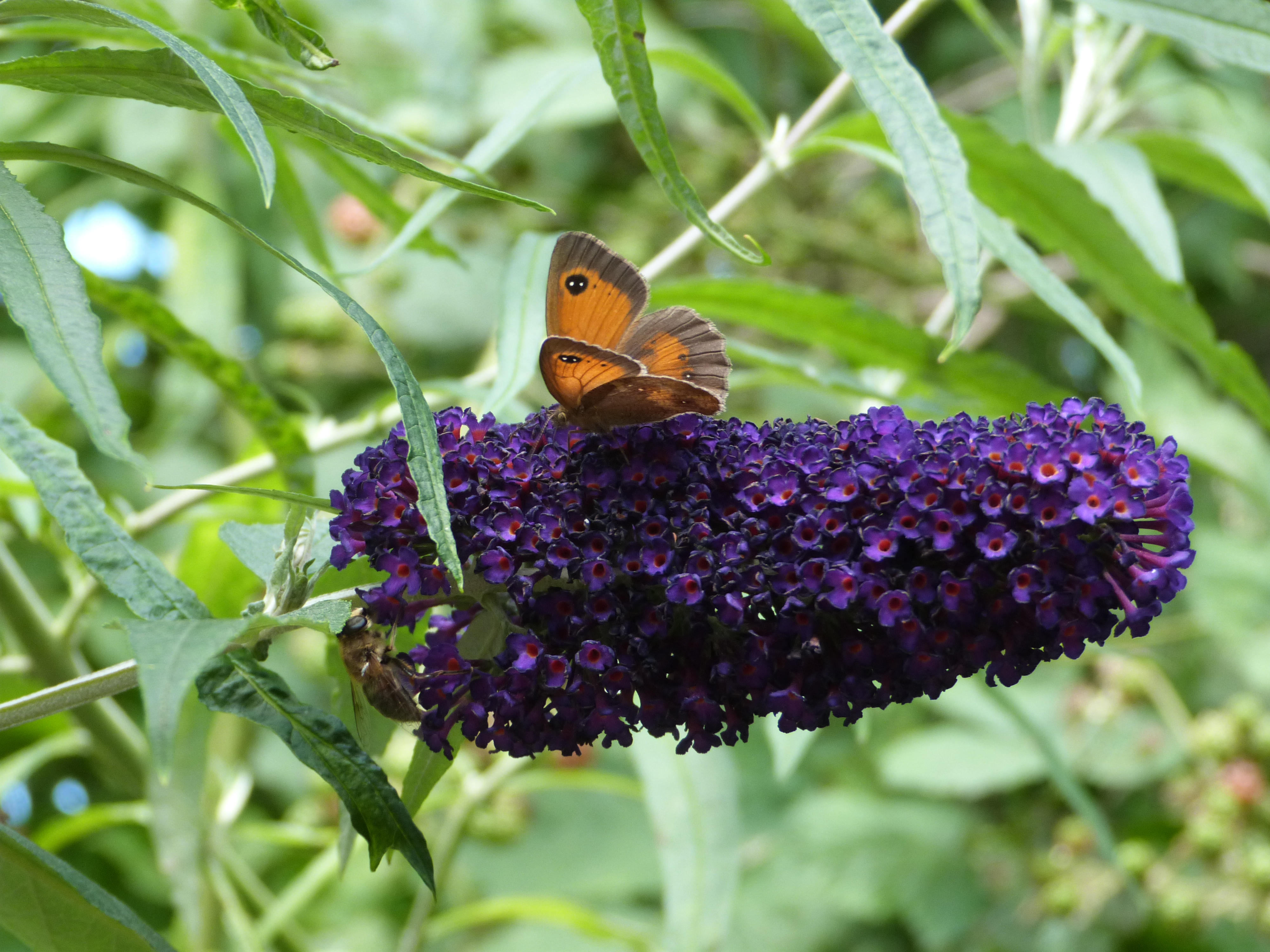
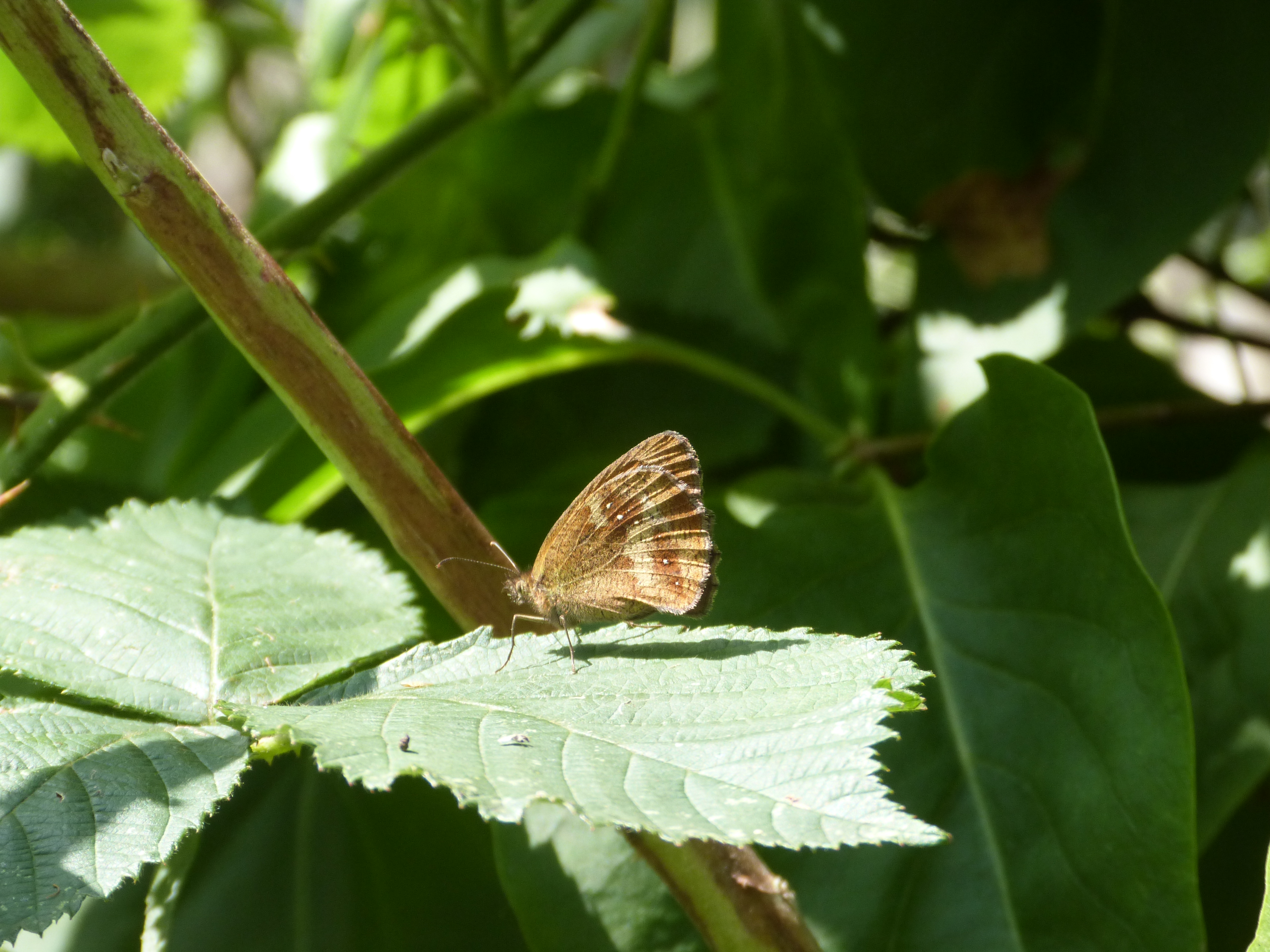
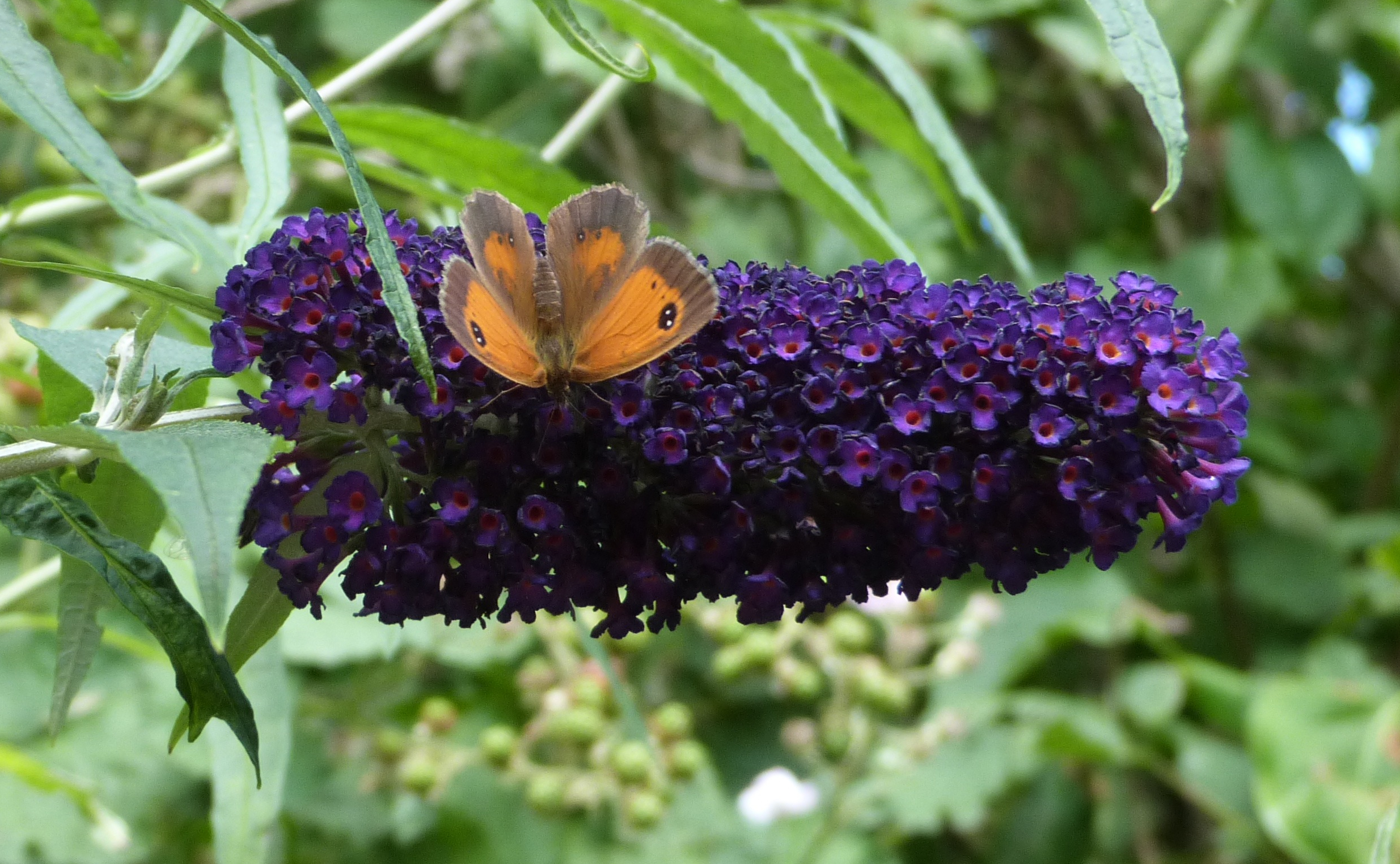
For my fourth contribution to Pollinator Awareness Week I’m going to highlight the Gatekeeper (Pyronia tithonus), a butterfly that I featured on this blog last year.  As I noted in that post, it’s fairly rare to have Gatekeepers in an urban garden which indicates that the shrubs and hedges grown by myself and my neighbours are providing the right microclimate for the adults.  In addition the overgrown lawns of some adjacent gardens give opportunities for egg laying as the caterpillars are grass feeders.

P1010467

Adult butterflies are very well camouflaged when resting with their wings folded. They take nectar from a range of plants in my garden but particularly love the dark, heavily scented infloresences of the buddleia variety pictured here.  They also visit the wild blackberries scrambling through the hedge that separates us from next door’s garden and probably pollinate those flowers.  Although it’s often said that butterflies are poor pollinators compared to bees, due to their general un-hairiness and habit of holding themselves above the stamens and stigmas in a flower, it very much depends on the type of flower.  We have an unpublished manuscript that I hope to submit to a journal later this year showing that butterflies are actually better pollinators of one grassland plant than bumblebees.

Gatekeeper cropped P1010472

Garden pollinators for PAW no. 3 – Little flower bee (Anthophora bimaculata)

Anthophora bimaculata 1 P1120172

There are only five Anthophora species in the UK and the Little flower bee (Anthophora bimaculata), as the name suggests, is one of the smallest.  This is a fast moving little beast and my fairly bog standard cameras (and a generally impatient personality) struggle to capture it: Steve Falk’s images do it justice better than I ever could.

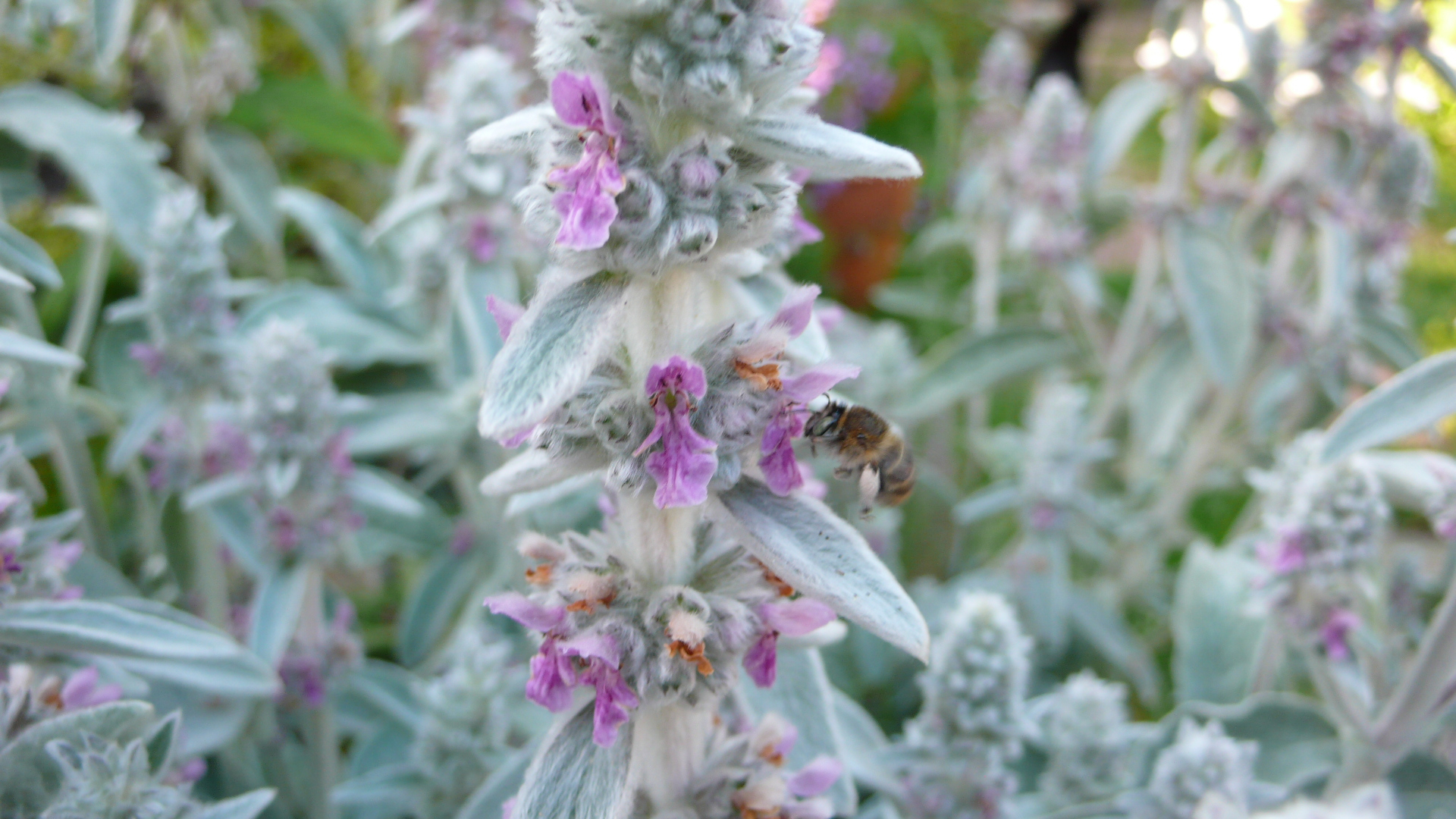
Once again, as with the Patchwork leaf-cutter bee, the flowers of Lamb’s ear are a real favourite in my garden.  Also like that bee, this is a solitary species, though this is one that nests in dry, sandy soil.  I’ve not been able to locate any nests in my own patch and I wonder whether it’s nesting in a nearby garden.

Another generalist species, I’ve seen this bee visit food crops with open flowers such as blackberry and raspberry in my garden.  Despite its size it is likely to be quite a good pollinator of those fruit as it’s abundant, fast moving between flowers, and hairy, and can carry significant amounts of pollen.

Interestingly, Anthophora bimaculata was not recorded by Muzafar Sirohi during his surveys of bees in Northampton town centre, so it’s another species that we can add to that urban list.

Anthophora bimaculata 2 cropped P1120172 copy