Category Archives: Ecosystem services

A Westminster pollinator seminar and The Great British Big Bee Count

20141028_180450

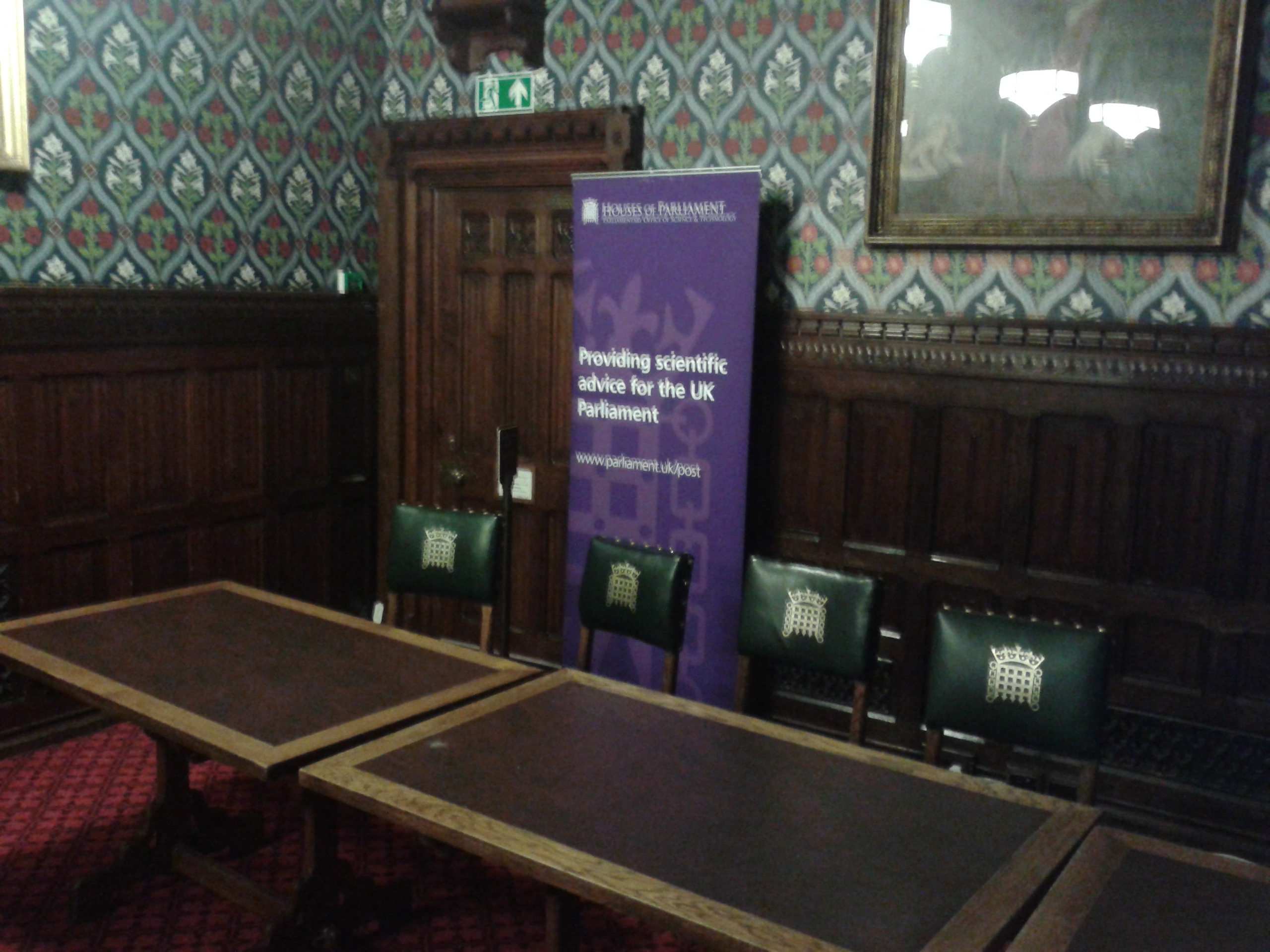
In the run up to Defra’s publication of a National Pollinator Strategy, due for release some time before Christmas, the Parliamentary Office for Science & Technology yesterday ran a two hour seminar at Westminster.  It was a full meeting in one of the small rooms, and apparently over-subscribed which doesn’t surprise me: there’s huge interest in pollinator conservation in the UK at the moment.  So it would have been better moved to a larger room to allow more scientists, practitioners, MPs, civil servants and other interested parties to attend.  In any case it was a useful couple of hours, with some interesting updates on what’s happening in relation to British pollinators.

The event was chaired by Sarah Newton MP and was kicked off by Adam Vanbergen from the Centre for Ecology and Hydrology who got everyone up to speed by giving an overview of the science of pollination, pollinator diversity, and the issues affecting pollinator populations.  In the process he cited our “How many flowering plants are animal pollinated?” paper which has fast become the default citation to use as evidence to support the ecological importance of biotic pollen transfer.  That’s hugely gratifying and is what it was designed to do.  We now have additional data with wider geographical coverage and I hope to update that analysis in the near future.  A lot of the information Adam was using can be found on the Insect Pollinators Initiative website.

Adam’s talk was followed by a presentation by Simon Potts from the University of Reading who discussed how we value pollination as an ecosystem service and how we can safeguard pollinator abundance and diversity.  There were some stark statistics on the economic contribution of pollinators to crops such as apples, including data from a study by Garratt et al. (2014) which suggests that both quality and quantity of apples could be improved by having more pollinators in British orchards.  Perhaps another way of viewing those data is that the UK apple industry is already experiencing the kind of pollinator deficit that conservationists have predicted?

Jane Memmott from Bristol University was next, presenting the preliminary results of the Urban Pollinators Initiative which is the first comprehensive study of the distribution of pollinators in large British cities.  The data look really exciting and it will be great to see the results finally published as it will make for an interesting comparison with Muzafar’s data on solitary bees in Northampton, the first manuscript from which has recently been submitted to a journal.

Finally Chris Connolly from Dundee University talked about pesticides in a presentation entitled “Why pick on the neonicotinoids?” and provided some disturbing statistics on how little we really know about what happens when the c. 350 types of pesticides (plus about 700 herbicides and fungicides) that we use in modern British agriculture combine in the environment to produce synergistic effects.  It’s also worrying that there is little understanding of the amounts of pesticides being applied because systematic data are not collated.  Chris is a neuroscientist working mainly in a medical context and gave the analogy of how combinations of therapeutic drugs can have unforeseen (even deadly) side effects.  Chris also used an image of Nigel Farage to illustrate a point which was a brave thing to do in the Houses of Parliament in the current political climate, but which got him a big laugh.

There followed 30 minutes of questions and discussion, and I managed to get in a plug for the Biodiversity Index when making a point of how difficult it is to get business to engage with biodiversity.  That led to an interesting conversation afterwards with a consultant that I need to follow up later today.

Out into the unseasonably warm London air by about 6.30pm, there were people standing outside pubs and sitting at cafe tables, as if we were in southern Europe rather than England in late October.  It reinforced some of the things I discussed in a post earlier this summer about climate change and current weather patterns.

Coincidentally (or not) Friends of the Earth released the results of their Great British Bee Count, a Citizen Science project designed to augment the monitoring work being done by specialist groups such as the Bees, Ants and Wasps Recording Society (BWARS).  I have mixed feelings about the Great British Bee Count.  On the one hand it’s great to engage the public in campaigns that raise the awareness of the importance of pollinators, and to get them out looking at bees.  But the reality is that the 832,110 records submitted to the count have very limited scientific value, despite what Friends of the Earth might claim.  That’s because it is very, very difficult to identify bees to even broad groups unless you’ve had some training, and (apart from some distinctive species) impossible to identify to species level unless you are a specialist.  I’ve been studying pollinators for 25 years and there are whole groups within our c. 250 native species that I have great problems identifying, and defer to the opinion of real specialists such as Stuart Roberts, chair of BWARS.

Stuart has made public his concerns at the quality of the data being submitted to the Great British Bee Count, and the fact that records cannot be checked because no photograph was taken and (worse) there are no specimens to compare.  The issues are neatly embodied in the fact that four species which were  recorded from Northern Ireland (Tawny mining bee, Hairy-footed flower bee, Red mason bee, and Tree bumblebee) have never previously been seen in Ireland and can all be confused with other similar species.  Of particular concern is the fact that Friends of the Earth expects the National Biodiversity Network Gateway to archive the data.  If that happens the Great British Bee Count data MUST be kept separate from the high quality, verified data on bee distributions that NBN already possesses, otherwise it will completely devalue the latter.  By all means let’s get the public engaged with pollinators and biodiversity more broadly, which is one of the purposes of this blog after all!  But let’s also be realistic about what can be achieved by these kinds of campaigns.

20141028_180501


Nature Improvement Area Annual Forum 2014 – influencing the future of conservation in England

NIA Forum - Sept 2014

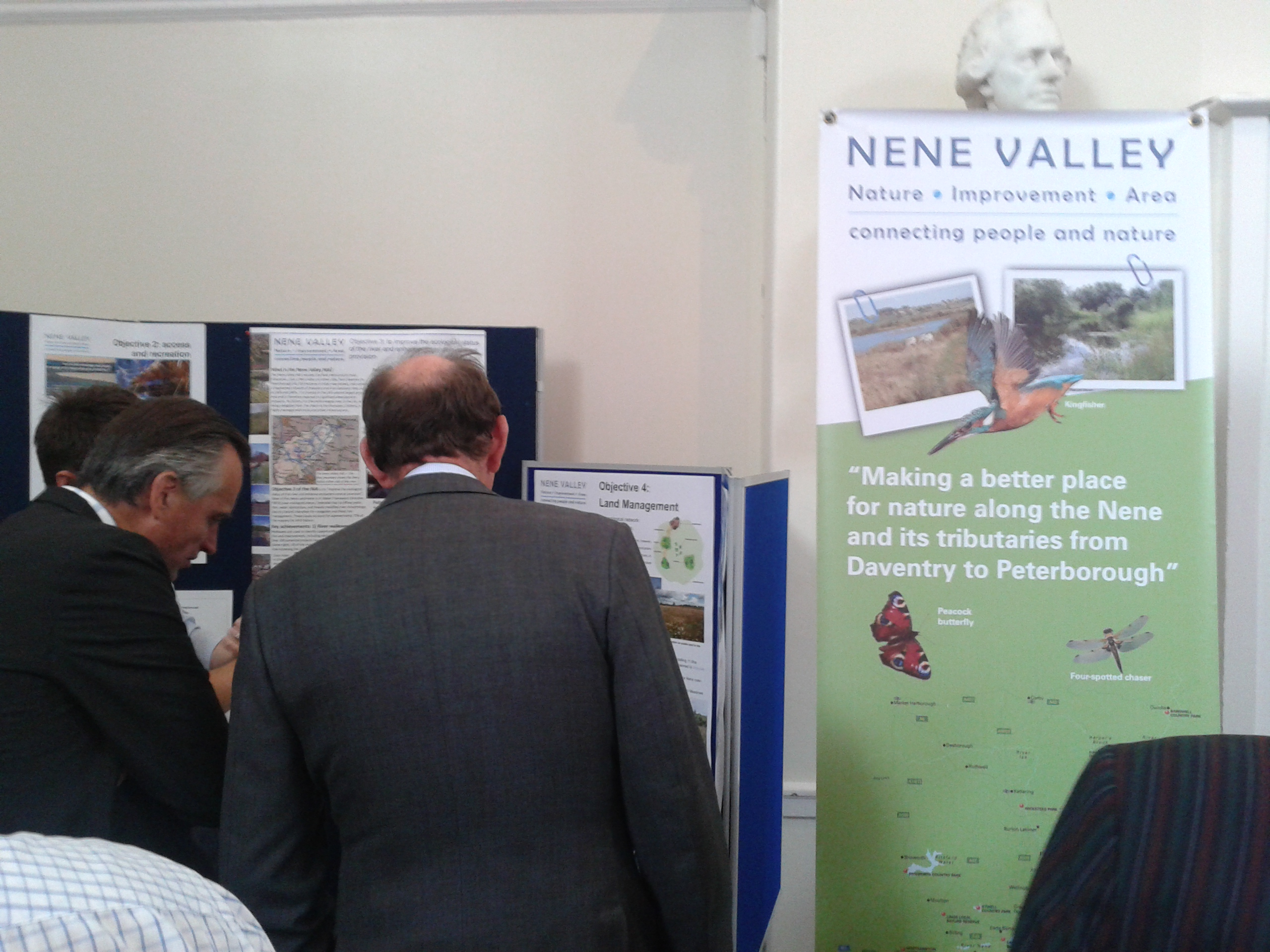
The Nature Improvement Area (NIA) Annual Forum took place in London yesterday and the Nene Valley NIA was well represented, with five of us from the University of Northampton attending, plus representatives from our partners in the Wildlife Trust, the River Nene Regional Park, the RSPB, and the River Restoration Centre.  It was an opportunity to see and hear what the twelve NIAs have achieved in the two and a half years since their inception, to compare notes, and (importantly) to think about the future of the NIAs.

The NIAs, as I’ve mentioned before, were meant to be pilot, flagship schemes to show how the future of conservation in England could become bigger, better and more connected across large swathes of landscape.  Their origin lies in the Lawton Report and Professor Sir John Lawton kicked off the day with a general introduction that, from the very beginning, brought up the one thing on everybody’s mind that day: the financial sustainability of the NIAs. The money runs out in March 2015, so where do we go from there?  All of the NIAs (ourselves included) have been applying for funding to continue the good work being done, but, as John Lawton, pointed out, if the Government is serous about the NIAs and wishes them to continue, there needs to be an investment of public money.  I deliberately use the term “investment” because we know that the natural environment of our islands plays a significant role in public health and the national economy more broadly.

John Lawton’s introduction was followed by a short speech by Lord de Mauley, Parliamentary Under Secretary of State for natural environment and science (who, incidentally, gave a nod in his speech to the National Pollinator Strategy). The Minister said a lot of the right things, how impressed he was with the NIA programme, that the government was committed to it in practice (but not necessarily financially), etc., etc.  There followed another speech by Andrew Sells, Chair of Natural England, who listed some of the achievements of the NIAs (see below), including the fact that for every £1 of Government funding, £3.50 was leveraged from other sources to support the activities of NIAs across the country.

There was an opportunity to ask questions of the first two speakers, plus representatives from the Environment Agency and Forestry Commission, the first of which came from our own Oliver Burke who asked about the government’s vision of the future of the NIAs.  All of the panel agree that there was a future, they just were not sure what it was, though there was commitment from Natural England (NE) and the Environment Agency (EA) that their staff would continue to advise and support NIA activities as part of their core activities.  That’s promising though perhaps not surprising given the nature of most of the partnerships, involving organisations that the NE and the EA would normally work with anyway.

The question I wanted to ask, had I found the right form of words, would have been about the current Government’s poor record on the environment.  But by the time I worked out a way of saying it that didn’t make it sound like a simple attack on the coalition, the opportunity was over.  A whistle-stop tour by the Minister and his coterie of the displays set out by the NIAs followed, which John Lawton later said had visibly impressed Lord de Mauley.  Amongst the achievements of the twelve NIAs, after only two years of activity, are:

  • Tens of thousand of hectares of priority and other habitats created, restored and/or improved in condition
  • Hundreds of kilometres of boundary and linear habitat (e.g. hedgerows) restored/created/improved
  • Tens of thousands of days of volunteer time devoted to the NIAs
  • Thousands of  people participating in educational visits.
  • Thousands of hectares of habitat managed specifically for ecosystem services such as improving water quality.

After lunch there were further talks including one from Simon Smith about the Cotswolds Ecological Networks project which had been one of the 70 applicants for NIA funding, was unsuccessful, and (impressively) went ahead with the project anyway as an “unofficial” NIA.  The Nene Valley NIA’s interactive website and photography competition was also highlighted in a talk by Helen Ashley from Dialogue by Design, and Dr Andy Stott from Defra discussed the monitoring and evaluation report for year 2 of the NIA programme.

Later in the afternoon we had a workshop at which, in small groups, we brainstormed some pressing questions, including (not surprisingly) innovative funding streams, and using the evidence base to demonstrate the effectiveness of the NIAs.  With regard to the latter it would seem sensible to use independent, long-term monitoring data such as the repeated species counts done by Butterfly Conservation (e.g. Big Butterfly Count) and the British Trust for Ornithology (e.g. Breeding Bird Survey) to verify whether or not the NIAs are being effective, though this of course requires that surveys have historically taken place within the NIAs (something that is certainly true for the Nene Valley NIA).  This would require quite a bit of coordination with the NGOs concerned, but should be doable.  I’d happily develop such a project if there’s someone out there with funding!

And then, with some final, supportive words from John Lawton, the day was over and we started to disperse out into an unseasonably warm mid-September London.  Several of us from the Nene Valley and the RSPB decamped to a great local pub (The Lord John Russell) to discuss the day.  One of the topics that everyone was talking about was, of course, the Scottish Referendum.  As I write this the country is absorbing the news that Scotland is to remain part of the UK.  As far as I’m concerned that’s a very good thing because (amongst other reasons) I think that a vote for independence would have negatively affected conservation in the British Isles.  Political focus of all government departments would move from environmental issues and on to trying to manage the split, which would take up a huge amount of time and resources that could be better spent elsewhere.  And NGOs such as the RSPB would have to devote time and resources to considering how they manage and fund their organisations, given their cross-border roles. That could have been to the detriment of Scottish conservation given that most of the funding is flowing south to north (which is purely a function of population size – there are many times more members in England and Wales than in Scotland).

Thank you Scotland, you’ve done the right thing.  And thank you to all 12 NIAs, you’ve shown the Government how successful large-scale nature conservation can be: let us hope they take notice.


Bad news for British biodiversity and a comment on ecosystem services

2014-08-16 15.36.53

Two related things have caught my eye this morning that I think deserve a quick blog entry.  The first is that Julia Leventon has posted an interesting piece on her frustrations with the ecosystem services concept over on the Ideas for Sustainability blog.  Go and read it – Julia raises some important points about the mismatch between our ever-more sophisticated concepts of ecosystem services and what it means to actually manage/support them within our society.  One of the things she said really struck me as it chimes with what I feel is a weakness of the current ecosystem services research agenda.  Julia says that:

I feel somewhat as though we are distracting ourselves by creating ever more complex physical constructs that require even more detailed physical understandings, and ever more complex chains of structures, processes, services and benefits.”

This I completely agree with. The underlying science (ecology/biodiversity/natural history/call it what you will) of ecosystem services is hugely complex, even for a reasonably well defined service such as crop pollination. As someone who has studied pollination ecology for 25 years I know how little we truly understand – yet this is supposed to be one of the more “straightforward” ecosystem services!

But to implement the ecosystem services concept within society we don’t need to know the finer details and dynamics of the species/communities/ecosystems involved (as interesting as they are). What we require is as much natural and semi-natural habitat within a landscape as is possible, appropriately managed (or left alone), and with as few anthropogenic stressors on it as possible (e.g. pesticides and other pollutants).  And we’ve known that for many years, long before ecosystem services was coined as a term in the 1980s.

Yet governments and agri-business consistently fail to deliver this basic requirement and our natural environment is becoming ever-less diverse and hospitable to the biodiversity that sustains ecosystem services.  See for example the latest bit of bad news regarding species-rich meadows in the UK, which are still declining long after it was pointed out that over 90% had disappeared: legislation designed to protect these grasslands seems to have had the opposite effect.  These are exactly the same kinds of habitats that are considered most important for the pollinators that agriculture relies upon!

The concept of ecosystem services, in my opinion, is a valuable one for focusing attention on the importance of the natural world, though there are others who disagree.  But the concept does not have to become mired down in the “ever more complex physical constructs” that Julia describes in her post. Let’s keep it simple and focus on what’s important rather than disappearing into a conceptual black hole that excludes practitioners, government, business and the public*.


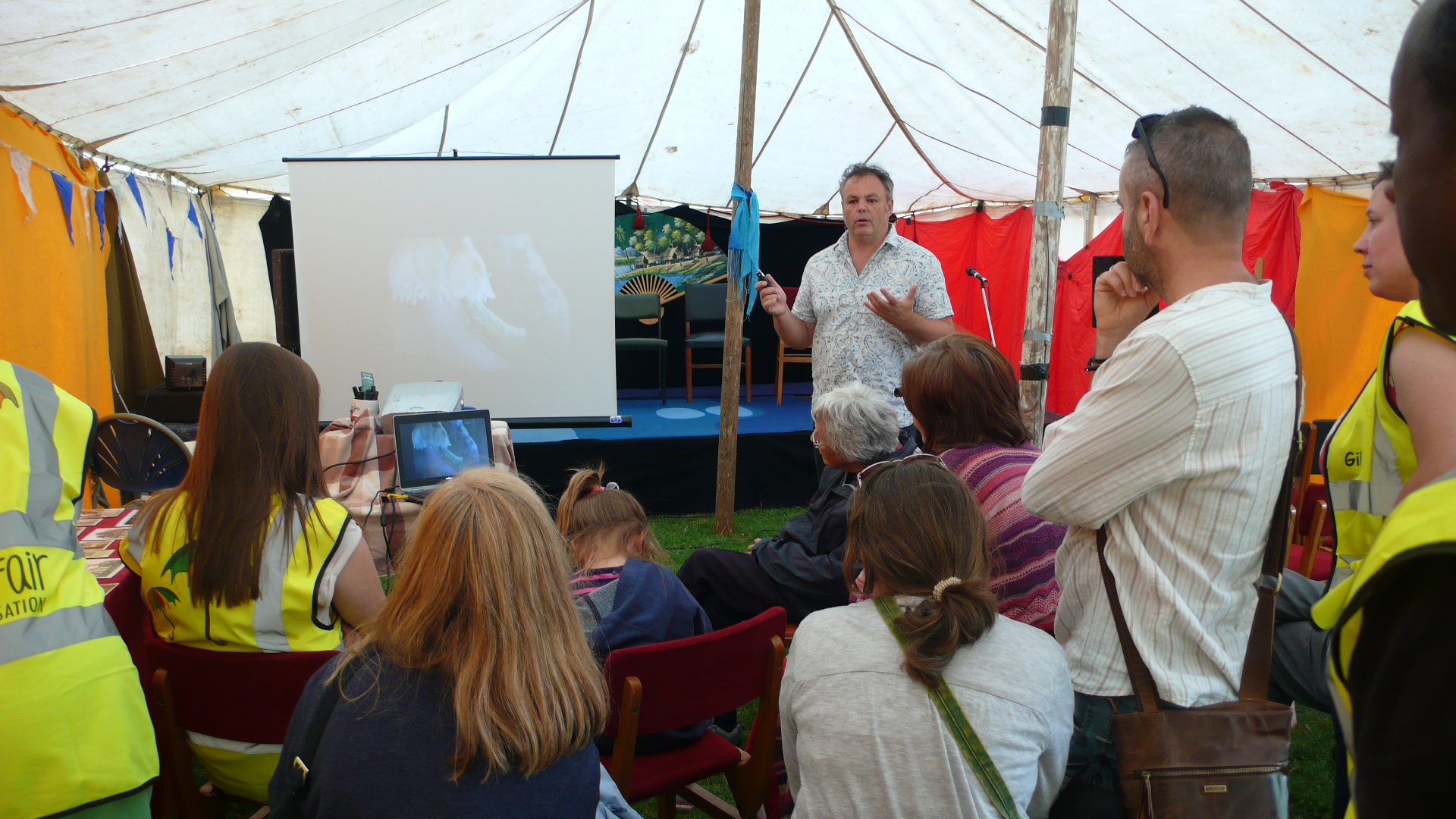
*The photograph above was taken a couple of weeks ago at Northampton’s Umbrella Fair, where I presented an over view of the importance of pollinators, and the idea of ecosystem services, to a small, [ahem] “mixed” audience, which included restless kids and incomprehensible drunks, in a marquee which was too light for the laptop projector to work.  But if even one of those who attended “got” the idea of ecosystem services I consider my job well done!

Ecosystem services online lecture by Robert Costanza

goldsworthy1

A few weeks ago I posted about ecosystem services and the differing opinions of writers such as George Monbiot and academics like Robert Costanza, together with a link to Monbiot’s lecture on the topic.  A new online lecture by Costanza has just been released, based on a webinar he presented last week.  It’s well worth watching, highly recommended as a state of the art over view of the concepts and progress in this area.

George Monbiot will not like it.


How do YOU value the Nene Valley?

Plane in river at Irthlingborough

Following on from my recent post about how contrasting ways in which to value nature, today sees the launch of a new interactive web site that is asking people which areas of the Nene Valley they value, and why.  There is also a photography competition with a chance to win pairs of binoculars.  The website link is:

www.nenevalleynia.org


Here’s the text from today’s joint University of Northampton/Wildlife Trust press release:

The Nene Valley Nature Improvement Area (NIA) project has today launched a new interactive website, which aims to encourage people to share their views on the local natural environment.

Covering over 41,000 hectares across Northamptonshire, Huntingdon and Peterborough­, the Nene Valley Nature Improvement Area features a variety of natural habitats, including wildflower meadows, wetlands, marshes, woodlands and wet grasslands. With fishing lakes, bird watching opportunities and children’s adventure playgrounds, the NIA is an attractive area for animals – such as otters, kingfishers and grass snakes – to call home.

Researchers from the University of Northampton have joined forces with conservation organisations and the national Sciencewise initiative to launch the new NIA website, which features a wealth of information, a virtual tour and a discussion forum.

The website provides an opportunity for local people to share their thoughts on the Nene Valley, and an online mapping survey has been developed to identify areas of the valley that are particularly valued and why these areas are important to visitors.  This will provide University researchers with valuable data that can be used to inform future plans for the valley.

A photo competition has also been launched to find some of the best images of the Nene Valley and to encourage people to explore the area over the summer.  Judges are looking for images of wildlife, landscapes, people, heritage, water, and the built environment taken in the Nene Valley.  There are separate categories for children so everyone can enter. Images should be submitted through the NIA website, and the winners will be selected through an online vote. The most popular photos will be displayed in the Autumn as part of the Nene Valley Festival, and the photographers of the top two images will each win a pair of Opticron binoculars. The competition closes for entries and voting at 5pm on 30 September.

Project co-ordinator Heather Ball from the Northamptonshire Wildlife Trust commented: “The new website is a great way to have your say about what goes on in the Nene Valley and share some fabulous images.”

University of Northampton researcher Dr Jim Rouquette added: “We need to gather information on the local places that people particularly value and the benefits that people gain from visiting.  By better understanding what is important to different people, we can start to target conservation efforts and ensure that local knowledge and values are incorporated into decision-making.”

​If you would like to contribute to this important project or take part in the photo competition please go to: www.nenevalleynia.org

How do we value nature? Costanza, Monbiot and the clash of concepts

2012-05-31 13.57.26

Is nature something that we should simply value for its own sake?  Or should we take account of how nature supports our society and our economy in real financial terms?  Back in 1997 Australian academic Robert Costanza and colleagues published a now classic paper in the journal Nature called “The value of the world’s ecosystem services and natural capital” that proved to be hugely influential and has been cited more than 3,500 times by other researchers in ecology, conservation, and ecological economics.  Soon after publication I began to use the paper in some of my classes, asking students how they felt about putting a monetary ($) value on how nature supports ecosystem services such as soil formation, pollination, carbon storage, climate regulation, etc.  Opinions were mixed, reflecting the fact that economic valuation of nature is controversial in theory, difficult to do in practice, and results in vast estimations of the “worth” of nature that seem to be fantastical.  The Costanza et al. study, for example, suggested that ecosystem services were worth $33 trillion per year to the global economy, a figure almost twice as large as the Global GDP at the time!

More than a decade and a half later, Costanza has published a follow up paper that updates the figures in the 1997 paper and arrives at a global valuation of natural capital of between $125 and $145 trillion per year, depending on assumptions made about changes to the area of biomes such as temperate forest, grassland, coral reefs, etc.  This last point is critical as loss of biome area due to changes in land use from agriculture and urbanisation has resulted in an estimated loss of ecosystem services of between $4.3 and $20.2 trillion per year between 1997 and 2011.  That’s a big change and, if nothing else, gives an indication of how we are altering the face of the planet at an ever faster rate, something I will come back to later in this post.

In this new paper Costanza and colleagues have also responded to some of the criticisms of the earlier work, particularly by journalist and activist George Monbiot who, as I’ve previously discussed on this blog, has a genuine, but I feel misguided, aversion to the whole notion of ecosystem services and natural capital. Monbiot’s been repeating these criticisms in a lecture, a video and text of which is available on the Guardian website.  I won’t go into a detailed discussion of his position, some of which I agree with, but I do believe that his major criticisms fail on two points.

The first is that Monbiot mixes up some very different concepts, bundling ecosystem services (a reasonable way of thinking about nature in relation to society) with biodiversity offsetting (a load of bollocks), green infrastructure (the importance of green space to urban development), carbon trading (dubious in theory and practice), and payments for ecosystem services (PES) schemes (which can work on a regional scale, as in the case of South West Water’s upland catchments project), as if they were all the same thing, which they are not.  In the Nene Valley NIA Project, for example, we are using an ecosystem services approach and are trying to develop a PES, but are wholly against biodiversity offsetting.

The second is that Monbiot sees all of this as some kind of neoliberal agenda to sell off the natural world to the highest bidder.  That’s really not the case and ecosystem services are being promoted as a concept by conservationists, NGOs and scientists whose motivation is saving the natural world, not selling it.  As Costanza et al. (2014) rightly state: “It is a misconception to assume that valuing ecosystem services in monetary units is the same as privatizing them or commodifying them for trade in private markets”

In his lecture Monbiot uses the classic rhetorician’s device of using partial quotes to support his point.  For example he quotes Dieter Helm as saying that:

“The environment is part of the economy and needs to be properly integrated into it so that growth opportunities will not be missed”.

Sounds bad, I agree.  But the full quote actually gives a very different and more profoundly “green” message:

“Over the coming decades, there will be a major programme to develop the UK’s infrastructure. The National Infrastructure Plan 2013 sets out ambitious plans – for new railways, roads, airport expansions, energy systems, water resources, sewerage investments, flood defences and a major increase in house building …….. In taking forward this major investment, it is important not to lose sight of natural infrastructure and the integral part that natural capital plays in delivering sustainable economic growth. …… the environment is part of the economy and needs to be properly integrated into it so that growth opportunities will not be missed.  Integrating the environment into the economy is hampered by the almost complete absence of proper accounting for natural assets. What is not measured is usually ignored.”

Monbiot does make some good points in relation to how power can trump any environmental monetary valuation, and how political influence works, but his solution of “mobilisation”, is most effective at a relatively small scale, for example the defeat of Derby Council over plans to develop a nature reserve.  Mobilisation by passionate environmentalists has failed to protect large swathes of Brazil’s natural environment, but arguments about the link between vegetation and rainfall, underscored by financial assessments of agricultural crop reductions, just might.

What is interesting about the lecture (which I encourage you to watch, Monbiot is a great speaker and it’s more entertaining than the transcript) is that not one of the audience questions afterwards actually dealt with the main topic of the lecture, namely the pricing of nature.  Is that because he won over the audience completely with his arguments?  Or is it because the ecosystem services approach to nature conservation is too recent a concept for its technicalities to have embedded themselves within public consciousness, and a general audience such as this might not feel confident enough to make challenging comments?  I suspect the latter because whenever I give public lectures to gardening and wildlife groups, for instance, I always ask who has heard of “ecosystem services”, and invariably it’s a minority of the audience.

If Monbiot was correct and it’s possible to sell off natural capital in the way he describes, then we would expect the coalition UK government, for one, as well as big business, to buy into the concept wholeheartedly and to invest much more than they currently do in order to make a quick buck out of biodiversity.  But they aren’t, and in fact this government has a track record that shows it has only the most cursory of interests in the UK’s natural ecosystems, and is willing to ignore scientific evidence to placate special interest groups who happen to be Conservative Party supporters (witness the recent badger cull debacle and the lack of action over illegal activity on grouse moors).

This is no doubt a debate that will continue but time is running out for the natural world and we don’t have many options: in Table 3 of Costanza et al. (2014) the authors present worrying data on how some biomes have greatly reduced in area since 1997 (e.g. coral reefs, wetlands) whilst croplands and urban settlement has increased.  That can’t go on: the natural world is too valuable, in all senses of that world, to lose, something I’m sure George Monbiot would agree with even if he doesn’t believe that monetary valuation is the way to do it.


All pollinators are equal, but some pollinators are more equal than others

The infamous line from George Orwell’s Animal Farm asserting that “All animals are equal, but some animals are more equal than others” nicely captures an ecological view of pollinators and their relationships with plants.  “Pollinators” by definition move pollen between flowers, but not all pollinators are equally good at transferring pollen of any particular plant: some are more effective than others. I’ll illustrate this with examples from the urban garden that Karin and I are developing, which I’ve discussed before.

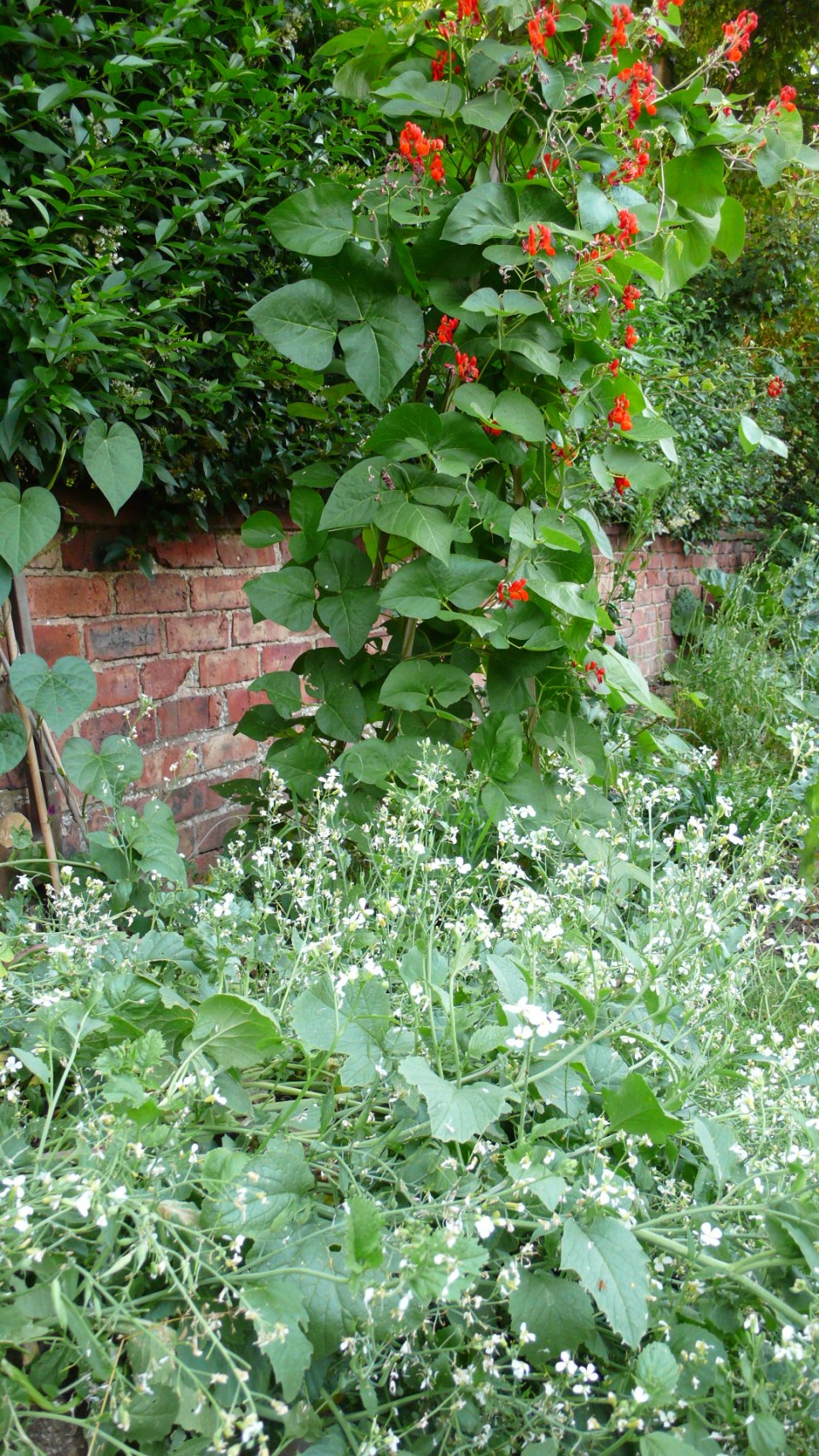
As you can see from that link, the garden is modest in size, but nonetheless this year it contains a significant biodiversity of edible plants that require pollinators for some or all of the fruit and seed set, including: strawberries, apples, greengages, cherries, blackcurrants, squashes, courgettes, blackberries, fennel, runner beans, french beans, passion fruit, tomatoes, raspberries, and radishes.

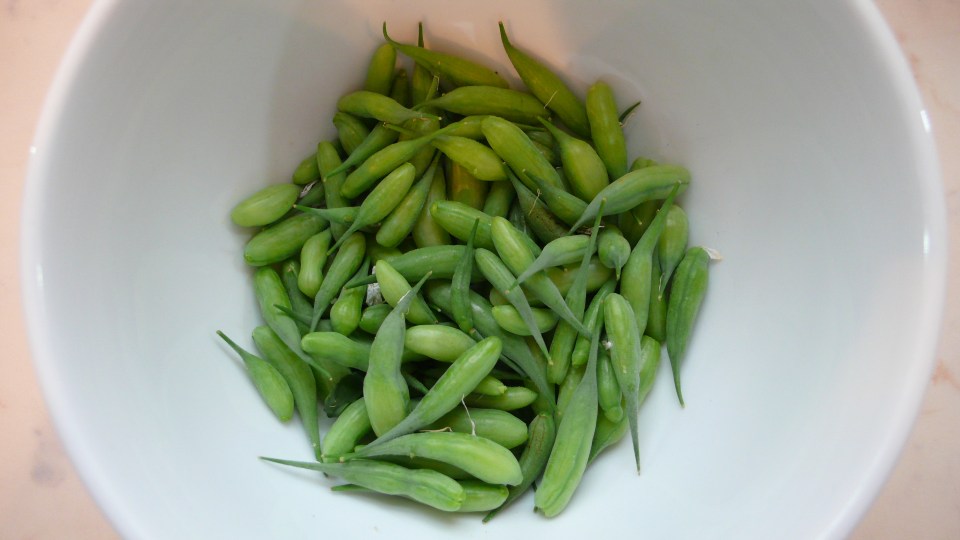
Radishes?!”  I hear you ask.  “But they are grown for their edible swollen roots which don’t require pollination!”  True, usually.  But we let our radishes flower because we mainly grow them for their seed pods which, picked young, are delicious in salads and stir fries, like mustardy mange tout.  They look like this:

2014-07-03 18.14.32

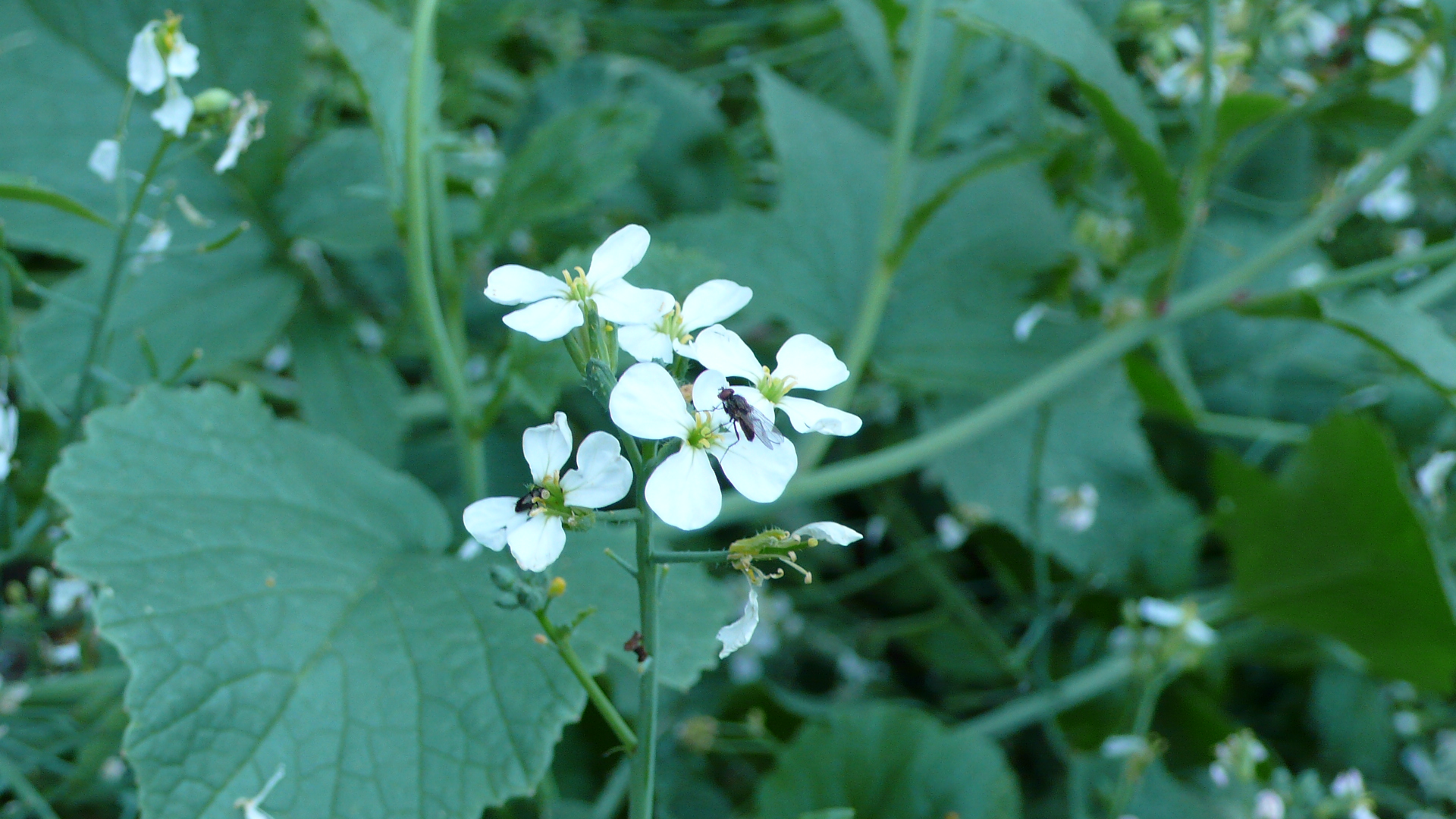
The radish flowers are pollinated by a diversity of insects including butterflies, bees, and small flies:

2014-07-03 19.40.34

These insects will vary in their effectiveness as pollinators of radish, depending on the frequency of visits, how often they move between flowers, and the amount of pollen on their bodies.  This last factor is largely a function of size and hairiness (bigger, hairier insects carry more pollen as a rule), though cleanliness also plays a part: insects often groom the pollen from their bodies and, in the case of bees, may pack it into their pollen baskets where it’s not available for pollination.

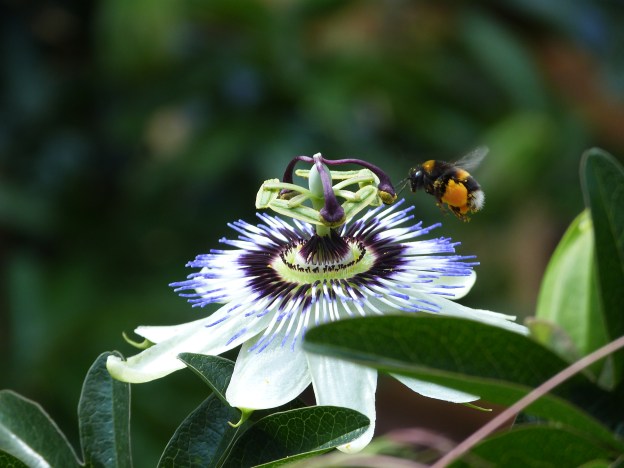
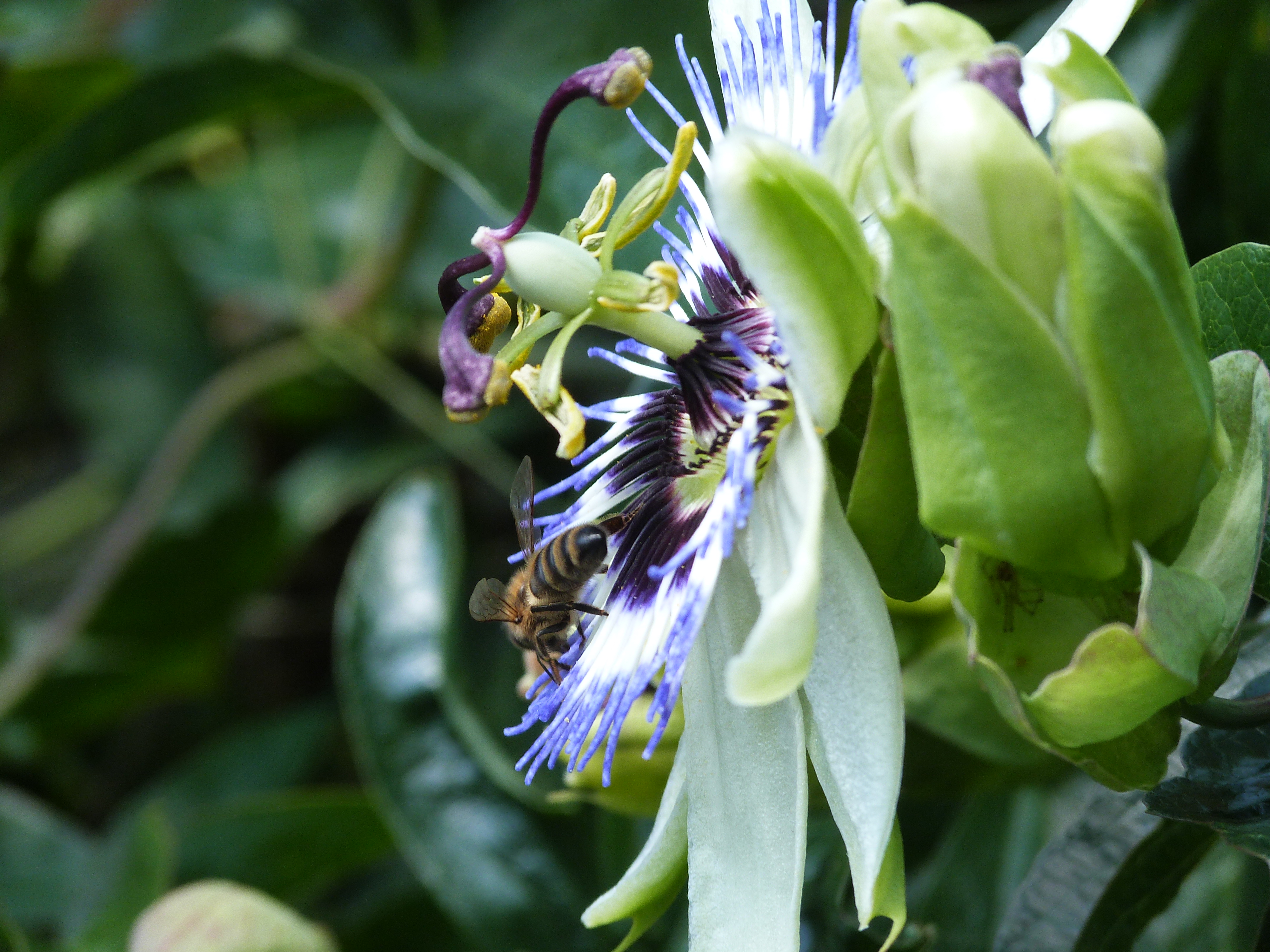
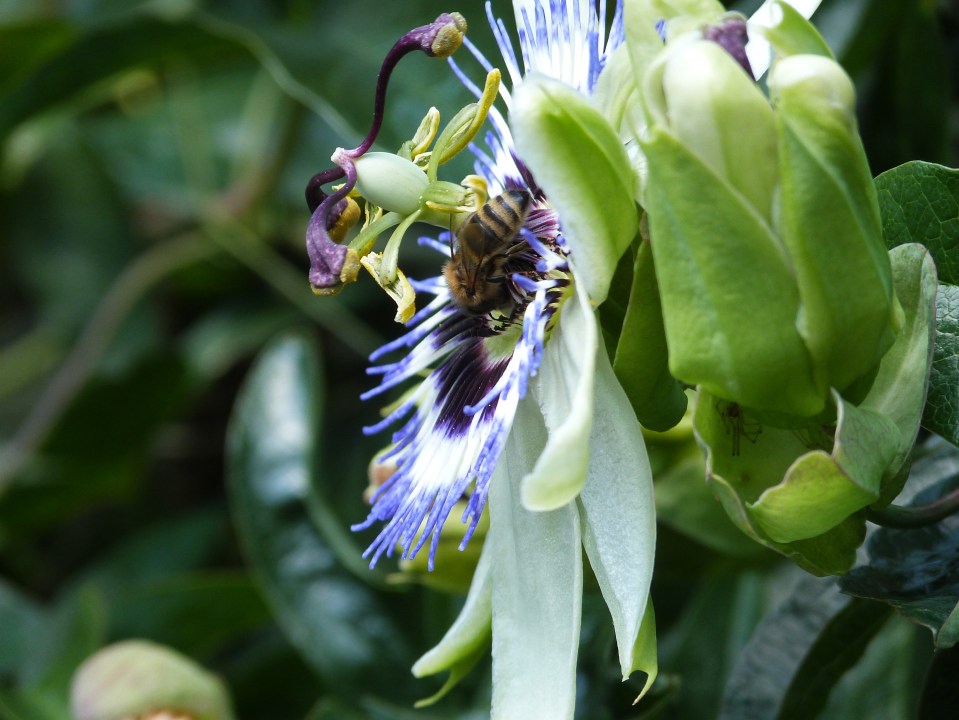
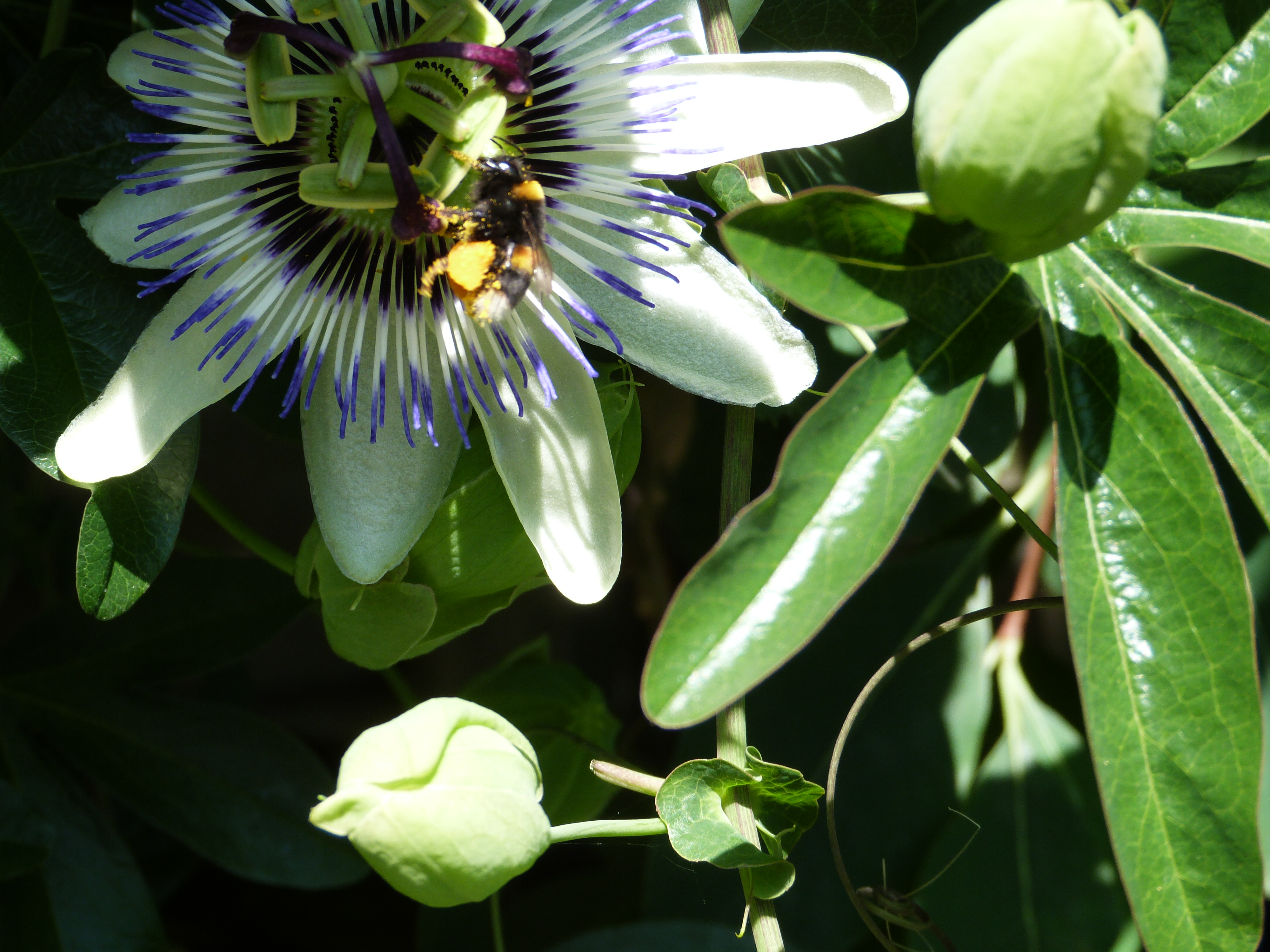
The size and behaviour aspect is best illustrated by some recent photos that I took of visitors to the flowers of passion fruit (Passiflora caerulea var.).  We have a large, sprawling plant growing up a fence which is currently being visited by honey bees, hoverflies, solitary bees and bumblebees.  In comparison to the size of the flower and the position of the anthers (male, pollen producing parts) and stigmas (female, pollen receiving parts), the hoverflies, honey bees and solitary bees are relatively small.  These two images are of honey bees (Apis mellifera):

P1010419

P1010418

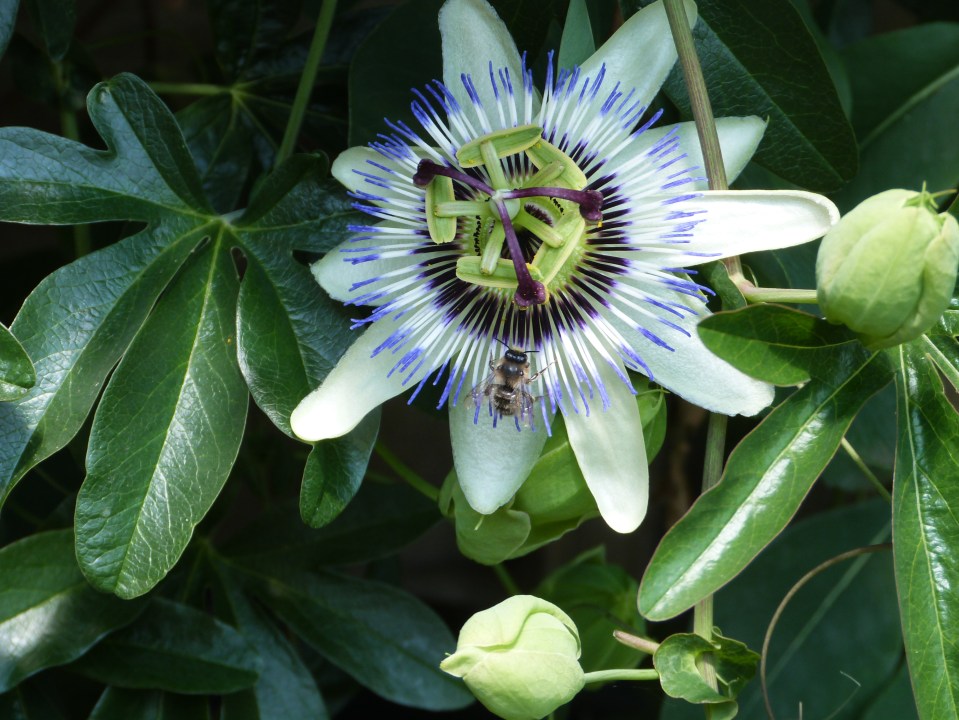
Here’s an unidentified solitary bee:

P1010431

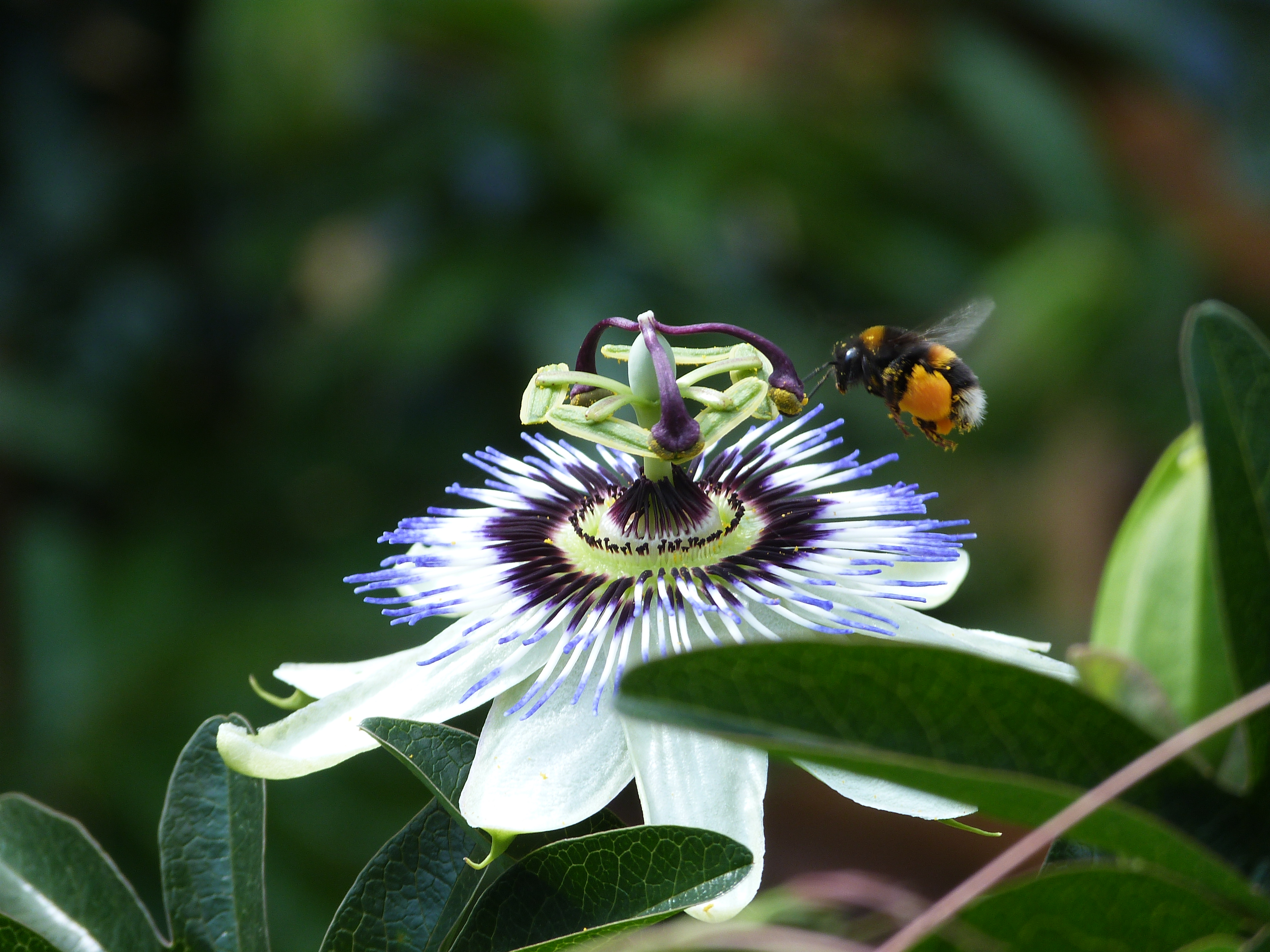
These bees were occasionally touching the anthers, mainly with their wings, so some pollen will be moved around.  But from what I observed it’s likely to be a relatively small amount in comparison to bumblebees, which are usually much larger and hairier, and don’t groom themselves as often as honey bees.  Here’s a Buff-tailed bumblebee (Bombus terrestris):

P1010430

They were actively collecting pollen as well as nectar.  Much of this pollen is packed into the pollen baskets on the rear legs and will go back to the nest to feed the developing larvae, but some will be involved in pollination:

P1010428

So it seems to be the bumblebees we have to mainly thank for the deliciously sweet-sour fruit we will enjoy later in the season. Of course to test this properly we would need to set up an experiment in which we excluded larger bumblebees from the flowers and only allowed smaller bees to forage, with appropriate experimental controls.  Would make a great project if any of my students are interested!  But it should give you a sense of just how complex the interactions between flowers and their pollinators are: the ecology of pollination is far from simple, despite what some would have us believe.

2014-07-03 19.40.18


“These things aren’t to study. They’re to turn up very loud and say, hey, once upon a time, everything was just as easy as this”

May June 2010 Garden, River of Flowers, Cambridge 011

The title of this brief post is a quote by Led Zeppelin frontman Robert Plant, from an interview that the BBC reported just this morning, regarding the forthcoming release of previously unheard Zeppelin material.  You can read the story and hear the interview here.

Regular readers of this blog will know that I’m not averse to sprinkling musical references into my posts, and this was a great quote that seemed to chime with something else I read this morning.  Over at the Small Pond Science blog, evolutionary ecologist Amy Parachnowitsch has a thought provoking post entitled “Save the bees, but maybe not this way“.  I’ll let you read it for yourself, but in a nutshell Amy is concerned about the scientific legitimacy of a “Save the Bees” campaign being crowd funded by online activist network Avaaz.org.

I share this concern and it worries me that whoever is organising the campaign is exploiting the genuine desire by people to “do something for the bees” without any regard for what exactly it is that’s “being done”.  It seems to me to be purely a campaign fund-raiser by people who don’t understand the issues or how science works, the message being: “These things aren’t to study. They’re to turn up very loud and say, hey, once upon a time, everything was just as easy as this”.

The organisers promise “the world’s first large scale, grass-roots supported, totally independent study of what’s killing our bees that decisively challenges the junk science of big pharma”.  As Amy notes, this is hugely offensive to independent scientists who are working on bee conservation issues (such as myself).  But without ever actually saying what they are going to do with the money, they’ve already had pledges of money from over 78,000 people!  If only raising funds for real research was that easy!

To reiterate what I said in the comments to Amy’s post, something that really worries me is that over-emphasis on pesticides and honey bees as single issues affecting “pollinator conservation” deflects attention from other factors which are at least as important, such as habitat loss. Colleagues and I have a manuscript in preparation at the moment showing that native bee and flower-visiting wasp extinctions in Britain began in the mid-19th century and reached their highest rate during the period 1929-1959, during a time of rapid agricultural intensification (but prior to the introduction of neonicotinoid pesticides that is currently exercising many people).  Loss of pollinator diversity is an issue that has deep roots.

In actual fact, although wild bee diversity is declining in the UK, overall abundance seems to be stable as some species are doing extremely well, including a new natural colonist, the Tree Bumblebee (Bombus hypnorum) which is spreading fast and is locally common.  But clearly greater diversity provides us with future insurance against losses of other species.

There are positive things that can be done for pollinator populations by every citizen, beyond giving money to crappy, pseudo-scientific campaigns, as I talked about in a recent post of mine.  So please don’t contribute to this Avaaz.org request, and use the money you save to buy some wild flower seeds and/or the Led Zeppelin reissues.  It will make the world a better place.


What are YOU doing for our pollinators this year? (reduce, reuse, recycle part 6)

2012-08-02 13.41.13

Earlier this year I was asked to write a short article by my former PhD student, and still a current collaborator, Dr Sam Tarrant.  Sam works for the RSPB as the CEMEX UK-funded Biodiversity Advisor, and wanted something on pollinator conservation that could be circulated in the CEMEX company’s e-newsletter.  In the spirit of reworking and reusing odd bits of writing, I thought I’d post it here too.


Insects are vital for our country’s economy.  Don’t believe me?  Then read on….

Beneath a large black mulberry tree near the University of Northampton’s Newton Building there is a plaque that commemorates its planting “On Shakespeare Commemoration Day, 3rd May 1916”.  Despite its age this tree annually produces large crops of succulent berries, aided by the fact that wind eddies are sufficient to disperse its pollen, ensuring pollination and fruit set.  Each year it’s a scramble between students, lecturers and birds, to see who can eat the most.

In contrast, the old apple trees in the grounds possess a different strategy – pollination by insects that move from flower to flower each spring.  This form of pollination is both more sophisticated and less reliable than wind pollination, and is currently under considerable threat: whilst there will never be a shortage of wind currents in Britain, insect pollinators are in decline.

The apples trees are not alone in requiring insects to pollinate them, so to do other farm and garden crops, including oil seed rape, field beans, courgettes, runner beans, and strawberries and other soft fruit.  It’s worth at least £440 million annually to the British economy, and most of it is done by wild bees and hoverflies, rather than managed hives of honey bees.

But all is not well with these insects in Britain – they are in decline.  Although the extent of the “pollination crisis” is debated by scientists, long term records show us that these insects are under pressure: 23 species of bee and flower-visiting wasp have gone extinct since the mid 1800s, as have 18 species of butterflies.  Less obviously, other species have considerably reduced in abundance so that they are now found in only a small part of their previous distribution.

There are lots of gardeners who want to “do something” for the pollinators, and keeping honey bees is often mentioned.  By all means, if you wish to help the honey bees (which are suffering their own problems) then keep a hive or two.  That will not, however, help our wild, native pollinators; the analogy I use is that it’s the equivalent of trying to help our declining songbirds by opening a chicken farm!

If you want to make a real difference for pollinators in your own garden, here are a few ideas:

  • start by planting nectar and pollen rich flowers; there’s a useful list on the Royal Horticultural Society’s website (see below).
  • allow plants such as clover and dandelion to flower in your lawn, bees love them.
  • as well as food, pollinators also need nest and egg laying sites, so you could help by allowing some of the far corners of your plot to run a little wild.
  • wait until late Spring to cut back hollow stemmed perennials as they are used as hibernating places by some of our bees.
  • allow mason bees to nest in old walls and don’t worry about them, the wall won’t fall down.
  • And finally, stop using pesticides!

Changing some of our gardening habits can help a group of insects on which we rely and which supports our economy in a very real way.


Further reading and information:

Bees Wasps and Ants Recording Society:   http://www.bwars.com/

Bumblebee Conservation Trust:  http://www.bumblebeeconservation.org.uk/

Butterfly Conservation:  http://www.butterfly-conservation.org/

Hoverfly Recording Scheme:  http://www.hoverfly.org.uk/

Royal Horticultural Society’s list of plants for pollinators:  http://www.rhs.org.uk/Gardening/Sustainable-gardening/Plants-for-pollinators