Category Archives: Biogeography

Garlicky archipelago

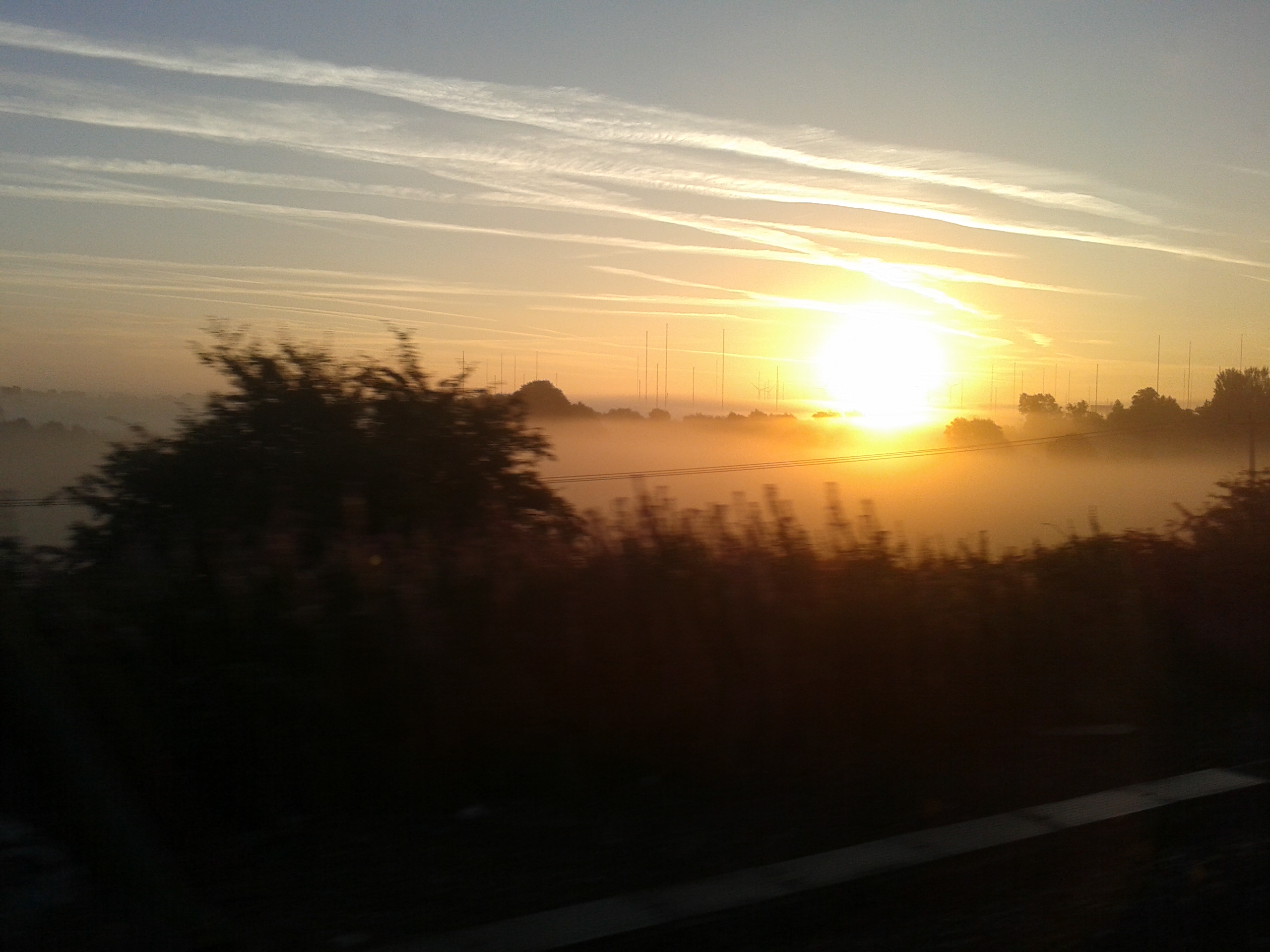
Sunrise from train September 2013

“Garlicky” is a great word, redolent of hot, pungent flavour and nose-filling odour: a Pavlovian word that ignites the senses as it’s uttered.  Perhaps I love the word because garlic is one of my favourite vegetables, a pleasure to both eat and grow.  A Garlic Festival is therefore not to be missed, and my family and I had the opportunity to attend one on the Isle of Wight during a short holiday a couple of weeks ago.  We were joined by university friends I’ve referred to previously, as the first one of us to reach a half century celebrated his 50th birthday.  There was more to the festival than just garlic, but for me its highlight was seeing the sheer variety of different garlic types that can be grown, testament to how this vegetable has been modified from its ancient wild origins in central Asia.  Karin and I bought seed bulbs of four different varieties as additions to the horticultural biodiversity of our vegetable plot, to be planted later in September.   These included the notable Elephant Garlic with its massive individual cloves, which, I’ve just learned while researching that link, is not a true garlic at all but rather a variety of leek.  We live and learn!

Archipelago is another great word and the time we spent on the Isle of Wight, travelling over by ferry from Southampton, served to remind me that the British Isles, with over six thousand islands of various sizes, is by any standards a significant archipelago.  Since at least the explorations of Alexander von Humbloldt, island groups have  been known to host unique species, isolated taxonomically and physically from their closest continental relatives.  Darwin’s later researches showed that archipelagos such as the Galapagos Islands are important as natural evolutionary laboratories, and in previous posts I’ve briefly discussed his unrequited desire to visit to the Canary Islands.  The Isle of Wight is too close to the continent of Europe to have evolved any unique biodiversity but I did pick up the hint of a subtle Island Biogeographic Effect whilst compiling a list of all the bird species I saw over the course of the week.  The list topped out at about 30 species, which I thought was rather low.  Some of the omissions surprised me (not a single blackbird, for instance) and I saw very few individuals of some other common British species.  Now, it could be due to my lousy birding skills I suppose, but it could also be due to the fact that we were on an island, even though it’s less than 1500m across The Solent to the mainland at its closest point.  This is close enough for bumblebees to fly to the island: I’ve seen them shadowing the ferry.  But nonetheless it might be far enough to affect both the diversity and population sizes of the bird life.  Enough wild speculation; I’d be interested to know what serious ornithologists who actually know something about the subject make of this.   

As I finish writing this post I’m on the other great island of my home archipelago, sitting in a bar in Terminal 2 of Dublin Airport.  I’ve been working at University College Dublin as external examiner for their MSc Applied Environmental Science course.  It’s been a fun couple of days reading theses and interviewing chatty, engaged students, which began with a dawn alarm yesterday in order to get to the train station and then Birmingham International in time for a 0850 flight.  Whilst waiting for my taxi I popped into the garden and paused to enjoy the early morning stillness before opening up the chicken coop.  A large flock of black-headed gulls passed low above me, backlit by a thin sliver of moon and silent except for the shuffle of feathers.  From the direction they were travelling I think they were heading from a roost on Pitsford Water and on to destinations unknown.  The garden was also busy with early risen blackbirds and a couple of flitting bats, whilst a little later my taxi passed a rangy fox idly trotting through low mist on the Racecourse park.   It was urban biodiversity at its most sublime.  

All this talk of Northampton is making me feel homesick to be back with the family (Karin, kids, cats and chickens) and start planting garlic.  But there’s just time for another Guinness before my gate opens.  Sláinte!

Scientists Must Write (and Speak and Listen and Review and Edit)

“Scientists Must Write” was the title of a book published back in the late 1970s by a former tutor of mine, Robert Barrass, at what was then Sunderland Polytechnic (now the University of Sunderland).  I had assumed the book was now a long gone publishing memory and no longer available.  But it turns out that Robert updated it in the early 2000s and it’s still in print.  Almost 30 years (30!) later I can clearly remember Robert impressing upon us the importance of good writing skills for scientists-in-training.  At the time I was as far from being a professional scientist as it’s possible to be and so didn’t fully grasp this, but nonetheless what he said chimed with my own notions that writing was important, even for a scientist.

Nowadays I realise that it’s not just the writing of standard, academic papers, book chapters and books which  is essential: writing of all kinds is a necessary facet of the life of a research active scientist.   This June sees the publication of two contrasting articles that illustrate this point.  The Royal Horticultural Society’s journal The Plantsman has published a piece entitled “The Importance of Native Pollinators“, whilst the historical journal Notes and Records of the Royal Society has published my paper on “John Tweedie and Charles Darwin in Buenos Aires“.  Neither of these is standard academic fare, at least for me.  The first is a popular article aimed largely at gardeners and others interested in understanding more about pollinator conservation.  The second, whilst academic and rigourously peer reviewed, is primarily historical rather than scientific.

Why am I writing popular conservation articles and historical papers?  Largely for different reasons, though they are linked by my overall fascination with biodiversity.  The Plantsman article is an example of taking ideas and findings from the LBRG‘s research and presenting it to a wider audience who might, at the least, find it interesting and hopefully useful.  One might describe it as “popular science” though I don’t really like the term: it suggests that it’s somehow different to “real” science, which is not the case: it’s really only the format of the presentation which is different.

The John Tweedie/Charles Darwin paper reflects my desire to understand where our scientific knowledge of biodiversity comes from.  As scientists and conservationists, we draw conclusions about species’ distributions, conservation threats, extinctions, and so forth, based on information from specimens that have been collected by people like Tweedie and Darwin, and curated at places such as Kew and the Natural History Museum.  By its nature it’s a historical process and historical research helps us to understand how we arrived at our current understanding.  The only reason we know that 23 species of bee have gone extinct in England since about 1800 for example, as I cite in my Plantsman article, is that over the past two centuries specimens and observations have been recorded and analysed.  This is an ongoing process, exemplified by the BWARS project mapping the spread of Bombus hypnorum   the most recent addition to the UK’s native bee list.

As well as writing we scientists gain much from listening to what others in our field have to say and a well attended, and very interesting, meeting in London last week launched the British Ecological Society’s Macroecology Special Interest Group .  The range of talks spanned community structure, interaction networks, ecosystem services, latitudinal gradients and disease biology, all at the large spatial and temporal macroecological scales covered by this subdiscipline of ecology.  Or is it really a multidisciplinary field, a merging of old fashioned biogeography with more modern ecological approaches?  Who knows, perhaps this is sterile semantics; as I mentioned to one of the organisers in the pub afterwards, “macroecology” seems to me to be more about a philosophy of approach rather than a field in itself.

Formal teaching has largely finished for the time being, so in addition to research activities and university administrative work, much of the remainder of the last couple of weeks seems to have been taken up with editorial and peer reviewing duties for journals, including PLoS ONE, for which I’m an academic editor. This can be time consuming and thankless, but is absolutely vital if the whole system of scientific publishing is not to grind to a halt.  Scientists must write, but that writing is supported by a body of individuals who act as peer reviewers, editors, proof readers, and so forth.  Collectively that eats up a lot of scientist-hours and is something we should never take for granted.