Category Archives: Biodiversity

Are honey bees native to Britain? And does it matter?

2013-04-15 13.54.19-2

It’s no secret that I’ve become frustrated over recent years by the general confusion in the media between the concerns relating to honey bee health (which are largely veterinary/husbandry problems, though pesticides may also play a role) and declines in wild pollinators, which are a wildlife conservation issue mainly due to habitat destruction, though again pesticides are probably having an impact.

That frustration came to a head last year when colleagues and I published a short letter in the influential journal Trends in Ecology and Evolution that was prompted by a throwaway remark in an earlier article stating that honey bees “are essential pollinators for the maintenance of natural biodiversity”  No they are not.  And you can read for yourself why we responded to that article if you follow the link above.

In a recent posting on the Adventuresinbeeland blog, Emily Heath discussed her attendance at a recent British Library event about pollinators and pesticides.   I commented on the blog and in passing mentioned honey bees as being “not native” to which one respondent demurred and wrote:   “I thought honey bees ARE native to Britain, although they have been bred with various breeds ……. Apis mellifera mellifera is a British native, isn’t it?”.   I’ll paraphrase my response here:

The only study that I’m aware of that has addressed this question is Norman Carreck’s paper from 2008 – you can download a PDF of that article here.  Norman is convinced that Apis mellifera mellifera is native to Britain but, as I interpret it,  the evidence he presents is circumstantial and the earliest archaeological remains of honey bees are all associated with human settlements. Even if honey bees were originally native to Britain, the present situation, in which honey bees have been selectively bred and hybridised, is akin to using Tamworth pigs as evidence that wild boar are native.

However for me the most compelling evidence that honey bees are not native is ecological: despite their generalist nature and ability to form large colonies when managed, out in the wider countryside of Britain honey bees do not do particularly well. “Wild” honey bees are never very abundant (compared with some bumblebee species, for instance) and feral colonies in natural settings are few and far between.

This prompted a to-and-fro discussion with Emily that you can read for yourself.

Are honey bees native to Britain?  The jury is out but the balance of evidence as I see it is pointing to them being a human introduction.  Does it matter?  In many respects, no.  Honey bees are (like any other agricultural animal) a utilitarian species that provides us with a range of benefits.  But in one respect it DOES matter – and that is in relation to how we formulate and put in place strategies to reverse the decline of wild pollinators such as bumblebees, hoverflies and butterflies.  If honey bees become the central focus of such strategies (and funding), due to confusion in the minds of the public, MPs, policy makers, businesses, the media and other influential bodies, then wild pollinators would lose out.  In my opinion that would be a great mistake.  I’d be interested to know what other people think.

The Cliff

Tenerife 2008 057 - students on the Aeonium field

UPDATE: Late conversations with colleagues has convinced me that this “cliff” is an artefact. Web of Science started to include search abstracts around 1990, making it much more likely that specific search terms would appear.

Over the past few months I’ve been thinking a lot about PhDs and doctoral students, and our expectations of them, specifically in contributing to cutting edge biodiversity science.  In part this is because August 2013 will mark the 20th anniversary of the oral examination (“viva”) of my PhD at Oxford Brookes University.  The viva (short for the Latin phrase viva voce or “living voice”) is a peculiarly British method of examining PhD students that differs significantly from its (often public) counterpart in the rest of Europe and Scandinavia, and even more so from its equivalent in North America and the rest of the world.

For those of you unfamiliar with the viva process, I can recommend Simon Leather’s recent posting on the topic.

Since 1993 I’ve had the honour of acting as an examiner for 22PhD theses (4 at the University of Northampton, 18 externally) including two so far this year;  I’ve yet to turn down an opportunity to examine a PhD as it’s flattering to be asked and (more importantly) a great opportunity to see new ideas and data being generated by minds younger than mine.

One of the things that has exercised me recently is how much knowledge the average PhD student in my main discipline of pollination ecology actually has to get to grips with while doing the background research for their topic.  I wondered how this had changed since my time as a postgrad in the 1990s, and how the expectations of my own PhD examiners had changed since the 1970s.  So, using the wildcard term “pollinat*” in Web of Science I searched the contents of seven journals (Oecologia, Ecology, Journal of Ecology, Oikos, Annals of Botany, American Journal of Botany, & American Naturalist) that have published a significant proportion of the literature on pollination ecology over the past forty-odd years.

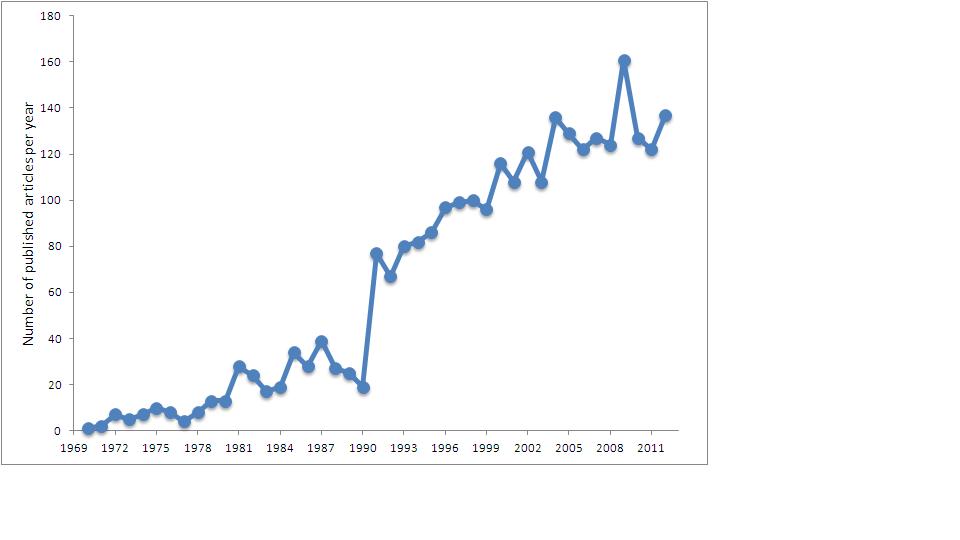
Of course I expected to see an increase in the number of papers on this topic being published per year over that time period, but not the two orders of magnitude difference that I found.  A PhD student studying pollination ecology in the early 1970s would be confronted with fewer than 10 papers on the topic coming from these seven journals whilst at the present time it’s averaging around 130 per year:

Pollination papers line graph

So it’s no wonder that PhD theses are tending to become more focussed as topics become more specialised.  So far, so expected.  But what I think is more interesting is the shape of the graph; why is there such a steep increase in the number of published papers in 1991?  I’ve nicknamed this point “The Cliff” because of its shape, and also because it seems to symbolise an intellectual barrier to be surmointed: an ability to read and synthesise a lot more information than was available prior to the early 1990s.  What is the reason for The Cliff?  Do other areas of ecology and evolution demonstrate a similar pattern in their historical rates of publication?  I see a link here to a discussion going on over at the Dynamic Ecology blog about the most cited ecology papers of the past few decades, and particularly the fact that “big ideas” papers are becoming less cited than review papers.  Perhaps it’s because we need these reviews to keep on top of literature that we’ve not got round to reading!

But that doesn’t explain why 1991 represents a step change for publishing in the field.  I’d be interested to hear the views of others working in pollination ecology.  What happened in the late 1980s to stimulate such an interest in doing research into plant-pollinator interactions?  Was it the publication of some key papers or books?  Did more funding become available specifically for work in this area?

Rewilding – inside and out

2012-05-11 08.39.32

The last blog entry I posted mentioned the reintroduction of red kites to England, surely one of this country’s most impressive conservation success stories of the past few decades.  Such reintroductions can be seen as one minor aspect of the “rewilding” programme being advocated by some conservation biologists.  In its most extreme form, radical rewilders advocate populating whole landscapes with large herbivores and predators that once roamed these regions but are now locally extinct, either because of human hunting pressure or environmental change (sort of Jurassic Park backed up with real science).  The idea is that reintroducing such animals results in more “natural” habitats in which ecological processes are returned to a more pristine state and biodiversity is maximised.  

There are arguments for and against rewilding in all its forms, and four recent coincidental occurrences make rewilding a topical subject for this blog.  

Coincidence one is that the Guardian newspaper has posted a great animated video about rewilding, voiced by environmental writer George Monbiot, whose work I’ve mentioned previously.  It’s an interesting overview of rewilding, if a bit simplistic; and (spoiler alert!) I’m sure I’d not want to jump naked into a river with hippos!  

Coincidence two is that I’m currently reading Once and Future Giants: What Ice Age Extinctions Tell Us About the Fate of Earth’s Largest Animals by Sharon Levy, which discusses some of the more radical rewilding notions that have been proposed, such as introducing elephants, lions, zebra and other African megafauna to North America, as stand-ins for their Pleistocene cousins which may (or may not) have been over hunted by the ancestors of native Americans.  That’s a controversial topic, as you might imagine, and it’s a book that’s well worth reading, not least because it effectively captures the atmosphere of the various camps of scientists promoting the hypotheses they personally support.

Coincidence three is that a paper was published in the journal Science last week which provides evidence for what can happen when larger animals (often the first to go locally extinct) are removed from ecological communities.  In this case, the seeds of a dominant, bird dispersed palm tree have evolved to be significantly smaller in size in those populations where the largest seed dispersing birds have been removed.  All of this has happened in the last 1o0 years or so, remarkably rapid evolution.  One of the authors, Spanish scientist Pedro Jordano, gives an account of the paper in his blog.  The study is one of the few published that links loss of biodiversity of species interactions to their ecological and evolutionary consequences, and has generated a lot of media attention.

The final coincidence is that a short review paper has finally appeared which I co-authored with Duke University medical researcher William Parker entitled Evolutionary biology and anthropology suggest biome reconstitution as a necessary approach toward dealing with immune disorders“.  You can take a look at the paper (or at least read the abstract) yourself.  But in essence the review places William’s Biome Depletion Theory in a broader perspective of how the loss of species with which Homo sapiens would normally interact (in this case gut worms of various types) can have profund knock-on effects for human health and may explain the epidemics of some conditions that are currently prevalent within industrialised societies.  More controversially, the review advocates that we begin to routinely rewild our gut fauna by selectively introducing one or more types of laboratory-bred worms to the guts of children.  There’s already a lot of discussion around this topic but one day in the future such procedures may become no more unusual than standard childhood vaccinations.

Having said that, there were enough problems convincing land owners that reintroducing beavers was a good thing in the Scottish Highlands, whilst similar plans for wolves and bears have stalled; reintroduction of tape worms to their children’s lowlands will probably take even more convincing.

A coiled Spring

Wellcome Trust - June 2009 006

April, according to T.S. Elliot, “is the cruellest month”.  Not sure about that, though April 2013 proved to be both frustrating (as we in northern Europe waited for Spring to arrive) and busy, as I tried to pack in a whole set of activities.  That’s my only excuse for not updating my blog, so the aim of this post is to catch up with biodiversity-related activities and observations over the past few weeks.

Just as iconic decades begin part-way through a given ten year period (the 60s didn’t really kick off until about 1963, for instance) so April for me actually began at the end of March.  In the last week of that month I completed my formal teaching for the term and celebrated the first anniversary of the Nene Valley Nature Improvement Project.  I also picked up my daughter Ellen from Heathrow Airport, on a two week visit back from working in China.  On the way I counted over 20 red kites flying near the M40 motorway – what an incredible success story their re-introduction has been!

One of the reasons Ellen had come back was that I was due to give my inaugural professorial lecture, entitled “How many bees does it take to wake up in the morning?  The importance of biotic pollination in a changing world”.  Another reason was to to celebrate my eldest son Patrick’s 18th birthday the following day.  Both once in a lifetime events and both had family at their heart.  It was a great week.

Some leave time followed, much needed after what seemed like an endless 12 week university term, during which I hoped to plant potatoes and do some other work in the garden.  But Spring refused to uncoil.  The northerly winds brought cold weather that froze all vernal activity in the act.  Flower and leaf buds were there waiting to unfurl; insects would occasionally appear then just as quickly disappear; and birds clearly wanted to get on with the important activities of raising young.  But all was delayed.  One could sense the tension, the build up of seasonal energy, biology waiting to happen.

A talk at Earlsdon Gardening Club near Coventry on Monday 8th April was well received and took my mind off the organisation of the biennial Bumblebee Working Group meeting on the 11th.  This semi-formal get together of scientists, NGOs, and other Bombus-minded individuals, shifts between venues every two years.  At the last meeting in 2011 I volunteered to host the next event and then put it out of my mind for 18 months.  Organising a scientific meeting is always a bit of a mad panic as the day draws closer and one wonders if anyone will actually turn up.  But as it turned out the event was well attended, with over 80 people listening to talks on diverse topics including the effects of neonicotinoid pesticides on bumblebee colonies;  I’ve uploaded a copy of the programme.

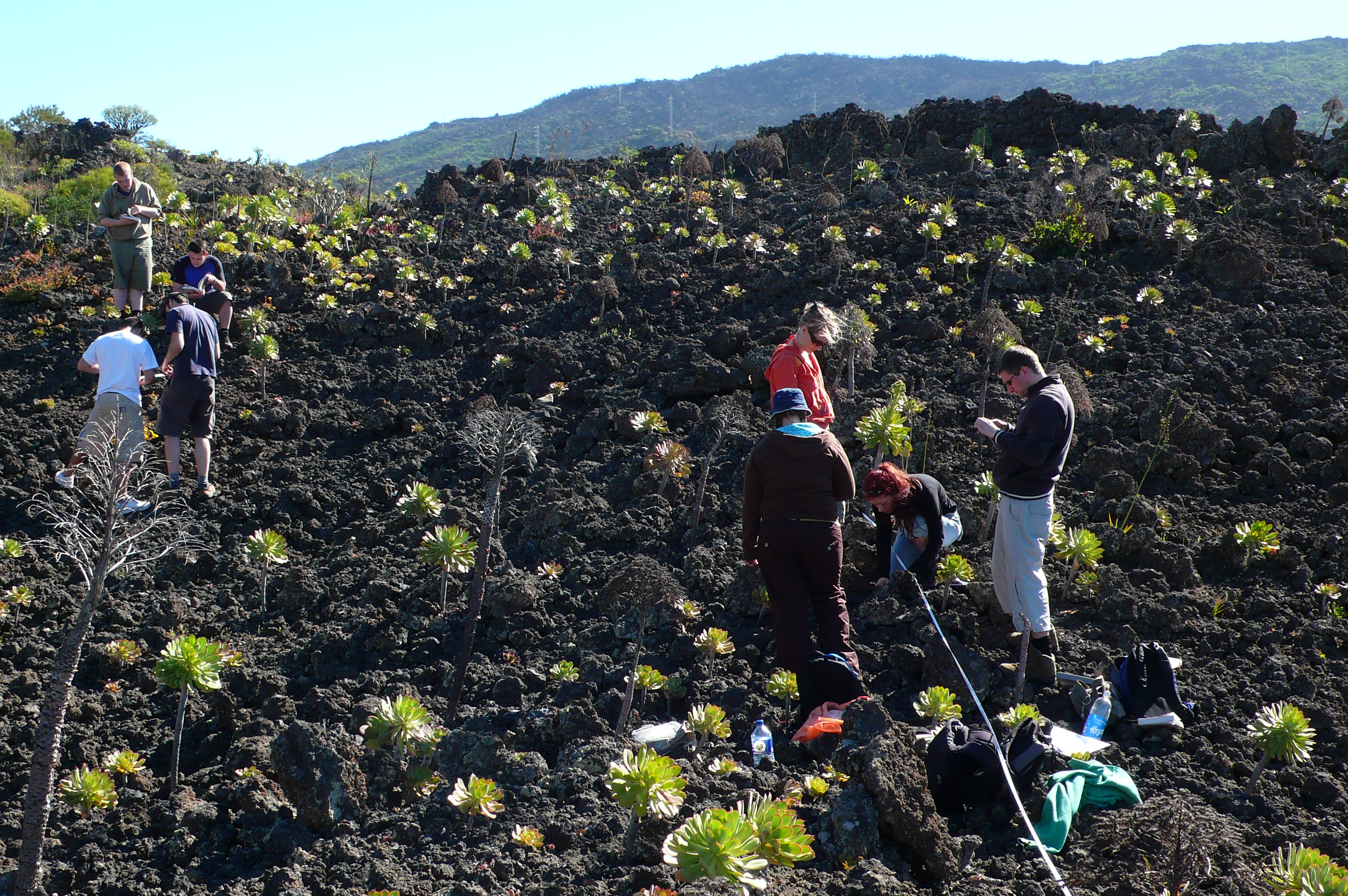
Friday 12th April was a frantic dash around office and lab to get books, equipment and sundries organised for our annual undergraduate Tenerife Field Course, which was flying out on the following Sunday.  A great time was had by all as we explored the biodiversity of Darwin’s Unrequited Isle and we came back with a wealth of great data plus not a little sunburn.  No matter how often I tell students that they really need to wear a hat and use sun block, some will never listen.

Arriving from Tenerife early on Monday 22nd, I slept for a few hours then was back at the university for the oral PhD examination of Hilary Erenler, whose work I have mentioned previously.  These exams are always stressfull for both student and supervisors but in the event Hils performed wonderfully and passed with only minor amendments.  A great result!  Now looking forward to publishing some papers from that work.

April ended, and May began, with a change in the weather.  Much warmer winds blew in from the south west and life suddenly erupted: pressure had been removed from the coiled Spring.  Lots of pollinators appeared in our garden including: Anthophora plumipes, one of my favourites for its glossy, black females and aggressively flower patrolling males; the relatively newly arrived Bombus hypnorum; the bee fly Bombylius major; and several different butterflies.

Clearly it’s time to plant those potatoes!

For she’s a jolly good Honorary Fellow (reduce, reuse, recycle part 4)

August 2009 - Gardeners World 052

The signals of spring are appearing across Northamptonshire.  Despite the current cold and wet weather, a couple of recent ventures out into the wilds revealed Prunus sp. and lesser celandine (Ranunculus ficaria) in flower, as well as lots of frisky birds doing their thing.  But for me there is no surer sign of approaching spring than the start of a new series of Gardeners’ World on BBC 2.  It’s a programme I’ve followed for many years and (as well as useful gardening information) it provides a barometer  for how a significant sub-class of the Great British Public (amateur gardeners) thinks about the environment and its biodiversity.   It’s also an influential programme that changes behaviours,  as I argue in the following piece of writing from last year, when the University of Northampton gave Gardeners’ World presenter and gardening writer Carol Klein an Honorary Fellowship.

Universities award honorary degrees and fellowships to famous people and “celebrities” for a variety of reasons, not all of them laudable and some ethically dubious.  But we proposed Carol Klein because of the effect her work has had on how gardeners garden.  I had the pleasure of introducing Carol at the graduation ceremony, in front of an audience of a couple of thousand graduands and their families.  What follows is the text of that presentation; as I’ve mentioned previously, why waste good words when they can be reduced, reused and recycled?

Following an introduction by the Vice ChancellorOllerton steps up to lectern dressed like an extra from a Harry Potter movie, be-gowned and be-capped. He starts to speak…..

Chancellor, insofar as the Council and Senate of the University have seen fit to establish Honorary Fellowships to confer on eminent individuals, I today present to the Chairman one on whom the Council and Senate have determined to confer such an award.

PAUSE – Carol was guided by a Marshall to stand at the front of the stage.  Once she was in place and the Marshall had returned to his seat, Ollerton continued….

I am delighted to introduce to you Mrs Carol Klein.

SHORT PAUSE – just for effect…..

There can be no doubt that the British are a nation of gardeners.  Whether it’s just developing a window box, a small back garden, or, for the more adventurous, an allotment, horticulture is a hobby that excites both young and old.  This is reflected in some astonishing statistics; the Horticultural Trade Association estimated that in 2010 the Garden Retail Market was worth £4.6 billion to the economy, whilst public gardens such as Kew and the Eden Project both host over one million visitors a year.

Much of this public passion for gardening is both reflected in, and fuelled by, the coverage it is given in newspapers, magazines, radio and (most especially) television.  And since its first broadcast in 1968, the BBC’s Gardeners’ World has been the pre-eminent gardening programme in Britain and Carol Klein is one of its most popular presenters.

Carol was born in Walkden in Salford, Lancashire and has never lost her accent!    Following her school education she trained as an art teacher and taught in schools in London before moving to Devon.  There Carol taught at North Devon College whilst developing her own interest in plants and gardening.

This grew, quite literally, into her own plant nursery, Glebe Cottage Plants, which she set up with her husband Neil.

What was once a hobby had become a career.  The nursery exhibited at all the major Royal Horticultural Society shows, winning gold medals at Hampton Court, Westminster, Malvern and of course Chelsea.  In 1989 a Gardeners’ World feature on Glebe Cottage Plants led to invitations to work as a guest presenter for the BBC and Channel 4.

In 1998 Carol wrote and presented a six-part series Wild About the Garden in which she promoted the ideals of finding space for native flora and fauna in our gardens, something which is very close to the hearts of those of us who teach and carry out research in the Department of Environmental and Geographical Sciences.

Carol has starred in other TV programmes, including two series of Real Gardens, as well as offering her expertise to television programmes such as Garden Doctors, Time Team and even Water Colour Challenge.  Carol’s most recent series, Life in a Cottage Garden, was filmed at her own Glebe Cottage.  In December the High Summer episode from the series won the prestigious Garden Programme TV Broadcast of the Year award at the 2011 Garden Media Guild TV & Radio Broadcast Awards.

Life in a Cottage Garden was also made into a book of the same name because as well as her television presenting work, Carol is a prolific author.  Carol has written a number of bestselling books including Grow Your Own Veg, with over 200,000 copies sold, and contributes articles for periodicals including Garden News, the Guardian, the Daily Telegraph and, of course, Gardeners’ World magazine.

And it is Carol’s weekly appearances as one of the presenters of Gardeners’ World for which she is most famous.  Every Friday night between March and October over 2 million of us watch the programme as it is broadcast, with many more catching up with it later on the BBC iPlayer.

Gardeners, whether experienced or novice, cannot help but be roused by Carol’s passionate and energetic on-screen persona.  However, this is not an act for the benefit of the audience, it’s how she is!  I learned that a couple of years ago when I had the pleasure of working  with Carol for a Gardeners’ World special edition called The Science of Gardening.  During a long day of filming Carol never lost her curiosity and enthusiasm for the subjects we were discussing.

The programme was filmed at Glebe Cottage.  In an article for the Guardian newspaper a few years ago, Carol wrote:  “It has taken a long time to get to know my garden – 30 and a bit years – and I’m still finding out about it……..at every twist and turn it unfolds new revelations.  A garden is a place to enjoy and indulge in, something you can love, somewhere you can nurture. It stimulates all the senses, and its very unpredictability gives it a vitality not often encountered in our contrived and controlled world.”

This, to me, sums up what makes Carol such a special gardening presenter and communicator – even familiar things excite her, whilst the unfamiliar is approached with a keenness to understand and to communicate it to the widest possible audience.  In that sense, Carol’s original training as a teacher has never been lost.

Chancellor, distinguished guests, graduands….

ANOTHER SHORT PAUSE – just for effect….

…..today we are honouring Carol Klein not just because of her work as a public gardening figure but also for her contribution to persuading gardeners to think about and to limit the negative impact of their hobby.

All human activity, including gardening, has an impact on the environment that sustains us.  It is Carol Klein’s championing of gardening in an organic, wildlife friendly way which may be her most lasting contribution.  Tellingly, a recent Public Attitude Survey by Defra showed that almost 70% of respondents “actively encouraged wildlife in their gardens, for example through feeding areas or specific planting”.  It is people such as Carol who have helped to shape public opinion in such a positive way.

As Carol put it in a newspaper article a few years ago, gardening with the environment in mind:  “relies on building up communities of fungi, flora and fauna in the soil, and any interruption or chemical intervention sets it back. It’s not a question of being hardcore; it’s about having faith in nature and natural processes.”  That faith is more than just “tree hugging” or “Saving the Planet”: the UK National Ecosystem Assessment in 2011 estimated that our natural environment contributes over £30 billion to our economy every year through the provision of ecosystem services such as fresh water, carbon storage, pest control and pollination.  Gardeners have an important part to play in ensuring that we do not compromise those ecosystem services and Carol Klein has played a significant role in promoting those values.

Chairman, In accordance with the decision of the Council and Senate, I am privileged to present to you Carol Klein that you may confer an Honorary Fellowship.

Applause from the audience as a very embarrassed looking Carol Klein steps forward to give an engaging and humorous speech.  Ollerton goes back to his seat on the stage, relieved his part is over

A (bird) book for bedtime (and a bit about bees besides)

2012-10-27 14.28.28

Biodiversity as it’s generally defined and conceived includes not only diversity of species and habitats, but also diversity within species, often (but not always) genetic in origin.   Eddie Izzard’s new two-part television series Meet the Izzards neatly captures the idea of genetic diversity, and how it informs our  understanding  of the past evolution and prehistorical dispersal of a large, bipedal mammalian omnivore.  “Cultural biodiversity” in Homo sapiens is less easy to define in this way as it has probably only a limited genetic component and is passed from individual to individual by copying and refining.  Other species have “culture”,  for example New Caledonian crows and chimpanzees, but human cultural diversity is more varied than that of any other species.

Take book reading as an example.  Some individuals of our species never read.  Others read only one book.  Incessantly.  And then argue about what it means with others who read the same book.  Other individuals gorge on a book a day or snack on one a  month, or manage on a starvation diet of one per year.  I’m a two book nibbler.  Normally I always have a novel and a volume of non-fiction on the go.  The novel is for last thing at night when I need to turn off my mind and do some easy reading; a few pages then it’s time to sleep.  Nibble, nibble.  The non-fiction is for the morning, if I wake up early enough, or weekends if they are free; or train journeys.  Still nibbling, but this time on more solid fare.

As with all cultural diversity, none of this is inflexible and at the moment I’m also reading a non-fiction book at night:  Fighting for Birds:  25 years. in nature conservation by Mark Avery, former Conservation Director of the RSPB.  Mark kindly came to give a talk at the university recently and brought copies of his book to sign and sell.  It was a stimulating lecture and feedback from the students who attended was very positive.  For those students who didn’t make it (and there were a lot) I have to ask:  why are you paying thousands of pounds a year to not turn up to events that will inspire, educate and develop you?  You had the chance of bending the ear of a very prominent British conservationist.  At the very least you could have asked:  “How do I get to do the job that you do?”  You’re currently investing a LOT of money in your future and, frankly, wasted opportunities such as this are the equivalent of failing to claim a share dividend.

Back to the book.  Although Mark claims Fighting for Birds is not an autobiography,  it is very autobiographical in scope and provides some great personal insights into the RSPB and the development of bird (and broader) conservation in the UK and the EU.  His description of the battles fought over the fate of the Flow Country brought back memories of writing an essay on that topic during my undergraduate years in the late 1980s.  I’ve still not visited that part of Scotland but I have in mind a road trip this summer that may take it in.  The RSPB is one of our partners on the Nene Valley Nature Improvement Area project so I was particularly interested in finding out more about what makes our most important wildlife charity tick.  Mark is an engaging and candid writer, forthright in his opinions political and ecological (and their interactions)  as you can see from his blog.        

By pure coincidence, this week Mark hosted a guest blogger in the shape of Matt Shardlow, Chief Executive of Buglife, talking about the current controversies over banning the group of pesticides known as neonicotinoids.  Matt puts forward a compelling case for withdrawing these chemicals from general use.  I don’t dispute anything he says about the role of neonicotinoids in bee deaths (though there is some debate about dosage levels used in some of the published studies and how this might translate into effects in the field).  But it does concern me that this new focus on pesticides is taking the spotlight off habitat loss, particularly grasslands, which is a far more important threat to pollinator populations.   There is a real danger that this single issue will be seen as an easy fix by government when a broader reform of farming practices is what’s really required.  The decline of wild bees and other pollinators can be tracked back to long before the introduction of neonicotinoids. There were some silly comments on the blog about neonics currently being the single most important conservation issue.  This is short sighted hyperbole and (again coincidently) Lynn Dicks has written an interesting piece on the subject of rhetoric, lies and over-the-top claims in the journal Nature.

The decline and extinction of pollinators in the UK has been an ongoing process since the 19th century.  I’d hate to see the government think that it’s “fixed” the pollinator problem by banning some pesticides, a much simpler task than protecting and restoring habitats, and encouraging farmers to manage their land more sensitively.  With 70% of the UK’s land dedicated to farming, human (agri)culture has got to be a key element in conserving biodiversity.

Waxwing winter

2013-01-04 15.27.49

January has been a month of biodiversity firsts for me.

First New Year celebrated with Karin in our new home, quietly with friends and kids, plus the cats and chickens that are part of our personal biodiversity. I’m going to write a lot more about this notion of “personal biodiversity” later this year, but in short, we’re all of us directly connected to biodiversity physically and in the space we inhabit at home and work.  Think about that next time you’re devouring a pot of Activia or watering the spider plant in your office.

The first paper (hopefully of several) from Sam Tarrant’s PhD thesis has finally been published in the journal Restoration Ecology online ahead of the print version.  In this paper Sam compares the pollinator communities and available floral resources on restored landfill sites to those on nearby nature reserves.  The landfill sites are just as good for pollinators as the reserves, a surprising finding that parallel’s  Lutfor Rahman’s results in relation to bird communities on restored landfill sites .  All of which has implications for how landfill sites might be managed after they have fulfilled their primary function.  Opportunities for biodiversity conservation sometimes come from unexpected sources.

Another first was discovering some of our research cited in the recent United Nations Convention on Biological Diversity’s progress report on the International Initiative for the Conservation and Sustainable Use of Pollinators.   We were very pleased to see our work getting that kind of exposure on the international stage, regardless of what one may think of the Convention on Biological Diversity.  The CBD  is not without its critics  as I recounted the first time I blogged, live from a CBD-associated scientific conference in Germany.  This was later published in Bulletin of the British Ecological Society as “Blogging from Bonn“.    

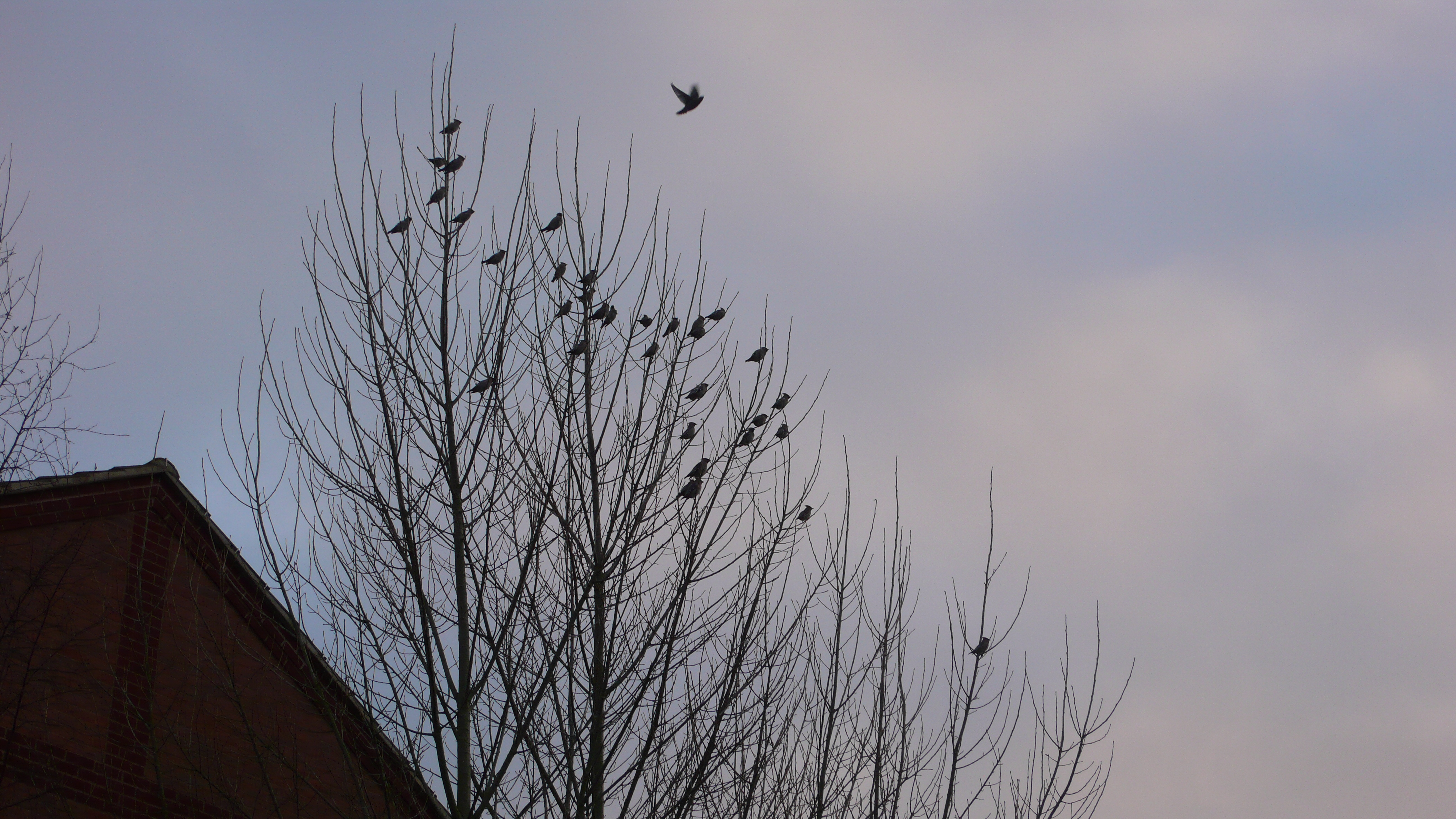
And I achieved a first by finally (after several years of trying) seeing a flock of waxwings (Bombycilla garrulus) a bird that, whilst not uncommon, is one which you really have to be in the right place at the right time to observe.  They are highly mobile and never in one spot for very long.  A friend of mine who is a very keen birder and has been trying for 25 years to see them and only achieved that birding tick this year.  One of our graduates, who blogs by the pseudonym of the Hooded Birder, has some great images of waxwings – take a look and you’ll see just what a beautiful bird this is, very exotic looking for a winter visitor to Britain.

At this time of year waxwings fly down from Scandinavia like avian vikings, marauding through the countryside devouring fruit from trees and shrubs such as rowan, hawthorn, apple, rose and any many others.  It’s quite a sight to see a bird the size of a starling eating large rose hips in a single swallow.  They are very approachable birds and we got  quite close to them.   Some years are marked by massive irruptions of these birds and are termed “waxwing winters”.  The latest data from the British Trust for Ornithology suggest that this is one such year and the Northants Birds site has regular reports of their appearance around the county.

Although I’m not by any means a serious birder, bird watching falls into the category of cultural/spiritual ecosystem services that is clearly supported by biodiversity.  Birding organisations are popular: the Royal Society for the Protection of Birds has over one million members and financial resources of almost £100 million, for example.

This weekend the RSPB will be running its regular Big Garden Birdwatch, a great example of citizen science in support of biodiversity monitoring.  I’ll do my hour of watching on Sunday morning; the current cold winter weather has brought birds into the garden that are normally found out in the wider countryside.  No waxwings yet but I live in hope.

When is a yucca not a Yucca?

Notice the difference?  The italicisation and capital initial of the second Yucca.  That’s how the genus name of a species should be formally presented in a scientific paper, or in a newspaper article, or wherever.  Like Homo – the genus in which our own species (Homo sapiens) sits.

It might seem like a narrow and pedantic point, but it’s important.  Accurate and descriptive naming of species, genera, families and other taxonomic ranks is crucial to those of us who study biodiversity and is at the core of our science: without names for species, for example, we cannot make informed conservation judgements or comparisons between habitats in relation to which species are present or absent.  Names matter.

But it’s not just the names themselves, it’s also how they are presented which is important:  when I see the words yucca and Yucca in print, they signify two different things to me.  The word “yucca” is an informal name for a group of plants that is widely applied by gardeners and has no formal scientific status.  Yucca on the other hand refers to a very specific group of plants and has a clear meaning to a biologist.

To give you an example of this I’ll first have to introduce you to the Northamptonshire Natural History Society (NNHS) which was founded in 1876 and must be one of the oldest surviving local natural history societies in the country.  Some important 19th Century scientists were honorary members, including Charles Darwin, Thomas Huxley and Joseph Hooker.  This perhaps reflects Northampton’s proximity to London though there may be other factors: one could compile quite a long list of scientists with links to Northamptonshire.

The Journal of the Northamptonshire Natural History Society was first published in 1880 and continues to the present day.  Which brings us back to yuccas.  Last year a short article by a NNHS  member summarised the local weather conditions in Northampton for each month of 2010 (J. Northants Nat. Hist. Soc. vol. 45, no. 1).  December of that year was a particularly cold month and the author notes that “the species of Yucca trees planted in Northampton, which although thriving in recent years, were killed by the cold period”.

Strictly speaking Yucca refers to plants of a particular group which are endemic (i.e. only naturally occurring) to the New World.  The genus Yucca is a member of the asparagus family (Asparagaceae), subfamily Agavoideae.  The plants which suffered so much in the cold winter of 2010 are in fact New Zealand Cabbage Trees (Cordyline australis) which, as the name suggests, are endemic to New Zealand.  The genus Cordyline is also a member of the family Asparagaceae but belongs to the subfamily Lomandroideae and is therefore only distantly related to Yucca.

The leaves and stems of Cordyline and Yucca do look very similar, hence gardeners tend to use yucca as an informal name for both.  However when these plants flower it is clear that they are very different.  Flowers of the various species of Yucca are typically quite large and are adapted to pollination by a very specialised group of moths which lay their eggs within the flowers.  The reward for these moth pollinators is a brood site for their caterpillars, which feed on a proportion of the developing seeds of the Yucca plant.  In contrast the flowers of Cordyline australis are small and produced in very large numbers in dense inflorescences.  They are also highly fragrant, to which anyone who has grown one of these plants to maturity in their garden can testify.  The fragrance attracts a range of insects which feed on the nectar produced by the flowers and so pollinate them in the process.  It is these differences in flower structure, more than characters of stems and leaves, which taxonomists use to classify such plants.

Until recently large New Zealand Cabbage Trees were a feature of many front gardens across Northampton.  Some particularly fine examples were to be found along the Kingsthorpe Road between Osborne Road and Balmoral Road.  I suspect that the largest Northampton specimens were planted in the 1970s, perhaps because people wished to recreate something of the exotic feel of package holidays to Spain and Portugal.  Following the freezing weather of December 2010, the growing tips of most of Northampton’s New Zealand Cabbage Trees were killed and the top growth gradually withered and died.  I was sad to see this happen to my own plant, a medium-sized specimen that I had rescued from a skip at the University several years ago, and which had become well established in my garden.  However later in 2011 my plant, and those in neighbouring gardens, re-sprouted from its deep tap root and started to produce multiple rosettes of leaves around the base of its dead trunk.  Give it a few years and Northampton gardens will once again be crowned by these exotic imports from the Southern Hemisphere.  I moved house in early 2012 and wasn’t able to take my rescued plant with me, but I have a feeling it will survive many more cold winters to come.

Names matter to biologists, indeed to scientists of all types.  They signify and tell us things beyond just the words themselves.  To give a very personal example, a few people have asked me why I chose the title “Professor of Biodiversity” rather than “Ecology” (my main area of training, though confused in some peoples’ minds with New Age philosophies); or “Biology” (a much broader designation than I feel comfortable with); or even “Pollination Ecology” (narrow, to the point, but too restrictive).  After a LOT of thought I chose “Biodiversity” because it very broadly reflects my interests in the whole of Earth’s life forms, the interactions between these species, and how they come together as assemblages, communities and ecosystems.   But I’m also interested in the history of our understanding of biological diversity and this title gives me scope to pursue those interests too.

It’s all in the name.

Wrestling the oiled serpent

Understanding the Earth’s biodiversity is not just about knowing where organisms are currently found, their interactions and community structure, and the threats to them and how they can be conserved.  It is also about understanding the evolutionary origins of that biological diversity.  With this in mind I was interested to read a number of news reports over the last few weeks about the relationship between science and religion, including a piece on a debate between scientists and theologians on the origin of the universe, and the removal of a young Earth creationist perspective in an exhibition about the formation of the Giant’s Causeway.

Whilst religious and scientific views of the universe are not necessarily incompatible, literal interpretations of the origin of the world and its biodiversity are clearly at odds with our understanding of the diversification of life through evolutionary processes.  Reading these reports brought back memories (not all of them positive) of an event I was involved in a few years ago.

Back in 2006, Northamptonshire Creation Group (motto: “Let true science speak” [sic]) approached our former Vice-Chancellor with the suggestion that the University of Northampton might care to put forward a speaker to debate creationist versus the evolutionary world views with a prominent Australian creationist who was undertaking a fairly high profile lecture tour of the UK that year.  I was asked if I was interested in taking part and agreed because I have a long-standing interest in creationist arguments.  One of my main research areas, the ecology and evolution of plant-pollinator interactions, is claimed by some to be one of those (supposedly) wonderful examples of how God has created precise interactions between species which could not possibly have evolved.

Richard Dawkins and others have argued that scientists should not be engaging in such debates  as this because it gives creationists publicity and a credence that they do not deserve.  However my perspective has always been that creationists are not going to go away and their influence on school curricula, for example, needs to be tackled head on.

This debate, in front of an audience of about 200 members of the public, colleagues and students, was undoubtedly the most difficult thing I’ve ever had to do professionally:  we were each given 15 minutes to present our case and that is a very short space of time in which to summarise 200 years of scientific research supporting the validity of the evolutionary world view.  But I gave it my best shot and pointed out at the end of the quarter hour that, had I more time, there was so much more evidence I could have presented, evidence which supports the evolutionary hypothesis.

Hopefully, I went on,  I’d convinced some of the audience of the validity of that way of viewing the world and the life it sustains, though I didn’t imagine that I’d changed my opponent’s worldview.  He was clearly a man of great energy and commitment to his cause to have sustained his point of view for 30 years.  But I wished for his sake that he’d not wasted that energy on a debate which was over long ago. which in fact Charles Darwin thought was finished when he died in 1882.

Rather than squabble over the source of biological diversity, I continued, I would rather that these creationists spent their time and energy on trying to save biodiversity.  Human activity has put enormous pressure on the species with which we share this planet and whole ecosystems are being dramatically altered even as we argued that night.  If creationists really care about God’s creation of life, why are they not furious at the way humanity treats it?  Why are they not directing their passion towards saving it?

I thanked the audience for their time and attention and passed the floor to my opponent.  What followed was not the evidence based “creation science” [sic] I was expecting (having researched his previous claims on the subject of the Earth’s age, etc.) but a rapid-fire delivery of theological arguments.  Over those 15 minutes I counted 50 PowerPoint slides, a Biblical smoke and mirrors approach to arguing evolution.  Interestingly, it was clear when he was loading up his presentation that he had about 8 different “Northampton lecture” that he could choose from, depending upon the tack that I took.  Had I gone for a theological approach to the debate, he would have argued “science” I am sure.

After our presentations we had an opportunity to ask one another one question before it was opened up to the audience.  The question that was addressed of me is one that to this day I don’t really understand.  To paraphrase he asked:

“Can you provide a single example of a species which has evolved into another species, without reference to the assumption that evolution has already occurred”

The second half of the question really made no sense to me and perhaps was designed to throw me off.  It worked: I asked my opponent to explain the question and received some heckling from nearby creationists who accused me of being evasive.  But he clarified his question: what he was really asking was, could I provide examples of species evolving recently.  I talked about antibiotic resistance in bacteria, insects which are now immune to pesticides, and also mentioned peppered moth evolution.  Then the debate was opened up to questions from the floor and the first thing I was asked (by a smirking creationist) was what the peppered moths had changed into: other moths or something different?  I explained the difference, in timescales and outcome, of microevolution and macroevolution.  But that was lost on him.

There was also a question about why peacocks and other species were so beautiful, if not for human enjoyment?  I spoke about sexual selection but my opponent countered that sweet peas in his garden were never visited by bees because they self fertilise, so why are they still attractive?  I suggested he grow some different Lathyrus species, ones which had not been selectively bred by people.

So it went on, trading example for example, neither side giving any ground, until we ran out of time .

The woman who asked me the question about beauty happened to be of Afro-Caribbean descent, and came up to me afterwards when the formal debate had ended.  She forcefully asked how I could support a theory which, according to her, stated that “black people are closer to apes and therefore lower on the evolutionary ladder than white people”.  I firmly explained that evolution says nothing about racism and “Darwinian” arguments about racial superiority were a later bastardisation of Darwin’s original ideas.  But to no avail:  the woman “knew” Darwin was a racist; everyone in her church knew that.

Another post-debate exchange with a creationist went something like:

Him:  Darwin states in Origin of Species that the fossil record was insufficient to support his ideas.

Me:  That was 150 years ago.

Him: Yes, but Darwin said it.

Me: But that was 150 years ago; as I showed, we have acquired an enormous amount of new fossil data since then.

Him:  But Darwin said it and he’s the father of evolution.

Me: But he was only one scientist and that was 150 years ago.

Him: But Darwin said it.

Etc. etc. etc.  Darwin seems to have an almost mythic, bogey-man status amongst creationists, as if everything he wrote HAS to be true and if it’s false then evolution is not true.  A weird interpretation of how science works.

At the end of the evening I went home exhausted and not a little depressed.  Wine was drunk and the evening dissected and I wrote up some notes about the event, including the title of this blog.  That phrase struck me as a suitably Biblical description of trying to have rational arguments with creationists: well greased serpents will always have a way of squirming out of the grip of logic and evidence, whilst throwing distracting coils around your limbs.  I don’t regret taking part in the debate but I’m not in a hurry to do another.

To Dream a River

The notion of streams and rivers as the veins and arteries of a nation, bringing life giving fluids to the country’s urban hearts, is an overplayed one for sure.  But it’s accurate nonetheless, even if these fluids contain biodiversity enough to give any blood disease specialist palpitations.   Given their importance it is therefore odd (I’m tempted to write “suicidal”)  that in Britain we have a history of our towns turning their backs, both metaphorically and literally, on our rivers, ignoring their cultural, social, biological and frankly life sustaining importance.  I’ve mentioned the brewery and sewage effluent entering the River Wear at Sunderland in an earlier posting.  As the pollution went in so there was a  gradual receding of business, industry and habitation away from the river.  There seems to be a correlation between the use and value of a river and the condition of its water and biodiversity: as rivers become ignored and disconnected from urban centres, so they become dumping grounds for whatever can be flushed or piped into them.

This process of riparian neglect was repeated throughout the twentieth century across the country and Northampton’s River Nene is no exception.  From its central place in the town’s commercial activities in the nineteenth century, with its links to the Grand Union Canal and to the North Sea, the Nene has declined in both importance to the town and in its ability to support wildlife, at least in the stretch running through the town and just down river.  Much of the ecological quality of water in this stretch is considered “moderate” to “poor” against the criteria set out by the Water Framework Directive, the main driver of European (and therefore UK) water management.

Against this backdrop of neglect and  river decline, recently a group of us went for a seven mile hike along the River Nene, from the western fringes of Northampton at Duston Mill, through the centre of the town, out to Billing Mill.   The trek was organised by a former student of ours, Neil Monaghan, now working for the River Nene Regional Park (RNRP).  The purpose of this walk was (quoting Neil’s brief for the day) “to inform the Northampton Enterprise Zone River Nene Re-naturalisation Study” by “identify[ing] issues and opportunities for works in-stream and in areas influencing the watercourse which would be likely to facilitate improvements (or at least negate degradation) through land use change or water management”.  My particular interest in this relates to the work we are doing as part of the Nene Valley Nature Improvement Area (NIA) project I’ve mentioned before. Also taking part in the hike were representatives from most of the groups with an interest in the River Nene’s ecology, water quality and flood risk management, including my university colleagues Duncan McCollin & Chris Holt; another former student Hugh Bunker, now working for the Environment Agency (EA); independent consultant ecologist Steve Brayshaw; Heather Ball and Oliver Burke from the Wildlife Trust; Martin Janes from the River Restoration Centre; and other staff from RNRP, the EA, Northants County Council and Northampton Borough Council.  All in all, a wide range of interests and expertise, giving their own perspectives on the River Nene.

Although I’d visited parts of the area that we walked, I’d never before hiked this whole stretch.  It was a revelation.  We passed some really pleasant stretches of river and lake close to commercial centres in Northampton that I know well, in the sense of “drive there, buy things, drive away”.  But I was wholly ignorant of just how close the river is to some of these points.

One of the reasons why it’s easy to lose track of the water courses and lakes, is that it is so geographically complex.  Take a look at the Nene Valley on Google Earth and what you’ll see what I mean.  The aerial view reveals a network of river branches, tributaries, canals and lakes, traced across the landscape.  Some of these seem to have no obvious starting point, or end abruptly.  At one point a lower lying stream passes under the river via a siphon.  It’s very confusing for a predominantly terrestrial ecologist!  The whole area is historically prone to flooding, as Chris has discussed in some of his published research and so understanding the dynamics of the whole catchment is an important task for the Environment Agency and local government.

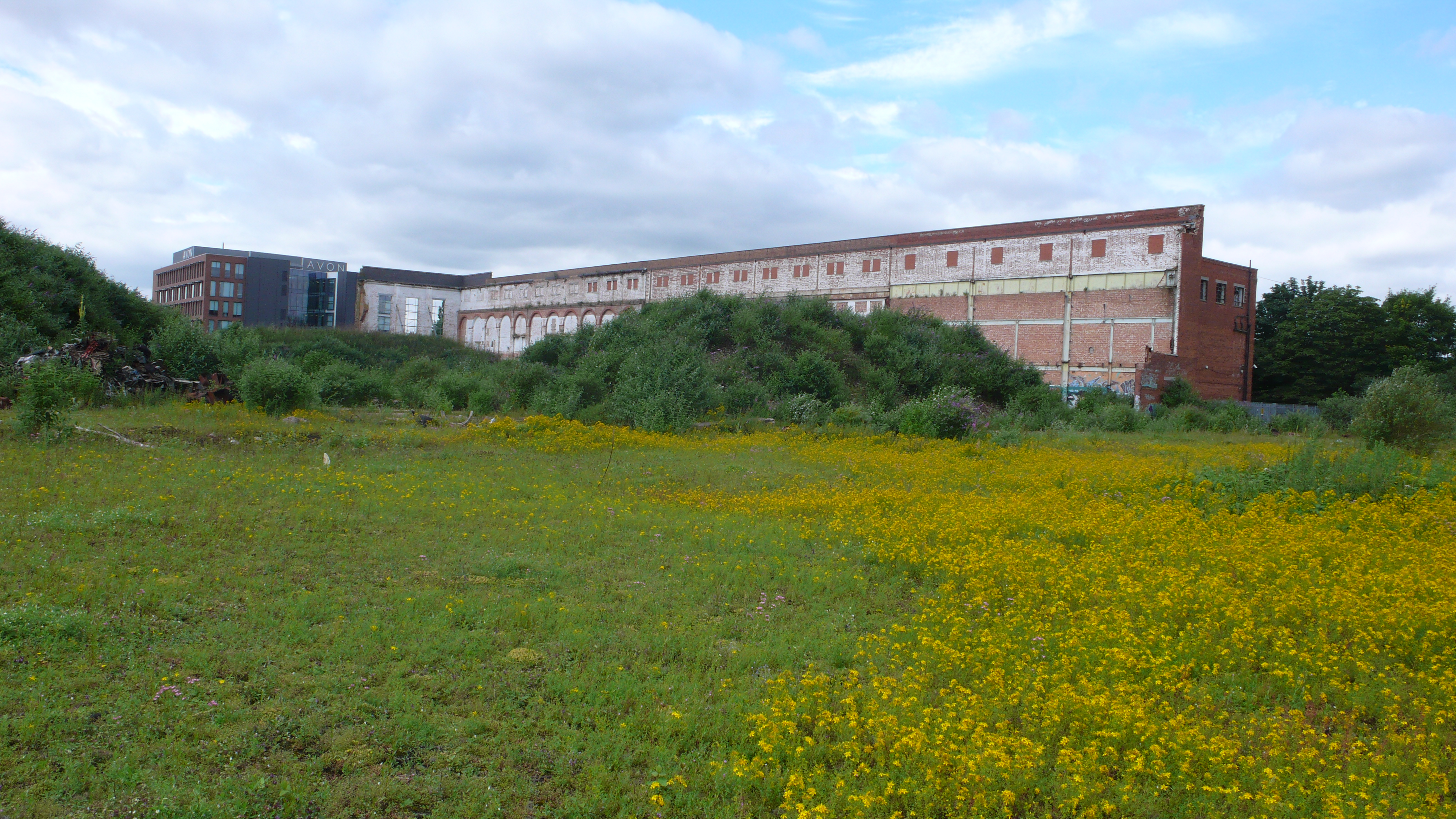
Away from the river, one of the highlights of the trip was a guerrilla visit to a post-industrial site that is posited as the new campus for the university.  It’s actually the site of the former Northampton power station and like many abandoned brownfields across the country, it has developed its own ecological community of invasive alien plants (for example buddleia, in abundance) and native species, many of them normally at home on dry grasslands.  One section was described by Steve, half seriously, as “urban tundra” as it was dominated by a species of lichen from the genus Cladonia.   

Our main attention was the River Nene, of course, never far from the path that we walked.  Further down the course we came to the Northampton Washlands, an area of low lying grassland and flooded gravel pits that serves to store flood water when the river overtops its banks.  It’s also an internationally important site for migratory birds such as lapwing and golden plover, and is part of the recently designated  Special Protection Area (SPA).  It was another highlight in a day of exploration and surprises.

The dream of a river which can support biodiversity, provide drinking water, allow a wide range of recreation, and be flood managed, is a hugely ambitious one.  But there are many people and organisations working hard to see it flourish because the River Nene is a  vital part of the life of the town and the county.  And without dreams, what are we….?