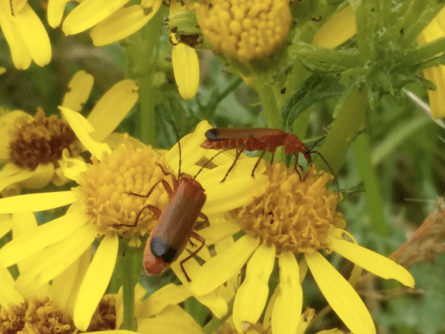
There is an oft-told story about the biologist JBS Haldane. Sitting with a group of theologians over dinner he was asked what his studies of the natural world had led him to conclude about God. After a pause, Haldane replied “He has an inordinate fondness for beetles”. The story is almost certainly apocryphal, though Haldane was fond of saying similar things – see this dissection of the evidence for example.
True or not, it’s a nice story that does in fact say something profound about the Earth’s biodiversity: beetles (Coleoptera) are far more species-rich than almost any other Order of insects. I say “almost” because the Dipterologists are convinced that the true flies (Diptera) have more species. And they may well be correct given that flies are less well studied than beetles, and a 4 ha area of tropical forest in Costa Rica can support an astounding 4,332 species, with the prediction that many more would be found with further sampling.
Regardless of the accuracy of the quote and of the statistics underlying it, the phrase “an inordinate fondness for” has inspired quite a number of titles of academic papers, chapters, and books – here’s some examples:
Fisher (1988) An inordinate fondness for beetles. Biological Journal of the Linnean Society
May (1989) Ecology – an inordinate fondness for ants. Nature
Evans & Bellamy (1996) An inordinate fondness for beetles. Henry Holt & Co.
Rouse et al. (2018) An inordinate fondness for Osedax (Siboglinidae: Annelida): Fourteen new species of bone worms from California. Zootaxa
Sochaczewski (2016) An inordinate fondness for beetles. The hero’s journey of Alfred Russel Wallace. In: Naturalists, Explorers and Field Scientists In South-East Asia And Australasia. Book Series: Topics in Biodiversity and Conservation
Thomas et al. (2015) Charles A. Triplehorn: an inordinate fondness for darkling beetles. Coleopterists Bulletin
Vieira et al. (2014) Toward an inordinate fondness for stars, beetles and Lobophora? Species diversity of the genus Lobophora (Dictyotales, Phaeophyceae). New Caledonia Journal of Phycology
Clare et al. (2014) An inordinate fondness for beetles? Variation in seasonal dietary preferences of night-roosting big brown bats (Eptesicus fuscus). Molecular Ecology
Dyer et al. (2014) New dimensions of tropical diversity: an inordinate fondness for insect molecules, taxa, and trophic interactions. Current Opinion in Insect Science
Kasson et al. (2013) An inordinate fondness for Fusarium: phylogenetic diversity of fusaria cultivated by ambrosia beetles in the genus Euwallacea on avocado and other plant hosts. Fungal Genetics and Biology
Mann et al. (2013) An inordinate fondness? The number, distributions, and origins of diatom species. Journal of Eukaryotic Microbiology
Chase (2013) An inordinate fondness of rarity. PLoS Biology
Harmon (2012) An inordinate fondness for eukaryotic diversity. PLoS Biology
Hamuli & Noyes (2012) An inordinate fondness of beetles, but seemingly even more fond of microhymenoptera! Newsletter of the International Society of Hymenopterists
Eide (2012) An “inordinate fondness for transporters” explained? Science Signaling
Snider et al. (2012) An inordinate fondness for rocks: roosting habits of bats at Mesa Verde National Park, Colorado. Bat Research News
Longino & Snelling (2009) An inordinate fondness for things that sting. Journal of Hymenoptera Research
Maderspacher (2008) Genomics: an inordinate fondness for beetles. Current Biology
Sandvik (2006) An inordinate fondness for Mecopteriformia. Systematics and Biodiversity
Grove & Stork (2000) An inordinate fondness for beetles. Conference: Celebration Symposium on A World of Beetles: Canberra, Australia.
Ashworth, Buckland & Sadler (1997) Studies in Quaternary entomology: an inordinate fondness for insects. John Wiley.
Bamber & Błażewicz-Paszkowycz (2013) Another inordinate fondness: diversity of the tanaidacean fauna of Australia, with description of three new taxa. Journal of Natural History
I’m sure there’s other that I missed, but you get the idea. The phrase “an inordinate fondness for” seems to be a bit over-used now and I wonder whether some of these papers might have benefitted from a more descriptive title? The title one chooses for a paper or a book really matters – see this old Small Pond Science blog post on the topic. I’m sure that there’s research published showing that papers with titles which describe their findings are more frequently cited but I can’t immediately find it. Perhaps one of my readers knows?















 Prof. Jeff Ollerton - ecological scientist and author