
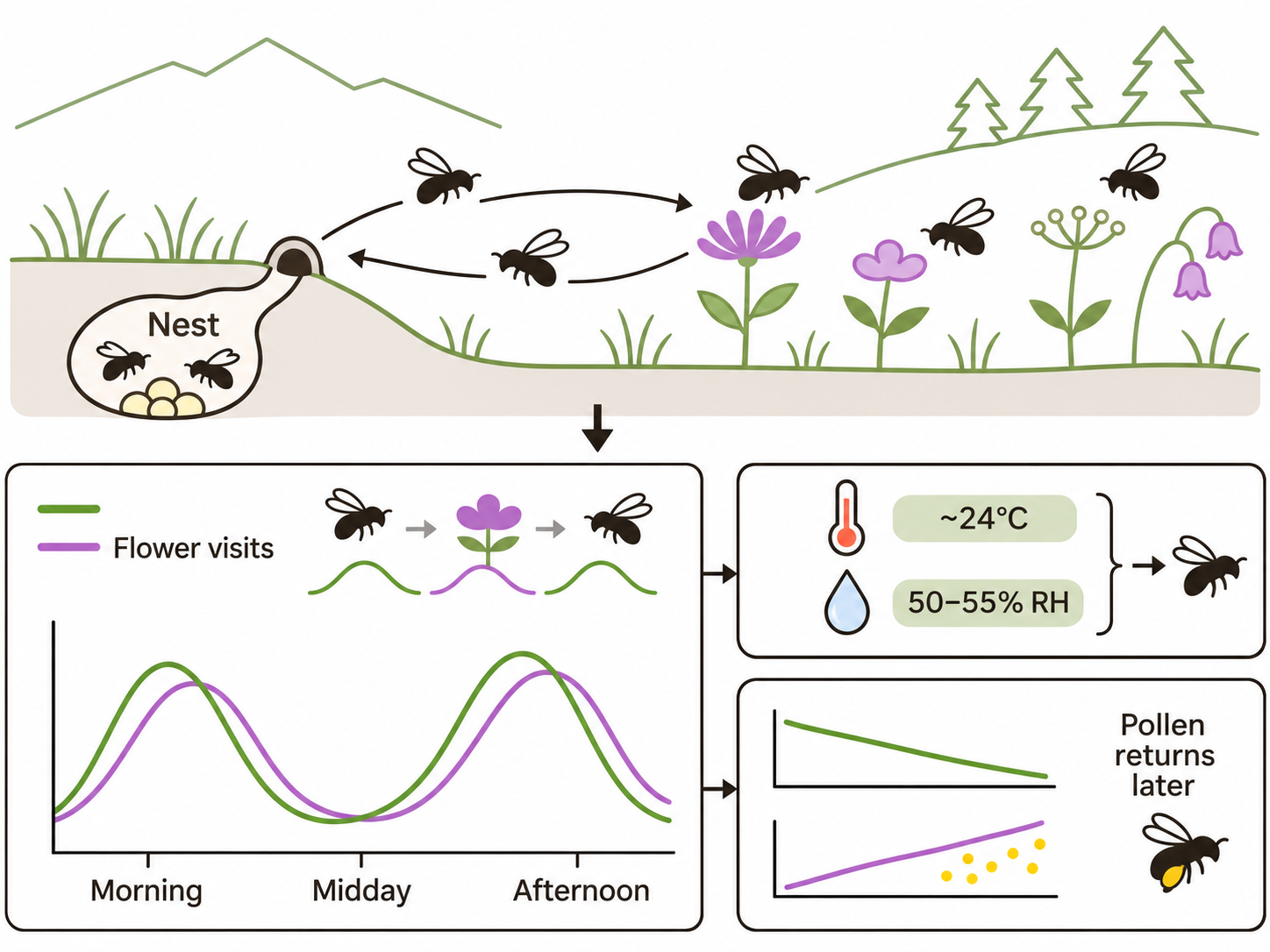
Earlier this year I wrote about our research on plant–pollinator interactions in the mountain meadows and forests of Yunnan, China. That study explored how pollination networks differ between habitats and across the day. But what are the bumblebees doing when they’re not visiting flowers? And how closely does their activity at the nest match what we observe in the surrounding plant communities?
A new paper published in the Journal of Pollination Ecology, led by my colleague Dr Xin Xu at the Kunming Institute of Botany, addresses these questions using observations of a naturally occurring nest of a poorly-known species (Bombus lepidus) on Yulong Snow Mountain, at an elevation of around 3,200 metres.
Over six days, bumblebees were recorded leaving and returning to the nest, noting which individuals were carrying pollen, and measuring environmental conditions. These observations were then compared with flower-visitation data collected in nearby meadow and forest habitats.
What emerged was a rather interesting pattern. The bees showed two main peaks of daily activity, one in the morning and another in the afternoon, with a lull around midday. These broadly corresponded with patterns of flower visitation, although there were some differences in timing. Nest activity was also strongly associated with temperature and humidity, particularly in the afternoon, with activity peaking at a nest-entrance temperature of approximately 24°C.
Of course, this study involved just a single colony, so we need to be cautious about generalising. But finding and monitoring natural bumblebee nests is surprisingly difficult, especially in these high mountain environments, and these observations provide valuable insights into the daily lives of a species about which we have limited data.
For me, the study reinforces an important point: understanding plant–pollinator interactions isn’t simply about recording which animals visit which flowers. We also need to understand when they are active, how their behaviour responds to environmental conditions, and (in the case of social bees) what is happening back at the nest.
This is another enjoyable outcome of my ongoing collaboration with colleagues in China, which continues to generate fascinating results from one of the world’s most biologically diverse regions.
Here’s the full reference with a link – the paper is open access:

