
Just after I arrived in Northampton in 1995, I set about looking for suitable local sites for conducting pollination ecology field work for myself and students. The campus on which we were situated at the time was adjacent to an urban park – Bradlaugh* Fields – parts of which were designated as local nature reserves. In the intervening years, data from that area have made their way into a wide range of published studies, including:
- The role of the dark central floret in the pollination of wild carrot
- Pollinator sharing between a parasitic plant and its host
- The many ways in which flowers can be “generalists”
- The question of how many flowering plants are pollinated by animals
- Phenotypic selection on flowering time and plant size in two plant species with separate sexes and different pollen vectors
- A comparison of urban versus suburban bee assemblages
- The macroecology of animal versus wind pollination
- How the experimental loss of generalist plants can alter plant-pollinator interactions in a community
I still have data collected during that time that have never been published, but good data are hard won and they may see the light of day at some point. Case in point is that we’ve just published a paper based on data from Bradlaugh Fields, the first of which were collected in 2001!
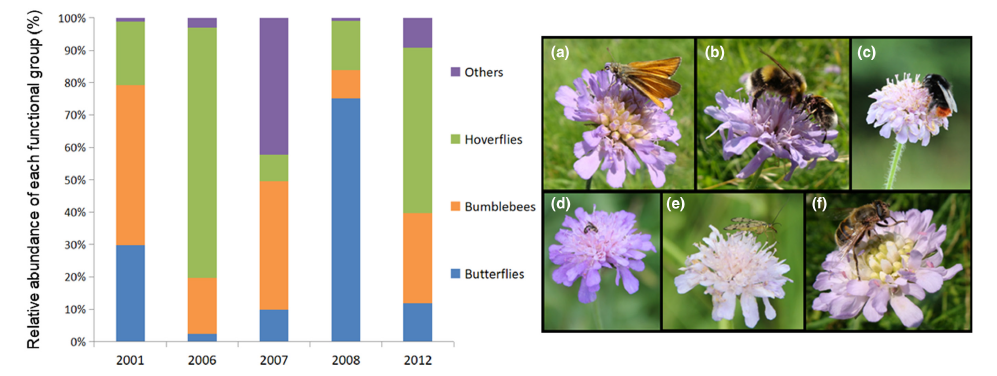
In this paper we’ve tested how effective hoverflies, butterflies and bumblebees are at pollinating the flowers of a common generalist grassland plant, colloquially called Field Scabious (Knautia arvensis). The expectation was that bumblebees, being generally larger, hairier and more flower-focused than the other groups, would be the most effective at transferring pollen to stigmas. To our surprise, they were not: hoverflies and butterflies performed just as well! In fact we argue that butterflies may be MORE important as pollinators of this plant because they fly further distances between individual plants, rather than hopping between the inflorescences of the same plants, as bumblebees tend to do.
Crucially, the importance of these different groups of pollinators varies enormously as the relative abundance of the insects visiting the flowers differs between seasons. In some years butterflies dominate as pollinators, in other years bumblebees or hoverflies. This is driven, we think, both by fluctuations in the populations of these insects and by the availability of other, more preferred flowers that may bloom at the same time.
The paper is part of a special issue of the Journal of Applied Entomology devoted to The Neglected Pollinators. It’s open access and you can download a copy by following the link in this reference:
Here’s the abstract:
Plant-pollinator interactions exist along a continuum from complete specialisation to highly generalised, that may vary in time and space. A long-held assumption is that large bees are usually the most effective pollinators of generalist plants. We tested this by studying the relative importance of different groups of pollinators of Knautia arvensis (L.) Coult. (Caprifoliaceae: Dipsacoideae). This plant is suitable for such a study because it attracts a diversity of flower visitors, belonging to different functional groups. We asked whether all functional groups of pollinators are equally effective, or if one group is most effective, which has been documented in other species with apparently generalised pollination systems. We studied two subpopulations of K. arvensis, one at low and one at high density in Northampton, UK. To assess pollinator importance we exposed unvisited inflorescences to single visits by different groups of pollinators (butterflies, bumblebees, hoverflies and others) and assessed the proportion of pollinated stigmas. We then multiplied the effectiveness of each pollinator group with their proportional visitation frequency in five different years. For each group we also compared time spent on flowers and flight distance between visits. The relative importance of each pollinator group varied between years, as did their flight distances between flower visits. Butterflies were the best pollinators on a per visit basis (in terms of the proportion of stigmas pollinated) and flew further after visiting an inflorescence. Different measures and proxies of pollinator effectiveness varied between taxa, subpopulations, and years, and no one group of pollinators was consistently more effective than the others. Our results demonstrate the adaptive value of generalised pollination strategies when variation in relative abundance of different types of pollinators is considered. Such strategies may have buffered the ability of plants to reproduce during past periods of environmental change and may do so in the future.
*Named after the estimable local MP and radical Charles Bradlaugh – see my blog post When Charles collide: Darwin, Bradlaugh, and birth control for Darwin Day 2016
 Prof. Jeff Ollerton - ecological scientist and author
Pingback: What are the limits to pollinator diversity? A new article poses the question | Prof. Jeff Ollerton – ecological scientist and author