
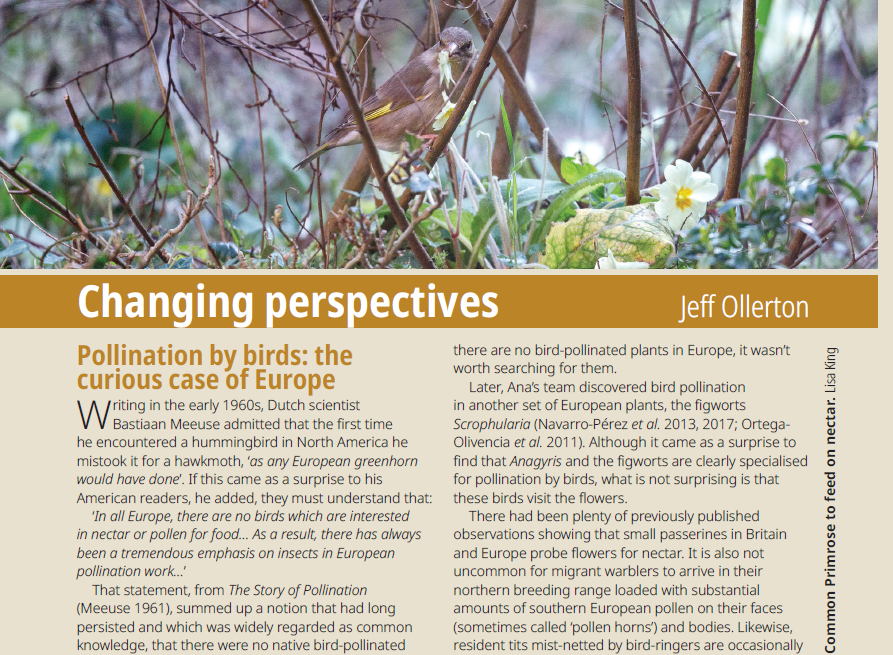
Earlier this year I was invited by the editor of British Wildlife magazine to write a piece for their Changing Perspectives section about how odd Europe is when it comes to bird pollination. It’s based on one of the chapters in my book Birds & Flowers: An Intimate 50 Million Year Relationship.
If you subscribe to the magazine, it will appear in the August issue, though I’m happy to send a PDF to anyone who doesn’t subscribe (or has not read the book) – use the Contact Page. The main accompanying photograph is by one of my former students, Lisa King, who kindly allowed me to use it.
 Prof. Jeff Ollerton - ecological scientist and author
Anagyris foetida isn’t playing by the rules, is it? Dull yellowish colors, lots of nectar and autumn flowering seems more indicative of pollination by late season hunting wasps in orchids, irids and Gentianceae under study in China and South Africa. I would like to see some attention paid to what small, European birds consume during migration. In North America, Cecile Lumer did a little work on this in southern Mexico and came to the conclusion that some species of warblers (Parulidae) consumed nectar of canopy trees and and certain epiphytes as they migrated through Mesoamerica. Too bad she never published or had funding to continue her work.
Pingback: Speaking at Oxford Ornithological Society – 11th September | Prof. Jeff Ollerton – ecological scientist and author