There is too much science.
That is not a complaint about the quantity of research being done. Quite the opposite: it is remarkable how much good work is now being published across the world. But the sheer volume creates a serious practical problem. How can any researcher keep track of what is relevant to their field, let alone read and properly absorb it?
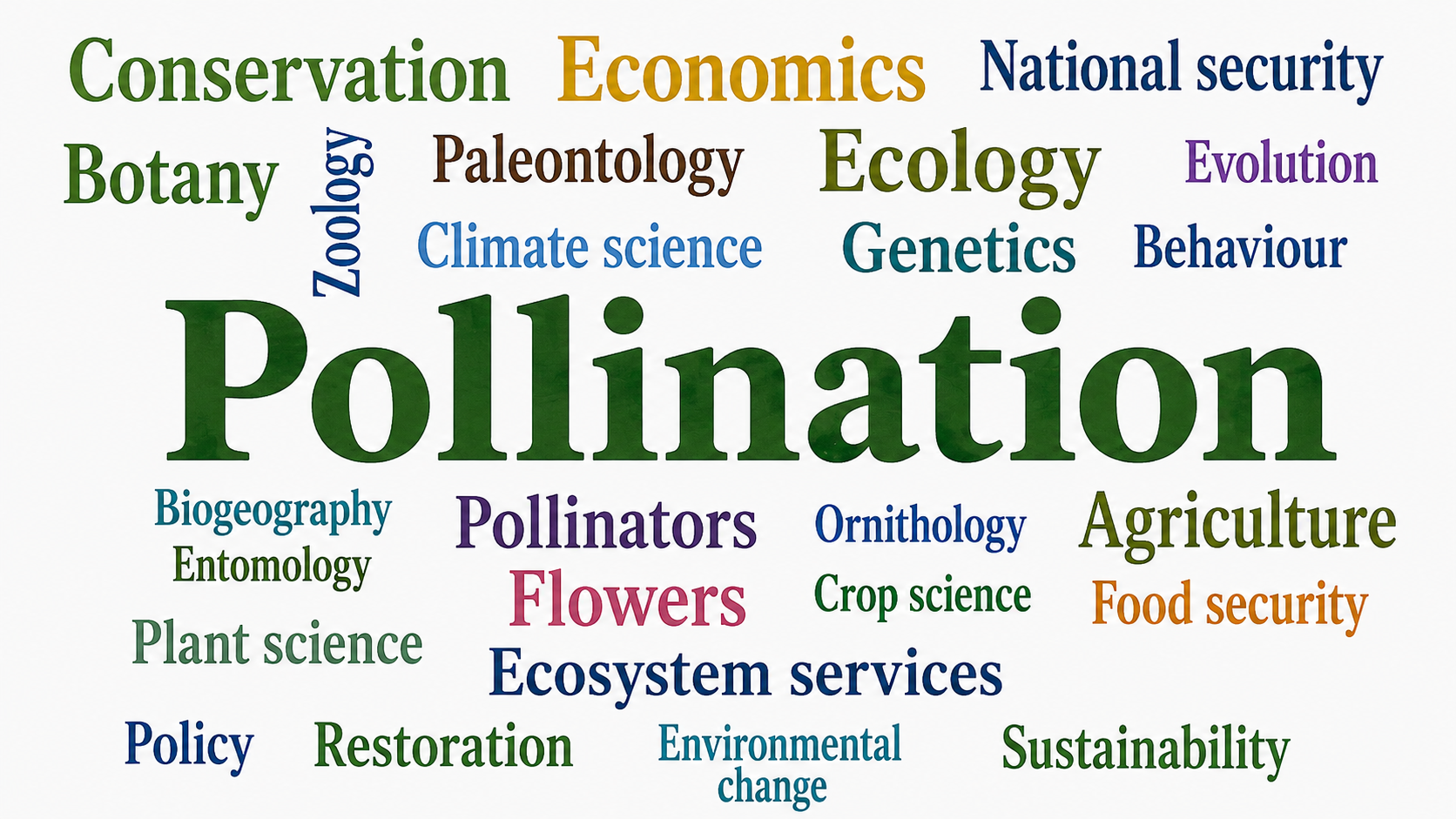
For someone interested in pollination, the difficulty is compounded by the extraordinary breadth of the subject. Pollination is not confined to a single academic discipline, or even to a small cluster of them. It cuts across botany, zoology, ecology, evolution, conservation biology, agriculture, economics, food security, national security, palaeontology, biogeography, genetics, behaviour, climate science and many other areas.
A paper that changes how I think about pollination might appear in a specialist plant journal, an entomological publication, or journals covering conservation, agricultural economics, or palaeontology. It might concern the structure of ecological networks, the nutritional quality of crops, the evolution of flowers, pesticide regulation, the movements of migratory birds or the fossil record of insects. It may not even use the word “pollination” prominently in its title or abstract.
That breadth is one of the great attractions of a subject that has kept me fascinated for 35 years, and which I tried to capture in my book Pollinators & Pollination: Nature and Society. It is also what makes keeping up with it so challenging.
The limitations of conventional alerts
There are, of course, many ways to receive information about new research. Journals send tables of contents. Google Scholar provides alerts based on keywords or authors. ResearchGate regularly tells me that someone has cited one of my publications.
These services have their place, but they tend to provide a rather narrow window onto the literature.
For example, Google Scholar can alert researchers to newly indexed material matching a search query. This is useful, but it is neither a comprehensive record of everything published nor a carefully curated selection: broad searches produce noise, while narrow ones inevitably miss relevant work.
A citation alert from ResearchGate tells me about research connected to work that I have already published. That can be valuable, and occasionally flattering, but it inevitably looks backwards. It shows me the expanding wake of my own research rather than offering a broad view of where the subject is moving.
Keyword alerts have a different problem. They can generate large quantities of material with very little discrimination. A search for “pollination”, “pollinator” or “plant–pollinator interactions” will retrieve many relevant papers, but also conference notices, marginally related studies, duplicate records and work of highly variable importance.
More restrictive searches reduce the noise but risk excluding the unexpected paper that turns out to be especially interesting.
What I need is not simply a larger stream of titles. I want something closer to an informed research assistant: a system that could search widely, exercise some judgement, explain why particular items might matter, and alter its approach in response to my comments.
I have therefore been experimenting with ChatGPT’s scheduling function as a weekly research-alert system.
A scheduled conversation
My current instruction is for ChatGPT to provide a shortlist every Friday morning of the most worthwhile new papers, preprints, reports and substantive analyses relating to plant–pollinator interactions, pollination networks, bird pollination and related broader biodiversity topics.
I have asked it to include no more than ten items, and fewer when the available material is weak. That final qualification is important: I do not need ten references merely to fill ten spaces, I’d rather receive four genuinely interesting papers than a padded list containing six that I will never read.
For each item, the system can provide the citation, a short account of the main finding and an explanation of why it may be relevant to my interests. It can also distinguish between peer-reviewed research, preprints, reports and other forms of analysis.
In that sense, the alert is already more useful than a conventional automated search. But the most important difference is that it is a conversation.
I can tell it that a particular paper was especially useful and ask it to look for more work of that kind. I can point out that another item was only marginally relevant. I can ask it to widen its search into palaeontology, ecological economics or agricultural policy, or to pay closer attention to a particular taxonomic group.
I can also tell it what not to do. When a major European pollinator-research white paper appeared, for example, the alert quite reasonably identified it as relevant. But I was one of its co-authors and did not need an artificial intelligence system to introduce it to me as a new discovery. I could therefore instruct the system to recognise my own publications and either omit them or flag them only when they were strategically relevant.
That adaptability is difficult to reproduce with conventional keyword alerts. The scheduled search is therefore not a fixed filter, it can be refined as my interests, projects and frustrations change.
From retrieval to assessment
The distinction between finding research and assessing it is also important.
A long list of newly published papers transfers the problem of selection from the search engine to the researcher. A useful alert should do more than retrieve documents. It should offer some preliminary judgement about novelty, relevance and significance.
Does a paper introduce a genuinely new idea, or does it repackage a familiar concept in new terminology? Is a striking conclusion supported by a strong study design? Does a paper matter because of its empirical results, its methods, its conceptual framework or its policy implications? Is it directly relevant to my work, or merely adjacent to it?
ChatGPT cannot answer such questions infallibly. Nor should its assessment be accepted without scrutiny. But it can help to triage the literature and identify which papers deserve closer attention.
This is particularly valuable outside one’s immediate specialism. I can usually make a rapid initial judgement about a field study of flower visitors or a paper on pollination networks. I may need more assistance in deciding whether a new economic analysis, remote-sensing method or palaeontological reconstruction is likely to be important.
The purpose is not to delegate scientific judgement, it is to direct that judgement more efficiently.
A few necessary cautions
There are obvious limitations.
An AI-generated research brief is only as good as the literature it can locate and the instructions it has been given. It may miss relevant work, misunderstand a paper, exaggerate novelty or place too much weight on a fashionable topic.
There is also a danger of creating an intellectual echo chamber. If I repeatedly tell the system what interests me, it may become increasingly good at confirming those interests while overlooking research that sits outside them. A useful alert needs some permission to surprise.
For that reason, I think the instructions should combine a clear core remit with an explicit request to include occasional unexpected items that could change how the field is viewed.
The summaries themselves must also remain starting points. Important papers need to be read, methods inspected and conclusions considered in relation to the evidence. An articulate paragraph generated by ChatGPT is not a substitute for engaging with the original study.
A better kind of alert
Used carefully, however, scheduled ChatGPT alerts offer something that conventional notification services do not: an iterative relationship between the researcher and the search process.
The system can learn that I am interested not only in pollination as an ecological interaction, but also in its agricultural, economic, evolutionary, historical and political dimensions. It can respond when I say that a particular area is becoming more important to a project. It can explain its selections, accept criticism and search differently the following week.
That makes it less like an electronic table of contents and more like a research assistant who arrives on Friday morning with a small pile of papers and a cup of coffee and says: “These are the ones I think you should look at, and this is why.”
Like any research assistant, it will sometimes be wrong. It may overlook something obvious, become overenthusiastic about a weak paper or misunderstand why a study matters. But it can be corrected. The conversation continues, and the next briefing can be better.
For a field as broad and rapidly expanding as pollination research, that may be the most useful feature of all.
I will finish with an example. Today’s alert arrived at the scheduled 08:00 (though I had to make my own coffee…) and included four items for me to look at; this was the fourth, which I’m reproducing verbatim:
4. Agarwala et al. — Biodiversity loss will decrease the future creditworthiness of nations
The authors incorporate projected losses of wild pollination, tropical timber and marine fisheries into sovereign credit-risk models for 23 countries. Their scenarios suggest that partial ecosystem collapse could substantially increase national borrowing costs and expose a major omission in conventional credit ratings.
Why it matters: This is one of the clearer attempts to translate pollination loss from ecosystem-service valuation into a decision framework already used by governments and financial markets. For ecological-economics work, the methodological bridge—from spatial ecosystem-service scenarios through macroeconomic models to sovereign credit ratings—is more important than the headline monetary totals.
The ecological assumptions deserve scrutiny. “Wild pollination” is compressed into a tractable economic input, so uncertainty in crop dependence, substitution, adaptation and spatial mismatch may be obscured once propagated through the financial model.
Assessment: Strategically consequential interdisciplinary analysis, not new pollination biology.
The paper actually appeared on 4th June but I missed it, even though it cites this paper by Millard et al., in which I was involved, and presumably appeared on a ResearchGate citation alert last month. ChatGPT rightly spotted that it was something which would interest me and that’s what’s so fascinating about this approach to keeping up with the literature – this system is intelligent enough to “understand” my needs, even if it’s not conscious of precisely why it understands them.
As always, I’d be pleased to hear your views on this topic – feel free to comment below.