Category Archives: University of Northampton
Should scientists accept funding from agro-chemical companies? The devil’s in the details

The relationship between use of pesticides (particularly neonicotinoids) and the decline of pollinators is one that I’ve touched on a few times in this blog – see for example: Bees and pesticides – a major new study just published; Butterflies and pesticides – a new study and a smoking gun; and Pesticides and pollinators: some new studies and contrasting conclusions. It’s an important and controversial topic that’s unlikely to go away any time soon. In an article in the New York Times, journalist Danny Hakim has given that particular pot a further stir by discussing Scientists Loved and Loathed by an Agrochemical Giant.
Although it’s been online since New Year’s Eve, the first I heard about the article was when an American colleague sent me a link this morning (the day it appeared in the printed version) and asked me if I had any thoughts and comments about one of the scientists featured – James Cresswell of the University of Exeter. I’ve known and respected James for over 20 years and I think his contribution to this article provides a brave and open answer to the question I pose in the title of this post: should scientists accept funding from agro-chemical companies?
Please do read that article, it’s fascinating, if not entirely objective in its own right. The tone and focus of the piece is best summed up by the one-sentence summary at the start, which incorporates a quote from Dave Goulson (University of Sussex): “With corporate funding of research, “there’s no scientist who comes out of this unscathed””. In fact that quote is taken rather out of context because Dave’s point was about perceptions of motives and biases, rather than actual corruption of the science and scientists concerned.
Having said that, the article does present a prima facie case that some scientists (though I emphasise not James himself) are playing fast-and-loose with the evidence related to pesticides and GM crops.
Back to perceptions. Industry funding of university-led scientific research is incredibly common, far more common than the public probably realises. There are three reasons for that. First of all, universities are where many subject experts are based, of course. Secondly, scientific research is expensive: it requires staff, facilities, equipment, funding for overheads, etc. University researchers are therefore always hunting for money to enable them to carry out research (which in turn is linked to promotion success, career development, and so forth). Thirdly, external income is an important performance indicator for universities and their constituent departments: James himself is quoted as saying “I was pressured enormously by my university to take that money”, a sentence that will resonate with many UK researchers.
In general the public’s perception (as far as I can tell) is that most of that research is not being corrupted by the industry funding that is attached to it. In my own faculty at the University of Northampton, for instance, my colleagues have obtained industry funding for research and consultancy work in areas such as product design, lift engineering, materials science, leather processing, computer networks, app development, and so forth. All controversy-free.
In much of the environmental sector that’s also the case: we’ve had funding from a large water utilities company to write a report on habitat management strategies for reducing rabbit densities close to water bodies, and one of my current research students is being funded by a solar farm company. Likewise colleagues have been funded by wastes management companies to advise and research in that field. None of this has generated any negative perceptions, with the possible exception of some aspects of wastes management where issues such as “waste-to-energy” remain controversial.
In other areas of environmental research, however, there have always been accusations of bias levelled at university researchers who are perceived to be industry shills, especially if they are not seen to be toeing a particular line. I’m deliberately using that word – shill – because it’s something I was accused of being during a heated social media discussion of causes of pollinator declines. A commenter claimed that I was an “industry shill” for daring to suggest that this was a complex topic, and that there were no easy answers to why (some) pollinators are declining, but that neonicotinoid pesticides were not the only cause. “Which chemical company is funding your research?” she aggressively demanded to know. I think I convinced her that I was not (and never have been) funded by chemical companies. But it raised an interesting question: would I ever accept funding from such companies, if it was offered?
The simple answer is that I don’t know. It depends what the money was for and what strings were attached in terms of non-disclosure, ownership of data, etc. As the title of this post states, the devil’s in the details. I know quite a number of researchers in my field who have had funding from Syngenta, Bayer, and other agro-chemical companies. Some of these are colleagues with whom I have published research papers. In general I have no reason to believe that the research conducted by any of these colleagues has been corrupted by their association with the funders. However in one instance I had a disagreement with a colleague who was not (in my opinion) objective in how they wished to frame part of a paper’s discussion and who may (in my opinion) have been influenced by their association with a particular funder. In the end this didn’t change the conclusions of the research (which was not itself industry funded) but it did make me pause to consider these subtle biases, which I’m sure could affect anyone*. Again, perceptions are key here.
Money for the kind of research that’s done by colleagues and myself is always, always going to be in short supply and competitively pursued, and failure to obtain it will always be much more common than success. Unless funding to address important ecological research questions from government (i.e. taxpayer money) and charities vastly increases, industry will be there to fund research in its own interests, and the perception of scientific bias will remain, whether or not it actually exists.
*I’m not prepared to say more about this particular example so please don’t ask.
Insect pollinators boost the market price of holly and mistletoe: a new study just published

Each year I’ve always added at least one Christmas-themed biodiversity post to the blog, for example: Thank the insects for Christmas, A Christmas vignette, and Six Kingdoms for Christmas. That’s partly because I really like Christmas as a winter festival, with its folklore and customs. But it’s also because these are a great vehicle to demonstrate how pervasive and important is natural capital and the ecosystem services it provides to society.
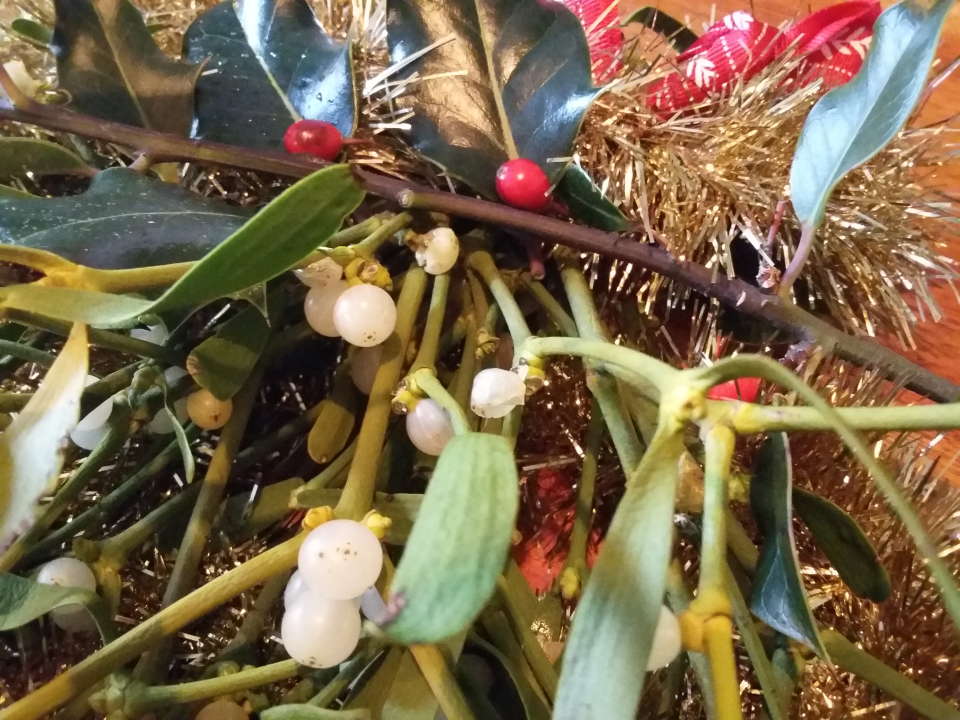
This year I’ve gone one stage further and actually published some Christmassy research to back up the blog post. Now, in a new study published in the Journal of Pollination Ecology, we have shown how important insect pollinators are in determining the market value of two of the most emblematic of Christmas plants: holly (Ilex aquifolium) and mistletoe (Viscum album). Here’s the full reference with a link to the paper itself, which is open access:
Holly and mistletoe are two seasonal crops that play a culturally important role as symbols of Christmas across the world, though both also have pre-Christian pagan roots. Now for the first time the role of insect pollinators in determining the commercial value of these plants has been investigated, using sales records going back over the last eleven years from Britain’s largest annual auction of holly and mistletoe, held every year in Worcestershire.
Analysis of the sales records of Nick Champion Auctions in Tenbury Wells shows that insect pollination raises the sale price of these crops by on average two to three times. This is because holly and mistletoe with berries is more sought after than material without berries, with wholesale buyers paying higher prices at auction. These berries in turn are the result of pollination by insects such as flies and bees: both holly and mistletoe are 100% dependent on insect pollination due to their having separate male and female plants.
There is some annual variation to the prices, and in years where berries are scarce (possibly due to low insect numbers) the price difference can be four-fold.
Due to concerns about pollinator declines and food security there is huge interest in the role of bees and other insects in supporting agriculture, and how we can value that role. However we believe that this is the first study showing that insect pollinators play a large part in determining the value of culturally symbolic, non-food crops. Almost all of the economic valuations of insect pollination to agriculture have focused on food crops such as beans, apples, cocoa, coffee, and so forth. Very little is known about how the value of non-food crops (fibres, construction materials, pharmaceuticals, ornamentals, etc.) is enhanced by insect pollination. This is an area where much more research is required.
But in the mean time, where better to end than with a bit of seasonal John Clare?
The shepherd, now no more afraid,
Since custom doth the chance bestow,
Starts up to kiss the giggling maid
Beneath the branch of mistletoe
That ‘neath each cottage beam is seen,
With pearl-like berries shining gay;
The shadow still of what hath been,
Which fashion yearly fades away.
The Shepherd’s Calendar (1827)
The Biodiversity Impact of Waterside Campus: an interim report on the bird surveys

In previous posts I’ve discussed the work that we are doing monitoring the effects of building a large, new campus for the University of Northampton (see: Monitoring the biodiversity impact of the new Waterside Campus and a video I did of a talk about this project). We have finally got round to writing an an interim report on the bird surveys we have been conducting (2014-2016), repeating the initial baseline surveys that were carried out in 2012-13. The executive summary is below and you can download a PDF of the full report here.
As you will see it’s a mixed picture, with some losses and some gains of species, but we are broadly optimistic that the planned landscaping and habitat creation will have a positive effect come the 2018 opening date of Waterside Campus. It’s important to note that studies such as this which follow up initial ecological surveys and assess the subsequent impact over time are extremely rare as there is no statutory obligation to do so.
Winter surveys will begin shortly and I will report back late next year, time willing. Any questions or comments, please let me know.
Executive summary
- Surveys of winter and spring bird diversity are being carried out to assess the effects of construction activities and habitat creation on local biodiversity at the University of Northampton’s new Waterside Campus.
- These results are compared to pre-construction baseline surveys in winter 2012-13 and spring 2013, undertaken as part of the ecological impact assessment of the site.
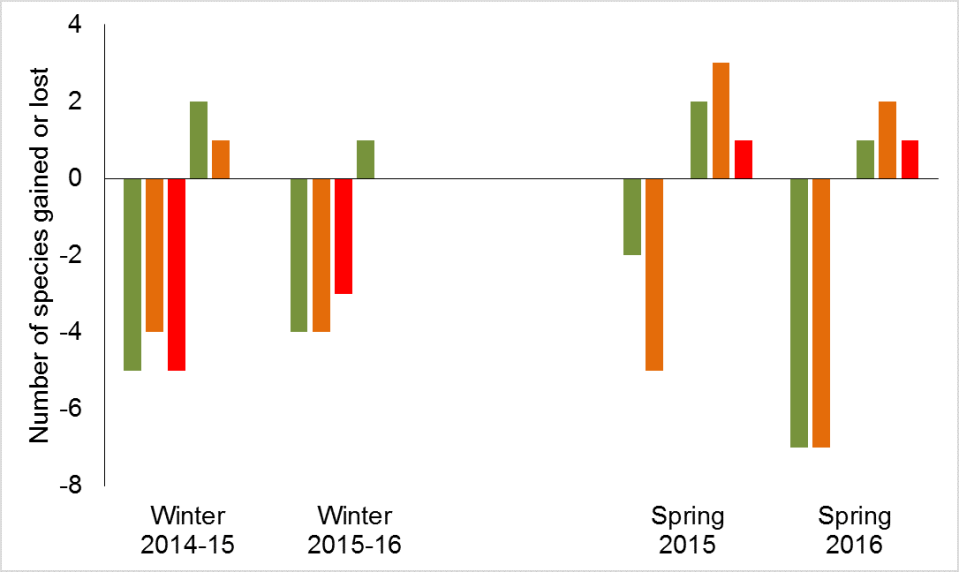
- Results after two repeat sets of surveys (winter 2014-15 and 2015-16; spring 2015 and 2016) are presented, with birds grouped into RSPB Green, Amber and Red categories.
- Winter bird diversity has dropped from 41 species to 31 species; more Red and Amber listed birds have been lost than Green listed species.
- Spring bird diversity has dropped from 40 to 36 species; more Green and Amber listed birds were lost, but the number of Red listed species increased slightly.
- As well as losing species the site has gained birds that were not recorded in the baseline surveys, including Green-listed Coot and Treecreeper, the Amber-listed Stock dove, and the Red-listed House sparrow.
- In addition, most of the “missing” birds are known to occur at sites 500m to 1000m from Waterside and could return following the end of construction and appropriate habitat creation.
- Surveys will continue until after Waterside Campus opens in 2018, and analyses will be undertaken to tease out how these changes in bird numbers are related to changes to both the local and regional environments.
- Outputs from this project so far include two conference presentations and two final year dissertations (one completed and one planned). At least one peer-reviewed research paper is anticipated.
5th annual Postgraduate Research Symposium at Moulton College (Northants) – 15th December
Really interesting line up of speakers at the 5th Postgraduate Research Symposium at Moulton College Thursday 15th December 2016 in P9 (Lecture Theatre, Pitsford Centre (Gate 4), Moulton, Northampton, NN3 7QL).
For more information and to book a place for catering purposes, please contact Dr Wanda McCormick: wanda.mccormick@moulton.ac.uk
1.00pm Steve Davies Principal: Opening address
1.15pm Julia Lock: Tree health: without the chemicals
1.30pm Helen Tedds: What does the future hold for exotic pet welfare?
1.45pm Blessing Katampe: Overview of aquaculture in Nigeria: prospects and challenges
2.00pm Claire Mitchell: Canine skull morphology: what we know so far
2.15pm Zainab Al-Rubaye: Lameness detection in sheep via multi-data analysis of a wearable sensor
2.30pm BREAK
2.45pm Emily Howard-Williams: The effect of eroded ecological networks on the movement of harvest mice (Micromys minutus)
3.00pm Clare Ellis: Do domestic rabbits (Oryctolagus cuniculus) show individual consistency in their response to being handled?
3.15pm Dominic Langdon: Inter-session reliability of resting systolic blood pressure and centre of pressure in young adults
3.30pm Jessica York: The kinematics of the equine axial skeleton when exercising on an aqua-treadmill
3.45pm Alex Laws: Impacts of solar farms on UK agriculture
4.00pm Adnan Haq: An evaluation of the effects of whole body cryotherapy treatment for sports recovery
4.15pm COFFEE, TEA, MINCE PIES AND NETWORKING
Engaging students with the fundamentals of biodiversity (2) – an assessed plant taxonomy questionnaire

In my post last week I described “The Taxonomy of Gastronomy“, a first year undergraduate exercise aimed at giving students experience and confidence using scientific names for species, as well as providing an understanding of taxonomic hierarchies and food diversity. The follow-up to this is an assessed questionnaire that focuses more deeply on plant taxonomy, phylogenetics, and human uses. Here’s the text of the exercise [with a few annotations in square brackets for clarity]:
ENV1012 Biodiversity: an Introduction
Assessed Questionnaire
This exercise is assessed and is worth 25% of your final grade for this module.
The questionnaire is time constrained; you have two hours in which to complete it. Once completed, upload it to NILE using the Submit Your Work folder [NILE is our Blackboard e-learning platform]. Any questions, please ask or email me if I’m not in the room [email provided – the class is so large that I had to split it across two computer suites].
The Task
At the beginning of this session you will be given the name of a plant family. Your job over the next two hours is to research that family and answer the questions below. Each of you will be researching a different plant family so by all means discuss what you are doing and collaborate, but everyone’s final answers will be different.
For this exercise focus on the following websites:
The Tree of Life Project: http://www.tolweb.org/tree/
Wikispecies: https://species.wikimedia.org/wiki/Main_Page
Wikipedia: https://en.wikipedia.org/wiki/Main_Page
Note that we don’t usually recommend Wikipedia as a source of information, but much of the taxonomic material on this site is quite good because it is produced and maintained by experts.
The Questions
Be accurate in your answers: you will lose marks for misspelled scientific names, genus and species names not italicised, appropriate use of capital initials, etc.
Do not copy and paste from websites – this will be spotted with the software that we use and your answers will be rejected.
- What is the scientific name of the plant family you are researching?
- Which botanist named the family? Hint – you will find an abbreviation of the name on the Wikipedia page.
- Does this family have a common name? If so, what is it? If not, say so.
- What is the distribution of the family, e.g. tropical or temperate, New World or Old World, global?
- Fill in this blanks on this taxonomic hierarchy:
Kingdom: Plantae
Order:
Family:
Subfamilies (if present):
Tribes (if present):
- What is the estimated number of genera in the family?
- Provide the names of up to three of those genera:
a.
b.
c.
- What is the estimated number of species in the family?
- What mode(s) of pollination do species in this family possess (e.g. wind, animal, water)?
- Provide a short description of the human uses of this family (no more than 50 words):
Using the Tree of Life site, find and list:
- The sister family or families to your family (hint: it’s the family or families closest on the evolutionary tree).
- The first “containing group” for your family (may be an unranked, informal taxonomic level).
- The next “containing group”.
- Keep going until you get to the final “containing group” – where do you end up? [a slightly trick question – everyone ends up at the same place]
- State one surprising or unexpected thing that you have learned from doing this exercise (no more than 25 words).
My students have now completed this exercise and I was very pleased with the outcome: the average grade was around A-/B+ and no one failed (yet, there are still come non-submissions…). The answers to question 15 were particularly interesting and included things like: “I had no idea that potatoes and chillies were closely related”, “amazed at the diversity of plants”, “didn’t realise that plants were so fascinating”.
The fact that students were able to do this in small groups, and discuss their findings, yet still produce largely unique answers, added a lot to the enjoyment of this exercise I think. Certainly there was a buzz in the room while they were researching their answers. It will be interesting to see what the module feedback is like at the end of term.
The grading criteria for this assessed questionnaire were fairly simple and straightforward:
- All questions answered.
- Answers are grammatically correct, with appropriate use of scientific conventions, e.g. underlined genus and species names, use of capitals, etc.
- Information presented is accurate
As always, feel free to comment, make suggestions, and point out errors and improvements.
Engaging students with the fundamentals of biodiversity (1) – “The Taxonomy of Gastronomy”

This term we have started refreshing and reformatting our first year undergraduate modules, partly in preparation for the move to our new Waterside Campus, but also because they were beginning to feel a bit tired and jaded. We have begun with ENV1012 Biodiversity: an Introduction, a 20 CATS module which mainly services our BSc Environmental Science and BSc Biology programmes.
One of the changes has been to go from a “long-thin” delivery of 2 class hours per week over two terms, to a “short-fat” delivery of 4 hours per week in one term. The advantages of this, we think, are two-fold: (1) it provides students with a richer, more immersive experience because they are not mind-flitting between different topics; (2) it frees up longer blocks of time for academic staff to focus on programme development, research activities, etc.
For now we have opted to deliver the 4 hours in a single session. That’s quite a long time for the students (and staff) to be taught (teaching) but it’s punctuated by short breaks and includes a lot of practical work in the field, lab, and computer suite.
One of the aims of ENV1012 Biodiversity: an Introduction is to engage the students with the use of taxonomic names of species and higher groups, familiarise them with the principles of biological classification, why this is important (and why it underpins the rest of biology and much of the environmental sciences), and so forth. Building confidence in how scientific names are used, and the diversity of species that all of us encounter on a day-to-day basis, are important aspects of this, and I developed a couple of new exercises that we are trialling this term which are focused on these areas.
The first one is called “The Taxonomy of Gastronomy” and was partly inspired by a conversation I had with Steve Heard when he posted about The Plant Gastrodiversity Game. It works like this. I begin with an interactive lecture that sets out the basic ideas behind taxonomic classification and its importance. After a short break the students then begin the hands-on part of the exercise. Working in groups of three they use a work sheet that lists 10 culinary dishes, including: fried cod, chips, and mushy peas; spotted dick; spaghetti bolognese; Thai green curry with tofu & okra; chocolate brownies, etc. (this can easily be varied and adapted according to needs).
The students’ first task is to find a recipe online for each dish. For each biological ingredient in that dish, they list its common name and find its taxonomic family, genus, and species (italicising the latter two, as per taxonomic conventions). I emphasise that it is important to be accurate with names as they will be doing something similar in a later assessed exercise.
This takes a couple of hours and then they feedback their results in a debriefing session, including finding out who had the longest list of species in a meal – the winner was 17 species in a moussaka recipe, with a Jamie Oliver fish and chips recipe coming a credible second with 12! We also discuss particularly common taxa that turn up frequently, for example plant families such as Solanaceae – the relatedness of tomatoes, chillies, peppers, potatoes, and aubergine, the students found very intriguing.
By the end of this exercise the students will have gained familiarity with researching, understanding, handling, and writing scientific names of species and higher taxonomic groups. In addition they will have a better understanding of the taxonomic diversity of organisms that we consume, and their relatedness. It may also have encouraged them to try out some new recipes!
If anyone wishes to comment or add suggestions for improvements, please do. If you’d like to try this yourself with your own students feel free to adapt it to your own needs, though an acknowledgement somewhere would be polite.
The Living Planet Report 2016 – taking stock with a student seminar

This morning I started the first in a series of weekly two-hour seminar sessions with my final year undergraduate students on their Biodiversity and Conservation module. By this stage in their BSc programme the students are being weaned off lectures and being encouraged to take a more critical perspective on the published scientific literature. Each week we deal with a specific issue relating to biodiversity such as: measuring biodiversity; current trends; spatial patterns; biodiversity and ecosystem services; and how much is there still to discover about biodiversity?
This morning we focused on the Living Planet Report 2016, the latest installment of an annual assessment of the rate and extent to which we are losing animals across the globe. The report, which came out last month, generated a lot of media attention with headlines such as “World wildlife falls by 58% in 40 years” and “World on track to lose two-thirds of wild animals by 2020“.
As preparation for the seminar I asked the students to read the first chapter of the report and then during the session I divided them into groups of three in order to take stock* of the report and answer a series of questions such as:
What do you understand by the “Anthropocene”?
What do you understand by the “Living Planet Index” (LPI)?
How do the LPIs vary across the planet and across taxonomic groups?
What is the evidence base for these trends?
Which LPIs show the greatest declines and which LPIs show the least declines? Can you account for these patterns?
Which LPI trend do you consider to be the most worrying, and why?
By way of a counter-point to the media hype, and to consider one potential area of criticism of the report, I also ask the students to look at critiques written by Simon Leather (You don’t need charismatic megafauna to go on an exciting safari) and Ryan Clarke (What about the little things?). In both of these posts the bloggers take the report to task by pointing out that it ignores the vast majority of animal life, i.e. invertebrates such as insects, crustaceans, and so forth.
Simon and Ryan have a valid point, of course, but the fact of the matter is that we simply don’t have the same quality of long-term population data for invertebrates as we do for birds, mammals, fish, reptiles and amphibians. The exception to that is the butterflies which the Living Planet Report does discuss, devoting a whole page to grassland butterflies. It also states (p20) that “Methods to incorporate invertebrates and plants are now in development”.
Although the hype around the report is a bit over the top, nonetheless this focus on the best possible data sets does emphasise the fact that the world’s biodiversity is declining in species richness and abundance. The final question I ask the students is whether, in their opinion, we on the verge of a “Sixth Mass Extinction” (as the report suggests). A show of hands at the end showed that about half think “yes”, a quarter think “no”; and a quarter (myself included) said “we don’t know”. It was a nice demonstration of the complexities around coming to any kind of consensus when it comes to reports such as this.
All-in-all it was a great session, the students really engaged with it and raised some very interesting points. I’m looking forward to the rest of these seminars, they promise to be very stimulating.
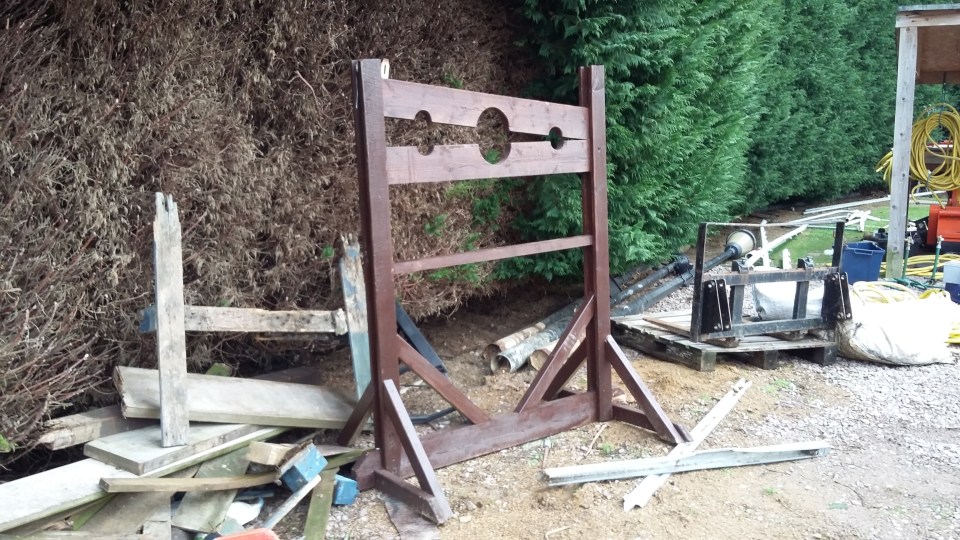
*Before anyone comments, yes, I know that the photo shows a pillory not a set of stocks. But we don’t have a set of stocks at the university, only a pillory. Exactly why we have a pillory on campus is another matter…..
Spiral Sunday #6 – Journey by Charlotte Mayer

For this week’s Spiral Sunday I’ve captured an image of a piece of sculpture I’ve known and loved, and regularly walked past, for over 20 years, as it sits prominently outside the main restaurant at the University of Northampton’s Park Campus.
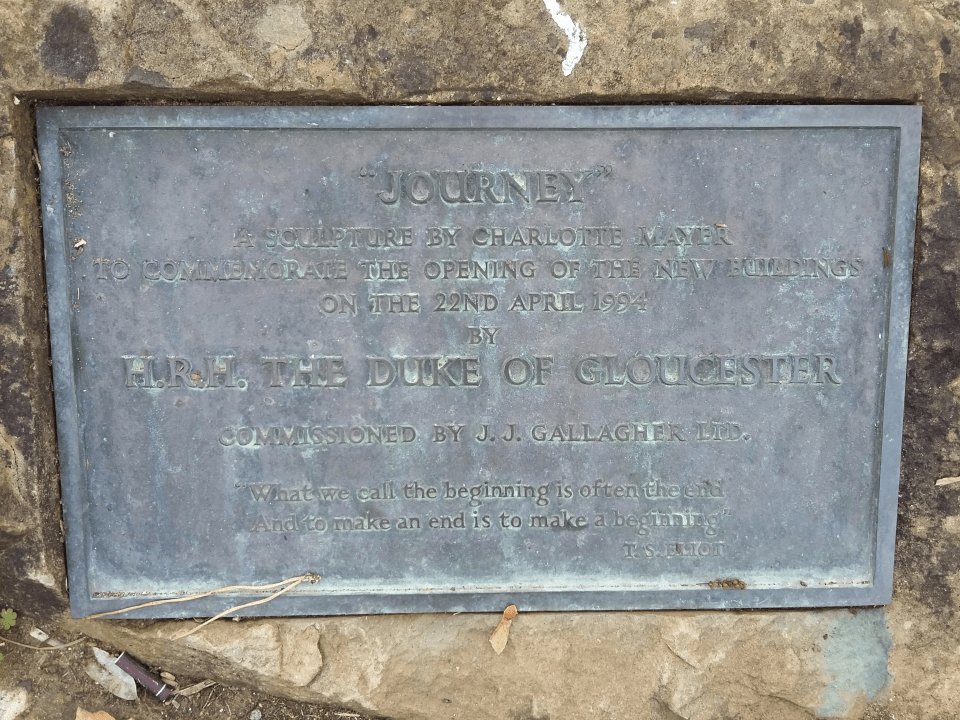
Journey by sculptor Charlotte Mayer depicts a flattened, ridged spiral shape cast in bronze. Like most people, when I first saw it, I assumed that Journey represented a stylised fossil ammonite. But I recall reading (or hearing?) that in fact it was inspired by a seed, possibly of a species of Malvaceae, but I may be mis-remembering. Can anyone enlighten me?
Accompanying the sculpture is a plaque that includes a quote from T.S. Eliot’s Little Gidding:
“What we call the beginning is often the end
And to make an end is to make a beginning.”
Journey originally sat within a small raised pond that was frequently empty other than for wind-blown trash. I was happy to see this week that the pond has been filled in and planted with a diversity of pollinator attracting flowers. A much more fitting setting for a lovely piece of art.
This week’s Spiral Sunday is dedicated to my wife Karin, who is starting an end and contemplating a beginning, in true spiral fashion.

Do reference management systems encourage sloppy referencing practices?
Over at the Dynamic Ecology blog there’s an interesting discussion going on about “how to keep up with the literature” that’s relevant to all fields, not just ecology. Spoiler alert: it’s impossible to “keep up” if “keep up” means “read everything”. But do check it out as there’s lots of good advice in that post.
One of the topics that’s arisen in the comments is about the use of reference management systems such as Endnote, Refworks, Zotero, Mendeley, etc. Everyone has their own preferences as to which to use, and there seems to be advantages and disadvantages to all of them. However a minority (so it seems) of us don’t use any kind of reference management system, which strikes those who do as very odd. Personally, I tried Endnote a long time ago, it was ok, then I lost the database when an old computer bit the dust.
I’m not sure how much more efficient/effective I would be as a publishing academic if I was to get back into using a reference management system. One of the supposed advantages of these systems, that they will format references to the specific requirement of a particular journal, seems to me to be a double-edged sword. I actually find re-formatting references quite relaxing and I think (though I may be wrong) that it develops attention-to-detail and accuracy skills that are useful in other contexts.
Also I suspect, but have no proof, that reference management software is responsible for perpetuating errors in the reference lists of papers that then result in mis-citations on Web of Knowledge, etc. My suspicion is that this has got worse over time as people rely more and more on reference management software rather than their brains. These citation errors can have an impact on an individual’s h-index, as I mentioned in a post last year.
By coincidence yesterday I spotted a hilarious example of just this kind of mis-citation that I think can be blamed on a reference management system. This paper of mine:
Ollerton, J., Cranmer, L. (2002) xxxxxxx Oikos xxxxxx
was rendered in the reference list of another paper as:
Ollerton, J., Cranmer, L., Northampton, U.C., Campus, P. (2002) xxxxxxx Oikos xxxxxx
The last two “authors” are actually from the institutional address – University College Northampton, Park Campus! [UCN is the old name for University of Northampton].
Now in theory that shouldn’t happen if an author’s reference management software is doing its job properly, and information has been correctly inputted, but it does happen: errors are not uncommon. In addition (it seems to me) authors often don’t check their reference lists after they have been produced by the reference management software. That’s sloppy scholarship, but I can understand why it happens: people are busy and why bother if the software is (in theory) getting it right every time? It also shouldn’t happen at the editorial production end of things, because references are usually cross-checked for accuracy, but again it does, even for top-end journals (in this case from the Royal Society’s stable!)
Again it’s anecdotal but I’m also noticing that reference lists in PhD theses that I examine are getting sloppier, with species names not in italics, various combinations of Capitalised Names of Articles, unabbreviated and abbrev. journal names, etc. etc.
Does any of this really matter? Isn’t it just pedantry on my part? Whilst the last statement is undoubtedly true, I think it does matter, because attention to detail at this very basic level gives the reader more confidence that attention has been paid at higher levels, such as citing accurate statistics from primary sources to back up statements, rather than relying on secondary sources, as Andrew Gelman discussed in an old blog post on referencing errors.
But maybe I’m a lone voice here, I’d be interested in your thoughts.