Category Archives: Personal biodiversity

A giant falls: the Tolkien tree is no more


March 2009 - Oxford Botanic Garden 012

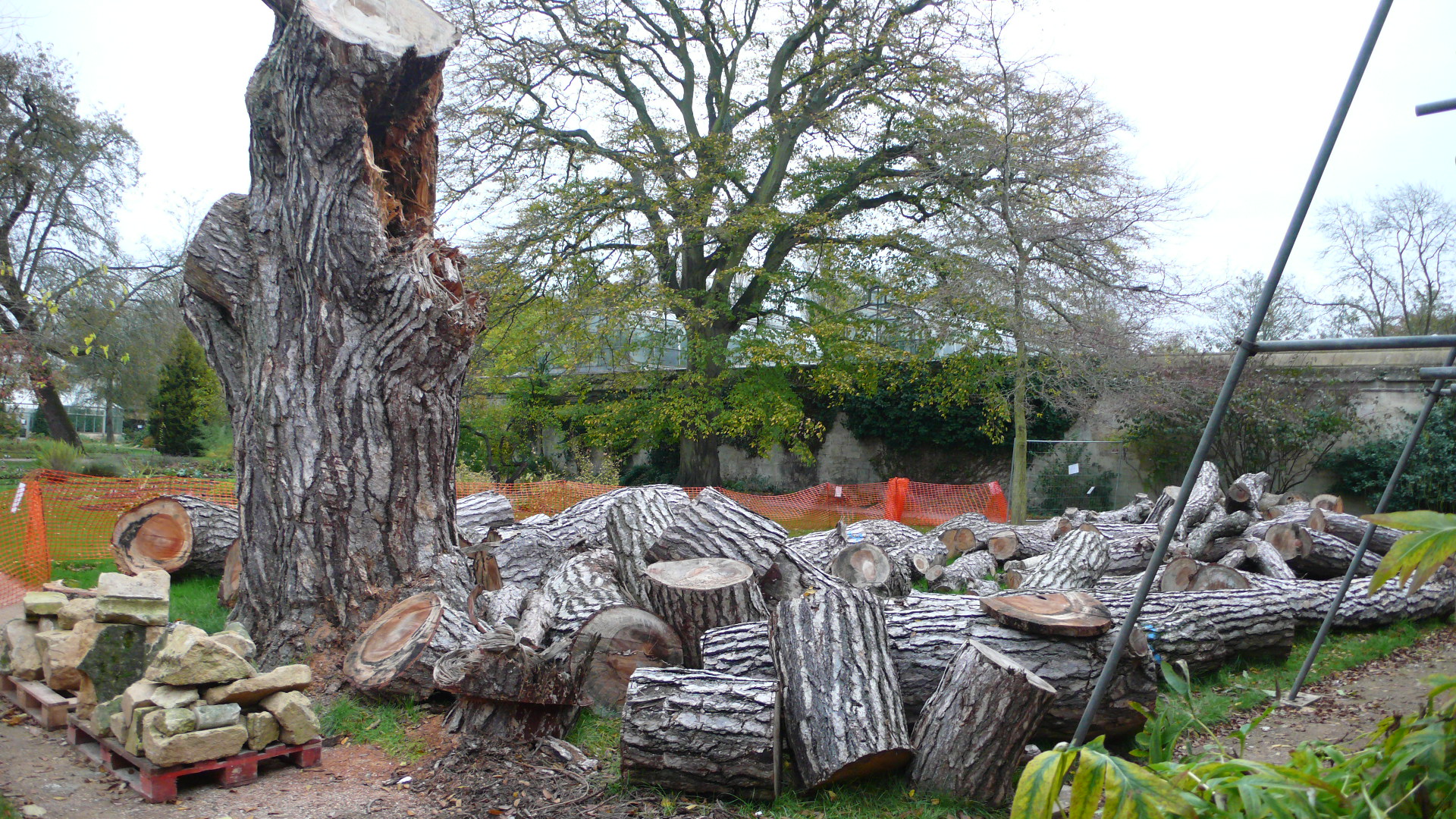
Perhaps more than any other aspect of biodiversity, big trees hold a special place in our emotions.  Sure, whales do too, but it’s hard to hug a whale.  Trees on the other hand can be approachable behemoths, instilling awe into the observer and grandeur into a locality.  So I was hugely saddened to discover today that the vast Black Pine (Pinus nigra) at Oxford Botanic Garden had been badly damaged a few months ago and has been felled.  I’ve known this tree since 1987, and have introduced generations of undergraduates to it during our annual trip to the Garden.  Each time I tell the story that it was one of J.R.R. Tolkien’s favourite trees and probably inspired his creation of the ents in Lord of the Rings.

The damage to the tree and its subsequent felling has been caught on camera, though I should warn you that for anyone who knew and loved the tree it’s an emotionally charged video.  The tree has been propagated and its offspring will live on, but it will be another 200 years before one of them becomes quite so majestic.

March 2009 - Oxford Botanic Garden 011

P1120016

Blackberry Week

2014-08-23 11.11.25

As a kid growing up in the north-east of England in the 1970s, the half-term school holiday that occurred early in October was always referred to as “Blackberry Week”.  A quick on-line search suggests that the phrase goes back to at least the 1930s (can anyone trace it earlier than this?) and it refers to the time when blackberries (Rubus fruticosus agg.) were ready for picking.  The local kids would spend hours at our favourite blackberry patches, picking bags full of dark, luscious berries to take home for our mothers to cook into pies and crumbles, or stewed to eat with cream. As much fruit was scoffed as was collected (“one for the bag, one for me, one for the bag, one for me…”) and over-ripe ones were pelted at one another until we looked like road casualties.

All of this has been brought to mind recently, since we began to pick blackberries in our garden – at the end of July.  That’s at least two months earlier than I recall doing as a youngster.  Part of this difference can be attributed to latitude; I now live more than 200 miles further south than I did, with a concomitant advance in relative dates of flowering and fruiting, amongst other phenological indicators.  But that can’t be the only answer, the difference is too extreme, though I have not (and I doubt if anyone has) assessed it systematically.

The main reason for the difference, it seems to me, is that our seasons are shifting. We know that spring is generally earlier now in the UK than it was 20 years ago, and with that shift, autumn has likewise been brought forward and is lasting longer, as shown by changes in fungi fruiting patterns.  There’s a lot of research interest in these changes, for example the Centre for Ecology and Hydrology’s collaborative project.  Whilst phenology scientists usually express these changes quantitatively, as number of days difference between events, such as bird migration dates or plant flower times, across a period of years, any person with an interest in the natural world can see these changes for themselves, even in gardens.

Without realising it, as kids we were also making decisions about where to pick blackberries that go directly to the heart of biodiversity, which is essentially about variation and difference in the natural world.  As part of our own knowledge of the local (and very personal) biodiversity of the area in which we played and explored, we would know the best bushes from which to pick fruit, and the ones to avoid because the plants produced berries that were small, or had a poor flavour. Blackberries are hugely variable in all manner of ways, including leaf shape, number and size of prickles, flower size and colour and, most importantly for us, characteristics of fruit quality.

Much of this variation is genetic rather than environmental and reflects the complex biology of the species, or should I say group of species. Let’s go back to the scientific name of blackberries: Rubus fruticosus agg.  I’ve posted in the past about the formalities of writing scientific names of species, and the “agg.” element is an unusual addition not often seen.  It’s an abbreviation of “aggregate”, which in its taxonomic sense means a collection of species that are very similar to, and may even be synonymous with, that species.  The plant that we know and love as the blackberry is actually an aggregate of many hundreds of “microspecies”, at least according to some plant taxonomists.  This is because of the variable sexual behaviour of blackberries and their tendency to hybridise.

Blackberries are often taken for granted and dismissed as invasive woodland dominators that need to be kept in check.  But they are important for their cultural significance, have a fascinating biology, attract a wide range of insects to their flowers, and provide both fruit and habitat for birds and mammals.  Blackberries are worth making space for if your garden is large enough.

All pollinators are equal, but some pollinators are more equal than others

The infamous line from George Orwell’s Animal Farm asserting that “All animals are equal, but some animals are more equal than others” nicely captures an ecological view of pollinators and their relationships with plants.  “Pollinators” by definition move pollen between flowers, but not all pollinators are equally good at transferring pollen of any particular plant: some are more effective than others. I’ll illustrate this with examples from the urban garden that Karin and I are developing, which I’ve discussed before.

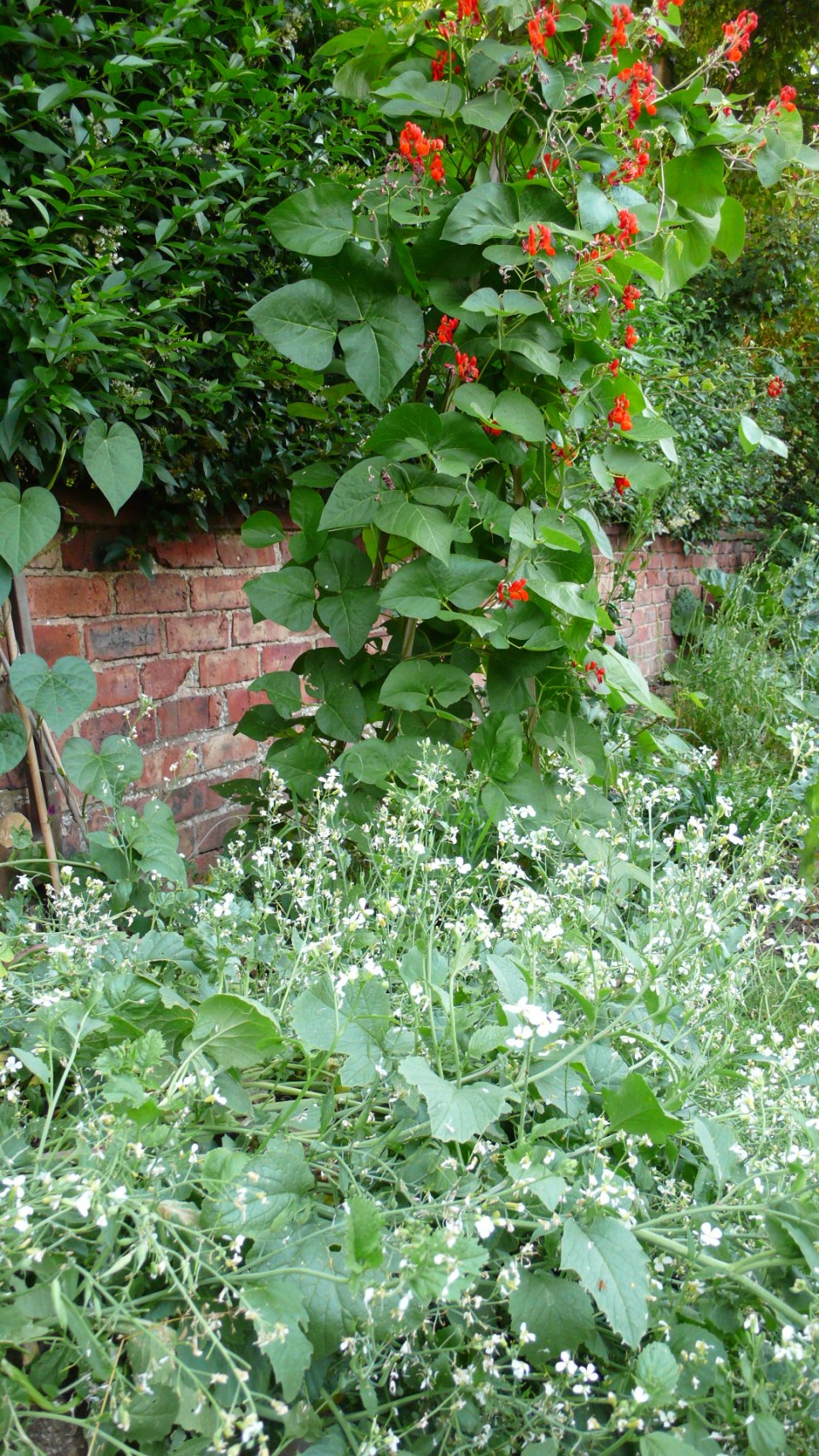
As you can see from that link, the garden is modest in size, but nonetheless this year it contains a significant biodiversity of edible plants that require pollinators for some or all of the fruit and seed set, including: strawberries, apples, greengages, cherries, blackcurrants, squashes, courgettes, blackberries, fennel, runner beans, french beans, passion fruit, tomatoes, raspberries, and radishes.

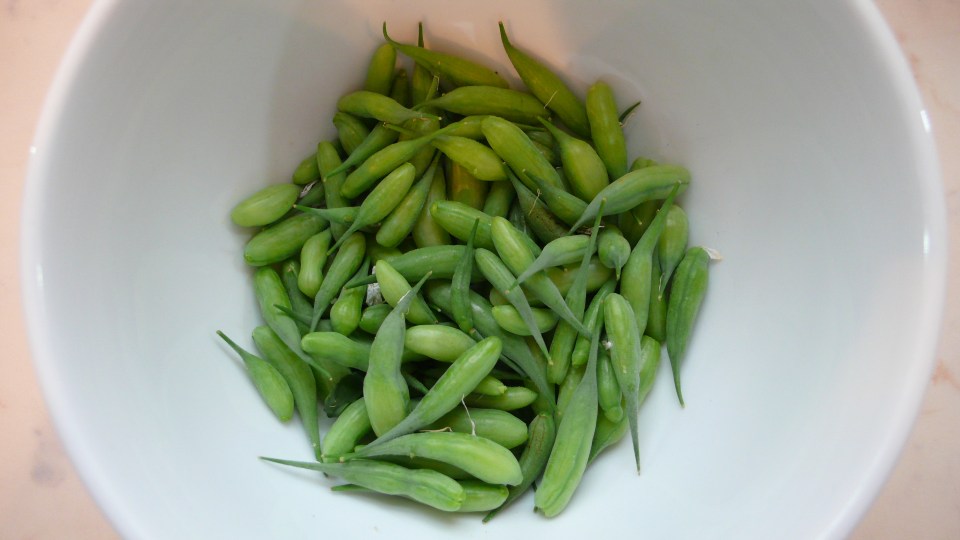
Radishes?!”  I hear you ask.  “But they are grown for their edible swollen roots which don’t require pollination!”  True, usually.  But we let our radishes flower because we mainly grow them for their seed pods which, picked young, are delicious in salads and stir fries, like mustardy mange tout.  They look like this:
2014-07-03 18.14.32

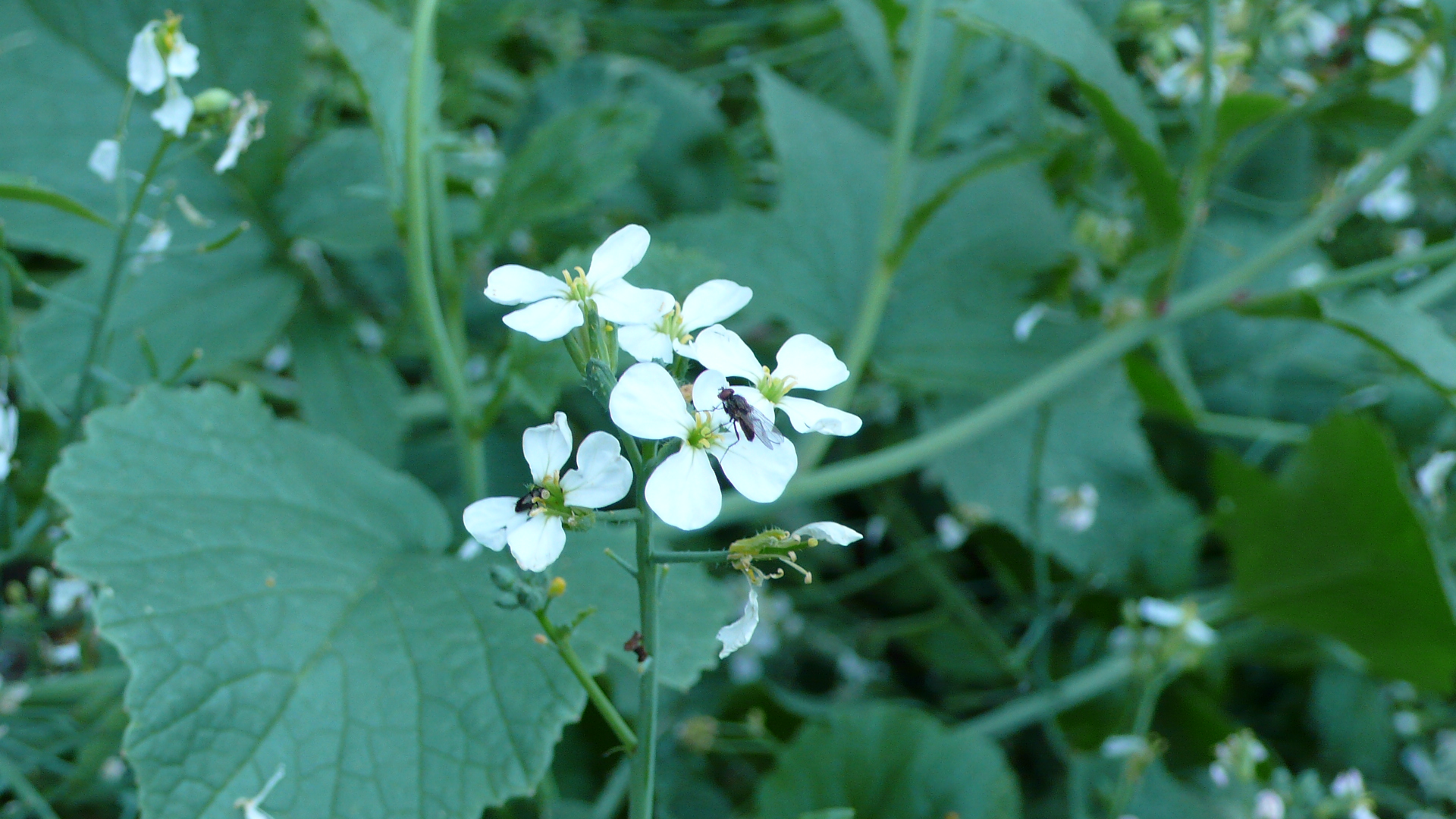
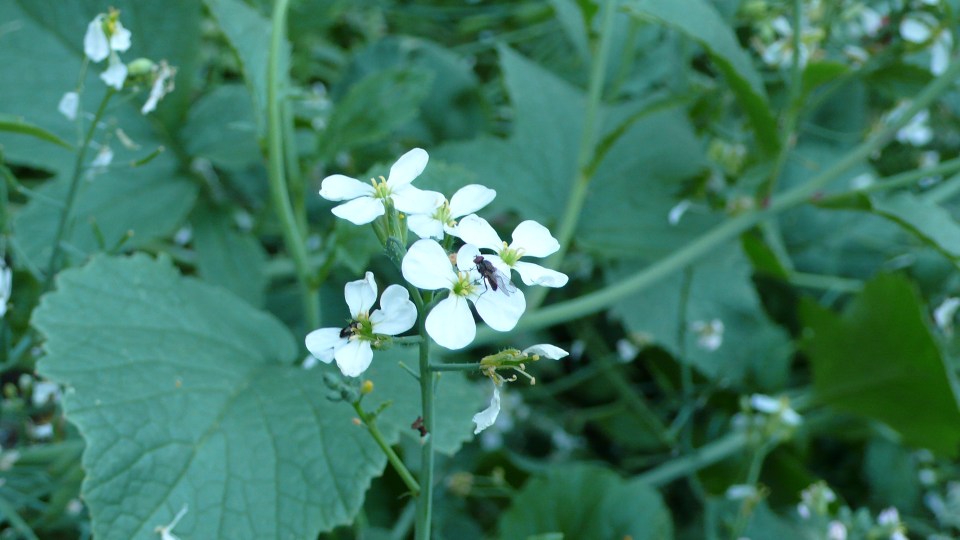
The radish flowers are pollinated by a diversity of insects including butterflies, bees, and small flies:
2014-07-03 19.40.34

These insects will vary in their effectiveness as pollinators of radish, depending on the frequency of visits, how often they move between flowers, and the amount of pollen on their bodies.  This last factor is largely a function of size and hairiness (bigger, hairier insects carry more pollen as a rule), though cleanliness also plays a part: insects often groom the pollen from their bodies and, in the case of bees, may pack it into their pollen baskets where it’s not available for pollination.

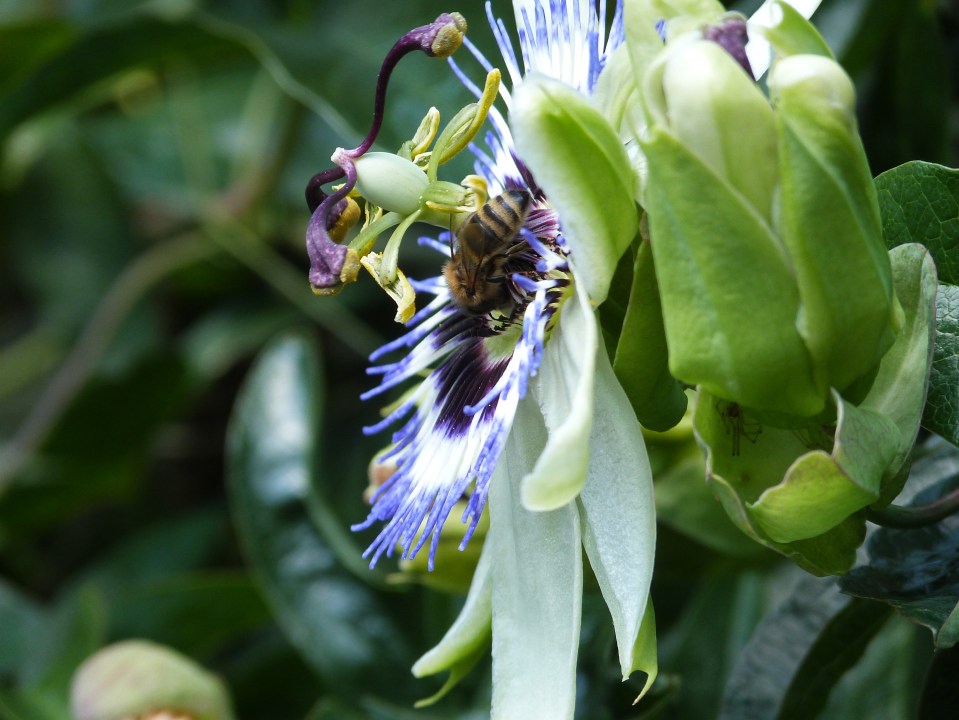
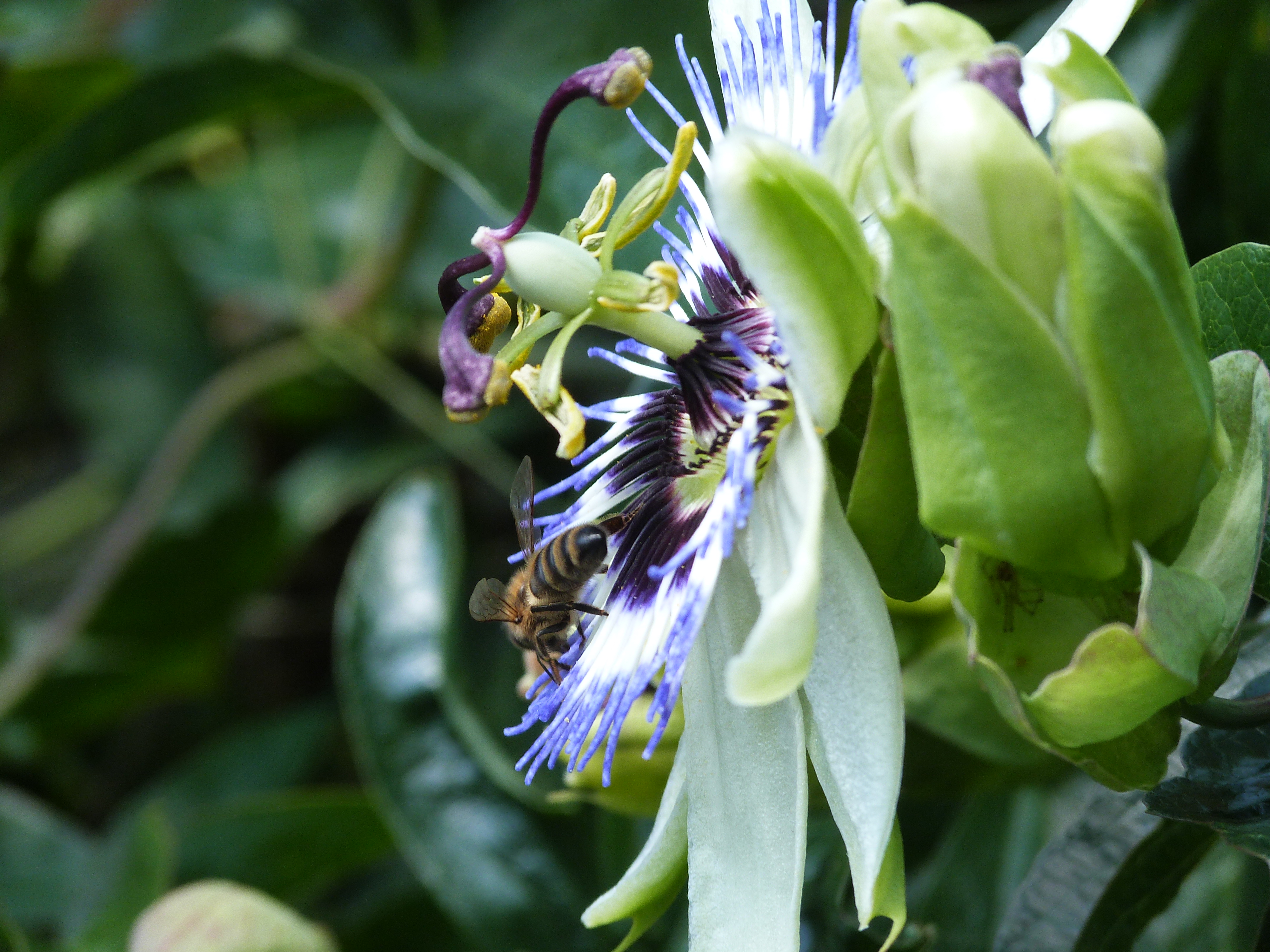
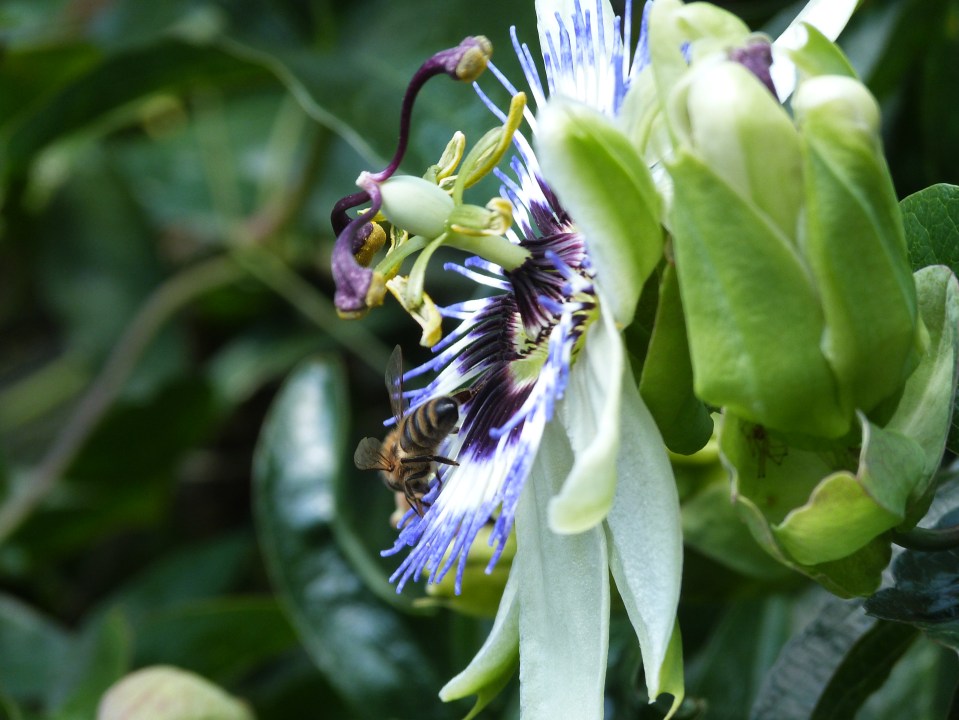
The size and behaviour aspect is best illustrated by some recent photos that I took of visitors to the flowers of passion fruit (Passiflora caerulea var.).  We have a large, sprawling plant growing up a fence which is currently being visited by honey bees, hoverflies, solitary bees and bumblebees.  In comparison to the size of the flower and the position of the anthers (male, pollen producing parts) and stigmas (female, pollen receiving parts), the hoverflies, honey bees and solitary bees are relatively small.  These two images are of honey bees (Apis mellifera):
P1010419

P1010418

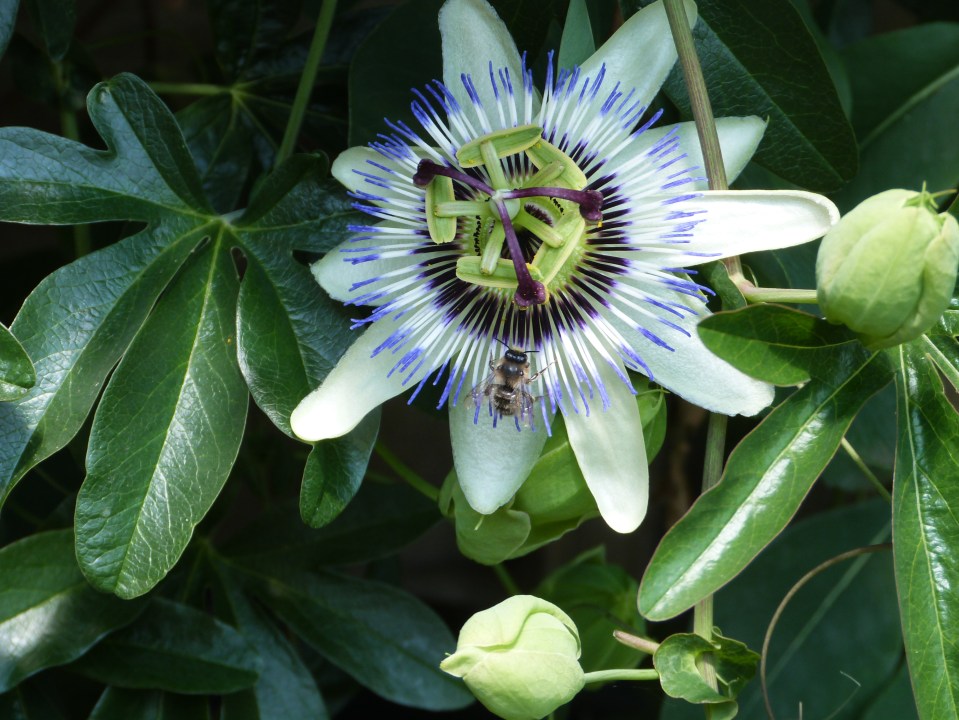
Here’s an unidentified solitary bee:
P1010431

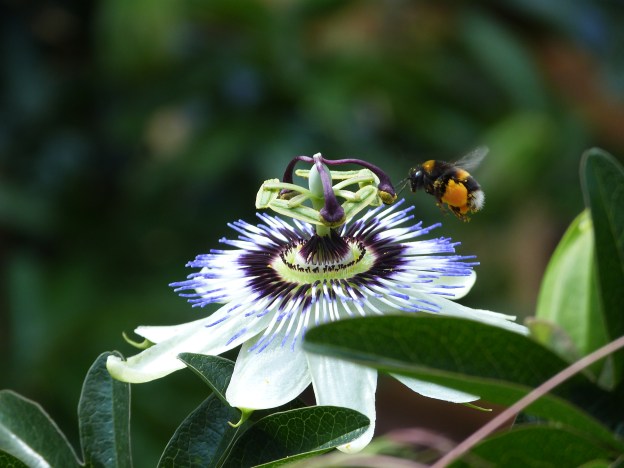
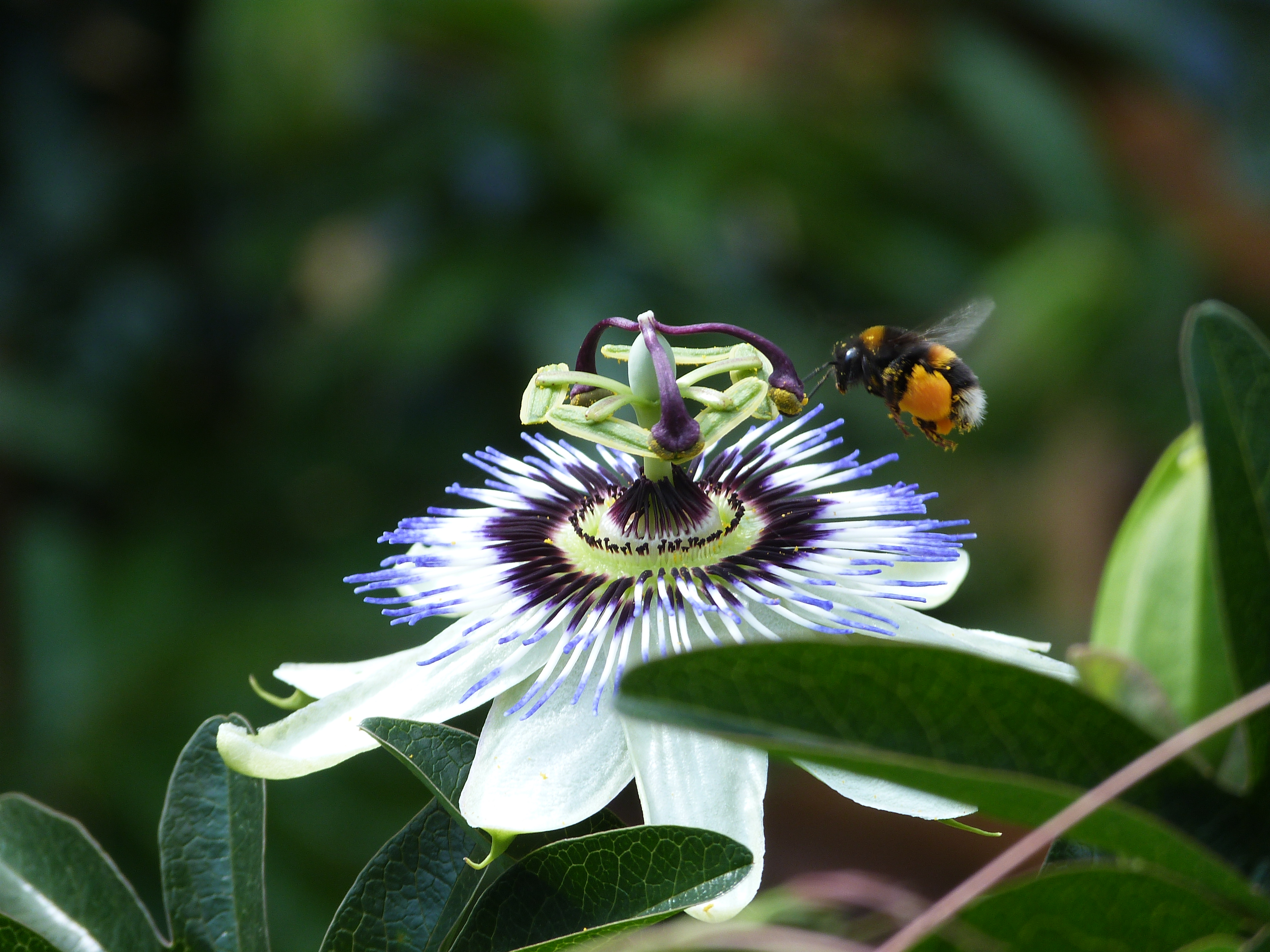
These bees were occasionally touching the anthers, mainly with their wings, so some pollen will be moved around.  But from what I observed it’s likely to be a relatively small amount in comparison to bumblebees, which are usually much larger and hairier, and don’t groom themselves as often as honey bees.  Here’s a Buff-tailed bumblebee (Bombus terrestris):
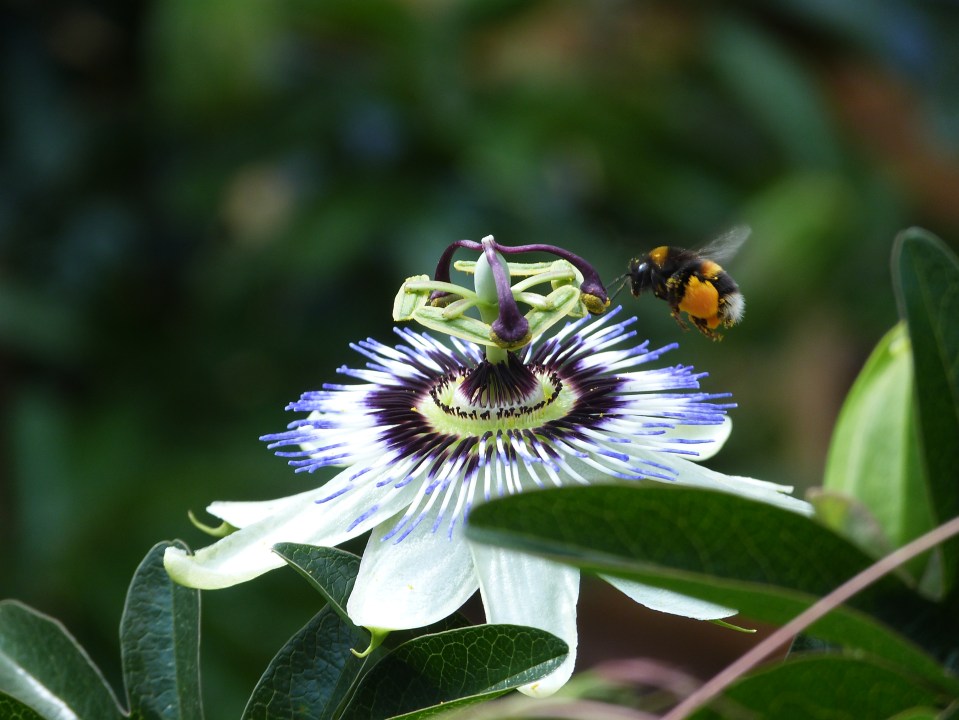
P1010430

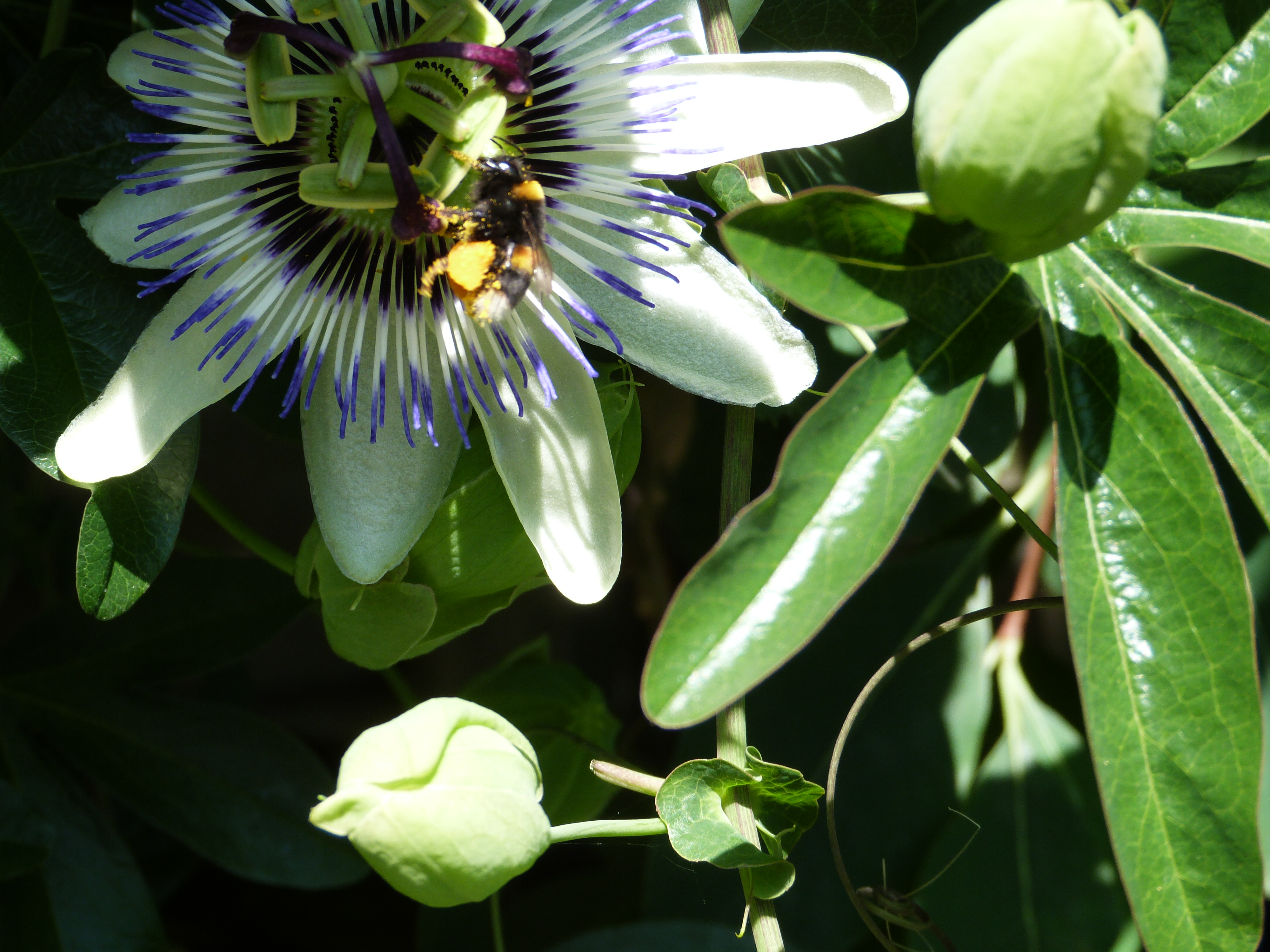
They were actively collecting pollen as well as nectar.  Much of this pollen is packed into the pollen baskets on the rear legs and will go back to the nest to feed the developing larvae, but some will be involved in pollination:
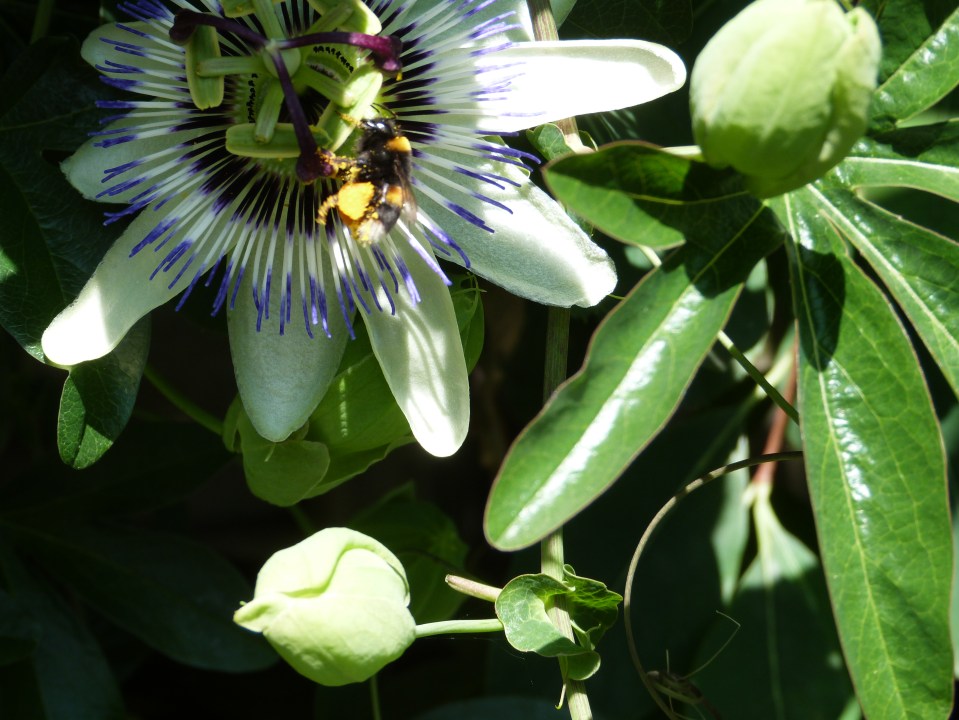
P1010428

So it seems to be the bumblebees we have to mainly thank for the deliciously sweet-sour fruit we will enjoy later in the season. Of course to test this properly we would need to set up an experiment in which we excluded larger bumblebees from the flowers and only allowed smaller bees to forage, with appropriate experimental controls.  Would make a great project if any of my students are interested!  But it should give you a sense of just how complex the interactions between flowers and their pollinators are: the ecology of pollination is far from simple, despite what some would have us believe.
2014-07-03 19.40.18


Harvest of evidence

P1100769

The last entry I posted was premature in its prediction that autumn is here and for the past week we’ve enjoyed some bright, warm weather: an Indian Summer before autumn proper envelops us.  Sunday afternoon was spent in the garden, digging up potatoes and planting the garlic we bought on the Isle if Wight.  Neither of these crops requires pollinators, but others we’ve been harvesting this month do, including squashes, runner beans and greengages.  The latter are from a mature tree that, when we took over the house in 2012, I assumed was a bog standard Victoria plum.  The tree did not crop last year but has more than compensated this season with abundant deliciously sweet fruit.

All of this provides useful anecdotes for public lectures.  Since appearing on Bees, Butterflies and Blooms I’ve regularly been asked to give talks to gardening societies and  I try not to refuse because they are usually fun with attentive, knowledgeable audiences.  At one such event earlier this year I was asked: “Is there any evidence that declining pollinators are resulting in lower crop yields in Britain?”  It’s a great question that goes to the heart of evidence-based conservation and the notion that science should be informing such policies as strategies to conserve biodiversity.

As far as I’m aware there is no indication that British insect pollinated crop yields have declined.  And if the evidence of our greengages, runner beans and squashes is anything to go by, there’s currently plenty of wild bees, hoverflies and other insects (we get few honeybees in this garden) to service those food plants that require their pollinating activities.  But that doesn’t mean we should be complacent and monitoring is required, because the evidence from other countries is that yields are down for insect pollinated crops and hand pollination is required in some places.

Evidence should inform everything that we do and believe as scientists, gardeners, informed members of the public, whatever label we choose for ourselves.  This is especially true of currently controversial issue such as the causes of global climate change or the effects of neonicotinoid pesticides on pollinator health (see Dave Goulson’s slides from a recent conference talk, for example).  But we should also understand that a basic tenet of science is that it can never “prove” anything:  new evidence may appear at any time that refutes our cherished notions, or disproves that pet hypothesis.  We make decisions on weight of evidence not on proof.  So it was depressing to read a widely publicised article about a Nigerian postgraduate student’s claims that he has “proved” that homosexual relationships are “unnatural” because only the opposite poles of magnets are attractive to one another, the same chemical compounds do not react together, and roosters only love hens.   At first I thought it was a spoof but it appears that the research student is perfectly serious and, more, has been tipped to win a Nobel Prize by his equally deluded supervisors.

It’s easy to scorn the guy’s findings and point out that people aren’t magnets or simple chemical compounds and that homosexual activity is widespread in the animal world (so how do we define “unnatural”?)   But Karin, as always, had a deeper and more nuanced view of this story than did I.  Perhaps it’s her training in psychotherapy but whatever the reason, she gave an alternative perspective and pointed out a sad possibility.  Karin suspects that the student has been manipulated by academic and political powers that have a vested interest in such “proof” because of threatened sanctions on aid.  Under this scenario the student has been encouraged by the academics at the university to pursue this misguided work, which can only support the Nigerian government’s anti-gay stance.  Of course the research will never be published by any reputable scientific journal and the story has harmed the University of Lagos’s international reputation.  But for the narrow minded and biblically fundamentalist, the story itself will be evidence enough to shore up their own prejudices.  One person’s crackpot claims is another’s decisive evidence.

Garlicky archipelago

Sunrise from train September 2013

“Garlicky” is a great word, redolent of hot, pungent flavour and nose-filling odour: a Pavlovian word that ignites the senses as it’s uttered.  Perhaps I love the word because garlic is one of my favourite vegetables, a pleasure to both eat and grow.  A Garlic Festival is therefore not to be missed, and my family and I had the opportunity to attend one on the Isle of Wight during a short holiday a couple of weeks ago.  We were joined by university friends I’ve referred to previously, as the first one of us to reach a half century celebrated his 50th birthday.  There was more to the festival than just garlic, but for me its highlight was seeing the sheer variety of different garlic types that can be grown, testament to how this vegetable has been modified from its ancient wild origins in central Asia.  Karin and I bought seed bulbs of four different varieties as additions to the horticultural biodiversity of our vegetable plot, to be planted later in September.   These included the notable Elephant Garlic with its massive individual cloves, which, I’ve just learned while researching that link, is not a true garlic at all but rather a variety of leek.  We live and learn!

Archipelago is another great word and the time we spent on the Isle of Wight, travelling over by ferry from Southampton, served to remind me that the British Isles, with over six thousand islands of various sizes, is by any standards a significant archipelago.  Since at least the explorations of Alexander von Humbloldt, island groups have  been known to host unique species, isolated taxonomically and physically from their closest continental relatives.  Darwin’s later researches showed that archipelagos such as the Galapagos Islands are important as natural evolutionary laboratories, and in previous posts I’ve briefly discussed his unrequited desire to visit to the Canary Islands.  The Isle of Wight is too close to the continent of Europe to have evolved any unique biodiversity but I did pick up the hint of a subtle Island Biogeographic Effect whilst compiling a list of all the bird species I saw over the course of the week.  The list topped out at about 30 species, which I thought was rather low.  Some of the omissions surprised me (not a single blackbird, for instance) and I saw very few individuals of some other common British species.  Now, it could be due to my lousy birding skills I suppose, but it could also be due to the fact that we were on an island, even though it’s less than 1500m across The Solent to the mainland at its closest point.  This is close enough for bumblebees to fly to the island: I’ve seen them shadowing the ferry.  But nonetheless it might be far enough to affect both the diversity and population sizes of the bird life.  Enough wild speculation; I’d be interested to know what serious ornithologists who actually know something about the subject make of this.   

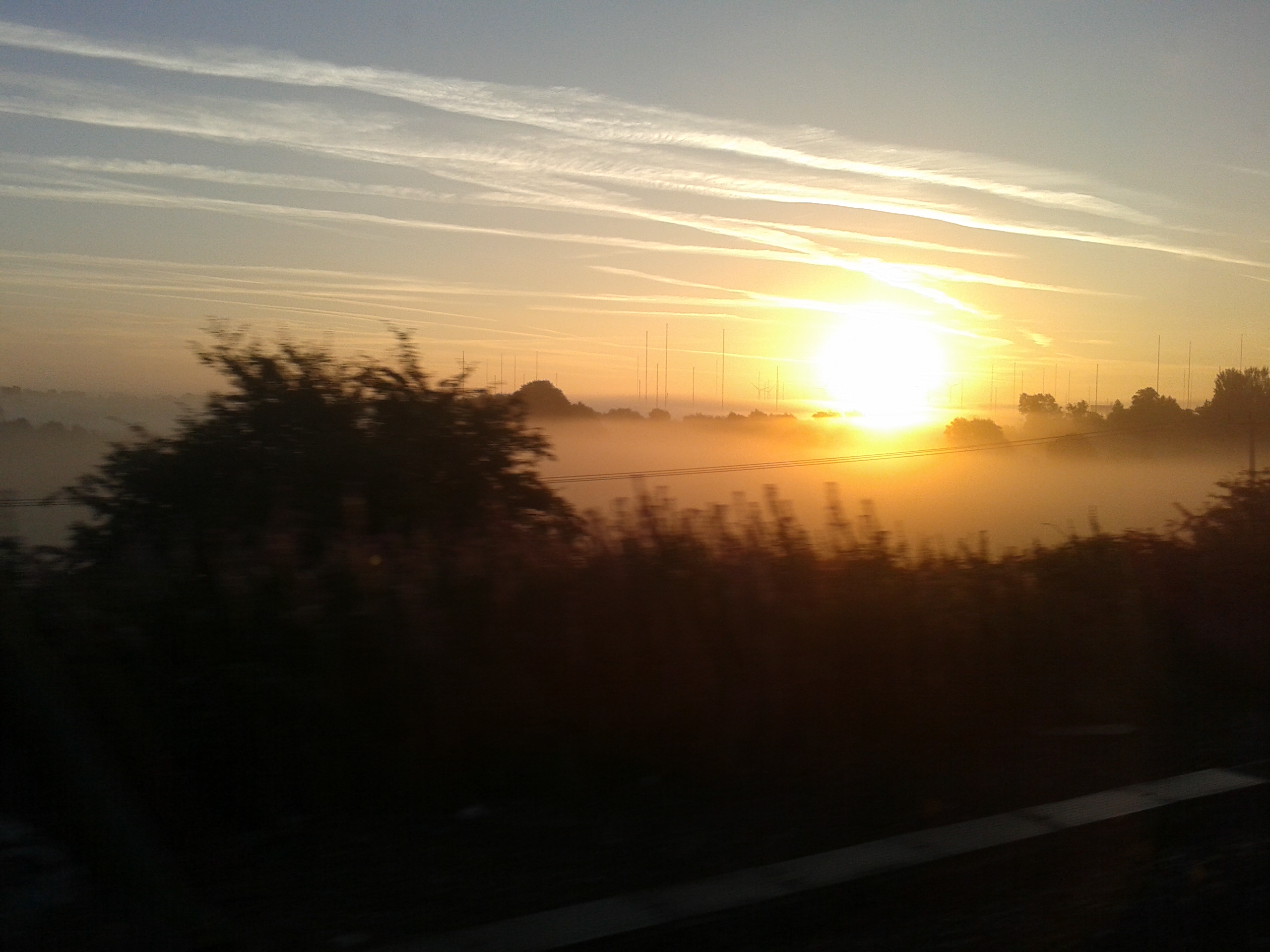
As I finish writing this post I’m on the other great island of my home archipelago, sitting in a bar in Terminal 2 of Dublin Airport.  I’ve been working at University College Dublin as external examiner for their MSc Applied Environmental Science course.  It’s been a fun couple of days reading theses and interviewing chatty, engaged students, which began with a dawn alarm yesterday in order to get to the train station and then Birmingham International in time for a 0850 flight.  Whilst waiting for my taxi I popped into the garden and paused to enjoy the early morning stillness before opening up the chicken coop.  A large flock of black-headed gulls passed low above me, backlit by a thin sliver of moon and silent except for the shuffle of feathers.  From the direction they were travelling I think they were heading from a roost on Pitsford Water and on to destinations unknown.  The garden was also busy with early risen blackbirds and a couple of flitting bats, whilst a little later my taxi passed a rangy fox idly trotting through low mist on the Racecourse park.   It was urban biodiversity at its most sublime.  

All this talk of Northampton is making me feel homesick to be back with the family (Karin, kids, cats and chickens) and start planting garlic.  But there’s just time for another Guinness before my gate opens.  Sláinte!

In defence of lawns UPDATED

2012-02-22 10.19.23

Over at the Small Pond Science blog, Terry McGlynn has a thought provoking post which asks ‘Are trees the lawns of the future?‘.  I won’t rehash Terry’s arguments, you can read it yourself, but I was intrigued by his stereotyping of lawns as always bad.  As a keen amateur gardener and a professional with research students who have worked on garden biodiversity projects, I’d have to say that there’s lawns and there’s lawns: it all depends on how they are managed and what the purpose is of a particular lawn. Clearly there’s a continuum from high diversity, natural “lawns” (i.e. close-cropped grassland which can support significant biodiversity such as some chalk grassland and African savannah lawns) through to the high resource input, monoculture, perfectly presented lawns seen on golf courses and around important buildings.  In the part of the continuum that Terry’s railing against, typical urban and suburban householder’s lawns and everything below that in terms of “naturalness”, it’s possible to manage lawns in a low-input way that is both productive and can support biodiversity.

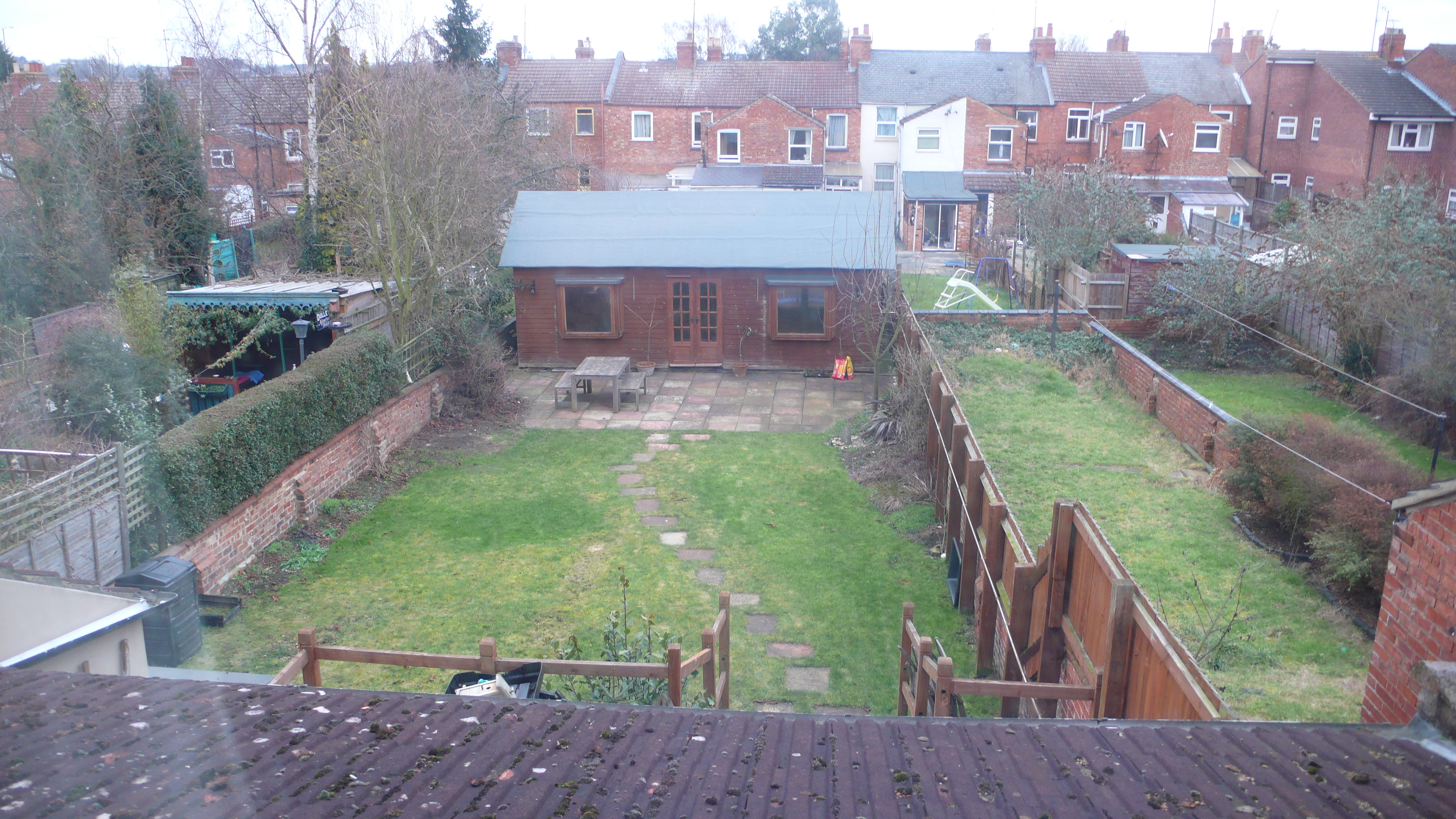
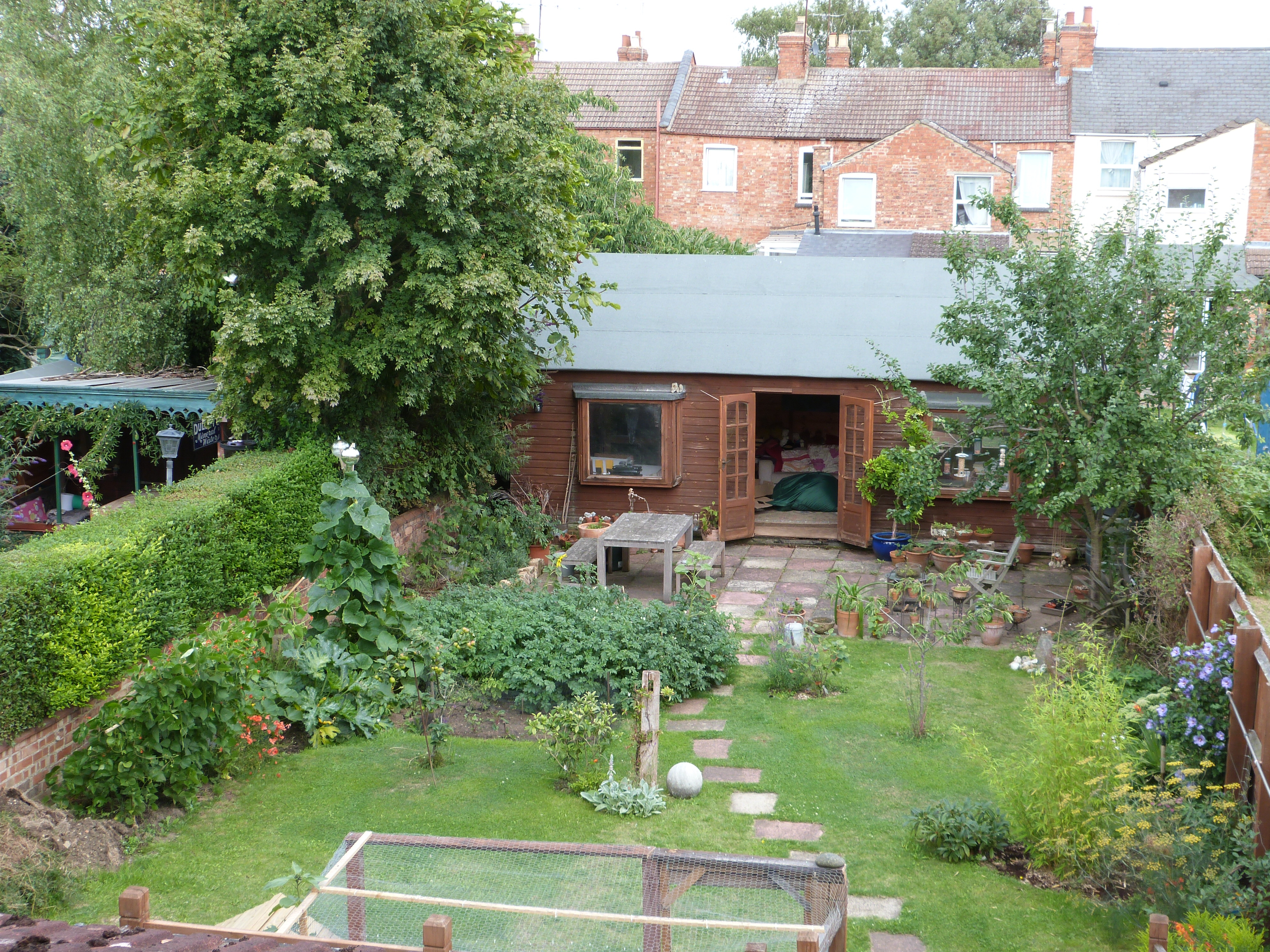
In the house that Karin and I moved into about 18 months ago, the garden was almost wholly laid to lawn; the picture at the top shows you what it was like in early 2012.  Since then we’ve dug flower borders, a vegetable patch and planted fruit trees, but kept about 50% lawn (though this will reduce as we widen borders). We don’t water or fertilise the lawn, just keep it regularly mown. I’ve not assessed it systematically but I’d estimate that, in addition to the grasses (some native, some not) there’s another 10 to 15 native plants growing in it, plus fungi which pop up every now and then. The plants include taxa which are popular nectar sources for bumble bees and solitary bees, e.g. clovers, dandelions, etc. These flower even though we mow regularly, and of course these bees pollinate our squashes, courgettes, apples, plums, etc.  The local blackbirds and starlings also find food on the lawn.

I mentioned that the lawn is “productive” and that’s where the grass cuttings come in. They are either put into the compost heap, fed to our chickens, or added directly to the vegetable patch as a mulch.  It’s also possible that the clover, which is a nitrogen fixing legume, is adding to the soil fertility that can be accessed by the far-reaching roots of the fruit trees.  Would be an interesting hypothesis to test.

So I think it’s possible to have a lawn that adds to local biodiversity and is productive for the gardener, but I accept that we may be unusual in that regard.  It’s not the kind of lawn that would make a grass obsessive proud; but that type, as Terry notes, needs a lot of input of resources, not least time.

UPDATE –  a few people have asked to see a picture of how the garden looks now, so below is more or less the same shot but taken today (15th August 2013) by Karin.  Comparing a British garden in February and August is clearly unfair!  But hopefully you can see that we’ve done quite a bit of work to it, though as with all gardens it’s a work in progress.

Garden 15th August 2013

Rewilding – inside and out

2012-05-11 08.39.32

The last blog entry I posted mentioned the reintroduction of red kites to England, surely one of this country’s most impressive conservation success stories of the past few decades.  Such reintroductions can be seen as one minor aspect of the “rewilding” programme being advocated by some conservation biologists.  In its most extreme form, radical rewilders advocate populating whole landscapes with large herbivores and predators that once roamed these regions but are now locally extinct, either because of human hunting pressure or environmental change (sort of Jurassic Park backed up with real science).  The idea is that reintroducing such animals results in more “natural” habitats in which ecological processes are returned to a more pristine state and biodiversity is maximised.  

There are arguments for and against rewilding in all its forms, and four recent coincidental occurrences make rewilding a topical subject for this blog.  

Coincidence one is that the Guardian newspaper has posted a great animated video about rewilding, voiced by environmental writer George Monbiot, whose work I’ve mentioned previously.  It’s an interesting overview of rewilding, if a bit simplistic; and (spoiler alert!) I’m sure I’d not want to jump naked into a river with hippos!  

Coincidence two is that I’m currently reading Once and Future Giants: What Ice Age Extinctions Tell Us About the Fate of Earth’s Largest Animals by Sharon Levy, which discusses some of the more radical rewilding notions that have been proposed, such as introducing elephants, lions, zebra and other African megafauna to North America, as stand-ins for their Pleistocene cousins which may (or may not) have been over hunted by the ancestors of native Americans.  That’s a controversial topic, as you might imagine, and it’s a book that’s well worth reading, not least because it effectively captures the atmosphere of the various camps of scientists promoting the hypotheses they personally support.

Coincidence three is that a paper was published in the journal Science last week which provides evidence for what can happen when larger animals (often the first to go locally extinct) are removed from ecological communities.  In this case, the seeds of a dominant, bird dispersed palm tree have evolved to be significantly smaller in size in those populations where the largest seed dispersing birds have been removed.  All of this has happened in the last 1o0 years or so, remarkably rapid evolution.  One of the authors, Spanish scientist Pedro Jordano, gives an account of the paper in his blog.  The study is one of the few published that links loss of biodiversity of species interactions to their ecological and evolutionary consequences, and has generated a lot of media attention.

The final coincidence is that a short review paper has finally appeared which I co-authored with Duke University medical researcher William Parker entitled Evolutionary biology and anthropology suggest biome reconstitution as a necessary approach toward dealing with immune disorders“.  You can take a look at the paper (or at least read the abstract) yourself.  But in essence the review places William’s Biome Depletion Theory in a broader perspective of how the loss of species with which Homo sapiens would normally interact (in this case gut worms of various types) can have profund knock-on effects for human health and may explain the epidemics of some conditions that are currently prevalent within industrialised societies.  More controversially, the review advocates that we begin to routinely rewild our gut fauna by selectively introducing one or more types of laboratory-bred worms to the guts of children.  There’s already a lot of discussion around this topic but one day in the future such procedures may become no more unusual than standard childhood vaccinations.

Having said that, there were enough problems convincing land owners that reintroducing beavers was a good thing in the Scottish Highlands, whilst similar plans for wolves and bears have stalled; reintroduction of tape worms to their children’s lowlands will probably take even more convincing.

Waxwing winter

2013-01-04 15.27.49

January has been a month of biodiversity firsts for me.

First New Year celebrated with Karin in our new home, quietly with friends and kids, plus the cats and chickens that are part of our personal biodiversity. I’m going to write a lot more about this notion of “personal biodiversity” later this year, but in short, we’re all of us directly connected to biodiversity physically and in the space we inhabit at home and work.  Think about that next time you’re devouring a pot of Activia or watering the spider plant in your office.

The first paper (hopefully of several) from Sam Tarrant’s PhD thesis has finally been published in the journal Restoration Ecology online ahead of the print version.  In this paper Sam compares the pollinator communities and available floral resources on restored landfill sites to those on nearby nature reserves.  The landfill sites are just as good for pollinators as the reserves, a surprising finding that parallel’s  Lutfor Rahman’s results in relation to bird communities on restored landfill sites .  All of which has implications for how landfill sites might be managed after they have fulfilled their primary function.  Opportunities for biodiversity conservation sometimes come from unexpected sources.

Another first was discovering some of our research cited in the recent United Nations Convention on Biological Diversity’s progress report on the International Initiative for the Conservation and Sustainable Use of Pollinators.   We were very pleased to see our work getting that kind of exposure on the international stage, regardless of what one may think of the Convention on Biological Diversity.  The CBD  is not without its critics  as I recounted the first time I blogged, live from a CBD-associated scientific conference in Germany.  This was later published in Bulletin of the British Ecological Society as “Blogging from Bonn“.    

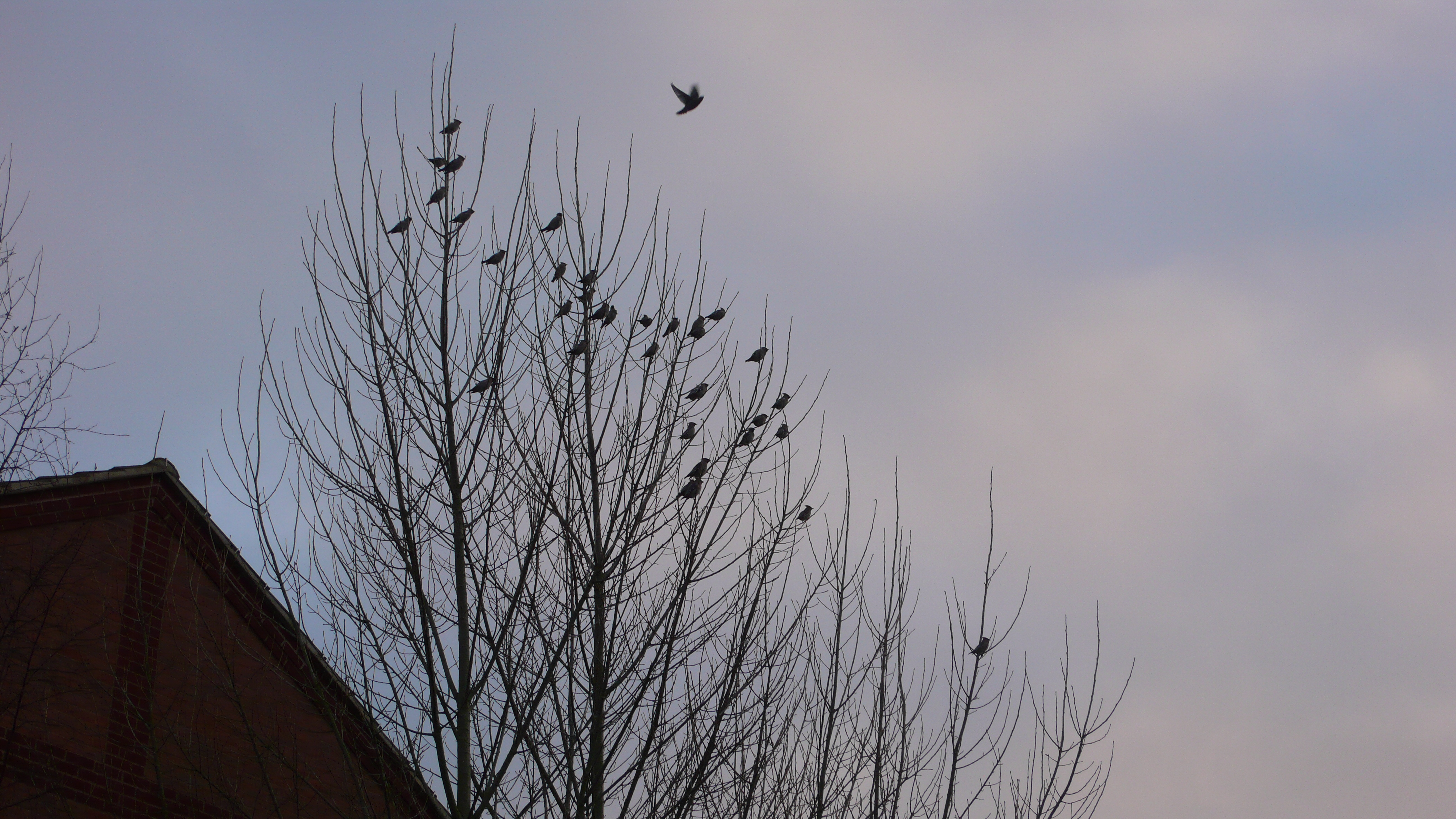
And I achieved a first by finally (after several years of trying) seeing a flock of waxwings (Bombycilla garrulus) a bird that, whilst not uncommon, is one which you really have to be in the right place at the right time to observe.  They are highly mobile and never in one spot for very long.  A friend of mine who is a very keen birder and has been trying for 25 years to see them and only achieved that birding tick this year.  One of our graduates, who blogs by the pseudonym of the Hooded Birder, has some great images of waxwings – take a look and you’ll see just what a beautiful bird this is, very exotic looking for a winter visitor to Britain.

At this time of year waxwings fly down from Scandinavia like avian vikings, marauding through the countryside devouring fruit from trees and shrubs such as rowan, hawthorn, apple, rose and any many others.  It’s quite a sight to see a bird the size of a starling eating large rose hips in a single swallow.  They are very approachable birds and we got  quite close to them.   Some years are marked by massive irruptions of these birds and are termed “waxwing winters”.  The latest data from the British Trust for Ornithology suggest that this is one such year and the Northants Birds site has regular reports of their appearance around the county.

Although I’m not by any means a serious birder, bird watching falls into the category of cultural/spiritual ecosystem services that is clearly supported by biodiversity.  Birding organisations are popular: the Royal Society for the Protection of Birds has over one million members and financial resources of almost £100 million, for example.

This weekend the RSPB will be running its regular Big Garden Birdwatch, a great example of citizen science in support of biodiversity monitoring.  I’ll do my hour of watching on Sunday morning; the current cold winter weather has brought birds into the garden that are normally found out in the wider countryside.  No waxwings yet but I live in hope.