Category Archives: Gardens

Nature as gardener (Darwin’s Unrequited Isle part 5)

P1110741

Gardening and gardens are a long-standing interest of mine, as I’ve mentioned in a few posts, such as “Harvest of evidence” and “In defence of lawns“.  At the moment the RHS Chelsea Flower Show is running and medals are being awarded to gardens and plants, some of which I like, some of which I don’t: make up your own mind from this gallery of images taken around the show.

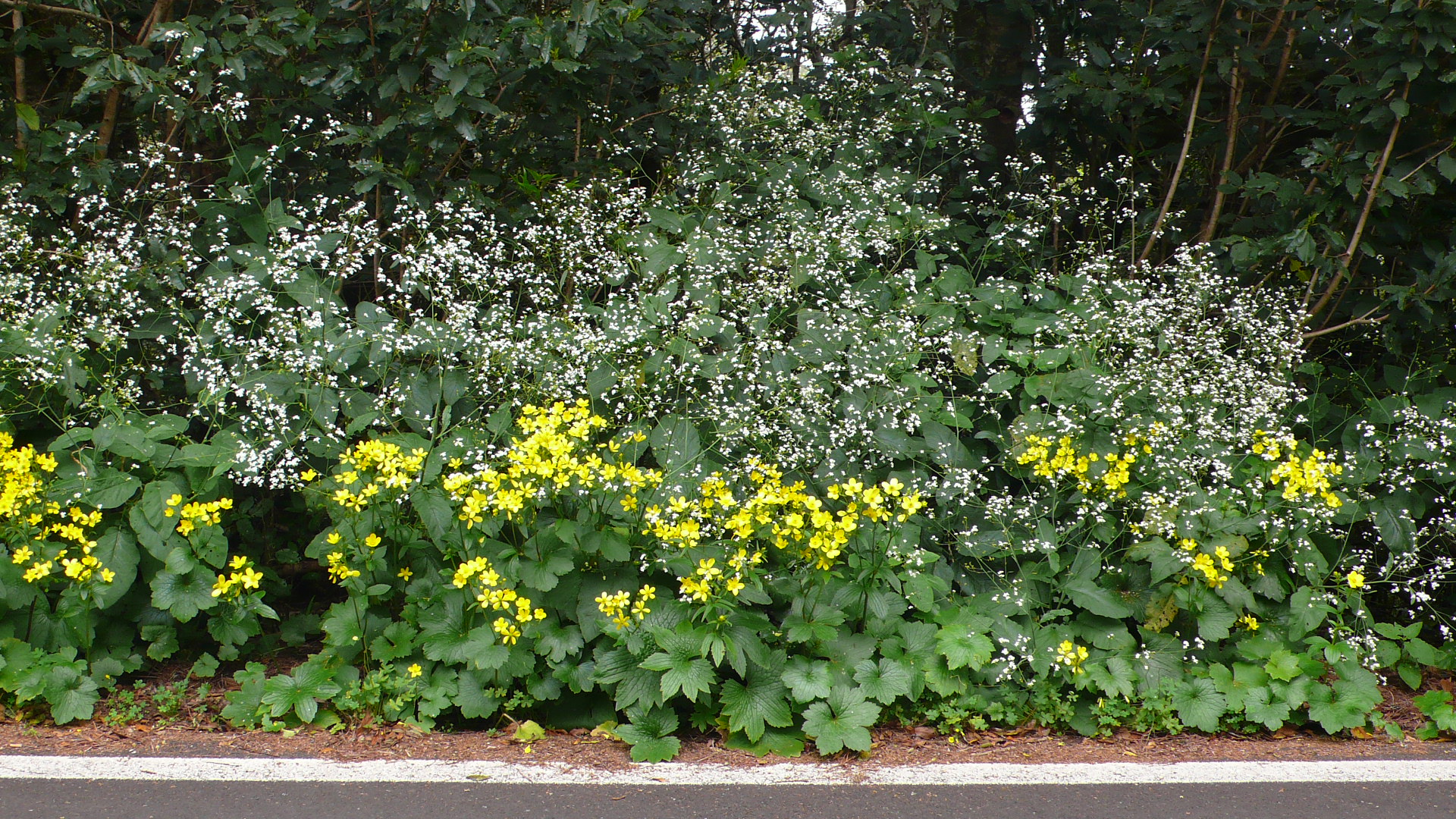
But nature often trumps us when it comes to aesthetically pleasing plant combinations.  The photograph above (which you can click to see a larger version) was taken in the Anagas Mountains during our recent Tenerife Field Course. Although it’s along a roadside, these two plants have grown there spontaneously – nature as gardener!  The plants are both endemic Macaronesian species:  the billowy white flowers of a Canary Island sea kale (Crambe strigosa) found only on Tenerife and La Gomera, spill over the vivid yellow blooms of a large buttercup (Ranunculus cortusifolius, from the Canary Islands and the Azores).

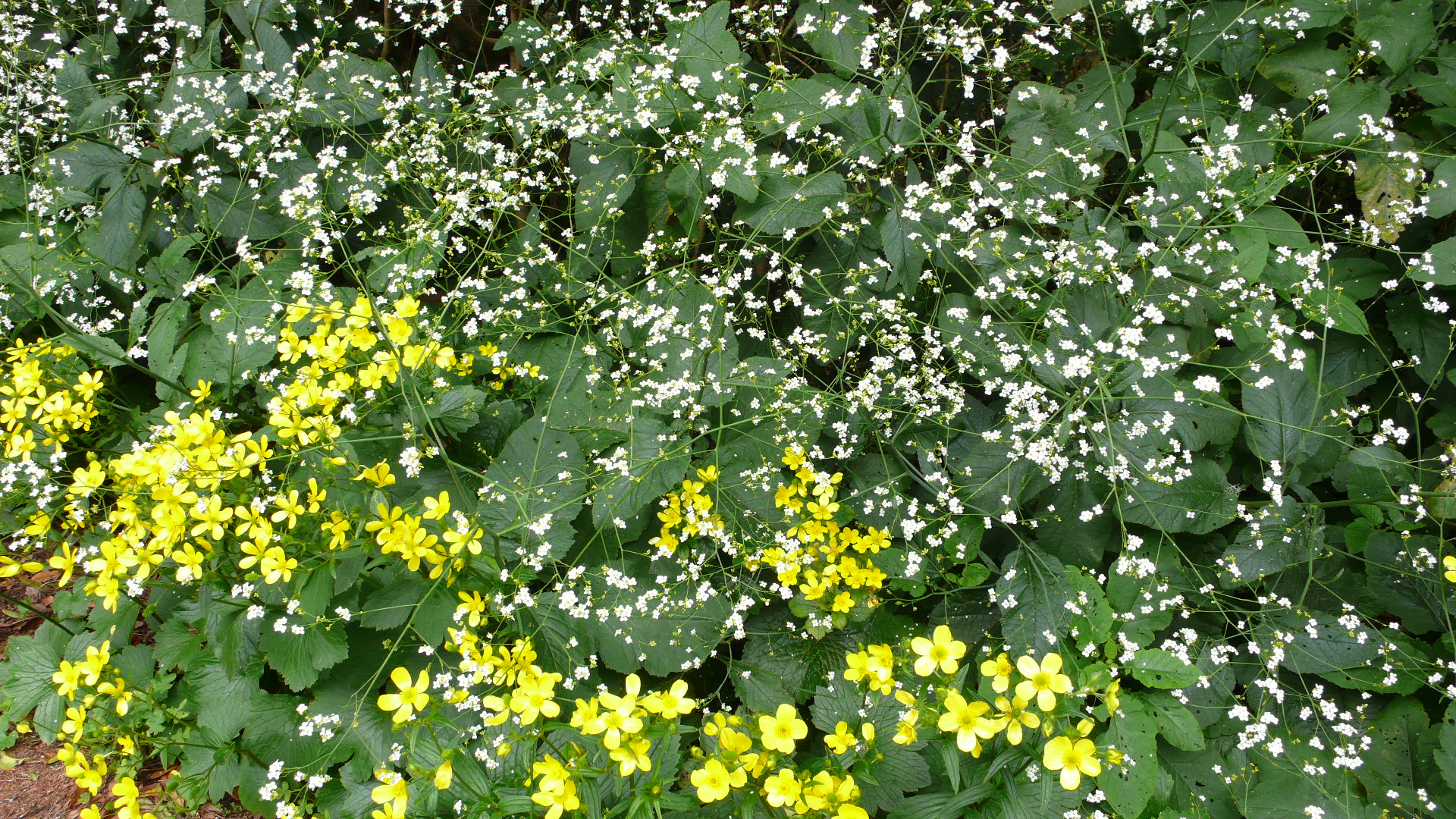
Up close it makes for a subtle but effective combination (again, looks better if you click to open it):

P1110742

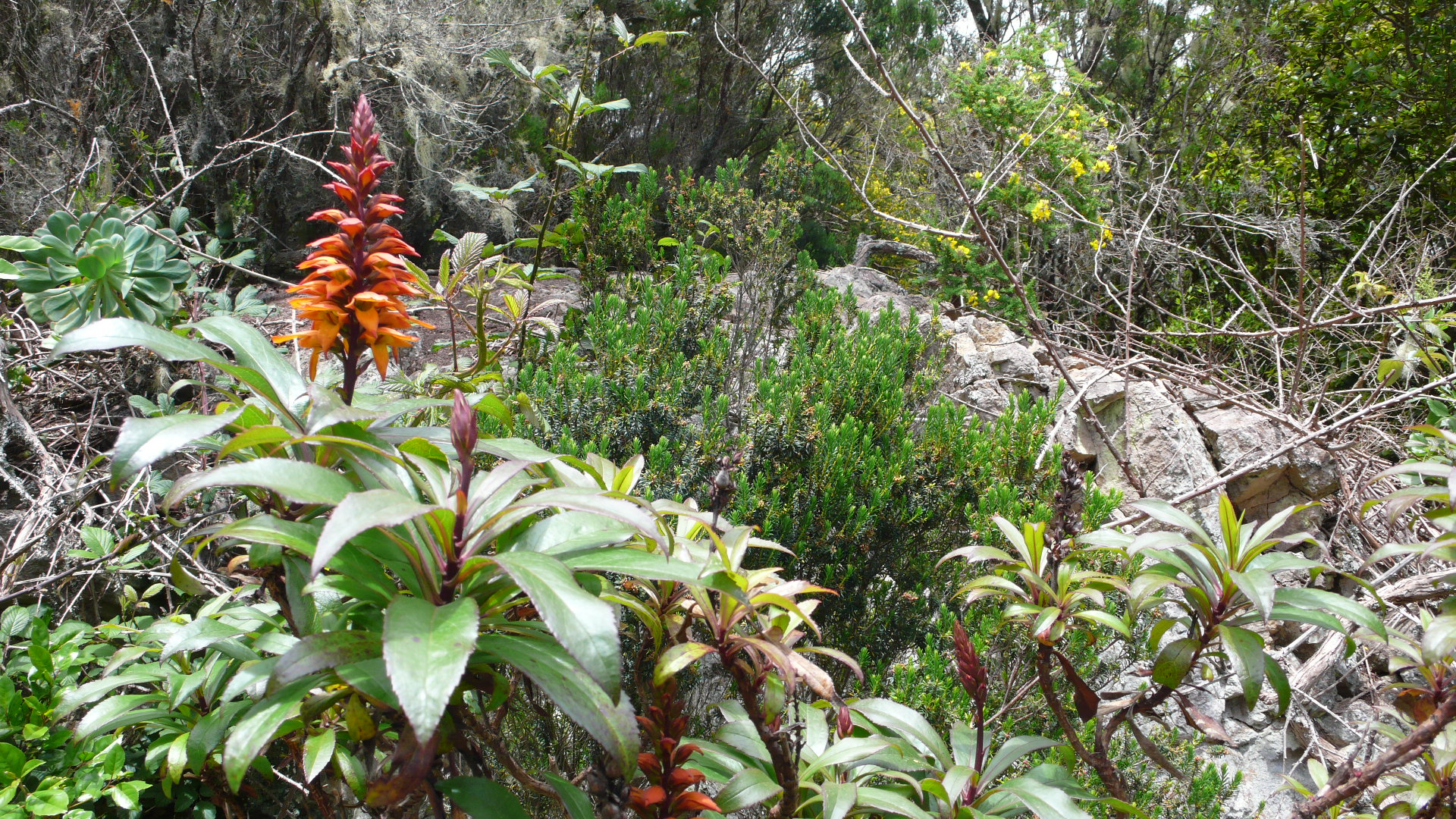
The plants of Tenerife never fail to impress – here’s the Canary Island Foxglove (Isoplexis canariensis) one of the bird-pollinated plants of Tenerife that we’ve studied in the past:

P1110767

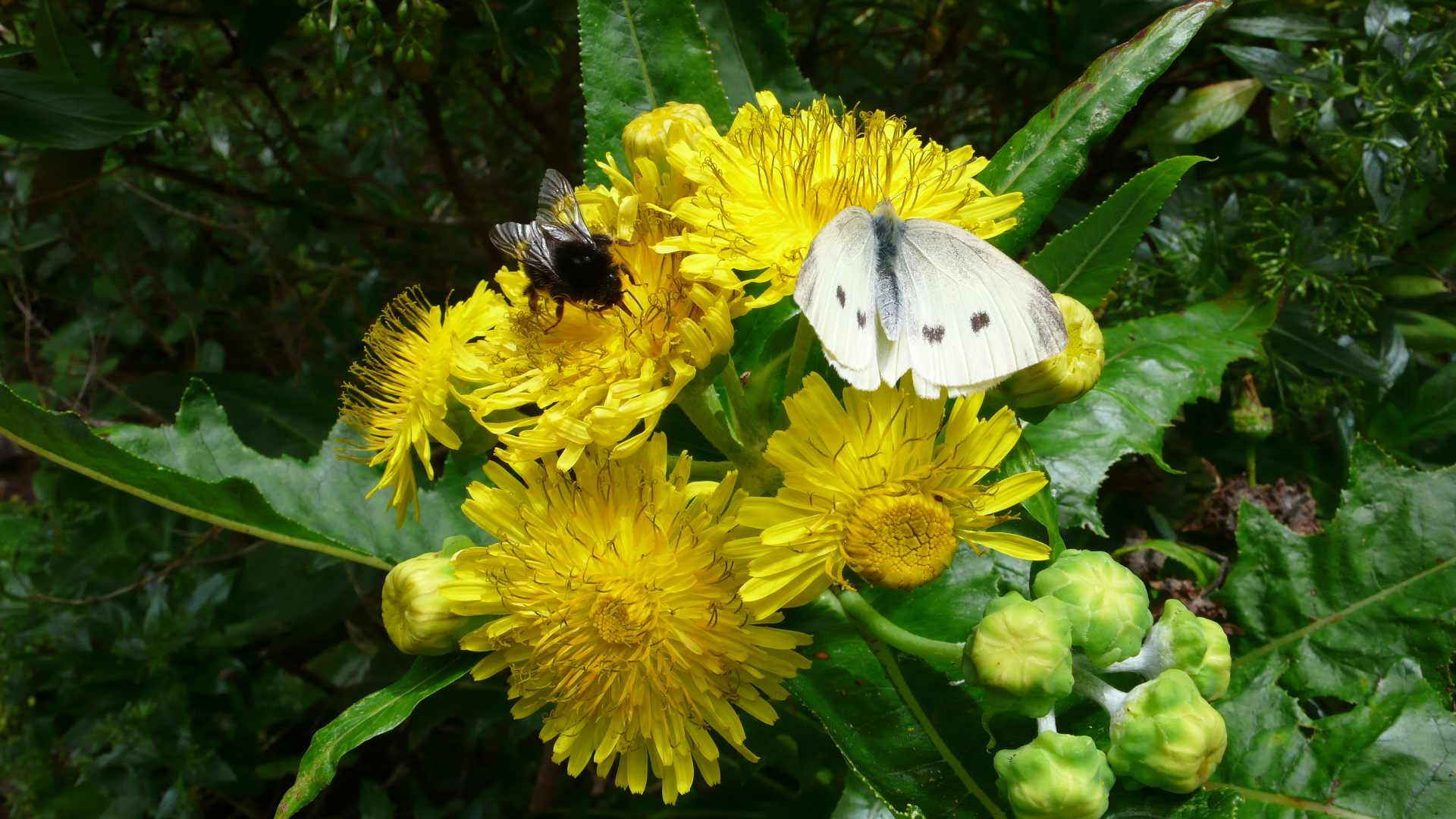
This post is largely deflection behaviour to take me away from grading student dissertations.  So before I return to it I’ll leave you with a gratuitous shot of three endemic Canary Island species:  a woody sow thistle (Sonchus sp.) being pollinated by the Canary Island Bumblebee (Bombus terrestris canariensis), and the Canary Island Large White butterfly (Pieris cheiranthi) whose caterpillars, to take us back to the beginning, feed on Crambe strigosa:

P1110763

Now, back to the coal face…..


“These things aren’t to study. They’re to turn up very loud and say, hey, once upon a time, everything was just as easy as this”

May June 2010 Garden, River of Flowers, Cambridge 011

The title of this brief post is a quote by Led Zeppelin frontman Robert Plant, from an interview that the BBC reported just this morning, regarding the forthcoming release of previously unheard Zeppelin material.  You can read the story and hear the interview here.

Regular readers of this blog will know that I’m not averse to sprinkling musical references into my posts, and this was a great quote that seemed to chime with something else I read this morning.  Over at the Small Pond Science blog, evolutionary ecologist Amy Parachnowitsch has a thought provoking post entitled “Save the bees, but maybe not this way“.  I’ll let you read it for yourself, but in a nutshell Amy is concerned about the scientific legitimacy of a “Save the Bees” campaign being crowd funded by online activist network Avaaz.org.

I share this concern and it worries me that whoever is organising the campaign is exploiting the genuine desire by people to “do something for the bees” without any regard for what exactly it is that’s “being done”.  It seems to me to be purely a campaign fund-raiser by people who don’t understand the issues or how science works, the message being: “These things aren’t to study. They’re to turn up very loud and say, hey, once upon a time, everything was just as easy as this”.

The organisers promise “the world’s first large scale, grass-roots supported, totally independent study of what’s killing our bees that decisively challenges the junk science of big pharma”.  As Amy notes, this is hugely offensive to independent scientists who are working on bee conservation issues (such as myself).  But without ever actually saying what they are going to do with the money, they’ve already had pledges of money from over 78,000 people!  If only raising funds for real research was that easy!

To reiterate what I said in the comments to Amy’s post, something that really worries me is that over-emphasis on pesticides and honey bees as single issues affecting “pollinator conservation” deflects attention from other factors which are at least as important, such as habitat loss. Colleagues and I have a manuscript in preparation at the moment showing that native bee and flower-visiting wasp extinctions in Britain began in the mid-19th century and reached their highest rate during the period 1929-1959, during a time of rapid agricultural intensification (but prior to the introduction of neonicotinoid pesticides that is currently exercising many people).  Loss of pollinator diversity is an issue that has deep roots.

In actual fact, although wild bee diversity is declining in the UK, overall abundance seems to be stable as some species are doing extremely well, including a new natural colonist, the Tree Bumblebee (Bombus hypnorum) which is spreading fast and is locally common.  But clearly greater diversity provides us with future insurance against losses of other species.

There are positive things that can be done for pollinator populations by every citizen, beyond giving money to crappy, pseudo-scientific campaigns, as I talked about in a recent post of mine.  So please don’t contribute to this Avaaz.org request, and use the money you save to buy some wild flower seeds and/or the Led Zeppelin reissues.  It will make the world a better place.


Budget cuts to Kew are cultural vandalism

P1110628


The Royal Botanic Gardens, Kew, is a beautiful place to visit, a tourist destination for visitors to London, and a green island in an urban ocean.  That’s the public face of the Gardens.  What is less well appreciated to most of the casual strollers around the flower beds and glasshouses, is that Kew is arguably the most important centre for botanical research anywhere in the world.  During its long history it has produced, and continues to deliver, top rate science that informs international conservation strategies, agriculture and horticulture, as well as basic plant science in ecology and evolutionary biology.

It’s also a welcoming, inclusive place that embraces scientific visitors from all over the world, as I know from personal experience.  Although I’ve never had a formal relationship with staff at Kew, I’ve benefitted enormously from informal links, which have facilitated research and teaching, including annual trips to the Kew Herbarium for my final year undergraduate students.

I first visited Kew as a naive 20 year old to look at their living plant collection during research for what became my first ever publication: “Adaptations to arid environments in the Asclepiadaceae” (British Cactus and Succulent Journal 1986).  So started a long appreciation of Kew and what it freely offers teachers and researchers, which has included access to specimens prior to overseas research trips, to assess distribution and flowering times; identification of specimens we’ve collected on those trips; and primary data for our study of fly pollination in the genus Ceropegia.  I’ve also used their archives for my work on John Tweedie.  Kew is an incredible resource that, in any civilised and culturally aware country, would be cherished and supported. Unfortunately it appears that I do not live in such a country.

Rumours have been circulating for a while about an impending, massive budget cut at Kew, on top of financial savings that have already been made.  Now it appears that those proposed cuts are  much bigger than anyone had thought and 120 posts, mainly in science, are threatened.  I won’t repeat the depressing statistics underlying all of this – I’ll just urge you to visit the online campaign against these cuts, read the details, watch the David Attenborough video, sign the petition, and share it with friends and colleagues.

Please don’t let Kew wither away; it’s too important to UK science, conservation and education to allow it to be gutted without a fight.


What are YOU doing for our pollinators this year? (reduce, reuse, recycle part 6)

2012-08-02 13.41.13

Earlier this year I was asked to write a short article by my former PhD student, and still a current collaborator, Dr Sam Tarrant.  Sam works for the RSPB as the CEMEX UK-funded Biodiversity Advisor, and wanted something on pollinator conservation that could be circulated in the CEMEX company’s e-newsletter.  In the spirit of reworking and reusing odd bits of writing, I thought I’d post it here too.


Insects are vital for our country’s economy.  Don’t believe me?  Then read on….

Beneath a large black mulberry tree near the University of Northampton’s Newton Building there is a plaque that commemorates its planting “On Shakespeare Commemoration Day, 3rd May 1916”.  Despite its age this tree annually produces large crops of succulent berries, aided by the fact that wind eddies are sufficient to disperse its pollen, ensuring pollination and fruit set.  Each year it’s a scramble between students, lecturers and birds, to see who can eat the most.

In contrast, the old apple trees in the grounds possess a different strategy – pollination by insects that move from flower to flower each spring.  This form of pollination is both more sophisticated and less reliable than wind pollination, and is currently under considerable threat: whilst there will never be a shortage of wind currents in Britain, insect pollinators are in decline.

The apples trees are not alone in requiring insects to pollinate them, so to do other farm and garden crops, including oil seed rape, field beans, courgettes, runner beans, and strawberries and other soft fruit.  It’s worth at least £440 million annually to the British economy, and most of it is done by wild bees and hoverflies, rather than managed hives of honey bees.

But all is not well with these insects in Britain – they are in decline.  Although the extent of the “pollination crisis” is debated by scientists, long term records show us that these insects are under pressure: 23 species of bee and flower-visiting wasp have gone extinct since the mid 1800s, as have 18 species of butterflies.  Less obviously, other species have considerably reduced in abundance so that they are now found in only a small part of their previous distribution.

There are lots of gardeners who want to “do something” for the pollinators, and keeping honey bees is often mentioned.  By all means, if you wish to help the honey bees (which are suffering their own problems) then keep a hive or two.  That will not, however, help our wild, native pollinators; the analogy I use is that it’s the equivalent of trying to help our declining songbirds by opening a chicken farm!

If you want to make a real difference for pollinators in your own garden, here are a few ideas:

  • start by planting nectar and pollen rich flowers; there’s a useful list on the Royal Horticultural Society’s website (see below).
  • allow plants such as clover and dandelion to flower in your lawn, bees love them.
  • as well as food, pollinators also need nest and egg laying sites, so you could help by allowing some of the far corners of your plot to run a little wild.
  • wait until late Spring to cut back hollow stemmed perennials as they are used as hibernating places by some of our bees.
  • allow mason bees to nest in old walls and don’t worry about them, the wall won’t fall down.
  • And finally, stop using pesticides!

Changing some of our gardening habits can help a group of insects on which we rely and which supports our economy in a very real way.


Further reading and information:

Bees Wasps and Ants Recording Society:   http://www.bwars.com/

Bumblebee Conservation Trust:  http://www.bumblebeeconservation.org.uk/

Butterfly Conservation:  http://www.butterfly-conservation.org/

Hoverfly Recording Scheme:  http://www.hoverfly.org.uk/

Royal Horticultural Society’s list of plants for pollinators:  http://www.rhs.org.uk/Gardening/Sustainable-gardening/Plants-for-pollinators

A Christmas vignette

P1110602

This afternoon I booked half a day’s leave to go into Northampton town centre to pick up some final Christmas gifts.  A crowd of shoppers in Abington Street was eager to lay their hands on the freebies being distributed by that traditional Yuletide apparition, The Coca Cola holidaysarecomingholidaysarecoming Big American Truck.  As red and shiny as Rudolf’s nose, it was pedalling its cheap brand of Christmas sentimentality to a willing audience.  

Shopping completed and daylight fading fast, I headed back to the multi-storey car park, again passing the Coca Cola queues, skirting them, determined not to be sucked in.

The car park was cold and ugly, as they tend to be.  But on the second floor, level with the bare crown of a tree that emerges from an adjacent pub garden, a mother and her young son stood.  Hands full of shopping bags, they had paused to listen to a male blackbird singing as the dusk drew in.  As I passed I heard them chatting about its song: both agreed it was beautiful.

Driving out of the car park I wound down my window: it was still singing as I passed the tree.

I could give a very academic spin to this tale and talk about the cultural and spiritual ecosystem services that are provided by such birds, which nourish us in ways that no amount of corporate marketing ever could.  But I shan’t: it was a perfect Christmas vignette and a perfect contrast to the earlier soulless commerciality.  And that’s sufficient.

Harvest of evidence

P1100769

The last entry I posted was premature in its prediction that autumn is here and for the past week we’ve enjoyed some bright, warm weather: an Indian Summer before autumn proper envelops us.  Sunday afternoon was spent in the garden, digging up potatoes and planting the garlic we bought on the Isle if Wight.  Neither of these crops requires pollinators, but others we’ve been harvesting this month do, including squashes, runner beans and greengages.  The latter are from a mature tree that, when we took over the house in 2012, I assumed was a bog standard Victoria plum.  The tree did not crop last year but has more than compensated this season with abundant deliciously sweet fruit.

All of this provides useful anecdotes for public lectures.  Since appearing on Bees, Butterflies and Blooms I’ve regularly been asked to give talks to gardening societies and  I try not to refuse because they are usually fun with attentive, knowledgeable audiences.  At one such event earlier this year I was asked: “Is there any evidence that declining pollinators are resulting in lower crop yields in Britain?”  It’s a great question that goes to the heart of evidence-based conservation and the notion that science should be informing such policies as strategies to conserve biodiversity.

As far as I’m aware there is no indication that British insect pollinated crop yields have declined.  And if the evidence of our greengages, runner beans and squashes is anything to go by, there’s currently plenty of wild bees, hoverflies and other insects (we get few honeybees in this garden) to service those food plants that require their pollinating activities.  But that doesn’t mean we should be complacent and monitoring is required, because the evidence from other countries is that yields are down for insect pollinated crops and hand pollination is required in some places.

Evidence should inform everything that we do and believe as scientists, gardeners, informed members of the public, whatever label we choose for ourselves.  This is especially true of currently controversial issue such as the causes of global climate change or the effects of neonicotinoid pesticides on pollinator health (see Dave Goulson’s slides from a recent conference talk, for example).  But we should also understand that a basic tenet of science is that it can never “prove” anything:  new evidence may appear at any time that refutes our cherished notions, or disproves that pet hypothesis.  We make decisions on weight of evidence not on proof.  So it was depressing to read a widely publicised article about a Nigerian postgraduate student’s claims that he has “proved” that homosexual relationships are “unnatural” because only the opposite poles of magnets are attractive to one another, the same chemical compounds do not react together, and roosters only love hens.   At first I thought it was a spoof but it appears that the research student is perfectly serious and, more, has been tipped to win a Nobel Prize by his equally deluded supervisors.

It’s easy to scorn the guy’s findings and point out that people aren’t magnets or simple chemical compounds and that homosexual activity is widespread in the animal world (so how do we define “unnatural”?)   But Karin, as always, had a deeper and more nuanced view of this story than did I.  Perhaps it’s her training in psychotherapy but whatever the reason, she gave an alternative perspective and pointed out a sad possibility.  Karin suspects that the student has been manipulated by academic and political powers that have a vested interest in such “proof” because of threatened sanctions on aid.  Under this scenario the student has been encouraged by the academics at the university to pursue this misguided work, which can only support the Nigerian government’s anti-gay stance.  Of course the research will never be published by any reputable scientific journal and the story has harmed the University of Lagos’s international reputation.  But for the narrow minded and biblically fundamentalist, the story itself will be evidence enough to shore up their own prejudices.  One person’s crackpot claims is another’s decisive evidence.

Any friend of coffee is a friend of mine

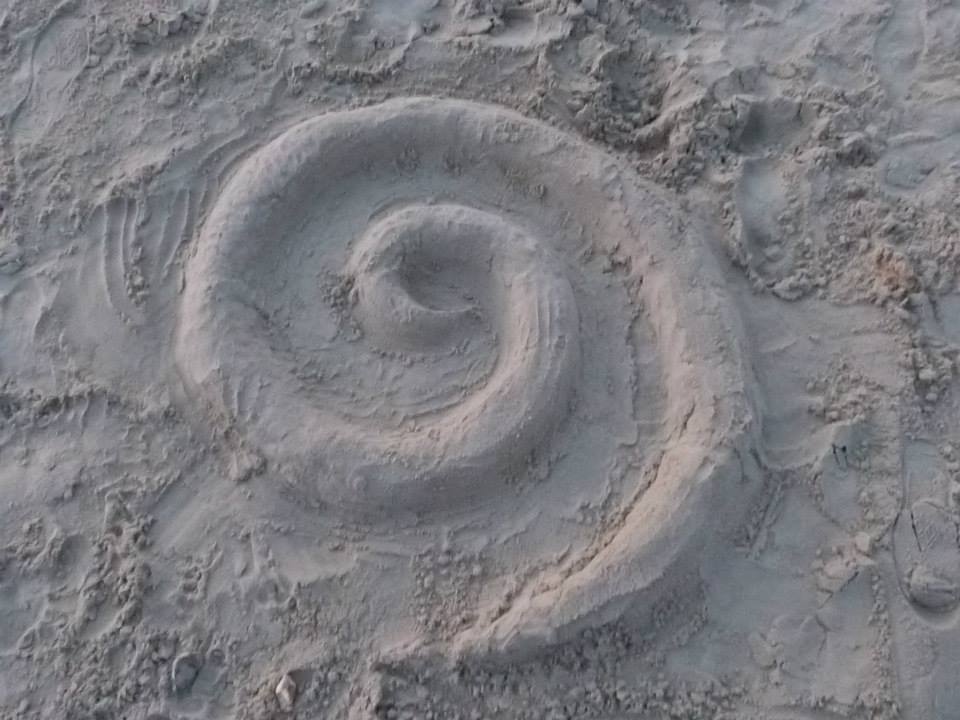
Beach spiral

As I begin to write this post rain is pattering against the windows with increasing frequency and a brisk wind stirs the browning horse chestnut leaves that overhang the garden from a neighbouring property.  Autumn is here.  It’s a chilly Sunday morning and beside me is a large cup of good coffee, hot, black, and bitter, warming and stimulating in equal measure.  It’s our first Sunday at home for a fortnight as last weekend was taken up by a speaking engagement in Hereford at a large bee keeping convention where coffee featured highly, as I’ll explain.

The Hereford convention wasn’t the kind of academic research conference that I’d normally attend, but I thought it would be fun to go with Karin, and I’d learn more about bee keeping (both proved to be true).  For this broad audience of amateur and professional bee keepers I presented a version of my professorial inaugural lecture from earlier this year entitled “How many bees does it take to wake up in the morning?  The importance of biotic pollination in a changing world”.  It’s a title with multiple layers of meaning, referring to bees as ecosystem service providers, my enjoyment of my work which gets me out of bed every day, and the energising effects of a strong cup of fresh coffee first thing.  

As part of that lecture I present some back-of-the-envelope calculations that are meant to put coffee production into a biodiversity perspective, rather than being a rigorous analysis, but which are nonetheless worth considering.  They go like this.

Global coffee consumption in 2010 (the most recent year for which I could find figures) amounted to 93 million export bags, each weighing on average 60kg (there are larger and smaller bags used in different parts of the world, so we’ll use this figure).  The export value of this crop was estimated at US$15 billion for the (largely tropical) countries that produced it.  That’s the value before it’s processed and sold, which is much more difficult to calculate, though coffee retailing is clearly big business.  For example, Starbucks’ total revenue for the same year was US$10.7 billion and it supports over 150,000 full time employees.  So it’s lucky for us that it pays its taxes.  

Although coffee is partly self pollinating, it relies on insect pollination to produce large crops, mainly involving bees of various types.  I tracked down a number of studies by researchers such as Alexandra-Maria Klein and Taylor Ricketts which showed that managed honey bees are responsible for anywhere between zero and over 90% of flower visits, depending on the diversity and abundance of local wild bees (over 40 species of which are known to pollinate coffee in Costa Rica alone).  At this point I throw out a question to the audience:  how well do we understand this globally important agricultural ecosystem service?  Do we have any idea of how many individual insects are required to support this industry?  Some more calculations:

Each coffee bean is the product of a single fertilisation event following the deposition of at least one pollen grain on a flower’s stigma.  The mean weight of a single coffee bean is 0.103g (I weighed a sample in preparation for the lecture) which means there are approximately 582,524 beans in a 60kg bag.   Total number of coffee beans produced in 2010 is therefore 93 million bags multiplied by 582,524 beans per bag, which equals  54,174,757,281,553.  In words, that’s  more than 54 trillion coffee beans.  As coffee is 50% self pollinating we can half that figure: coffee production requires at least 27,087,378,640,777 (over 27 trillion) pollinator visits.

But here I confess to the audience that it’s impossible to go further and answer the questions I posed above:  we really have no idea how many bees are supporting the coffee industry.  The problem is that there are big gaps in our knowledge of some basic aspects of the natural history of these bees and their interactions with coffee flowers.  For example, how many flowers does an individual bee visit in its lifetime?  How effective are different bees at pollinating  the flowers?  What is the minimum population size for these bees, below which they would go locally extinct?  All that we can say with certainty is that the global coffee industry (and the individual productivity of many workers) is supported by a LOT of bees.   Many billions is my best guestimate.  Perhaps we don’t need to know the number: perhaps it’s enough to know that if we provide sufficient good quality habitat for these bees, they will provide the service.  But at least it illustrates our reliance on these insects and is something to consider when you’re enjoying the first cup of the day.

Bees are not the only animals that we have to thank for coffee production as a recently published study has shown:  birds in Costa Rica help to reduce the impact of an important pest of coffee.  As Jana Vamosifrom whom I shamelessly stole the title of this posting, commented when I posted this link on Facebook:  any friend of coffee is a friend of mine!


Garlicky archipelago

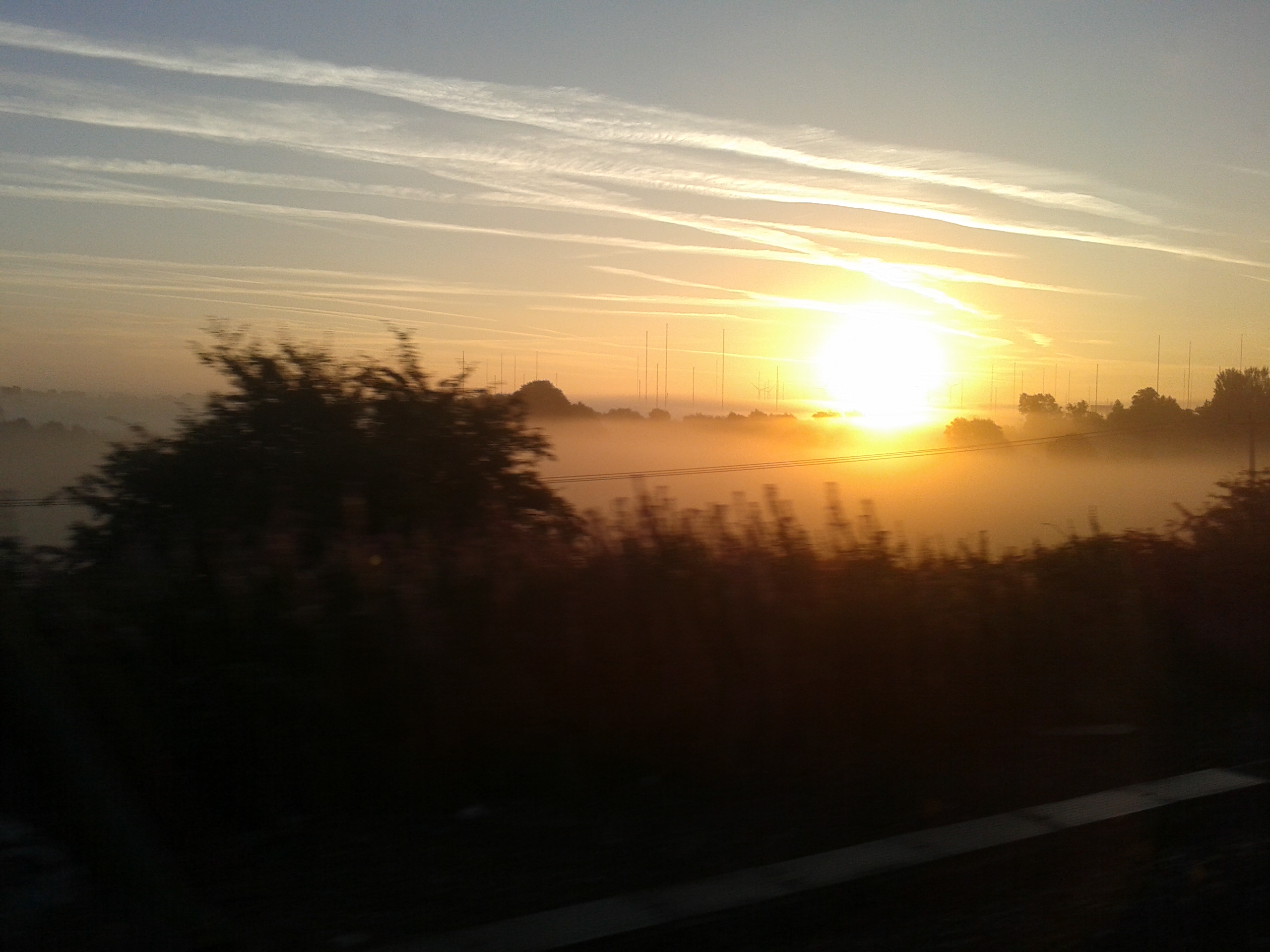
Sunrise from train September 2013

“Garlicky” is a great word, redolent of hot, pungent flavour and nose-filling odour: a Pavlovian word that ignites the senses as it’s uttered.  Perhaps I love the word because garlic is one of my favourite vegetables, a pleasure to both eat and grow.  A Garlic Festival is therefore not to be missed, and my family and I had the opportunity to attend one on the Isle of Wight during a short holiday a couple of weeks ago.  We were joined by university friends I’ve referred to previously, as the first one of us to reach a half century celebrated his 50th birthday.  There was more to the festival than just garlic, but for me its highlight was seeing the sheer variety of different garlic types that can be grown, testament to how this vegetable has been modified from its ancient wild origins in central Asia.  Karin and I bought seed bulbs of four different varieties as additions to the horticultural biodiversity of our vegetable plot, to be planted later in September.   These included the notable Elephant Garlic with its massive individual cloves, which, I’ve just learned while researching that link, is not a true garlic at all but rather a variety of leek.  We live and learn!

Archipelago is another great word and the time we spent on the Isle of Wight, travelling over by ferry from Southampton, served to remind me that the British Isles, with over six thousand islands of various sizes, is by any standards a significant archipelago.  Since at least the explorations of Alexander von Humbloldt, island groups have  been known to host unique species, isolated taxonomically and physically from their closest continental relatives.  Darwin’s later researches showed that archipelagos such as the Galapagos Islands are important as natural evolutionary laboratories, and in previous posts I’ve briefly discussed his unrequited desire to visit to the Canary Islands.  The Isle of Wight is too close to the continent of Europe to have evolved any unique biodiversity but I did pick up the hint of a subtle Island Biogeographic Effect whilst compiling a list of all the bird species I saw over the course of the week.  The list topped out at about 30 species, which I thought was rather low.  Some of the omissions surprised me (not a single blackbird, for instance) and I saw very few individuals of some other common British species.  Now, it could be due to my lousy birding skills I suppose, but it could also be due to the fact that we were on an island, even though it’s less than 1500m across The Solent to the mainland at its closest point.  This is close enough for bumblebees to fly to the island: I’ve seen them shadowing the ferry.  But nonetheless it might be far enough to affect both the diversity and population sizes of the bird life.  Enough wild speculation; I’d be interested to know what serious ornithologists who actually know something about the subject make of this.   

As I finish writing this post I’m on the other great island of my home archipelago, sitting in a bar in Terminal 2 of Dublin Airport.  I’ve been working at University College Dublin as external examiner for their MSc Applied Environmental Science course.  It’s been a fun couple of days reading theses and interviewing chatty, engaged students, which began with a dawn alarm yesterday in order to get to the train station and then Birmingham International in time for a 0850 flight.  Whilst waiting for my taxi I popped into the garden and paused to enjoy the early morning stillness before opening up the chicken coop.  A large flock of black-headed gulls passed low above me, backlit by a thin sliver of moon and silent except for the shuffle of feathers.  From the direction they were travelling I think they were heading from a roost on Pitsford Water and on to destinations unknown.  The garden was also busy with early risen blackbirds and a couple of flitting bats, whilst a little later my taxi passed a rangy fox idly trotting through low mist on the Racecourse park.   It was urban biodiversity at its most sublime.  

All this talk of Northampton is making me feel homesick to be back with the family (Karin, kids, cats and chickens) and start planting garlic.  But there’s just time for another Guinness before my gate opens.  Sláinte!

In defence of lawns UPDATED

2012-02-22 10.19.23

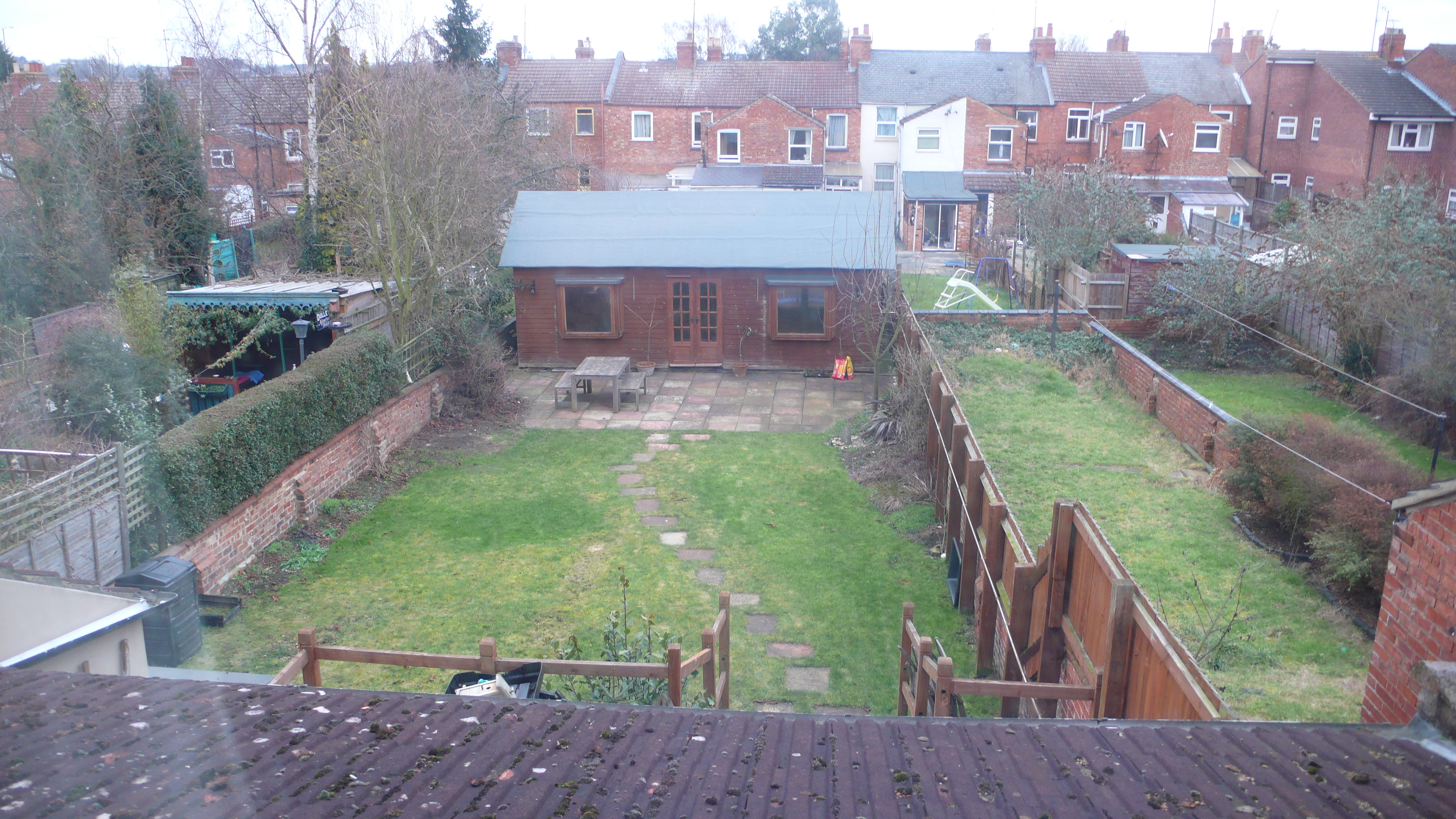
Over at the Small Pond Science blog, Terry McGlynn has a thought provoking post which asks ‘Are trees the lawns of the future?‘.  I won’t rehash Terry’s arguments, you can read it yourself, but I was intrigued by his stereotyping of lawns as always bad.  As a keen amateur gardener and a professional with research students who have worked on garden biodiversity projects, I’d have to say that there’s lawns and there’s lawns: it all depends on how they are managed and what the purpose is of a particular lawn. Clearly there’s a continuum from high diversity, natural “lawns” (i.e. close-cropped grassland which can support significant biodiversity such as some chalk grassland and African savannah lawns) through to the high resource input, monoculture, perfectly presented lawns seen on golf courses and around important buildings.  In the part of the continuum that Terry’s railing against, typical urban and suburban householder’s lawns and everything below that in terms of “naturalness”, it’s possible to manage lawns in a low-input way that is both productive and can support biodiversity.

In the house that Karin and I moved into about 18 months ago, the garden was almost wholly laid to lawn; the picture at the top shows you what it was like in early 2012.  Since then we’ve dug flower borders, a vegetable patch and planted fruit trees, but kept about 50% lawn (though this will reduce as we widen borders). We don’t water or fertilise the lawn, just keep it regularly mown. I’ve not assessed it systematically but I’d estimate that, in addition to the grasses (some native, some not) there’s another 10 to 15 native plants growing in it, plus fungi which pop up every now and then. The plants include taxa which are popular nectar sources for bumble bees and solitary bees, e.g. clovers, dandelions, etc. These flower even though we mow regularly, and of course these bees pollinate our squashes, courgettes, apples, plums, etc.  The local blackbirds and starlings also find food on the lawn.

I mentioned that the lawn is “productive” and that’s where the grass cuttings come in. They are either put into the compost heap, fed to our chickens, or added directly to the vegetable patch as a mulch.  It’s also possible that the clover, which is a nitrogen fixing legume, is adding to the soil fertility that can be accessed by the far-reaching roots of the fruit trees.  Would be an interesting hypothesis to test.

So I think it’s possible to have a lawn that adds to local biodiversity and is productive for the gardener, but I accept that we may be unusual in that regard.  It’s not the kind of lawn that would make a grass obsessive proud; but that type, as Terry notes, needs a lot of input of resources, not least time.

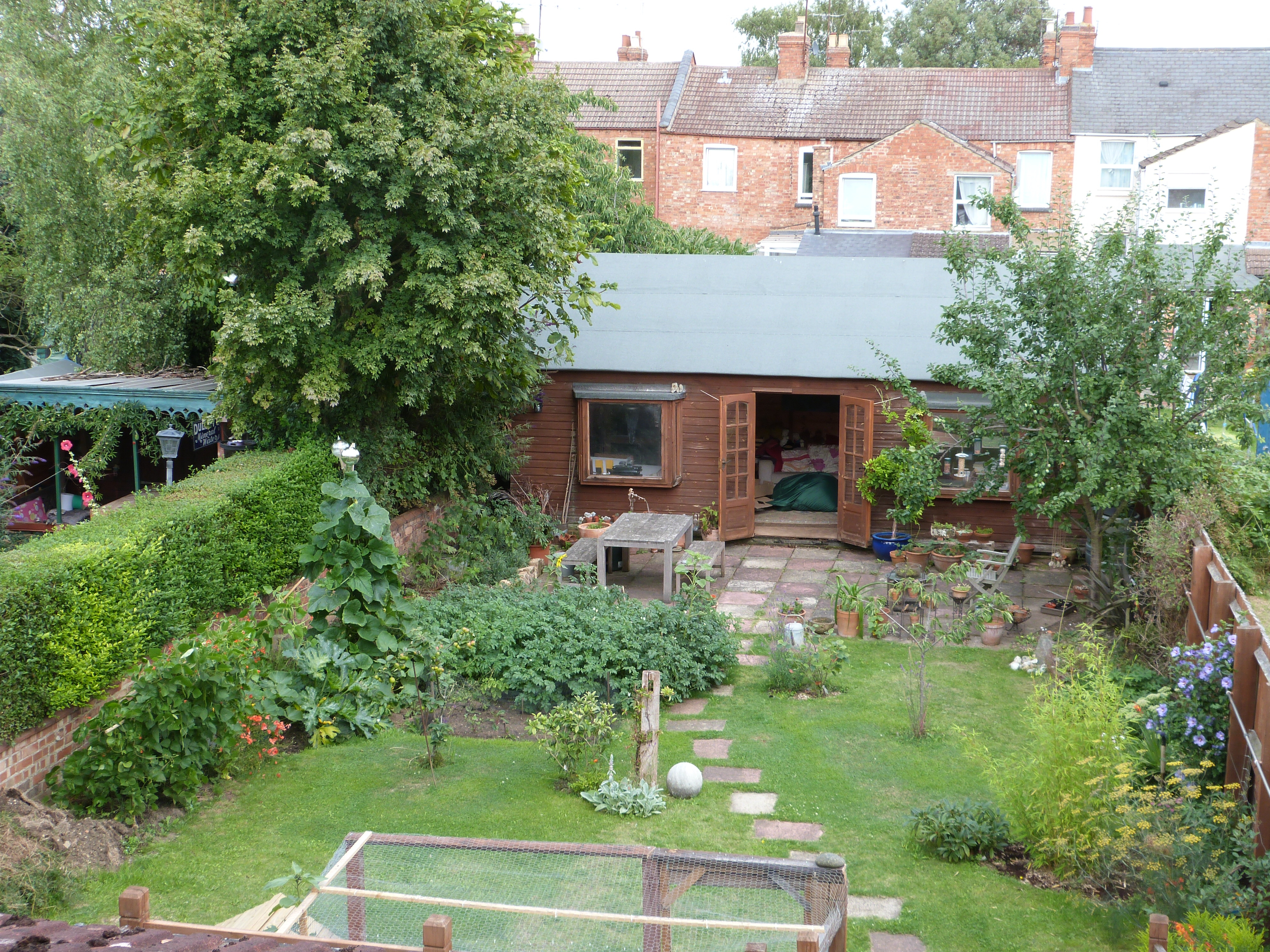
UPDATE –  a few people have asked to see a picture of how the garden looks now, so below is more or less the same shot but taken today (15th August 2013) by Karin.  Comparing a British garden in February and August is clearly unfair!  But hopefully you can see that we’ve done quite a bit of work to it, though as with all gardens it’s a work in progress.

Garden 15th August 2013

A coiled Spring

Wellcome Trust - June 2009 006

April, according to T.S. Elliot, “is the cruellest month”.  Not sure about that, though April 2013 proved to be both frustrating (as we in northern Europe waited for Spring to arrive) and busy, as I tried to pack in a whole set of activities.  That’s my only excuse for not updating my blog, so the aim of this post is to catch up with biodiversity-related activities and observations over the past few weeks.

Just as iconic decades begin part-way through a given ten year period (the 60s didn’t really kick off until about 1963, for instance) so April for me actually began at the end of March.  In the last week of that month I completed my formal teaching for the term and celebrated the first anniversary of the Nene Valley Nature Improvement Project.  I also picked up my daughter Ellen from Heathrow Airport, on a two week visit back from working in China.  On the way I counted over 20 red kites flying near the M40 motorway – what an incredible success story their re-introduction has been!

One of the reasons Ellen had come back was that I was due to give my inaugural professorial lecture, entitled “How many bees does it take to wake up in the morning?  The importance of biotic pollination in a changing world”.  Another reason was to to celebrate my eldest son Patrick’s 18th birthday the following day.  Both once in a lifetime events and both had family at their heart.  It was a great week.

Some leave time followed, much needed after what seemed like an endless 12 week university term, during which I hoped to plant potatoes and do some other work in the garden.  But Spring refused to uncoil.  The northerly winds brought cold weather that froze all vernal activity in the act.  Flower and leaf buds were there waiting to unfurl; insects would occasionally appear then just as quickly disappear; and birds clearly wanted to get on with the important activities of raising young.  But all was delayed.  One could sense the tension, the build up of seasonal energy, biology waiting to happen.

A talk at Earlsdon Gardening Club near Coventry on Monday 8th April was well received and took my mind off the organisation of the biennial Bumblebee Working Group meeting on the 11th.  This semi-formal get together of scientists, NGOs, and other Bombus-minded individuals, shifts between venues every two years.  At the last meeting in 2011 I volunteered to host the next event and then put it out of my mind for 18 months.  Organising a scientific meeting is always a bit of a mad panic as the day draws closer and one wonders if anyone will actually turn up.  But as it turned out the event was well attended, with over 80 people listening to talks on diverse topics including the effects of neonicotinoid pesticides on bumblebee colonies;  I’ve uploaded a copy of the programme.

Friday 12th April was a frantic dash around office and lab to get books, equipment and sundries organised for our annual undergraduate Tenerife Field Course, which was flying out on the following Sunday.  A great time was had by all as we explored the biodiversity of Darwin’s Unrequited Isle and we came back with a wealth of great data plus not a little sunburn.  No matter how often I tell students that they really need to wear a hat and use sun block, some will never listen.

Arriving from Tenerife early on Monday 22nd, I slept for a few hours then was back at the university for the oral PhD examination of Hilary Erenler, whose work I have mentioned previously.  These exams are always stressfull for both student and supervisors but in the event Hils performed wonderfully and passed with only minor amendments.  A great result!  Now looking forward to publishing some papers from that work.

April ended, and May began, with a change in the weather.  Much warmer winds blew in from the south west and life suddenly erupted: pressure had been removed from the coiled Spring.  Lots of pollinators appeared in our garden including: Anthophora plumipes, one of my favourites for its glossy, black females and aggressively flower patrolling males; the relatively newly arrived Bombus hypnorum; the bee fly Bombylius major; and several different butterflies.

Clearly it’s time to plant those potatoes!