
In these turbulent times it’s hard to know where to focus one’s gaze. Do we concentrate on Ukraine? Greenland? Venezuela? Sudan? China? Russia? The Middle East? The rise of the far right and religious fundamentalism? Cyber security? Global organised crime? If it’s confusing and worrying for the average person, imagine what it’s like for national security services who are charged with assessing and responding to such threats.
It is increasingly recognised that national security in the 21st century extends beyond military threats to encompass food systems, economic resilience, public health, and the stability of critical ecological infrastructure. Which is why it’s no surprise to learn that the UK’s national security organisations – MI5 and MI6 – have just released a report titled Global biodiversity loss, ecosystem collapse and national security: A national security assessment.
The report has been covered by The Guardian under the heading “Biodiversity collapse threatens UK security, intelligence chiefs warn” and the article begins:
The global attack on nature is threatening the UK’s national security, government intelligence chiefs have warned, as the increasingly likely collapse of vitally important natural systems would bring mass migration, food shortages and price rises, and global disorder.
This framing explicitly treats biodiversity loss not as an environmental side issue, but as a systemic risk multiplier capable of amplifying existing geopolitical, economic, and social stresses. I have emboldened two words in that quote in order to emphasise that this report is very much about the state of the world, not just the state of my home country. In an interconnected global food and trade system, ecological collapse in one region rapidly propagates elsewhere through markets, migration, and political instability. What happens globally has implications locally; not just food security from imports, but “geopolitical instability, economic insecurity, conflict, migration and increased inter-state competition for resources”, to quote the report.
Where does pollination fit into this? As far as I know, pollination has never been singled out in security analyses, yet it underpins many of the very food systems, rural economies, and ecosystem functions upon which national resilience depends. In my book Pollinators & Pollination: Nature and Society I mention “food security” about ten times, as I firmly believe that loss of pollinators is a serious issue to food supply chains. The report similarly states that:
UK food production is vulnerable to ecosystem degradation and collapse. Biodiversity loss, alongside climate change, is amongst the biggest medium to long term threat to domestic food production – through depleted soils, loss of pollinators, drought and flood conditions.
But I would go further and state that loss of pollination by insects and vertebrates poses a national security threat that extends far beyond just their role in food production.
Let me explain why I believe this.
The Global biodiversity loss report focuses on six different parts of the world (and seven ecosystems) that it considers “critical ecosystems…at risk of collapsing”. One of those areas – the coral reefs of Southeast Asia – is not directly dependent upon pollinators to support its long-term functioning. Two areas – the boreal forests of Canada and Russia – are dominated mainly (though not exclusively) by wind-pollinated trees, such as conifers and birches. The other four ecosystems, however, have a dependence on pollinators that ranges from significant to enormous. These are the Mangroves of Southeast Asia and the Himalayas (both significant) and the Amazon Rainforest and Congo Basin (both enormous).
What do I mean here by words like “significant” and “enormous”? What is my measure? What I mean is the number and proportion of flowering plants—particularly dominant species, often trees—that underpin most ecosystem functions, such as photosynthesis and carbon storage, and that rely to some extent on pollinators to reproduce.
In high elevation areas such as the Himalayas, I know from experience that it’s common for there to be a mixture of wind and animal pollinated species in communities. Similarly, mangrove species include some which are wind pollinated – see this review for example. In other words, the long-term population stability of Himalayan woodland and Southeast Asian mangrove forests is, in large part, dependent on the pollinators that those ecosystems support. If those pollinators were lost, in the long term (decades to centuries) wind-pollinated trees would dominate and biodiversity would significantly decline.
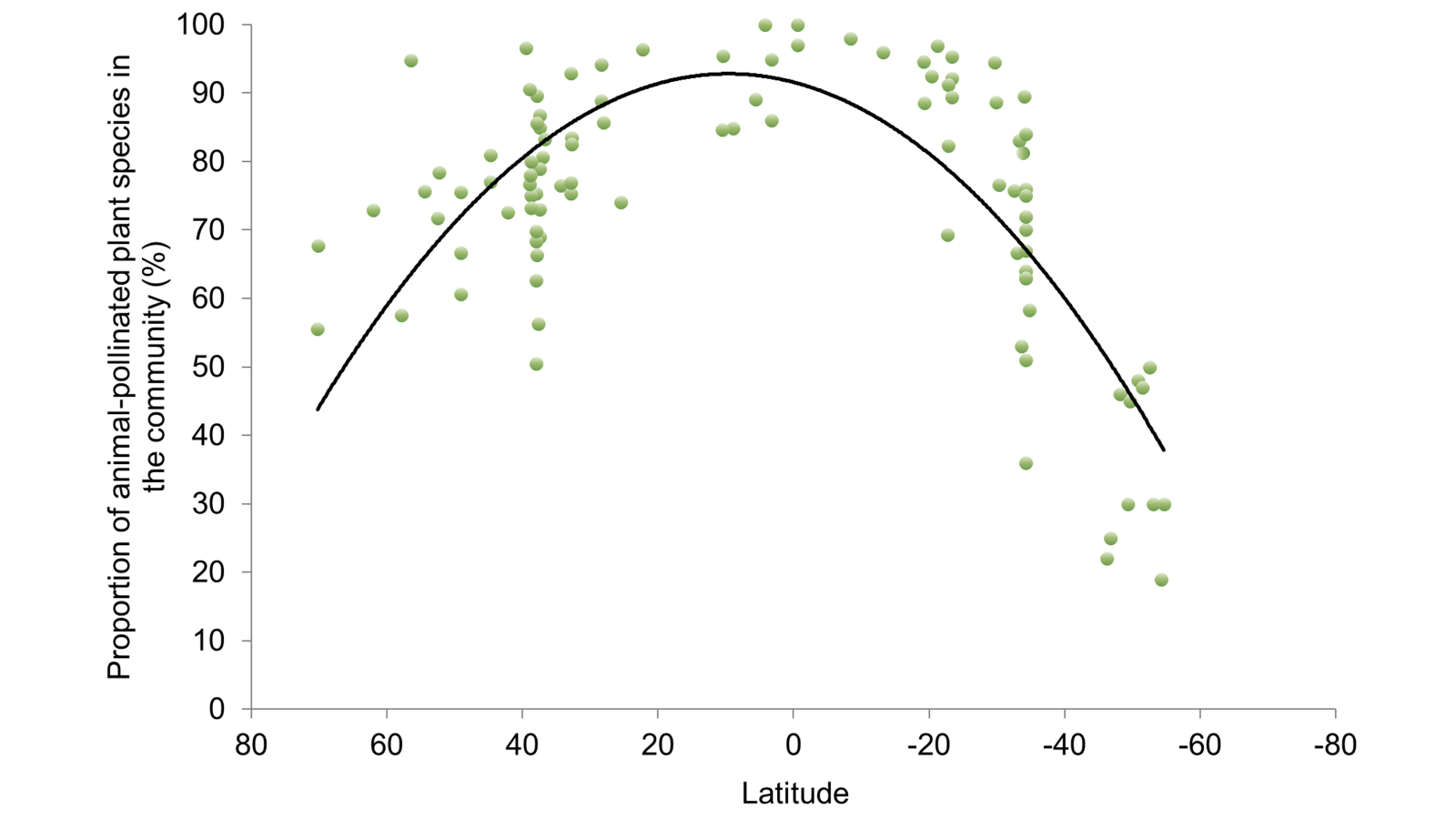
The situation in the forests of tropical South America and west Africa is rather different. Not only is there a much greater diversity of plant species in these ecosystems, but in these largely rainforest regions, often all of them are animal pollinated, as we showed in this paper and which is reflected in the graph above, which comes from my book. Lose the pollinators and we lose the long-term viability of ecosystems that provide regionally- and globally-vital functions.
Ultimately, if we are to protect pollinator communities, and the ecosystem functions and services they provide, we need to take their conservation more seriously than we do at the moment. Framed this way, pollinator conservation becomes a form of preventive security investment, analogous to maintaining flood defences or safeguarding energy and cyber infrastructure. The European Union’s Pollinator Initiative and the projects that it supports, including Butterfly and ProPollSoil in which I’m involved, is a good example. Likewise, there are policy movements appearing in China, as I recently reported. But biodiversity conservation is a global issue, as the security services report makes clear, and that applies to pollinators.
There will no doubt be sceptics out there who think that I am over-playing the importance of pollinators and pollination. That’s fine, it’s good to have these debates. Pollination is not a national security issue in the narrow, traditional sense of defence against hostile actors. But in the 21st-century security landscape, where threats are systemic, slow-burning, and ecologically grounded, pollination loss clearly qualifies as a strategic risk to national stability and resilience.
In that respect, I believe that the question is not whether pollination is a national security issue—but whether national security thinking has yet fully adapted to the biological foundations on which societies depend.
 Prof. Jeff Ollerton - ecological scientist and author