
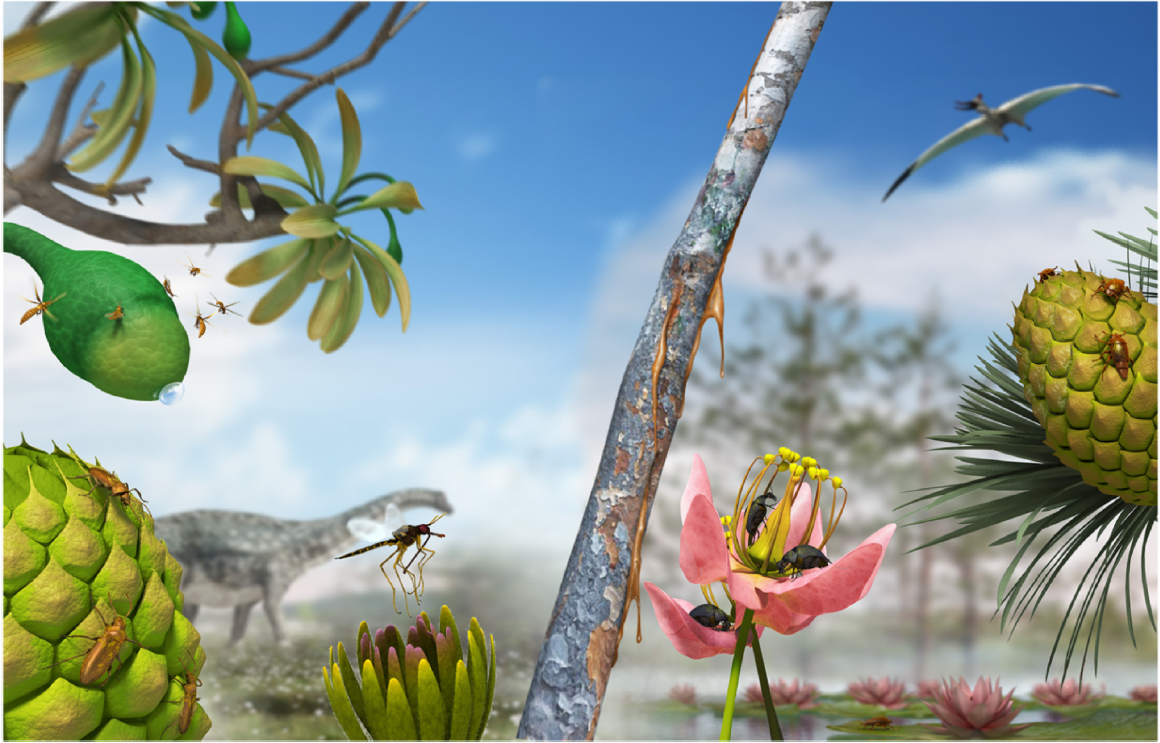
As a teenager one of my main interests was collecting fossils. In search of specimens I wandered for hours, scouring the Carboniferous coal shale heaps and Permian reef outcrops of my native Sunderland. I spent so much time bothering the geology curator at the local museum with my inquiries that he offered to host me for a year as the placement part of my college course. If I had been able to convince my tutors that paleontology was really just biology in deep time I may have ended up as a professional fossil researcher. But it was not to be and instead I spent a (mostly happy) year working in the microbiology laboratory of a local brewery.
My interest in the ecology of the past has never left me, and over the years I’ve contributed a few articles to journals commenting on the latest fossil findings as they relate to pollination and flowering plant evolution. So I was delighted to be asked by Spanish paleontologist David Peris to help with a new review of insect pollination in deep time, led by PhD candidate Constanza Peña-Kairath. That review has just been published in Trends in Ecology & Evolution, and for the next 50 days it’s available for free download by following the link in the reference:
Here’s the abstract:
Inferring insect pollination from compression fossils and amber inclusions is difficult because of a lack of consensus on defining an insect pollinator and the challenge of recognizing this ecological relationship in deep time. We propose a conceptual definition for such insects and an operational classification into pollinator or presumed pollinator. Using this approach, we identified 15 insect families that include fossil pollinators and show that pollination relationships have existed since at least the Upper Jurassic (~163 Ma). Insects prior to this can only be classified as presumed pollinators. This gives a more nuanced insight into the origin and evolution of an ecological relationship that is vital to the establishment, composition and conservation of modern terrestrial ecosystems.
 Prof. Jeff Ollerton - ecological scientist and author
The article is a fascinating insight into the deep time evolution of insect pollination. Thanks for sharing!
You’re most welcome!
Pingback: What are the limits to pollinator diversity? A new article poses the question | Prof. Jeff Ollerton – ecological scientist and author