Tag Archives: Science

A Christmas vignette

P1110602

This afternoon I booked half a day’s leave to go into Northampton town centre to pick up some final Christmas gifts.  A crowd of shoppers in Abington Street was eager to lay their hands on the freebies being distributed by that traditional Yuletide apparition, The Coca Cola holidaysarecomingholidaysarecoming Big American Truck.  As red and shiny as Rudolf’s nose, it was pedalling its cheap brand of Christmas sentimentality to a willing audience.  

Shopping completed and daylight fading fast, I headed back to the multi-storey car park, again passing the Coca Cola queues, skirting them, determined not to be sucked in.

The car park was cold and ugly, as they tend to be.  But on the second floor, level with the bare crown of a tree that emerges from an adjacent pub garden, a mother and her young son stood.  Hands full of shopping bags, they had paused to listen to a male blackbird singing as the dusk drew in.  As I passed I heard them chatting about its song: both agreed it was beautiful.

Driving out of the car park I wound down my window: it was still singing as I passed the tree.

I could give a very academic spin to this tale and talk about the cultural and spiritual ecosystem services that are provided by such birds, which nourish us in ways that no amount of corporate marketing ever could.  But I shan’t: it was a perfect Christmas vignette and a perfect contrast to the earlier soulless commerciality.  And that’s sufficient.

The strange and the familiar….. (back from) Brazil Diary 8

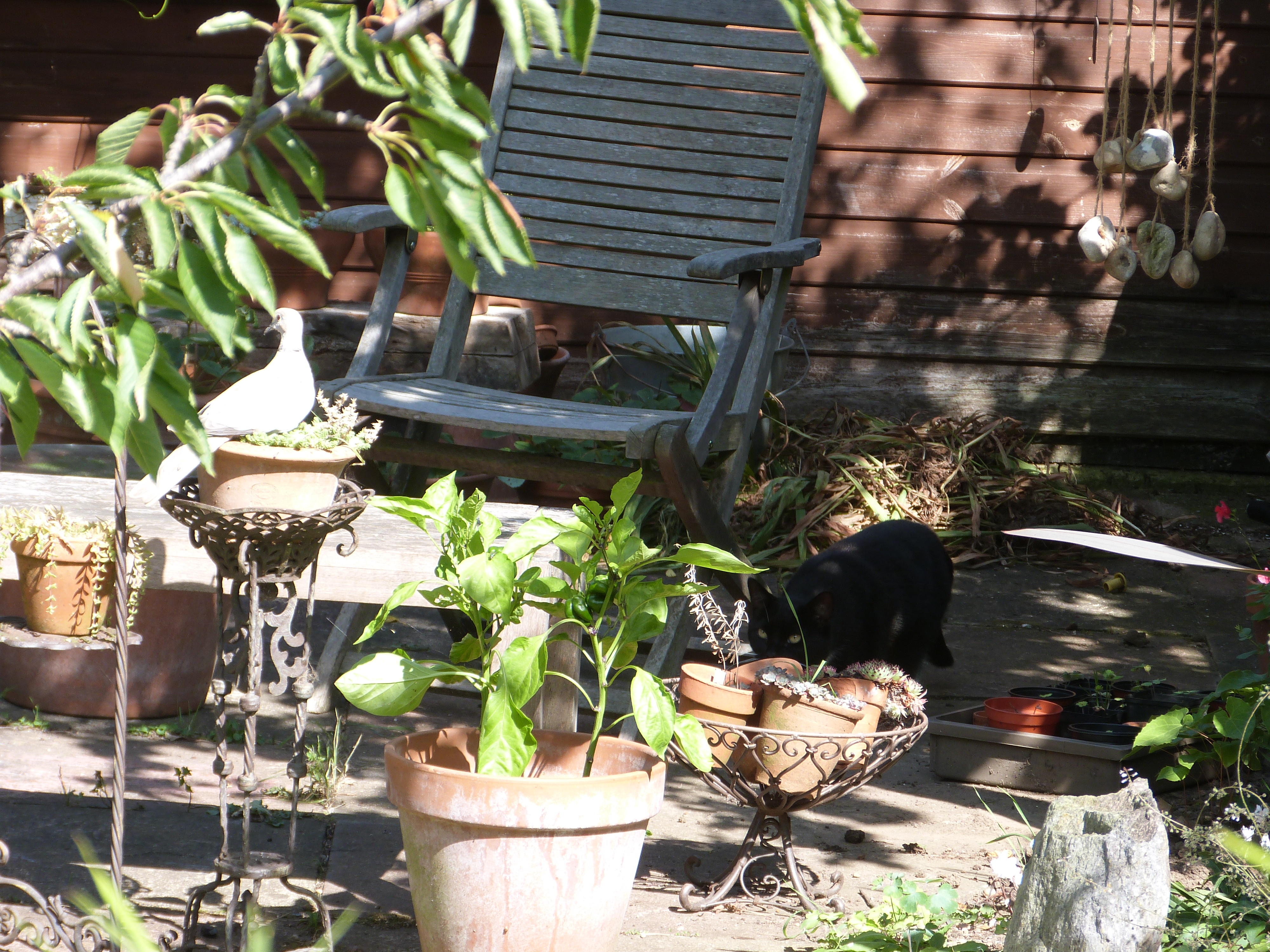
Monty and the collared dove - Sept 2013

The first bird I identified when I arrived in Brazil on 1st November was a feral pigeon (Columba livia) foraging around the airport; the first bee I spotted, visiting flowers around FUNCAMP, was a honey bee (Apis mellifera).  This tells you a lot about the widespread, near ubiquitous distribution of such species, which have been moved across much of the planet, accidentally and on purpose, by human activities.  For someone who is deeply interested in biodiversity, seeing these species is both humdrum and interesting.  Humdrum because they are so familiar, we see them everywhere we go, they are not exciting and exotic.  Interesting because they tell us a lot about the effects that humans have on their environment, how we are altering it by the introduction of non-native species.

Away from the large cities I saw introduced species such as these less and less frequently, such is their association with humans.  But of course there were also plenty of native Brazilian species that have become associated with human activities.  Some of these had a familiarity about them which transcended the fact that they were species I’d never see in Britain.  Black Vultures (Coragyps atratus) are the best example.  I would frequently observe them perched on lamp posts in towns, scanning for food or squabbling amongst themselves, and also spotted a huge number feeding on the refuse being piled into a landfill site.  Back home I associate this sort of behaviour with various species of gulls.  Strange and familiar.

Back in Northampton I’ve been reflecting on my month-long visit to Brazil, catching up with colleagues, telling stories that get more impressive with each iteration.  It’s been a packed couple of weeks and Brazil seems a long way away, not just geographically.

The Biodiversity Index did not win the Green Gown Award that it was short listed for, as I previously reported, but it did receive a Highly Commended citation.  Green Gown have asked us to produce a video, so a few days after I returned home, and still with a bit of my brain in Brazil, I took part in a short recording session about the Biodiversity Index, which will be released shortly.  The video is produced by Jo Burns and her company Amplitude Media.  Jo is a graduate of the University of Northampton and this is a nice example of how the University is supporting former students as they develop their careers.

At the end of last week we also got the news that the Biodiversity Index has been shortlisted for a Guardian newspaper University Award in the sustainability category.  More recognition for the work we’ve done on that project, and we are very pleased!  The result will be known early next year.

As of this week our paper on “How many plants are pollinated by animal?“, published in the journal Oikos in 2011, has notched up its 100th citation according to Web of Knowledge.  The less conservative Google Scholar puts it at 164, so the true answer will be somewhere in between.   Clearly peers think it’s a useful bit of work.  And to think it was almost rejected by Oikos, saved only by an appeal.  The idea for the paper arose when I was trying to find a solid figure in the literature for the proportion of plants that are biotically pollinated.  Lots of figures were being bandied about, but once you follow the reference chain back through the papers that cite them you find that numbers which are cited as solid facts disappear into speculation and guestimates.  Like many of the simple and obvious questions, the assumption is that we “know” the answer.  That’s no basis for science-informed policy, but I suspect that it happens all too frequently.


Cockroach with a hint of lemon – Brazil Diary 7

P1110560

Hummingbirds have been a continuous feature of my travels around south-east Brazil since day one when I ticked off the Sword-tailed hummingbird from my list at FUNCAMP.  Since then I’ve kept a special ear and eye out for their whirring wing beats and rapid, darting movements, partly because they are significant pollinators in these Neotropical plant communities, but also because members of our research group have a long-standing interest in their ecology.  Stella Watts for example has worked on hummingbird-flower interactions in Peru, and our friend and colleague Bo Dalsgaard spent a year in Northampton during his PhD research on Caribbean hummingbirds, and we now collaborate on some macroecological questions about hummingbird specialization in relation to current and past climates.  And I did some work on their role as (probable) pollinators of some forest Apocynaceae in Guyana during field work in the late 1990s, which remains unpublished.  Must write up those data one day… 

The bird guide I’m using for this trip lists more than 80 hummingbird species for Brazil, many of which are found within the Atlantic Forest system.  Over the last few days we’ve seen several of them in the lowland rainforest around Ubatuba, which proved to be a lot drier and warmer than the montane forest I described last time.  It’s been good to have Pietro Maruyama on hand to identify the birds as they flash past.  Pietro’s been studying the interactions between these birds and the flowers on which they feed as part of his PhD work, and has recently published a great paper on the subject.

On most days of field work we might see two or three species, but the day before yesterday we saw 11 species in just an hour.  We were visiting a private garden belonging to a retired gentleman named Jonas who has been feeding the hummingbirds in and around his property constantly for about 12 years.  The day we visited, Jonas had 13 bottles of sugar solution hung up around the house and we estimated that over 100 individual birds were using them.  It’s hard to be more accurate as these birds move so fast, disappearing and re-appearing without warning, like hyperactive kids on a outing to a chocolate factory.  It’s a quite stunning sight.

The 11 species we observed are about half of the total number Jonas has recorded since he began feeding the birds and there’s a regular annual rhythm to their appearance, presumably in response to temperature and plant flowering in other parts of the country.  The density and richness of birds in this one small property is clearly artificial and we saw nothing like it out in the forest.   Jonas is concerned that by feeding the birds so frequently (he uses 5kg of sugar a day and replenishes each feeder several times) he might be negatively affecting plant pollination in the surrounding forest.  I doubt that this is the case and reassured him that his efforts were probably positive, certainly compared to some of the other activities that go on around the area, such as building, clearing forest, agriculture, and so on.  Assuming that food availability limits the population size of these birds (which may or may not be the case) then feeding the hummingbirds should result in a population increase in that area which will spill out into the wider forest.  Similar arguments apply to feeding garden birds in the UK, particularly in the winter.

As I watched the birds crowd and jostle around the feeders, frequently erupting into conflict and chase, I reflected that my trip to Brazil was passing as swiftly as the waft from a hummingbird’s wing on my skin.  These last few days in lowland rainforest and restinga vegetation were spent conducting another two surveys of wind versus animal pollination, to add to the previous ones.  This lowland forest is very similar in structure to the montane forest 1000 m higher, whilst the coastal restinga forest has rather shorter trees and is also drier.  The coastline is stunningly beautiful but there’s a clear tension between its roles as a tourist destination and as an area of rich biodiversity.  Humans are often drawn to such places and may unintentionally destroy what they so value, one of the ironic aspects to ecotourism as an ecosystem service.

Over the last few days I’ve been talking a lot with the students who are accompanying us, about their research data and what it means.  One of our ongoing themes is the idea of flower colour, shape, smell, etc., as hypotheses about the likely pollinators of those flowers, a notion captured in the idea of “pollination syndromes”.  For some flowers the syndromes are probably good predictors, for example the red tubular hummingbird-pollinated species of Fuchsia, Aeschynanthus and other Atlantic Forest plants.  But there are also lots of examples of plants with flowers that don’t fit the conventional, “classic” syndromes.  Yesterday on a 6km hike we encountered a species of Piper with very oddly smelling flowers, which by general agreement we described as “cockroach with a hint of lemon”.  We have no idea what pollinates this plant, though we have some predictions.  The genus Piper with its deceptively simple flowers has long fascinated me, ever since I undertook a short postdoctoral project on some Australian species in 1993-94.  Hopefully Andre and Coquinho will spend some time observing the plants with their digital movie camera when they are in the forest next month; the results could be fascinating.  

The Brazilian students I have met are a committed, passionate bunch who believe strongly in the importance of the natural heritage they are studying and trying to conserve.  Though I’ve come and gone from their country like a hummingbird to a feeder, I hope I’ve made some impression on them.  They’ve certainly impressed me and I’ve learned a lot from them, from their professors, and from the places we’ve visited.  It’s been an amazing adventure but it’s time to come home now and see my family and friends, and colleagues.  Over-and-out from Brazil.

P1110537

It’s called rainforest for a reason, right? Brazil Diary 6

2013-11-24 14.01.20

Tropical rainforest is not glamorous.  The sanitised, technicolour, televisual view of rainforest that we see in nature documentaries, of whizzing butterflies, flash-dancing birds, and flamboyant flowers, presents only part of the story.  Rainforest is dirty, wet, and it smells, of mould and mud, and dead leaves and flowers, and rotting wood.  By day it hums and chimes and fizzes with a thousand animal conversations, and green dominates all: colour is as rare as it is welcome.  By night those conversations, of insects, frogs, mammals, and birds, increase one hundred-fold.  With the night come also the insects (silent or whining) that bite and suck your blood, while above your head in the roof space of your bedroom, bats awaken and chirp and scuttle, flitting out to hunt.

Always, day and night, there is water in the form of rivers, streams, ponds, and pools.  And rain; or the threat of rain; or the aftermath of rain.  For the four days we have spent in Santa Virginia field station in the Serra do Mar state park it has rained every day, all day, all night.  It’s called rainforest for a reason, right?

For the persistent habitué of the rainforest, nothing remains dry for long, clothes and bedding are constantly damp, wood and leather obtains a greyish grape-bloom.  It is a difficult environment in which to live and work, particularly for a European used to a particular climate and situation.  No, rainforest is not glamorous.  But it has a glamor, in the old English sense of casting a spell over those it has charmed into visiting its depths and trying to know its ways.  The visitor to tropical rainforest who appreciates its biological richness and functioning is always charmed, and returning to it feels like a return to something very special indeed.

Although I have conducted field work in tropical rainforests in Africa, Australia and other parts of South America, one reason why I have long wished to visit the Atlantic Rainforests of Brazil is that John Tweedie, whose life and career I am researching,  wrote frequently in his letters to William Hooker about his love of the forest in South Brazil.  And the forest has not disappointed me: it is beautiful and wonderful, even if wet and, because of its altitude of around 1000 metres a.s.l., quite cold.

One of the most spectacular aspects of the Atlantic Rainforest is the sheer abundance and diversity of epiphytic plants, a sub-type of rainforest communities that can only be supported in areas of high rainfall such as this.   Over the last couple of days, Andre, Coquinho, Vini and I have hiked a couple of forest trails despite the rain, and orchids and ferns, bromeliads and forest cacti were more abundant than I’ve ever previously seen.  These plants are generally thick and complex in form, as they store water internally in leaves and stems, or within tanks formed of overlapping leaf bases.  On one short section of trunk, up to waist height, we counted six different orchid species mixed together, and saw at least 20 species along a 3km trail on Sunday.  Coquinho has been putting together a checklist of the orchids around the field station and it currently numbers 130 species.  Astounding diversity!

As we walked and slid and macheted our way through a 9km trail on Sunday, the ringing calls of male Bare-throated bellbirds (Procnias nudicollis) were resounding through the forest, whilst smaller birds played hide and seek from our binoculars.  Still scoring plants for wind and animal pollination, as I previously described, we recorded 75 plant species in flower along the trail, but most of them we encountered only once or twice.  Diversity and rarity go together in these plant communities.  No wonder Tweedie loved the Atlantic Rainforest; there is always something new to collect and the climate under the trees is cooler than in the open pampas grasslands of Argentina, where he was based.  Perhaps the rain made him think of his home in Scotland?  It’s called rainforest for a reason, right?

2013-11-24 15.44.01

No Sleep ’til Ubatuba – Brazil Diary 5

2013-11-18 12.17.15

The food in Brazil has been great, as diverse and abundant as the biological richness of this huge country, and I’ve had an adventurous diet so far, trying everything that was recommended to me (and a few things that weren’t).  This includes bits of animal I’ve never eaten before (chicken stomach, chicken blood stew, and cow hump) and five new plant families to add to my life list. So what gave me food poisoning a few days ago in Botucatu? A f**king pizza!  I plan to stick to the exotic stuff in future, though a few people have told me that the pizzas in Sao Paulo are the best in the world.  We’ll see.

The food poisoning didn’t prevent me spending a morning in the field collecting more data on the proportion of wind pollinated plants in cerrado vegetation, but in the afternoon I went to bed, sick and exhausted.  The title of this Brazil Diary post is an homage to the classic live album by Motörhead because at times this trip has felt like a relentless tour of different venues, with André as my trusty road manager, sorting out accommodation and places to eat as we go along.  I owe him a big thank you at the end of the month!  I estimate that we’ve travelled over 2,500 km so far and, including the pollination biology course at Unicamp, I’ve presented 10 lectures in 20 days.

The lecture at the university campus in Botucatu was attended by staff and students,  plus a lot of people from the local council environmental department.  They have an issue with honey bee colonies setting up in peoples’ houses, which they remove if possible and take out to an agricultural area.  So they were interested in finding out more about pollination as an ecosystem service.  It was great to have that kind of outreach, but none of them spoke English.  André translated each of my slides as we went along, turning a 50 minute lecture into a two and a half hour session, including some interesting discussion at the end.

Yesterday was a morning pollination mini-symposium at the Federal University of Sao Carlos, at which I spoke along with Felipe Amorim and Daniel Carstensen, both passionate and creative early career scientists with lots to say and some great studies published and in progress.   It’s been a real pleasure to discuss biodiversity with these guys, with André, and with all the students and professors I’ve met along the way.  There’s now less than 10 days to go before I return, and the tour rolls on.  In about 20 minutes we leave for a six hour drive down to Santa Virginia in the Atlantic Rainforest of Serro do Mar, where we will do more field work in a vegetation type that’s a huge contrast to the cerrado we’ve been looking at so far.  When I get a chance I’ll report back, though internet may be sporadic there, and might have to wait until we reach our final destination of Ubatuba.

2013-11-15 20.51.00

If your ears aren’t dirty, you’re not doing it correctly – Brazil Diary 4

P1110320

The first part of this post was written on a long car journey down through Minas Gerais State to Botucatu, with Andre, Felipe Amorim and Ana Moraes.  It’s more than a 1000 km drive from Serra do Cipo state park, so we have done the journey in two parts, beginning at 5.30pm Saturday night, driving for over 3 hours, back through Belo Horizonte to the small town of Igarapé.  Arriving at 9pm, we looked for a hotel in which to spend the night.  The first one was a flea pit and Ana was sure she’d seen an insect running from the light when we assessed the rooms.  All of us love biodiversity, but not that much, so we politely declined.  The second place we tried was the Marketing Palace Hotel and was basic but clean.  After a quick dinner and a few beers we retired to bed.  I dreamt of magic and suicide in vivid technicolour, but fortunately didn’t wake Andre with whom I was sharing.

With little supporting evidence, I put the dreams down to secondary compounds in the Miconia fruit I’d been eating during field work earlier that day.  The morning had started early with a trip into the State Park in search of a population of an orchid that Ana is studying for her postdoctoral project, the species Epidendrum campestre.  Ana has already assessed several populations for their genetic and morphological variability and was keen to add another to her data set.  There is a herbarium collection from this area from 1978 but it’s not been relocated since.  The park is over 33,000 ha in area, soon to increase to about 39,000 ha with the purchase of an adjacent farm that will become part of the park.

Once we had left the main trail and headed for the low, rocky hills, the walking (really scrambling) became tough, slow going.  As we picked our way from rock to rock, pushing through the less dense patches of vegetation, it was clear that this is an area of incredible plant diversity.  Rocky outcrops and ravines are always good for plant diversity as species that cannot survive the greater competition found in richer soils are able to hang on in crevices and in shallow, humus-filled depressions.  But we had no luck; the orchids were not in that part of the park.

As well as helping Ana and Felipe to search for these legendary orchids, Andre and I recorded all of the plant species that were in flower, and scored them for animal or wind pollination, based on the type of flowers, pollen release, flower visitors, etc.  Over the day we recorded about 60 species in flower (perhaps one quarter of the total flora, as many species were not flowering), of which 10% were wind pollinated.  This fits with the prediction of a study I published in 2011 of around 90% animal pollinated species for these tropical communities, compared to 70-80% on average in the temperate zone.  It’s satisfying when ecology is a predictive science in this way, though understanding why these patterns exist is less straightforward; is it because there are more animals in the tropics that can act as pollinators?  Perhaps, though bee diversity actually peaks in subtropical latitudes, in seasonally dry Mediterranean vegetation rather than in the tropics.

As well as scoring pollination systems, I was also looking out for species from my favourite plant family, Apocynaceae.  And I wasn’t disappointed; not only did we see at least 10 species (most of them flowering) but I was able to taste the fruit of one species, Hancornia speciosa, adding another family to my life list of those that I’ve eaten.

Following a quick lunch of apples, local cheese bread and small pies, it was clear that we were running out of water.   So we decided to follow a small stream up to a point where it was fast flowing and potable.  The community here was low gallery forest, cool and welcoming and with a succession of shallow pools, the humidity allowing the growth of epiphytic sundews, ferns, and a few bromeliads.  Tired by the climb, I sat and watched as a Green Kingfisher bobbed and displayed on a branch.  Although dirty, hot, and aching, I felt myself very fortunate indeed to be in such a special place.  The title of this posting comes from a comment that Andre had made the previous day as we scrumped ripe mangos from a roadside tree; according to his father, when eating mangos, “if your ears aren’t dirty, you’re not doing it correctly”.  The same notion applies to field work; if by the end of a day of tropical field work you are not dripping in sweat, filthy, with insect bites and stressed muscles, and desperate for a shower and a cold beer, you’re not doing it right.

P1110353

Game of three halves – Brazil Diary 3

2013-11-13 18.47.49

Karl Marx famously said that religion is the opium of the masses.  Nowadays I think that role has been usurped by soccer; or at least it has here in the city of Belo Horizonte.  For two nights (Sunday and Wednesday) the streets around my hotel have been full of fans of the local team, Cruzeiro Esporte Clube, which seems to have won at least one Brazilian championship title or other, possibly two (my grasp of football being almost as tenuous as my understanding of Portuguese).  The symbol of the team is the Southern Cross, a great song by Crosby, Stills & Nash, providing a likewise tenuous link back to a recent post of mine.

Both nights I suffered from lack of sleep, but last night was particularly bad. I had hoped that by 2am the fans would have run out of fireworks, voice and energy; but no, they were still going strong at 3.30am as I drifted into restless sleep. Today the city has been punctuated by the sound of contagious car horns; as soon as one person starts parping away, it’s followed by the rest of the poor bastards stuck in another of this city’s many traffic jams.  They remind me of the cicadas I’ve been hearing during the more suburban legs of my journey – once one starts, the others follow; a species at FUNCAMP sounds like it’s having the best insect orgasm ever as it delivers a high-pitched “yesyesyesyesyesyesyesyesyesyesyesyesyesyesyesyes”!

The contrast between the urban, suburban and rural aspects of this trip so far has resulted in different joys and excitements, and has provided the title of this post, an almost fitting soccer idiom.  The Botanical Congress here in Belo Horizonte has been a very urban experience, being based in the centre of the city, over the road to the central covered market, a dense and diverse shopping experience.  On Tuesday I delivered my conference lecture which seemed to go down well with the audience, though it was hard to follow two talks on hummingbird pollinated flowers (by Leandro Freitas and Paulo Eugênio Oliveira) with a lecture on Ceropegia, the flowers of which are bizarre and pollinated by flies that are less than 2mm in length on average.  But I did my best, though it was noticeable that the audience dropped from about 250 to 150 during my talk, however that may have been due to the fact that I delivered it in English.  Maybe…..

The conference has been an opportunity to catch up with Sandy Knapp, a Solanum taxonomist from the Natural History Museum in London.  Sandy delivered two thought-provoking talks in one day, an impressive feat, and has been blogging about her field work in Brazil.  This has whetted my desire to get out of the city and start seeing more of this country’s biodiversity.  So yesterday I travelled with Andre and some of the other Unicamp postgrads to the pretty and historic town of Ouro Preto, then on to a protected State Park at Itacolomi.

At the visitors centre we looked at a small exhibition on the early natural history explorers of the region who followed the Estrada Real (“Royal Road”) into the hinterland of this part of Brazil.  Then we walked a little in the cerrado vegetation, admiring the diversity of plants in flower and talking about their pollination systems.  In an hour we had also spotted 20 bird species, including lekking males of the lovely little White-bearded manakin, which make a very distinct snapping sound with their wings.  The cerrado is a fabulously rich biome and I enjoyed discussing its formation and definition with the postgrads, and look forward to exploring it further in the next few days, as we head out of the city and on to some field work.

Today I headed up to UFMG at the invitation of Marco Mello to give a talk to students and colleagues in his department about our research on pollinator conservation in the UK.  An interesting contrast of perspectives was apparent in the discussion that followed.   The afternoon ended with a walk around the campus nature reserve; few birds, perhaps because of the noise of the nearby traffic and military shooting range in the area where we strolled, but some interesting plants including at least four Piperaceae, a favourite family of mine.

Back home the news is that our Biodiversity Index has picked up a “Highly Commended” citation in the annual Green Gown Awards, another accolade to add to the one we won earlier this year.  I’m glad my colleagues were there to pick it up and look forward to hearing more about it when I return.  It’s now 11pm and the city is quieter than it was last night; time for bed and hopefully sleep, as long as there are no more football prizes to be won.

A city without trees is like a bird without feathers – Brazil Diary 2

P1110073

Today is my last day at FUNCAMP and I’m currently sitting in the hotel lobby, waiting for our lift to Belo Horizonte and the National Botanical Congress.  It’s likely to be a 7 hour drive, but longer if we stop for food, toilet breaks, and to look at birds and interesting landscapes (which we will!)

Yesterday André and I went to Campinas city centre accompanied by two of his former professors, Cristina and Zezo, to have lunch and discuss future collaborations when they come to Northampton for a sabbatical in 2014.  Campinas is big and busy, hot and hectic.  Temperatures were in the low 30s centigrade in the open streets, but as soon as we passed beneath the shade of any of the larger trees, the heat was blocked and we were much more comfortable.  City trees provide multiple ecosystem functions: they store carbon, of course, but they also significantly alter the local microclimate.

Nowhere is this more apparent that in subtropical and tropical regions, but you can also feel their effects even in a British city, where the presence of trees cools parks and pavements, insulating against high temperatures.  Do trees in temperate cities also insulate against cold in the winter?  I’m not sure but it would be an interesting area to research.

Trees are also beautiful, of course, and so the analogy with birds works on multiple levels: a city without trees is like a bird without feathers, because trees and feathers are both functional and ornamental.  In Campinas many of the trees were from families familiar to me, such as figs, legumes and mangos.  But others were new, including a species of Lagerstroemia from the loosestrife family (Lythraceae).   

Does it matter whether the trees are native or not?  That’s a debatable point; the last day of the pollination course at Unicamp on Friday included a session of student presentations of the projects that they’ve worked on all week.  One of them was an assessment of the diversity and origin of the trees within the park adjacent to the campus.  The students identified 64 tree species, 45% of which were native to that region of Brazil.  The remaining 55% are from other parts of Brazil, or from other countries, but nonetheless they provide resources for pollinators and birds within the park.   Perhaps this is acceptable in urban areas but not in areas of nature conservation or wilderness?

Our lift is here so I will sign off, except to note that my bird list is getting longer (over 50 species now) and that the award for Mammal of the Week goes to the agouti.  This a pretty, colourful relative of the guinea pig was abundant in the park in Campinas and completely charmed me with its confident and graceful demeanour.  If only I could bring one home…..

FUNCAMP – Brazil Diary 1

P1100895

“Nobody but a person fond of natural history can imagine the pleasure of strolling under cocoa-nuts, in a thicket of bananas and coffee plants, and an endless number of wild flowers”

Charles Darwin – letter to his father; Brazil, February 1832

When Darwin wrote this letter he was 23 years old and was experiencing the tropics for the first time in his life.  It’s a typically understated, 19th Century view of the sheer unfamiliarity and exuberance that tropical environments impress upon the traveller from north temperate climes.  In actuality Darwin was probably initially overwhelmed by the whole experience: I’m 48 and have made many such trips, and the first few days in the tropics never fail to overwhelm and excite me. Last Friday I arrived in Brazil for a month of teaching, lecturing and research funded by a grant from FAPESP awarded ​to my Brazilian collaborators, Professor Marlies Sazima and André Rodrigo Rech.  This week, with André’s help, I am running a course for graduate students entitled: “Pollination: ecology, evolution and conservation” at the University of Campinas, which everyone refers to as Unicamp, one of the most prestigious  and research active universities in Latin America.  The following week we head to Belo Hori​​zonte where I’m giving a talk at the National Botanical Congress, and a lecture at the Federal University of Minas Gerais. 

​Following all these teaching and lecturing engagements,  I head out into the field with André and some of the other Unicamp postgrads for two weeks of data collection on the ecology of Brazilian plants and their pollinators. The field work starts in the Serra do Cipó National Park, then mov​​​​es on to the Serra do Mar State Park, one of the largest remaining areas of Atlantic Rainforest.

We’re half way through the pollination course and the students have been just great; there are 28 of them, including some postdocs and professors from other universities, which is very flattering.  Each day is structured around a lecture, plus papers to read and the students bring questions to pitch to the group for discussion.  We’re also doing a little field work around the campus though the weather has been rather wet the last couple of days, which has limited what we can do.  

As well as interacting with the students, a real highlight of the trip so far has been the diversity of bird species on the campus.  After checking into my hotel on 1st November I took a stroll around the grounds and immediately spotted bird after bird that I’d never seen before, but which are common in this area.  No sooner had I started to identify one species (initially using Ber van Perlo’s Field Guide to the Birds of Brazil, which I soon augmented by a locally produced guide to the birds on campus ) than another hove into view and I’d have to remember its features in order to identify it next; and then another; and then another.  Information overload and, as I said, overwhelming!  

Bird of the Week has been the Southern Crested Caracara which I first saw sitting at the top of a tree from my bedroom window.  By the 2nd November I had counted 21 bird species; this went up to 36 the next day which included a walk around a small lake on campus.  Current total is about 40, but there are others which I’ve yet to identify and have been too busy with the course to spend much time birding.  But I’ve also added two new plant families to my life list of those I’ve eaten: Aquifoliaceae, the holly family, which provides the popular South American drink maté.  And Dilleniaceae, via the introduced species Dillenia indica the fruit of which is edible and popular in South East Asia, though is hopefully better cooked than raw: to me it tastes of lemon infused with car tyres.

Note to my family, students and colleagues back in Northampton:  whilst it’s true that my hotel is called FUNCAMP, this actually stands for Fundação de Desenvolvimento da Unicamp.  It in no way implies that I’m not working hard!

Je ne egret rien

Little Egret - cropped

Conservation does not mean the same as preservation, despite the popular synonymy of these two words.  Preservation implies that something remains the same, is static and held in the same unchanging state.  One can preserve an old book, or fruit, or traditions for instance.  But one cannot preserve biodiversity because species change in abundance and distribution, regardless of the activities of humans.  That’s just how nature is.  One could take a deep time view of such change and consider the ancient habitats and organisms that built much of Britain’s underlying geology, as I mentioned when I described some walking on the Dorset coast a while back.  But even over shorter time scales that are comprehendible to humans, biodiversity changes, by the day, the month and the year.

That’s where egrets, and the pitiful punning title of this post, come in.  At the end of last week Karin and I spent a long weekend on the Suffolk coast, in the village of Walberswick.  It’s an old stomping ground for Karin but I don’t really know this area very well at all.  We spent our time talking and reconnecting, eating local food, drinking the good local Adnams beer, walking along the beaches, through saltmarsh and reed beds, and collecting stones and sea glass (I really like sea glass and have amassed bottles of the stuff over the years that we keep on sunny windowsills – think of it as aesthetic waste management).  And we looked at birds as we encountered them in these rich, diverse habitats.  Final total for the weekend was a respectable 37 species, including a few I couldn’t identify, helped along by a trip to the RSPB’s Minsmere Reserve (with, it seemed, every other birder in Suffolk; we had to queue to get into some hides). 

Two of the species we saw were egrets, a common name that covers several genera in the heron family Ardeiedae.  As the Wikipedia entry for egrets notes: “The distinction between a heron and an egret is rather vague, and depends more on appearance than biology”, as good an argument for the importance of scientific species names as any I’ve encountered. 

The first of the two species I spotted was the Little Egret (Egretta garzetta), an elegantly roaming bird that actively hunts along river margins and through marshland and flooded fields.  I was able to get within 10 metres or so of a bird at Walberswick and could admire its poised movements on vivid yellow feet, contrasting with black legs to make it look like a woman wearing footless stockings, as Karin put it (she took the photograph that accompanies this entry).  The second species of egret was the Great White Egret (Ardea alba), a much taller bird than the first, and an ambush hunter; like the related Grey Heron its strategy is to stand still and wait until prey comes to it.

The earliest record of a Little Egret in Britain was almost 200 years ago, in East Yorkshire in 1826.  However it is not known to have bred in this country until a pair did so in Dorset in 1996.  In other words, just 20 years ago this was an uncommon bird in Britain whose rare arrival would have generated a flurry of local twitching.  Now it hardly gets a mention on birding sites, we are so familiar with it.  Not so the Great White Egret which still raises some excitement when it appears.  Although this species was also recorded as early as 1821 in Britain, Great White Egrets only began to breed in Britain in 2012 and there is considerable anticipation that it will follow the Little Egret in expanding its population in this country.

We could add other birds to this list of species which have naturally colonised Britain within living memory, such as the almost ubiquitous Collared Dove (Streptopelia decaocto) as well as insects such as the Tree Bumblebee Bombus hypnorum and the Ivy Bee Colletes hederae.  Others will undoubtedly follow in the future, and perhaps the Cattle Egret will be the next member of the heron family to take up permanent residence on our shores.

Of course the flip side of new arrivals such as these is extinction, a topic that I will return to at some point as we’re currently putting the finishing touches to what I hope will be an exciting new paper on British bee and wasp extinctions.   Understanding the ebbs and flows of biodiversity over time requires data to be collected and we are fortunate in Britain to have a number of active monitoring schemes that regularly survey different groups of organisms.  This activity is vital if we are to be able to monitor our wildlife and to take action if we see declines, though the most recent results for the Status of Priority Species index makes grim reading:  the overall abundance of threatened species in the UK declined by 68% between 1970 and 2010.  It’s a complex message, though, and there are some success stories within those statistics.  But the animals that have fared worst have been the insects, particularly moths and some of the bees, wasps and ants.

Against this background of monitoring and decline I was happy to accept an invitation last week to attend a Defra-sponsored meeting at the Natural History Museum in London to discuss the setting up of an insect pollinator monitoring scheme.  A group of about 50 scientists and conservationists discussed what such a scheme might look like and how it could be implemented.  I’ll report back in more detail about this in the future once some decisions have been made as to how to proceed.

Meetings such as this, as well as being important in their own right, provide an opportunity to catch up with old friends and colleagues and discuss their latest work, or latest child/house move/job move, as appropriate.  So it was good to have a couple of beers after the meeting and chat with a few people including Dave Goulson, arguably one of the most significant scientists working in British pollinator conservation, and an outspoken critic of the current use of neonicotinoid pesticides.  Dave founded the Bumblebee Conservation Trust and has produced a lot of the scientific literature on bumblebees as he describes with wit and passion in his recent book A Sting in the Tale.  I’ve known Dave for over twenty years (we were PhD students together) so I was a little embarrassed to ask him to sign my copy of his book, but as a collector of signed editions I wasn’t going to let the opportunity slip.  Dave mentioned that the book has been shortlisted for the Samuel Johnson Prize and I hope it wins: ok, I’m biased, and can read it in Dave’s own voice which adds enormously to the book.  But it’s a great read for anyone interested in pollinators, or conservation, or just in the processes which turn a natural history obsessed kid into a professional scientist. 

This will be my last blog entry from Britain for a month; on 31st October I fly out to Brazil to spend time with André Rodrigo Rech, running a short pollination biology course, speaking at the Brazilian Botanical Congress, and conducting field work.  I’ll try to blog as I go along.  In a happy coincidence the Great White Egret is depicted on the Brazilian five real banknote.  I’ll look out for it.