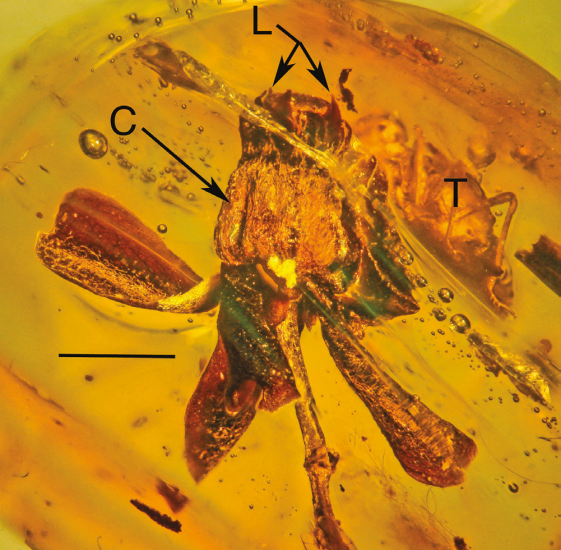
There have been only a handful of occasions in my professional life when I’ve been sent a manuscript to review that has caused my jaw to hit the floor with amazement. The last time it occurred was July 2016 when I received a request to review a study that claimed to have found a fossil flower in amber, with an associated pollinator. Not only that, but the flower appeared to belong to a species of asclepiad (Apocynaceae subfamily Asclepiadoideae) – the plant group on which I have focused a good deal of my attention over the years. Even better, the study was by George Poinar, the originator of the idea to extract DNA from amber-encased fossils, thus inspiring Jurassic Park. George is also the author of two books (Life in Amber and Quest for Life in Amber) that made a big impression on me when I was a PhD student and young post-doc*.
An asclepiad in amber? From George Poinar? How could I possibly refuse?!
One of the almost unique features of the asclepiads is that they disperse their pollen as discrete packages – pollinia – that attach en masse to their pollinators. Only the unrelated orchids do anything similar, which means that identifying the pollinators of asclepiads is much more straightforward than for most plants, making them an ideal model group for studying plant-pollinator interactions. I’ve had a deep interest in the asclepiads, and particularly their pollination ecology, for over 30 years. Over that time I’ve occasionally daydreamed that perhaps a fossil asclepiad flower in amber might be discovered in my lifetime, or an insect with a pollinarium attached, but I was amazed to see that this study had discovered both in the same piece of amber. In the image at the top of this post, L and C point to some significant features of the flower, whilst T marks the pollinator. And T stands for….
….a termite! Termites are rare overall as pollinators and unknown in that role in relation to the asclepiads; P in this image points to the pollinia attached to the front of the head of the termite:
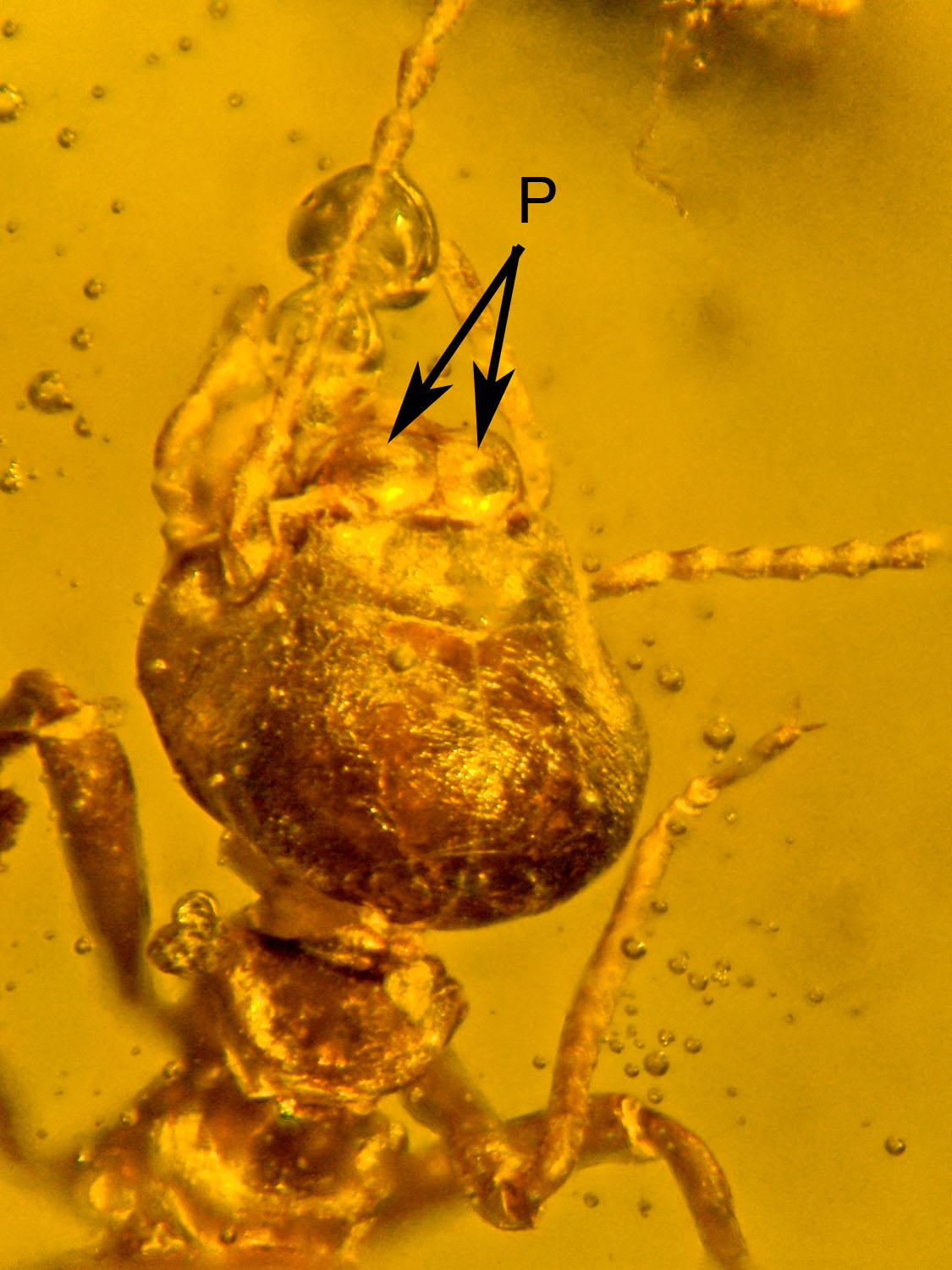
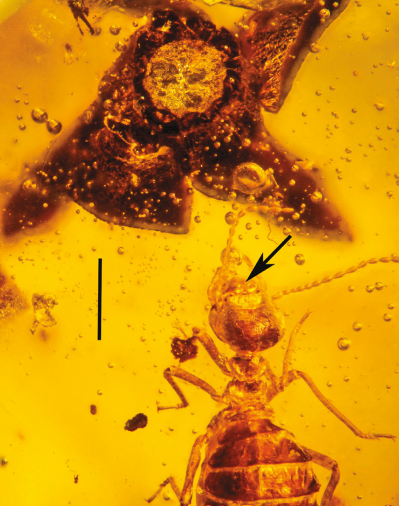
You can get a better sense of the relationship between the flower and the pollinator from the photograph at the end of the this post.
After reading and re-reading and re-re-reading the manuscript I came to the conclusion that assigning the flower to a living group of asclepiads was problematical. So (with the Editor’s permission) I solicited the views of a few colleagues with more experience than I of some of the less well-known groups of asclepiads, and related Apocynaceae s.s., the morphology of which may shed light on this intriguing fossil. Without going into the technical details (which I’m happy to discuss with anyone who is interested) we concluded that the flower may well represent a transitional taxon as it has features of a number of different extant asclepiad lineages. This amber, from the Dominican Republic, is estimated to be between 15 and 45 million years old, so it’s perhaps not unexpected that the set of floral features in this flower appear rather odd from a modern perspective: plants, and their flowers, evolve, just like all other organisms.
George has assigned the flower to a new genus and called it Discoflorus neotropicus – the “different flower from the Neotropics”. Millions of years ago this flower bloomed in the tropical forest that covered that part of the world, and attracted a worker termite to feed on its sweet nectar, pollinating the flower in the process. Before that could take place both flower and pollinator found themselves entombed in the sticky sap being exuded by a leguminous tree called Hymenaea protera. Many asclepiads are climbers so it’s quite possible that Discoflorus neotropicus was climbing through the branches of that tree when it got stuck. A fateful day for flower and insect that has come down to the present day as an all-too-rare insight into ancient plant-pollinator interactions: the first fossil asclepiad flower and the first fossil asclepiad pollinator.
The study is published as follows, with a link to the journal:
Poinar Jr, G.O. (2017) Ancient termite pollinator of milkweed flowers in Dominican amber. American Entomologist 63: 52-56
My sincere thanks to George for allowing me to highlight his research, and use his images, on my blog. All images are (c) George O. Poinar Jr.
*I have a life-long interest in palaeontology that goes back to my youth, collecting fossils on the shale heaps produced from coal mining in the north of England (heaps, incidentally, that my father, grandfather, and paternal uncles had helped to create – all were coal miners in the area). I very nearly became a professional palaeontologist but the lure of living ecosystems overcame my interest in those that are dead, though my fascination with fossils continues, particularly those in amber and (as I’ve related previously) human ancestors.

 Prof. Jeff Ollerton - ecological scientist and author