Category Archives: Biodiversity and culture

A (bird) book for bedtime (and a bit about bees besides)

2012-10-27 14.28.28

Biodiversity as it’s generally defined and conceived includes not only diversity of species and habitats, but also diversity within species, often (but not always) genetic in origin.   Eddie Izzard’s new two-part television series Meet the Izzards neatly captures the idea of genetic diversity, and how it informs our  understanding  of the past evolution and prehistorical dispersal of a large, bipedal mammalian omnivore.  “Cultural biodiversity” in Homo sapiens is less easy to define in this way as it has probably only a limited genetic component and is passed from individual to individual by copying and refining.  Other species have “culture”,  for example New Caledonian crows and chimpanzees, but human cultural diversity is more varied than that of any other species.

Take book reading as an example.  Some individuals of our species never read.  Others read only one book.  Incessantly.  And then argue about what it means with others who read the same book.  Other individuals gorge on a book a day or snack on one a  month, or manage on a starvation diet of one per year.  I’m a two book nibbler.  Normally I always have a novel and a volume of non-fiction on the go.  The novel is for last thing at night when I need to turn off my mind and do some easy reading; a few pages then it’s time to sleep.  Nibble, nibble.  The non-fiction is for the morning, if I wake up early enough, or weekends if they are free; or train journeys.  Still nibbling, but this time on more solid fare.

As with all cultural diversity, none of this is inflexible and at the moment I’m also reading a non-fiction book at night:  Fighting for Birds:  25 years. in nature conservation by Mark Avery, former Conservation Director of the RSPB.  Mark kindly came to give a talk at the university recently and brought copies of his book to sign and sell.  It was a stimulating lecture and feedback from the students who attended was very positive.  For those students who didn’t make it (and there were a lot) I have to ask:  why are you paying thousands of pounds a year to not turn up to events that will inspire, educate and develop you?  You had the chance of bending the ear of a very prominent British conservationist.  At the very least you could have asked:  “How do I get to do the job that you do?”  You’re currently investing a LOT of money in your future and, frankly, wasted opportunities such as this are the equivalent of failing to claim a share dividend.

Back to the book.  Although Mark claims Fighting for Birds is not an autobiography,  it is very autobiographical in scope and provides some great personal insights into the RSPB and the development of bird (and broader) conservation in the UK and the EU.  His description of the battles fought over the fate of the Flow Country brought back memories of writing an essay on that topic during my undergraduate years in the late 1980s.  I’ve still not visited that part of Scotland but I have in mind a road trip this summer that may take it in.  The RSPB is one of our partners on the Nene Valley Nature Improvement Area project so I was particularly interested in finding out more about what makes our most important wildlife charity tick.  Mark is an engaging and candid writer, forthright in his opinions political and ecological (and their interactions)  as you can see from his blog.        

By pure coincidence, this week Mark hosted a guest blogger in the shape of Matt Shardlow, Chief Executive of Buglife, talking about the current controversies over banning the group of pesticides known as neonicotinoids.  Matt puts forward a compelling case for withdrawing these chemicals from general use.  I don’t dispute anything he says about the role of neonicotinoids in bee deaths (though there is some debate about dosage levels used in some of the published studies and how this might translate into effects in the field).  But it does concern me that this new focus on pesticides is taking the spotlight off habitat loss, particularly grasslands, which is a far more important threat to pollinator populations.   There is a real danger that this single issue will be seen as an easy fix by government when a broader reform of farming practices is what’s really required.  The decline of wild bees and other pollinators can be tracked back to long before the introduction of neonicotinoids. There were some silly comments on the blog about neonics currently being the single most important conservation issue.  This is short sighted hyperbole and (again coincidently) Lynn Dicks has written an interesting piece on the subject of rhetoric, lies and over-the-top claims in the journal Nature.
The decline and extinction of pollinators in the UK has been an ongoing process since the 19th century.  I’d hate to see the government think that it’s “fixed” the pollinator problem by banning some pesticides, a much simpler task than protecting and restoring habitats, and encouraging farmers to manage their land more sensitively.  With 70% of the UK’s land dedicated to farming, human (agri)culture has got to be a key element in conserving biodiversity.

Thank the insects for Christmas (reduce, reuse, recycle part 2)

2012-11-26 15.38.04

The university term has drawn to a close in a flurry of activity as we complete our pre-Christmas teaching and assessments, and the Department of Environmental and Geographical Sciences conducted a successful five-yearly Periodic Subject Review of its degree programmes.  I’m conscious that some of the things I wanted to write about since my last blog entry have slipped past without action, including a week that was bookended by visits with students to iconic localities on the biodiversity and conservation map.  These were a Monday trip to the Darwin Centre of the Natural History Museum in London with students on my final year Biodiversity and Conservation module; followed by a Friday visit to Wicken Fen, arranged by my colleague Janet Jackson for second year students on her Habitat Ecology and Management module.  Both great days away from the lecture room, if for different reasons.

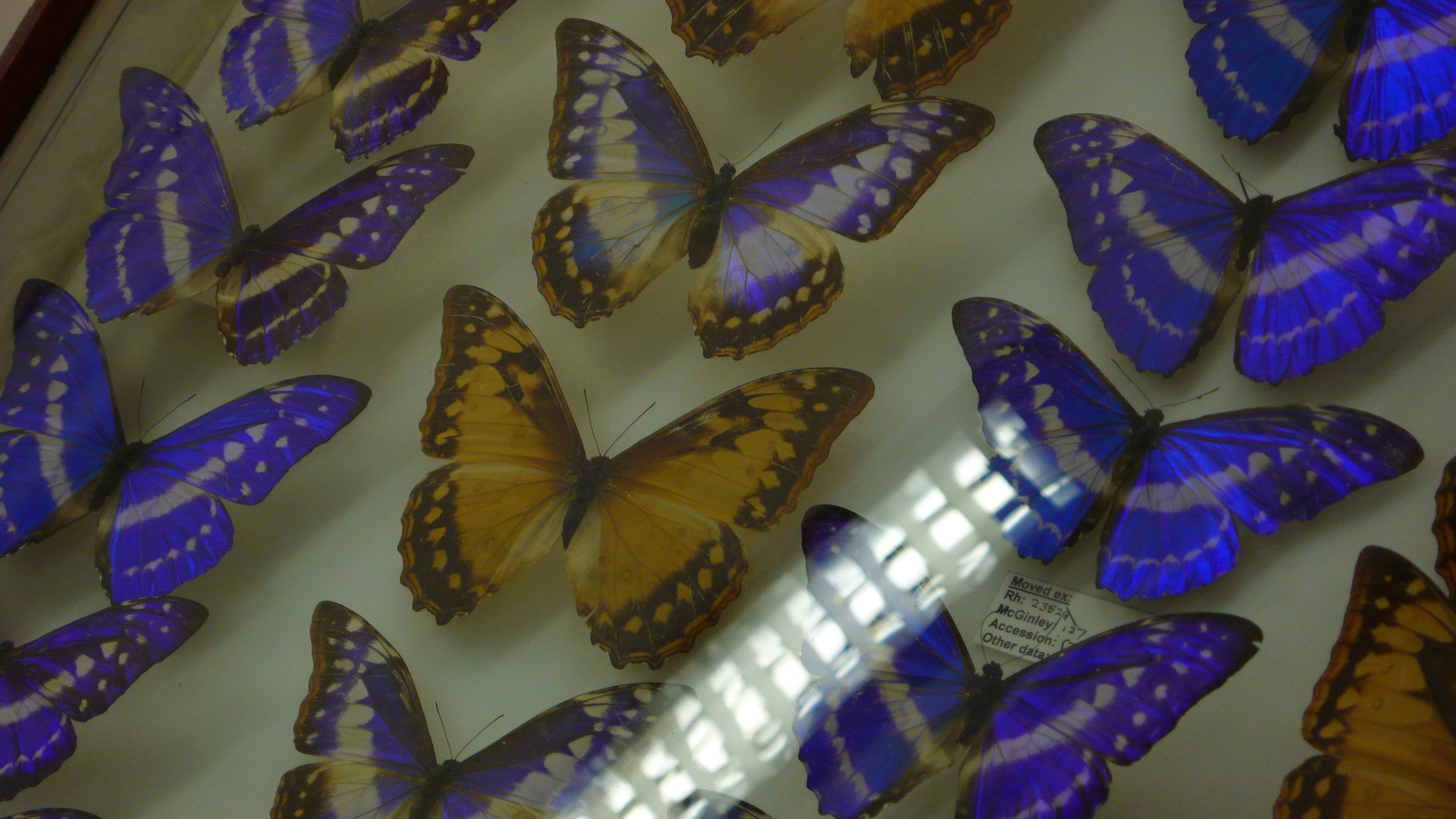
At the Natural History Museum we looked at the insect research collections, behind the scenes where the public does not normally venture.  Wicken Fen, on the other hand, is open to all and we met birders and walkers as we toured the site.  I kept a tally of the number of bird species we identified and the final count was 29 (30 if you include the chickens being kept in a back garden close to the visitor centre).  It would have been impossible to make a meaningful species count  at the Musuem as we were overwhelmed by the statistics presented by the curators:  85,000 butterfly and moth specimens in the Lepidoptera section, 3 to 4 million specimens of true flies (Diptera).  On it went; wonderful diversity and an incredible scientific resource.

Which brings me neatly to the main topic of this entry: the importance of insects at Christmas!  I’ve mentioned before that one of the intentions of this blog was to reuse some of the writing I’ve done over the years in various fora, sometimes updating and re-casting it ro reflect recent activities or events (hence the “reduce, reuse, recycle” epithet).  The publication this month of the final report of the Government-sponsored workshop Insect Pollinators: Linking Research and Policy in which I was involved has prompted me to modify and re-post an entry that first appeared on the University of Northampton’s blog at this time last year.

The social and economic news is not great, global poverty is on the increase even in the richest countries and the range of human-influenced assaults on the natural environment seems to be escalating on a weekly basis.  But at least it’s Christmas!  A time to relax and enjoy ourselves, to share time with family and friends, and to unwind during the cold and gloom of winter.  Whatever your faith, or lack of it, Christmas should be about taking a break and reflecting on the year that has passed.  We’re helped in that respect by the ceremonial seasonal trimmings: the Christmas tree, strings of flashing lights, baubles and tinsel.  So while you’re kissing a loved one under the mistletoe, admiring that glossy holly wreath, or tucking into your Christmas dinner, spare a thought for the insects.

What in Saint Nicholas’s name”  you are asking ”have insects got to do with Christmas?!”  Well, like the turkey, we’d be stuffed without them:  they play an essential part in providing us with the things we associate with the Christmas.  If we had no flies, wasps, bees and other bugs acting as pollinators there’d be no berries on your mistletoe or your holly.  Kissing and admiring would be a less festive affair and that’s just for starters.  These insects also pollinate many of the vegetables, herbs and spices on your plate, as well as some of the forage that went to fatten your roast bird or tender joint of meat.   Not to forget much of what went into the nut roast that’s feeding the vegetarian relatives.

The economic value of insect pollination in the UK was estimated by the recent National Ecosystem Assessment to be about £430 million per year .  In fact this is a huge under valuation because the labour costs alone of paying people to hand pollinate those crops would run into billions of pounds.  This sounds far fetched but it’s already happening to fruit crops in parts of China.  The answer is to encourage wild insects, not artificially  managed honey bees, because collectively the former are far more abundant, and often more effective, as pollinators.  Their diversity is an insurance against losing any one species in the future.

The NEA’s valuation is also too low because it only deals with edible crops.  Mistletoe and holly are both dioecious species, which is to say that individual plants are either male or female, as is the case with most animals.  This means that the plants cannot self pollinate and insects are absolutely vital to their reproduction and to the production of the decorative berries we so value (a holly wreath without berries is just a big spiky doughnut, in my opinion).  Whilst researching the economic value of the annual mistletoe and holly crops for this blog posting I’ve been having a conversation with Jonathan Briggs over at Mistletoe Matters and he tells me that “the mistletoe trade in Britain is entirely unregulated and not documented in any tangible way” and the same is true of holly.  We therefore have no idea what the economic value actually is.  But some back-of-the-red-and-gold-Christmas-lunch-napkin calculations can at least give us an insight.  Auction reports this year  show that on average the best quality berried holly was selling for £2.50 per kg whilst equivalent quality holly without berries cost only 75p per kg.  In other words, pollination by insects increases the value of that crop by over 300%.   Similarly the high quality mistletoe averaged 80p per kg, whilst the second grade stuff was only 20p per kg.  And the best holly wreaths (presumably with berries!) were averaging £3.40 each.  These are wholesale prices, of course; retail cost to the customer is much greater.  A decent holly wreath will set you back between £15 and £30 whilst online shopping for mistletoe is in the £5 to £15 bracket.  The national census of 2011 shows us that there are 23.4 million households in England and Wales, plus there are 2.36 million in Scotland and 0.70 million in Northern Ireland.  Let’s round it down and say there’s 26 million households in the whole of the UK.  Let’s also be very conservative and estimate that only 5% of those households bought one holly wreath and some mistletoe at a total cost of £20.  Multiply that by the small proportion of households buying these festive crops and you arrive at a figure of about £26.5 million!  And that doesn’t include non-household use in shops, offices and businesses.  So there you have it: an industry worth a few 10s of millions (at least) all being ultimately supported by insects.

With pollination, timing is everything, and Jonathan also made the point that spring flowering mistletoe and holly can be important early nectar sources for insects.  Therefore despite the poor  summer weather, this year has been a good one for mistletoe berries because the pollination happened before the heavy rains began.  Despite being quite common plants, rather little research has been done on either holly or mistletoe pollination in the UK and it would make for an interesting student project.

The Landscape and Biodiversity Research Group here at the university is playing its part by working to understand the ecology of plants and pollinators, and how to best conserve them.  In this blog I’ve referred a few times to some ongoing projects researching how the wider landscape is supporting pollinators in habitats such as country house gardens   (Hilary Erenler’s PhD work which she’s currently writing up) and urban centres (ongoing PhD work by Muzafar Hussain).  There’s also the recently completed work by Sam Tarrant and Lutfor Rahman on pollinator (and other) biodiversity on restored landfill sites.   Plus work that’s only just started by Kat Harrold on how whole landscapes support pollinators in the Nene Valley Nature Improvement Area. This is all part of a broader programme of research into the conservation of biodiversity in our region and beyond, including a contribution to the Shared Enterprise Empowering Delivery (SEED) sustainability project.   Biodiversity matters and its importance to our society is being increasingly recognised by government, business and the public.

So if you make one New Year’s resolution on the 31st December, let it be that you will put away your bug sprays for 2013 and learn to love the insects (even wasps!) who give us so much and help to support our economy in a very real way.  It costs us nothing; all we need to give them is well managed, diverse, unpolluted habitats in which to live.

Have a great Christmas everyone!

The Great eSCAPE

As I begin to write this blog entry, there’s a buzz of voices around me, excitedly discussing future research or past results, or saying goodbye to friends and colleagues, old and new.  It is the last day of SCAPE 2012, the annual meeting of the Scandinavian Association of Pollination Ecologists (or “for Pollination Ecology” or “for Pollination Ecologists” – the name seems to have drifted over the years).  SCAPE was the first overseas conference I attended, as a young and enthusiastic PhD student, in 1991.  Older but no less enthusiastic, SCAPE is for me a regular fixture in the calendar.  Even if I can’t always attend, I try to send my good wishes to the organisers, with a promise to be there the following year.

SCAPE was founded in 1986 as an informal get together of Swedish research students who were all broadly interested in questions of pollination ecology.  Since then it has been held every year, maintaining the informal organisation and circulating between Sweden, Denmark, Finland and Norway, which is the venue for this year’s meeting in Skjærhalden in the beautiful Ytre Hvaler National Park.  Attendance in recent years has varied between 50 and 80 participants, peaking when it’s one of the 5 yearly anniversary specials.  One of the many great things about SCAPE is that it’s a very friendly, open hearted conference at which new research students rub shoulders with established researchers, and can present their provisional research findings safe in the knowledge that they will receive constructively critical feedback.  Those established researchers can expect to have their conclusions challenged, as good scientists should, but it’s never done with malice.

The talks this year have spanned the usual wide range of geographical localities (Brazil, Israel, Spain, Ireland, as well as Scandinavia), scales of research focus (from the genetics of self incompatibility to landscape scale assessments of pollinator diversity), and quality of presentations (overuse of laser pointer on text-dense slides to textbook examples of how to deliver a message in 15 minutes).

Although I enjoyed the whole meeting and gained new knowledge from every presentation,  there have been some talks which really stood out for me because I appreciated the overall approach, the message that was being delivered, or the insights it gave into questions I’d not previously considered.  These include Dara Stanley’s estimate that bumblebees from 800 different nests were foraging on a single field of oil seed rape; Achik Dorchin’s account of the staggering number of bee species in small habitat fragments in Israel (totalling more than in the whole of Britain); a dissection of the question of when pollination can be a limiting ecosystem service for crops by Ignasi Bartomeus; and Robert Junker’s initial account of the huge diversity of bacteria associated with different flower organs.   There were many others I enjoyed, of course, but that gives a taste of how diverse the subjects were.

Although I wasn’t speaking this year, two members of my research group were:  André Rodrigo Rech talked about his PhD work on pollination of Curatella americana in Brazilian savannahs; and Stella Watts presented some of her postdoctoral work on honey bee versus unmanaged bee pollination in an endemic Iris species in Israel.  This last work was undertaken with Amots Dafni, one of the doyens of pollination ecology.  Amots attended the conference and told us he’d finally decided, in his 68th year, to retire from formal university teaching, administration and supervising research students – and begin a new project!  Enjoy your “retirement” Amots!

Karin attended SCAPE with me and enjoyed scientist-watching, a hobby that gives me frequent insights into how we work as a community, and gives her insights into what makes me tick.  Half a day of travel saw us back home at 2am Monday morning; I then had to be in university for a 9am seminar with students on my final year Biodiversity & Conservation module.  Despite being tired the seminar went well, perhaps fuelled by the post-conference buzz I usually feel after these events.  The seminar finished early to enable me to drive up to Park Campus, the university’s other site, for a brief  meet-and-greet with the head of Sandtander Universities and his team.  Banco Santander’s higher education arm has been funding scholarships and research activities at the university for several years now and it was a small grant from them that enabled André to attend SCAPE.  Seemed only polite to say thank you.

A highlight later that week was Thursday, which was taken up with our annual first year undergraduate trip to Oxford Botanic Garden, part of my module Biodiversity: an Introduction.  I also wrote about this in March but for the current academic year we have brought the trip forward.  Our visit  was hosted by the superintendent, Timothy Walker, who engaged the students for an hour as we walked the gardens, covering everything from the medical importance of plants such yew trees (Taxus spp.) in providing treatments for cancer, to the importance of specific trees for two Oxford writers, JRR Tolkien and Phillip Pullman.  Timothy also described how much of the planting is laid out in beds according to plant families as defined by the latest phylogenetic research the (APG III system) stressing the importance of modern systematics to understanding biodiversity.  If you want to know more about this, Timothy wrote and presented a recent television series called Botany: A Blooming History which remains the best account I’ve seen of the history of plant taxonomy and why it is relevant to modern plant sciences.

That evening Karin and I attended the opening of a show at the university’s gallery called “Encounters with Drawing” by artist Angela Rogers.  There’s some very thought provoking material in the show and I recommend a visit if you are local and have time – it runs until 30th November.  We chatted with Angela about the “drawing conversations” she has with people and some of her comments about “how much space do individuals need” chimed with familiar ideas from ecology about intra- and inter-specific competition in organisms and niche theory.

I’m going to end this entry with a link to a video post by my friend K.-D. Dijkstra (who I introduced in an earlier blog).  It’s not often that the actual moment that a species new to science is discovered gets captured for everyone to see, but here’s K.-D. doing just that!

There’s a reason why toilet seats are curved

The recent announcement of a study showing a correlative link between the loss of biodiversity and the decline of human cultural diversity (specifically of local languages) reminds us once again that studying biodiversity is more than just about discovering how many species there are in different geographical locations and how they can be conserved.  The remit of biodiversity covers all levels of biological organisation, from genes to species to ecosystems, including the human species and those ecosystems we have created for ourselves.  Not only that, biodiversity is also about why species occur where they do and how they have adapted to their local conditions, including interactions with the other organisms that shape their ecology and evolution.

Plants and pollinators are a good case in point: if there is not a suitable size or morphological fit between flower and animal, the animal will not be able to obtain its reward and the flower will not receive pollen. Both immediate ecological context (which species are present in a community?) and longer term evolution (how have these species adapted to one another?) are important in this regard.  These thoughts were very much on my mind as I sat uncomfortably on a rectangular toilet seat in a very swish hotel in Switzerland last week.  There’s a reason why toilet seats are usually curved: it fits the usual shape of our arses.  Rectangular toilet seats are not well adapted to their role and do not work effectively: they are uncomfortable and a victory of Swiss style over human functionality.  The same applies to the convex saucers on which breakfast coffee was served.  They were the anthithesis of biological adaptation where the stylish patterns of a butterfly’s wings, say, have evolved for a purpose (display and/or camouflage) rather than to look pretty.

Karin and I were in Switzerland at the invitation of Nadir Alvarez from the University of Lausanne.  Nadir and his  group are using the latest molecular techniques to carry out fascinating research on species interactions and patterns of phylogeography, including work on one of my favourite groups of plants, the genus Arum.  At Nadir’s request I gave rather a broad talk on the theme of the ecology and conservation of plant-pollinator interactions in highly managed landscapes, focusing on the work that members of the LBRG have done in Northamptonshire and adjacent counties.  The questions afterwards suggested that it generated quite a lot of interest in the audience of about 50 faculty members, postdocs and research and MSc students.  Before and after the lunch hour talk I spent time chatting with postgrads and staff about their research projects, moving from office to office in a carefully Swiss-timed fashion, always conscious that outside each window were fantastic views across Lake Geneva to the snow crowned Alps beyond: “You forget it’s there after a few weeks” claimed one postgrad.

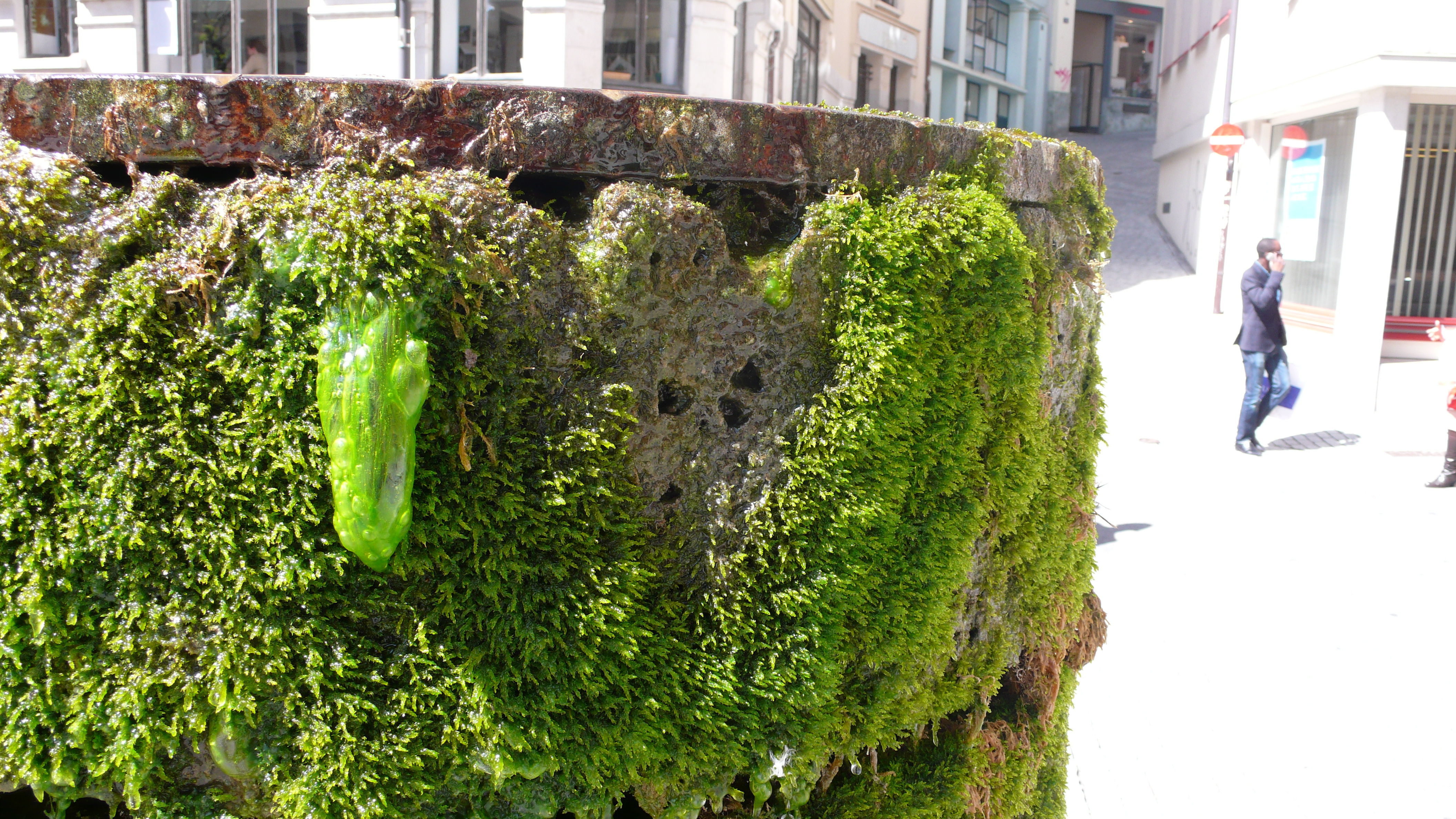
Lausanne is a lovely city which is enhanced by the human-contrived biodiversity of planted roofs, green walls, and public green spaces.  And by the species which naturally colonise suitable habitats, such as the moisture loving mosses and algae which have found a home in the stone and steel fountains designed by Georges Descombes  in La Place de la Louve.

Back in Northampton late Friday night, then up early Saturday morning to prepare a talk for the local branch of Friends of the Earth’s Bee Cause campaign launch.  It was the usual general over view of what pollination is, why it’s important, why pollinators are declining etc., etc.  I pointed out at the start that the public audience (once again of about 50) were getting a free taster of what, from September 2012, our students will be paying £8,500 per year to listen to.  They seemed to enjoy it and had some interesting questions afterwards, though one guy claimed my talk was too long and “a bit like being in church”.  This was the same individual who asked me whether “wasps and nettles can sting each other” which perhaps gives an insight into his world view.

Back at the coal face of university life this week, however, the dominant theme has been marking student work.  Lots of of it, as we work to get final grades into the system prior to exam boards in early June.  A pile of about 90 first year reports on woodland community structure, based on field work we carried out last autumn, has been hard work but in many ways enjoyable.  Some of these students have done very well and really engaged with the aims of the assignment.  Quite a number independently found a recent study on the importance of rot holes in trees for maintaining epiphytic lichen diversity.  Has anyone looked at this in British oaks?  It would make an interesting final year student project.  Which brings us back to the links between biodiversity and human culture, because lichens have been used for millenia as sources of pigments for painting, for example in illuminated Saxon manuscripts such as the Lindisfarne Gospels.

Up a Mountain, Darkly

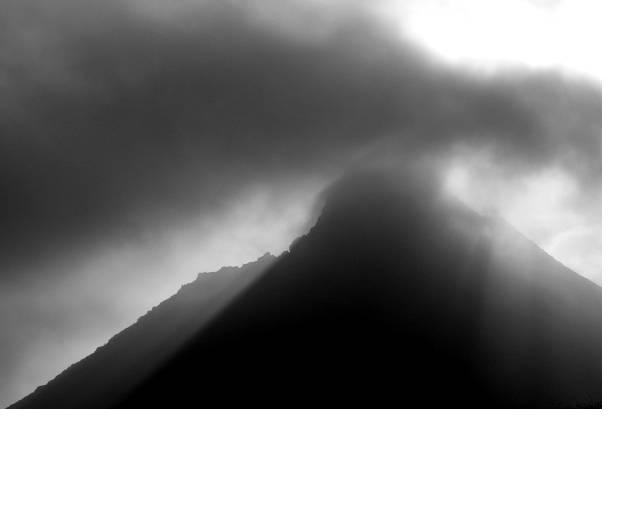
Someone (probably claiming to be wise) once said something along the lines of:  “There are many paths but only one mountain”.  Or possibly: “There’s only one mountain but many paths”.  Or some other contortion of those words and ideas.  I don’t know where it originated and a quick google doesn’t really help; there’s lots of permutations and attributions out there in cyberspace.  Whoever the author and whatever the original meaning behind it, the notion has now come to refer to religious and spiritual pluralism: believe what you like, worship how you will, we’ll all get to God in the end.

Anyone who knows me well knows that I’m in no way religious, and spiritual only in so far as wild landscapes, beautiful organisms, profound notions and great buildings make me feel a bit strange inside.  But it struck me recently that the paths and mountain concept could equally apply to approaches to environmentalism and biodiversity conservation.  It came out of  a conversation I’ve been following that’s going on over at Thoreau Farm between Wen Stephenson and Paul Kingsnorth.  The discussion began as a rather bad tempered exchange on Twitter but ended with a large degree of mutual respect and an agreement to differ.  It’s worth reading.

A few years ago I met writer and (former) environmental activist Paul Kingsnorth when he came to the university to give a talk about the ideas he was developing (with Dougald Hine) around the Dark Mountain Project.  Paul is an engaging writer and thinker, and the notion of the Dark Mountain intrigued me both as a metaphor and as a framework for exploring what it is to be “environmentally aware” or “green” or an “ecologist” (in all senses of that widely used word).  The debate with Seth centres around his (initial) impression that Paul and the Dark Mountain Project were promoting giving up the environmental struggle and letting things run their course: our society collapses, ultimately, and then we dust ourselves off and build something new.  However a lot of what the Dark Mountain is about is to build stories and ideas and other acts of creativity that will prepare us for this “Uncivilisation”.  As Paul argues, this is very different to “giving up”.

Some months after we met I sent Paul the first draft of an article that was subsequently published in issue one of the Dark Mountain book.  W(h)ither science was a very personal take on the role of scientists, and the knowledge they generate, in the early 21st century.  It was framed within the context of the Dark Mountain’s ideas of “what happens when it all goes wrong?”  I prefer to think of it as “if” rather than “when” because, as I originally put it, “knowledge is not predictable”.  In other words, we don’t know what will happen in the future, we can only prepare for a range of outcomes.  In the last two centuries England has lost about 95% of its diverse meadows and grasslands to intensive agriculture.  Linked to this around 10% of our bee and butterfly species have gone extinct and many others have declined enormously.  Yet our natural and agricultural ecosystems, and the society they support, continue to function.  How long that can last, who knows?

I am drawn to the Dark Mountain because it scares me.  The implications of its message are profound: our western (and increasingly eastern and southern) civilisation in its present form is doomed because our lifestyles cannot possibly be maintained at their present levels of resource use.  The resulting environmental degradation, intensified by climate change, will reach a point where ecosystem services will no longer be sustained and our societies will collapse.  It’s a bleak prospect but Paul sees it as an honest one;  as he puts it: “I am trying to walk away from dishonesty, my own included. Much environmental campaigning, and thinking, is dishonest. It has to be, to keep going.”

Sometimes it’s good to be scared.  Karin and I attended the first Dark Mountain Festival in summer 2010 and thoroughly enjoyed the mix of spoken word, music, art and creativity (but not the Welsh weather, the walk back to the camp site or the crappy beer).  However we missed the second festival in 2011 as I was teaching on the TBA Tanzania field course I referred to in an earlier blog.  Also teaching on that course was a remarkable Dutch entomologist Klaas-Douwe Dijkstra.   K.-D., as he is known universally, is an authority on the Odonata, the dragonflies and damselflies.  He is probably the most widely traveled African odonatologist there is, with an encyclopaedic memory for the details of African dragonfly biodiversity.  This week he and a raft of colleagues have published an important paper on the diversity of African Odonata and how they can be considered as “guardians of the watershed”.

Also this week, our research group has been joined by André Rodgrigo Rech from Universidade Estadual de Campinas in Brazil.  André will be working with me for the next 12 months on his doctoral thesis on pollination and reproductive biology in some neotropical members of the plant family  Dilleniaceae.  He’s also going to get involved with some of this season’s field work.  These collaborative processes are important to scientists as they widen the scope of our knowledge: I’m going to learn a lot about some plants that I’m unfamiliar with and André will gain an understanding of temperate European plants and pollinators.

The contrast between these ways of doing scientific conservation and the Dark Mountain project is striking.  But I see them not as at odds with one another, but as complimentary.   As Paul says in one of his contributions to the debate with Seth: “Do what you need to, and what you have to, and what you feel is right.”  To paraphrase: find your own path.  The mountain is dark and we have no idea what’s at the top.  But there are plenty of mountaineers traveling up its many faces, some on paths well trod and others hacking their own trails.  See you at the summit.

Whisht! lads, haad yor gobs, an’ Aa’ll tell ye aall an aaful story

River Wear in the 1980s

Every other Thursday I try to make it to the 6pm seminar organised by the Media, English and Culture department of the School of The Arts.  The seminars take place in the building adjacent to the one in which I work; they feature a diverse mix of internal and external speakers; and wine is always served.

Invariably I’m the only scientist in a room full of staff and postgrads with research and teaching interests as varied as 19th Century Gothic literature, Elizabethan playwrights, the history of the BBC’s Radiophonic Workshop and the scientific romances of HG Wells.  So the wine helps to imbue a cosy sense of oneness with my fellow academics and by the second glass I’ve convinced myself that I can contribute something meaningful to the discussion which follows.  (One day I’ll have to record those conversations and listen to them sober…..)

The seminar this week was by Dr Jon Mackley, a specialist in the literature of the early Medieval and “Dark Age” periods.  Jon talked about the writing he’s been doing aimed at understanding the lost pantheon of gods worshipped by our Anglo Saxon ancestors, and their fates as feast days and rituals were absorbed into British Christian culture.  This replacement of deities put me in mind of Neil Gaiman’s brilliant novel American Gods, but that’s by the by.

What has this got to do with biodiversity, you ask?  Bear with me…..

Conversation afterwards got onto dragon-hero myths and (fortified by some cheap red) I brought up the story of the Lambton Worm.  This legend originates from County Durham, the part of England in which I grew up, and so has always been a part of my personal culture.  My dad often sang the first few lines of the 19th Century  song when I was young and in turn I’d occasionally sing it to my kids when they were very small, in a broad Durham dialect:

Whisht! lads, haad yor gobs,
An’ Aa’ll tell ye aall an aaful story,
Whisht! lads, haad yor gobs,
An’ Aa’ll tel ye ‘boot the worm.

(Wikipedia provides a useful translation of the song for anyone born south of Darlington)

When I was thinking about the legend afterwards it struck me that there were some interesting metaphors regarding biodiversity and ecosystem services contained within it, beyond the culturally important “mythical biodiversity” of such creatures as dragons, unicorns and griffins.

The story of the Lambton Worm begins with young Sir John Lambton fishing in the River Wear:

One Sunda morn young Lambton went
A-fishing in the Wear;
An’ catched a fish upon he’s heuk
He thowt leuk’t vary queer.

Exploitation of wild fish stocks has always been an important provisioning ecosystem service for human societies in a local context, with Sunday fishermen such as John Lambton taking the occasional fish for their family; and at a national level, providing significant amounts of protein for the human food chain.  Global fish stocks are beyond the level at which they can be sustainability exploited, however, and a scandalous proportion of what is currently netted is thrown back into the sea, often dead, as “bycatch“.   The “fish” that Lambton caught was in fact a juvenile dragon (or “worm”) which looked so strange (and presumably inedible) to the young knight that he disposed of it:

But whatt’n a kind ov fish it was
Young Lambton cudden’t tell-
He waddn’t fash te carry’d hyem,
So he hoyed it doon a well

John Lambton throwing the worm into a well could be a metaphor for the way in which our society so often gets rid of the things that we produce and that we don’t want, with no real thought for its fate.  As a kid growing up in the 1970s close to the banks of the very same River Wear where John Lambton fished the Worm, I well remember the stream of turds, condoms, tampons and filth slicks that the river was expected to absorb and to transport into the North Sea.  Later I worked for a while in the local Vaux Brewery which flushed its untreated waste water in vast volumes into the Wear.  By then no one was bothering to fish the river.  In the 1980s new sewage treatment works were built to deal with the effluent of what was at that time the largest town in Britain. Slowly the water quality of the River Wear improved until it is now considered by the Environment Agency to be “one of the most improved rivers in England“.  A river which John Lambton would perhaps now recognise.

Alongside the quality of the water, the quality of life of people who live by or visit the Wear has also improved as the river’s ability to sustain cultural ecosystem services related to work, tourism and leisure has increased.  Which brings us back to the department of Media, English and Culture.  What is a muddy boots ecologist with interests in the biodiversity of species interactions doing sitting in on their seminars on a Thursday evening?  Beyond the fact that they are always entertaining and informative (and they serve wine), it’s the opportunities these seminars provide to draw parallels and create metaphors which relate to my own area of expertise which fascinates me.  Making such connections and spinning these stories is something my brain does without me asking it and I find them useful for understanding not just the complexity of the science I deal with, but also the environmental challenges facing humanity.  As a species we cannot get away from our evolutionary and ecological roots within the totality of biodiversity of planet Earth (a topic which I’ll return to in future blogs) and that is reflected in the cultural biodiversity of ideas and research topics that a university such as Northampton sustains.