Author Archives: Jeff Ollerton

Unknown's avatar

About Jeff Ollerton

Independent consulting scientist and author, working on understanding and conserving biodiversity

A city without trees is like a bird without feathers – Brazil Diary 2

P1110073

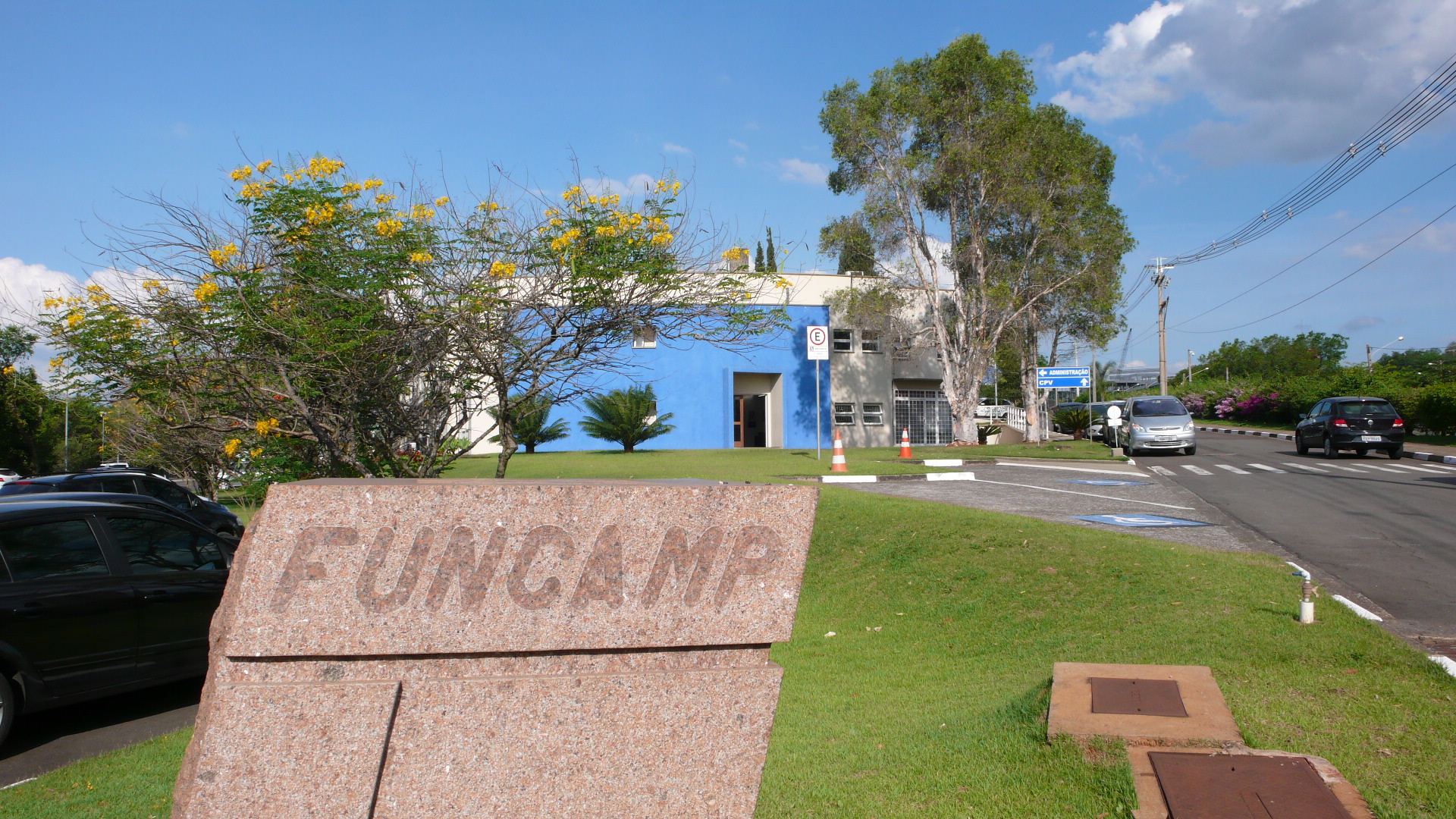
Today is my last day at FUNCAMP and I’m currently sitting in the hotel lobby, waiting for our lift to Belo Horizonte and the National Botanical Congress.  It’s likely to be a 7 hour drive, but longer if we stop for food, toilet breaks, and to look at birds and interesting landscapes (which we will!)

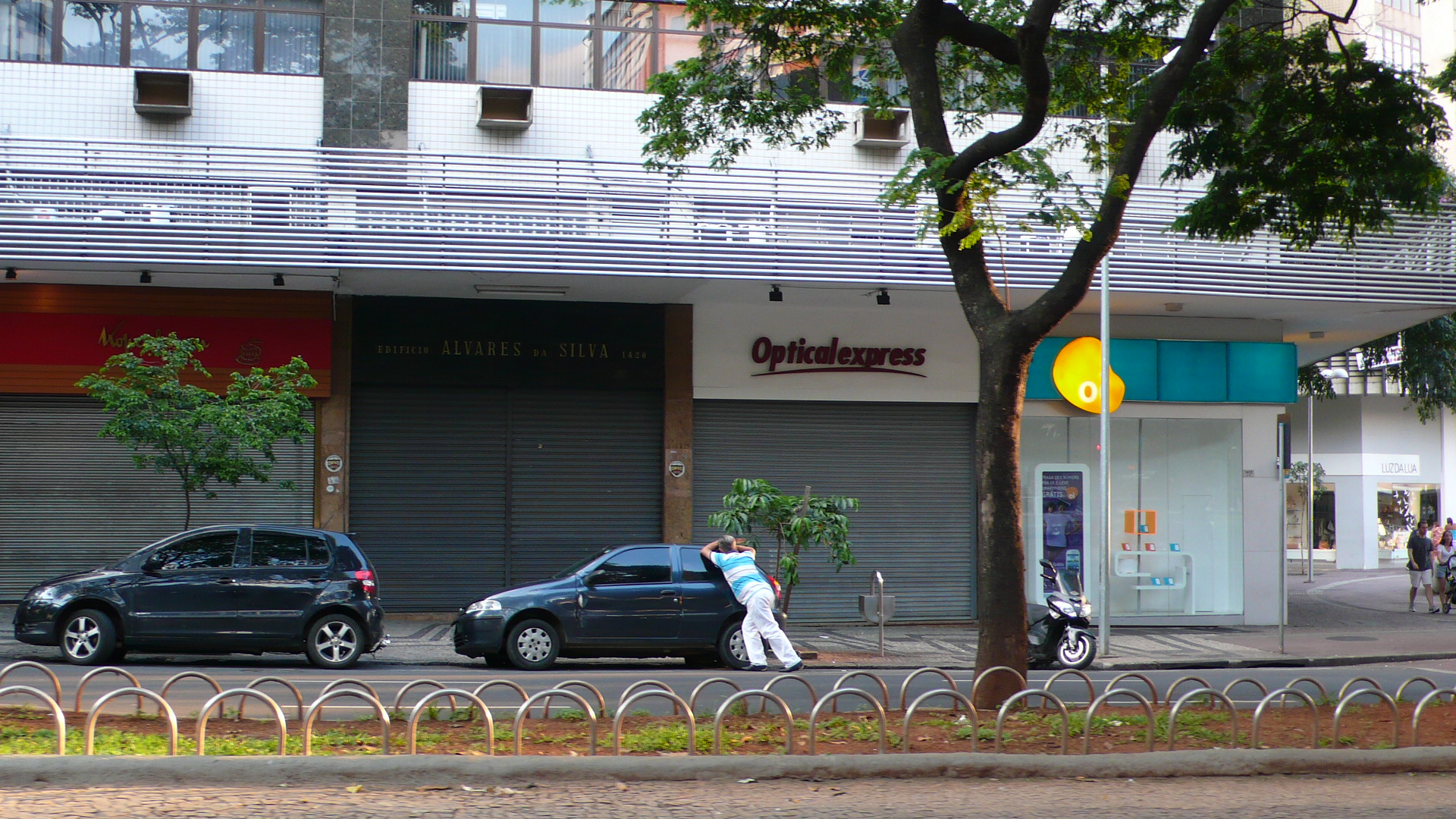
Yesterday André and I went to Campinas city centre accompanied by two of his former professors, Cristina and Zezo, to have lunch and discuss future collaborations when they come to Northampton for a sabbatical in 2014.  Campinas is big and busy, hot and hectic.  Temperatures were in the low 30s centigrade in the open streets, but as soon as we passed beneath the shade of any of the larger trees, the heat was blocked and we were much more comfortable.  City trees provide multiple ecosystem functions: they store carbon, of course, but they also significantly alter the local microclimate.

Nowhere is this more apparent that in subtropical and tropical regions, but you can also feel their effects even in a British city, where the presence of trees cools parks and pavements, insulating against high temperatures.  Do trees in temperate cities also insulate against cold in the winter?  I’m not sure but it would be an interesting area to research.

Trees are also beautiful, of course, and so the analogy with birds works on multiple levels: a city without trees is like a bird without feathers, because trees and feathers are both functional and ornamental.  In Campinas many of the trees were from families familiar to me, such as figs, legumes and mangos.  But others were new, including a species of Lagerstroemia from the loosestrife family (Lythraceae).   

Does it matter whether the trees are native or not?  That’s a debatable point; the last day of the pollination course at Unicamp on Friday included a session of student presentations of the projects that they’ve worked on all week.  One of them was an assessment of the diversity and origin of the trees within the park adjacent to the campus.  The students identified 64 tree species, 45% of which were native to that region of Brazil.  The remaining 55% are from other parts of Brazil, or from other countries, but nonetheless they provide resources for pollinators and birds within the park.   Perhaps this is acceptable in urban areas but not in areas of nature conservation or wilderness?

Our lift is here so I will sign off, except to note that my bird list is getting longer (over 50 species now) and that the award for Mammal of the Week goes to the agouti.  This a pretty, colourful relative of the guinea pig was abundant in the park in Campinas and completely charmed me with its confident and graceful demeanour.  If only I could bring one home…..

FUNCAMP – Brazil Diary 1

P1100895

“Nobody but a person fond of natural history can imagine the pleasure of strolling under cocoa-nuts, in a thicket of bananas and coffee plants, and an endless number of wild flowers”

Charles Darwin – letter to his father; Brazil, February 1832

When Darwin wrote this letter he was 23 years old and was experiencing the tropics for the first time in his life.  It’s a typically understated, 19th Century view of the sheer unfamiliarity and exuberance that tropical environments impress upon the traveller from north temperate climes.  In actuality Darwin was probably initially overwhelmed by the whole experience: I’m 48 and have made many such trips, and the first few days in the tropics never fail to overwhelm and excite me. Last Friday I arrived in Brazil for a month of teaching, lecturing and research funded by a grant from FAPESP awarded ​to my Brazilian collaborators, Professor Marlies Sazima and André Rodrigo Rech.  This week, with André’s help, I am running a course for graduate students entitled: “Pollination: ecology, evolution and conservation” at the University of Campinas, which everyone refers to as Unicamp, one of the most prestigious  and research active universities in Latin America.  The following week we head to Belo Hori​​zonte where I’m giving a talk at the National Botanical Congress, and a lecture at the Federal University of Minas Gerais. 

​Following all these teaching and lecturing engagements,  I head out into the field with André and some of the other Unicamp postgrads for two weeks of data collection on the ecology of Brazilian plants and their pollinators. The field work starts in the Serra do Cipó National Park, then mov​​​​es on to the Serra do Mar State Park, one of the largest remaining areas of Atlantic Rainforest.

We’re half way through the pollination course and the students have been just great; there are 28 of them, including some postdocs and professors from other universities, which is very flattering.  Each day is structured around a lecture, plus papers to read and the students bring questions to pitch to the group for discussion.  We’re also doing a little field work around the campus though the weather has been rather wet the last couple of days, which has limited what we can do.  

As well as interacting with the students, a real highlight of the trip so far has been the diversity of bird species on the campus.  After checking into my hotel on 1st November I took a stroll around the grounds and immediately spotted bird after bird that I’d never seen before, but which are common in this area.  No sooner had I started to identify one species (initially using Ber van Perlo’s Field Guide to the Birds of Brazil, which I soon augmented by a locally produced guide to the birds on campus ) than another hove into view and I’d have to remember its features in order to identify it next; and then another; and then another.  Information overload and, as I said, overwhelming!  

Bird of the Week has been the Southern Crested Caracara which I first saw sitting at the top of a tree from my bedroom window.  By the 2nd November I had counted 21 bird species; this went up to 36 the next day which included a walk around a small lake on campus.  Current total is about 40, but there are others which I’ve yet to identify and have been too busy with the course to spend much time birding.  But I’ve also added two new plant families to my life list of those I’ve eaten: Aquifoliaceae, the holly family, which provides the popular South American drink maté.  And Dilleniaceae, via the introduced species Dillenia indica the fruit of which is edible and popular in South East Asia, though is hopefully better cooked than raw: to me it tastes of lemon infused with car tyres.

Note to my family, students and colleagues back in Northampton:  whilst it’s true that my hotel is called FUNCAMP, this actually stands for Fundação de Desenvolvimento da Unicamp.  It in no way implies that I’m not working hard!

Je ne egret rien

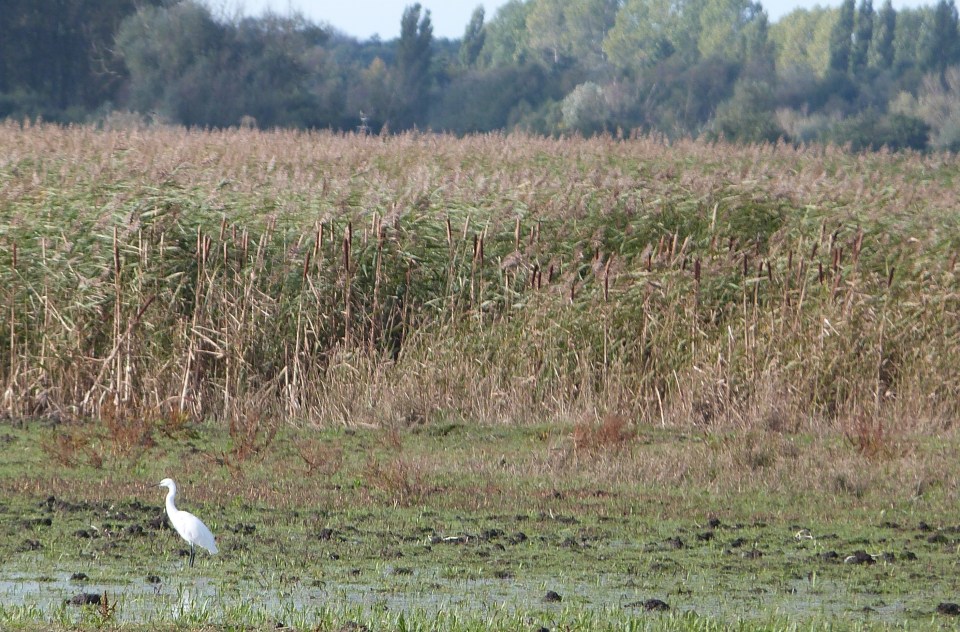
Little Egret - cropped

Conservation does not mean the same as preservation, despite the popular synonymy of these two words.  Preservation implies that something remains the same, is static and held in the same unchanging state.  One can preserve an old book, or fruit, or traditions for instance.  But one cannot preserve biodiversity because species change in abundance and distribution, regardless of the activities of humans.  That’s just how nature is.  One could take a deep time view of such change and consider the ancient habitats and organisms that built much of Britain’s underlying geology, as I mentioned when I described some walking on the Dorset coast a while back.  But even over shorter time scales that are comprehendible to humans, biodiversity changes, by the day, the month and the year.

That’s where egrets, and the pitiful punning title of this post, come in.  At the end of last week Karin and I spent a long weekend on the Suffolk coast, in the village of Walberswick.  It’s an old stomping ground for Karin but I don’t really know this area very well at all.  We spent our time talking and reconnecting, eating local food, drinking the good local Adnams beer, walking along the beaches, through saltmarsh and reed beds, and collecting stones and sea glass (I really like sea glass and have amassed bottles of the stuff over the years that we keep on sunny windowsills – think of it as aesthetic waste management).  And we looked at birds as we encountered them in these rich, diverse habitats.  Final total for the weekend was a respectable 37 species, including a few I couldn’t identify, helped along by a trip to the RSPB’s Minsmere Reserve (with, it seemed, every other birder in Suffolk; we had to queue to get into some hides). 

Two of the species we saw were egrets, a common name that covers several genera in the heron family Ardeiedae.  As the Wikipedia entry for egrets notes: “The distinction between a heron and an egret is rather vague, and depends more on appearance than biology”, as good an argument for the importance of scientific species names as any I’ve encountered. 

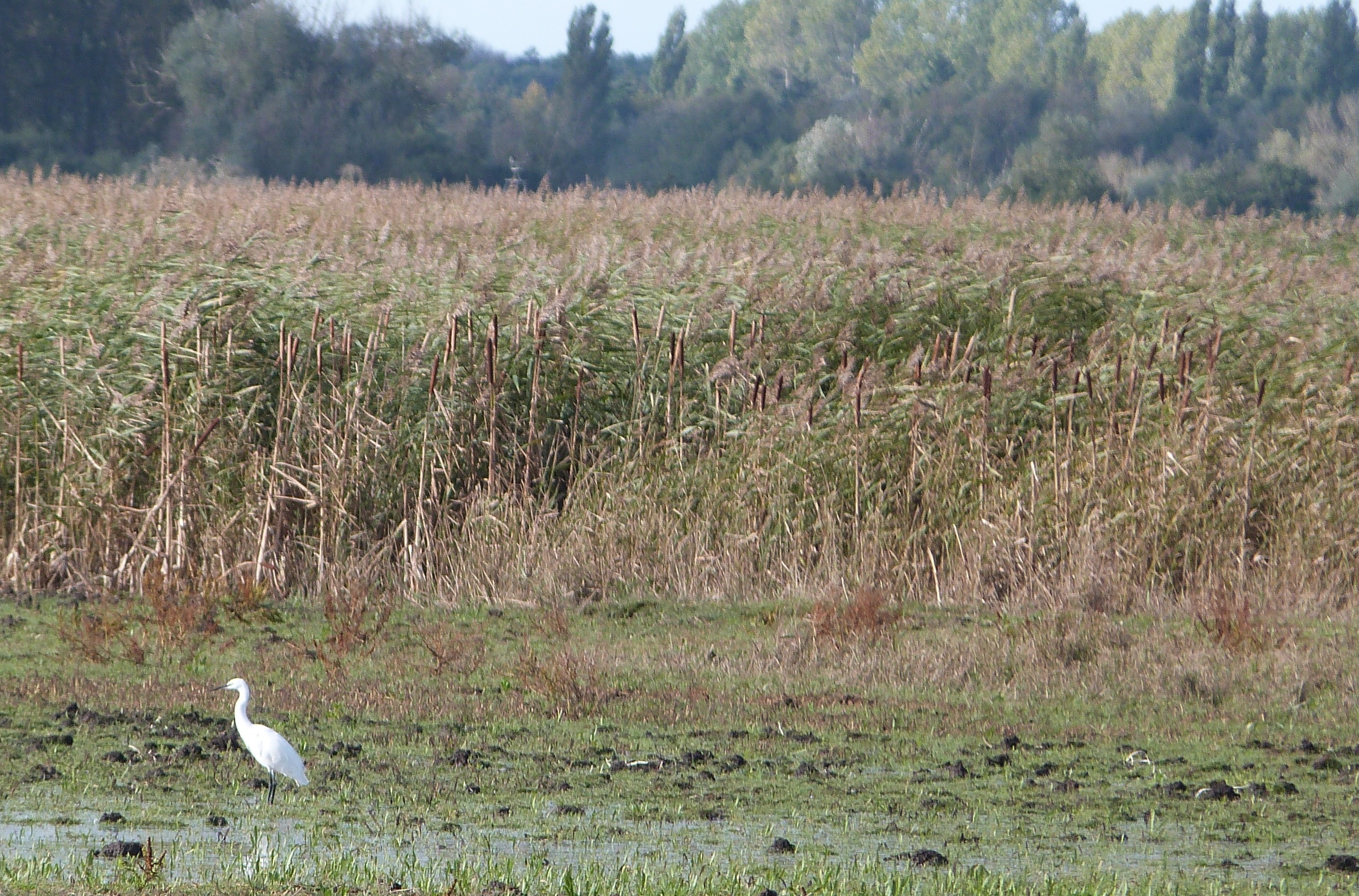
The first of the two species I spotted was the Little Egret (Egretta garzetta), an elegantly roaming bird that actively hunts along river margins and through marshland and flooded fields.  I was able to get within 10 metres or so of a bird at Walberswick and could admire its poised movements on vivid yellow feet, contrasting with black legs to make it look like a woman wearing footless stockings, as Karin put it (she took the photograph that accompanies this entry).  The second species of egret was the Great White Egret (Ardea alba), a much taller bird than the first, and an ambush hunter; like the related Grey Heron its strategy is to stand still and wait until prey comes to it.

The earliest record of a Little Egret in Britain was almost 200 years ago, in East Yorkshire in 1826.  However it is not known to have bred in this country until a pair did so in Dorset in 1996.  In other words, just 20 years ago this was an uncommon bird in Britain whose rare arrival would have generated a flurry of local twitching.  Now it hardly gets a mention on birding sites, we are so familiar with it.  Not so the Great White Egret which still raises some excitement when it appears.  Although this species was also recorded as early as 1821 in Britain, Great White Egrets only began to breed in Britain in 2012 and there is considerable anticipation that it will follow the Little Egret in expanding its population in this country.

We could add other birds to this list of species which have naturally colonised Britain within living memory, such as the almost ubiquitous Collared Dove (Streptopelia decaocto) as well as insects such as the Tree Bumblebee Bombus hypnorum and the Ivy Bee Colletes hederae.  Others will undoubtedly follow in the future, and perhaps the Cattle Egret will be the next member of the heron family to take up permanent residence on our shores.

Of course the flip side of new arrivals such as these is extinction, a topic that I will return to at some point as we’re currently putting the finishing touches to what I hope will be an exciting new paper on British bee and wasp extinctions.   Understanding the ebbs and flows of biodiversity over time requires data to be collected and we are fortunate in Britain to have a number of active monitoring schemes that regularly survey different groups of organisms.  This activity is vital if we are to be able to monitor our wildlife and to take action if we see declines, though the most recent results for the Status of Priority Species index makes grim reading:  the overall abundance of threatened species in the UK declined by 68% between 1970 and 2010.  It’s a complex message, though, and there are some success stories within those statistics.  But the animals that have fared worst have been the insects, particularly moths and some of the bees, wasps and ants.

Against this background of monitoring and decline I was happy to accept an invitation last week to attend a Defra-sponsored meeting at the Natural History Museum in London to discuss the setting up of an insect pollinator monitoring scheme.  A group of about 50 scientists and conservationists discussed what such a scheme might look like and how it could be implemented.  I’ll report back in more detail about this in the future once some decisions have been made as to how to proceed.

Meetings such as this, as well as being important in their own right, provide an opportunity to catch up with old friends and colleagues and discuss their latest work, or latest child/house move/job move, as appropriate.  So it was good to have a couple of beers after the meeting and chat with a few people including Dave Goulson, arguably one of the most significant scientists working in British pollinator conservation, and an outspoken critic of the current use of neonicotinoid pesticides.  Dave founded the Bumblebee Conservation Trust and has produced a lot of the scientific literature on bumblebees as he describes with wit and passion in his recent book A Sting in the Tale.  I’ve known Dave for over twenty years (we were PhD students together) so I was a little embarrassed to ask him to sign my copy of his book, but as a collector of signed editions I wasn’t going to let the opportunity slip.  Dave mentioned that the book has been shortlisted for the Samuel Johnson Prize and I hope it wins: ok, I’m biased, and can read it in Dave’s own voice which adds enormously to the book.  But it’s a great read for anyone interested in pollinators, or conservation, or just in the processes which turn a natural history obsessed kid into a professional scientist. 

This will be my last blog entry from Britain for a month; on 31st October I fly out to Brazil to spend time with André Rodrigo Rech, running a short pollination biology course, speaking at the Brazilian Botanical Congress, and conducting field work.  I’ll try to blog as I go along.  In a happy coincidence the Great White Egret is depicted on the Brazilian five real banknote.  I’ll look out for it.

Cities and biodiversity – a new resource

LondonDecember2007013

This is by way of a re-post from the good folks over at the bio-Diverse blog.  They’ve noted that there is now  an online, interactive version of the Cities and Biodiversity Outlook report.  It’s a product of a collaboration between the UN Convention on Biological Diversity, the Stockholm Resilience Centre (SRC) and Local Governments for Sustainability (ICLEI), and was launched at the at the CBD COP in Hyderabad in 2012. There’s a video introduction narrated by actor Edward Norton and it deals with the huge increase in urbanisation that is predicted for the next few decades, together with the impacts it is likely to have on biodiversity, as well as the opportunities for nature within urban cityscapes.

It’s an interesting resource that deserves to be more widely advertised.  As more of us become city folk, these are messages to which we need to pay heed if our descendants are to have healthy and happy lives.

Conservation: from CSN to CSR

P1100235

The history of what might be loosely called “the conservation movement” is a complex one with roots that are both deep and ramified.  In the west, direct antecedents can be found in the work of 19th century pro-environmental writers such as Henry David Thoreau  and George Perkins Marsh, but there are arguably also more subtle influences from other sources, for example the “Northamptonshire Peasant Poet” John Clare  whose natural history inspired verse captured a rural way of life and a landscape that was rapidly disappearing:

All nature has a feeling: woods, fields, brooks
Are life eternal: and in silence they
Speak happiness beyond the reach of books

The later foundation of organisations such as the RSPB, the Audubon Society, and the precursors of the Wildlife Trusts gave impetus to environmental campaigns focused on specific issues such as species extinctions and destruction of important wildlife sites.  But it was in the 1960s that nature conservation, and environmentalism more generally, began to become of wider concern.  Again the influences were broad but certainly included both popular science writing such as Rachel Carson’s Silent Spring, and  the attitudes and campaigning of the counter-culture.   Yet a generation later, as a student studying the subject in the 1980s, it was clear to me that the mainstream had not fully engaged with what was still considered hippy, tree-hugging notions of saving the planet/whale/rainforest/ [delete as appropriate].

Having always been a fan of vintage West Coast rock,  these hippy ideals were on my mind at the start of last week when I travelled to the BBC’s Maida Vale studios to attend a recording of Radio 4’s Mastertapes featuring David Crosby and his band.  As well as playing music from his first solo album, the haunting and majestic If Only I Could Remember My Name, Crosby talked about his life and political activism.  The following evening Karin and I were back in London, this time at the Royal Albert Hall to see Crosby with his compadres Steven Stills and Graham Nash, performing as the incomparable CSN.  A number of songs from their back catalogue feature environmentalism in one form or another and, despite their vintage, they are as in touch with the political scene as ever.

Now, in the first decades of the 21st century, the green agenda has gone mainstream and it seems that every large business discusses the environment in their Corporate Social Responsibility statements.  So with only a few hours sleep I jumped from CSN to CSR, a theme that recurred during  the first Northamptonshire Local Nature Partnership conference held at the University the next day.  One hundred and twenty delegates heard talks that presented environmentalism and nature conservation from the perspectives of citizen health and well being, Christianity, on-the-ground conservation activities, and the needs of business and enterprise.  In the afternoon there were smaller showcase sessions and I presented an overview of pollination as an ecosystem service.  

Every organisation (public and private sector) wants to be “green” these days, which is a good thing of course if it’s genuine and well conceived.  But as David Rolton pointed out in his talk, businesses were few and far between at this event.  During the question-and-answer session I followed up David’s comment with a description of our experiences with the Biodiversity Index.  Despite winning a Green Apple Award, and having lots of verbal encouragement from the private sector, as soon as we explain to businesses that they have to pay to use the Index, all interest dissipates.  These are the same businesses who are willing to invest in green initiatives such as recycling and energy efficiency, presumably because it saves them money as well: it seems that CSR for most businesses does not extend beyond paying lip service to biodiversity, despite an economic input of over £30 billion that the UK receives  from the natural environment every year.  

It took time for businesses and other organisations to acknowledge their responsibilities to the environment, and to develop policies relating to recycling, non-pollution and resource efficiency.  It seems that businesses are only just beginning to acknowledge their societal (rather than corporate) responsibilities with regard to conservation, and it’s an ongoing process that exercises government.  But conservation of biodiversity has got to become a priority; once a species is lost it’s lost forever, and we erode not only a natural heritage that has evolved over billions of years, but also the direct and tangible benefits biodiversity gives us.  In the words of CSN: “It’s been a long time coming; it’s going to be a long time gone.

Biodiversity and urban cultural fabric

093

It’s easy to take for granted the biodiversity of our towns and cities, though “urban ecology” has become a buzz phrase within the subject and there’s lots of research groups working on this topic, as I’ve mentioned previously in relation to Muzafar Hussain‘s work on solitary bee diversity within Northampton.  Muzafar is currently analysing his data and writing up the results, and I hope to share some of his exciting findings with you at some point in the future.

However another aspect of urban “biodiversity” has hardly been researched at all, as far as I’m aware:  the way in which elements of the natural world have been incorporated into the physical fabric of urban landscapes. The use of flower and animal figures around doorways and windows, and in the metalwork, of Victorian town houses in Northampton, for example.  Some of the most impressive are to be found on a couple of houses in the Barrack Road Conservation Area, where the iron railings around street-side balconies have been cast to resemble botanically accurate Epihyllum cacti in full flower.  There are many others, including birds incorporated into boot scrapers, and flowers and trees used for house names  (“Holly Cottage”, “Lonicera House”, “The Lindens”).  Much of the housing and commercial architecture in Northampton dates to the back end of the 19th century and the use of such motifs possibly reflects the influence of the iconic Natural History Museum in London, Alfred Waterhouse’s cathedral of biodiversity a century before the term was coined.

The names of pubs and inns may sometimes reflect our fascination with the natural world (“The White Elephant”) or with agricultural biodiversity (“The Cock Hotel”), a topic that I’ve written about in the past.  I was therefore unhappy to read that a pub in Northampton town centre is to be renamed, despite the fact that its old name of The Fish Inn reflects a history of that part of town which goes back to at least the 16th century and was included in a town heritage trail.  Why do councils allow this to happen?  It devalues the cultural fabric of the town ever further.  

Oxford, I’d like to think, might treat its local history a little better, regardless of whether one can spin a loose link to biodiversity.  It’s always a pleasure to return to the city which turned me into a professional scientist so I was happy to make the almost two hour early morning car and bus trip to attend the first day of the Biodiversity Resilience symposium.  I was teaching on the second day so had to miss it, but the first half of the symposium was interesting and thought provoking.  Highlights for me included:

  • Sam Turvey‘s analysis of whether or not human range expansion over the past several thousand years has driven the extinction of large mammals.   In some cases the evidence is clear cut, in others it’s not.
  • Lydia Cole on using the fossil pollen record of tropical forests to estimate recovery times of forest vegetation following disturbance; it appears that whilst all forests can recover, not all regions do so equally quickly, with time scales varying from around 150 to 350 years.
  • Graham Stone describing his group’s work on  how the history of interactions between oak gall wasps and their parasitoids in Europe can be reconstructed using molecular genetic data.
  • Guy Woodward on the effects of stressors such as pollution and drought on freshwater food webs.
  • John Dearing linking social science with natural science in an analysis of how population growth and exploitation of natural resources might lead to environmental problems in some parts of China in the near future.

These should give you a sense of the diversity of topics covered and that was the overwhelming impression that I came away with at the end of a long day: the study of biodiversity is as broad as one can imagine, from genes to ecosystems, interactions to extinctions.  Notions of what is meant by “resilience” were equally wide, with each presenter having a subtly different take on a slippery concept.  This illustrates the value of conferences such as this: it brings together a community of individuals who might work in complete ignorance of one another’s work, even though it could inform and challenge their own studies.  If day two was as stimulating as day one, then the organisers can count it a success.

Harvest of evidence

P1100769

The last entry I posted was premature in its prediction that autumn is here and for the past week we’ve enjoyed some bright, warm weather: an Indian Summer before autumn proper envelops us.  Sunday afternoon was spent in the garden, digging up potatoes and planting the garlic we bought on the Isle if Wight.  Neither of these crops requires pollinators, but others we’ve been harvesting this month do, including squashes, runner beans and greengages.  The latter are from a mature tree that, when we took over the house in 2012, I assumed was a bog standard Victoria plum.  The tree did not crop last year but has more than compensated this season with abundant deliciously sweet fruit.

All of this provides useful anecdotes for public lectures.  Since appearing on Bees, Butterflies and Blooms I’ve regularly been asked to give talks to gardening societies and  I try not to refuse because they are usually fun with attentive, knowledgeable audiences.  At one such event earlier this year I was asked: “Is there any evidence that declining pollinators are resulting in lower crop yields in Britain?”  It’s a great question that goes to the heart of evidence-based conservation and the notion that science should be informing such policies as strategies to conserve biodiversity.

As far as I’m aware there is no indication that British insect pollinated crop yields have declined.  And if the evidence of our greengages, runner beans and squashes is anything to go by, there’s currently plenty of wild bees, hoverflies and other insects (we get few honeybees in this garden) to service those food plants that require their pollinating activities.  But that doesn’t mean we should be complacent and monitoring is required, because the evidence from other countries is that yields are down for insect pollinated crops and hand pollination is required in some places.

Evidence should inform everything that we do and believe as scientists, gardeners, informed members of the public, whatever label we choose for ourselves.  This is especially true of currently controversial issue such as the causes of global climate change or the effects of neonicotinoid pesticides on pollinator health (see Dave Goulson’s slides from a recent conference talk, for example).  But we should also understand that a basic tenet of science is that it can never “prove” anything:  new evidence may appear at any time that refutes our cherished notions, or disproves that pet hypothesis.  We make decisions on weight of evidence not on proof.  So it was depressing to read a widely publicised article about a Nigerian postgraduate student’s claims that he has “proved” that homosexual relationships are “unnatural” because only the opposite poles of magnets are attractive to one another, the same chemical compounds do not react together, and roosters only love hens.   At first I thought it was a spoof but it appears that the research student is perfectly serious and, more, has been tipped to win a Nobel Prize by his equally deluded supervisors.

It’s easy to scorn the guy’s findings and point out that people aren’t magnets or simple chemical compounds and that homosexual activity is widespread in the animal world (so how do we define “unnatural”?)   But Karin, as always, had a deeper and more nuanced view of this story than did I.  Perhaps it’s her training in psychotherapy but whatever the reason, she gave an alternative perspective and pointed out a sad possibility.  Karin suspects that the student has been manipulated by academic and political powers that have a vested interest in such “proof” because of threatened sanctions on aid.  Under this scenario the student has been encouraged by the academics at the university to pursue this misguided work, which can only support the Nigerian government’s anti-gay stance.  Of course the research will never be published by any reputable scientific journal and the story has harmed the University of Lagos’s international reputation.  But for the narrow minded and biblically fundamentalist, the story itself will be evidence enough to shore up their own prejudices.  One person’s crackpot claims is another’s decisive evidence.

Any friend of coffee is a friend of mine

Beach spiral

As I begin to write this post rain is pattering against the windows with increasing frequency and a brisk wind stirs the browning horse chestnut leaves that overhang the garden from a neighbouring property.  Autumn is here.  It’s a chilly Sunday morning and beside me is a large cup of good coffee, hot, black, and bitter, warming and stimulating in equal measure.  It’s our first Sunday at home for a fortnight as last weekend was taken up by a speaking engagement in Hereford at a large bee keeping convention where coffee featured highly, as I’ll explain.

The Hereford convention wasn’t the kind of academic research conference that I’d normally attend, but I thought it would be fun to go with Karin, and I’d learn more about bee keeping (both proved to be true).  For this broad audience of amateur and professional bee keepers I presented a version of my professorial inaugural lecture from earlier this year entitled “How many bees does it take to wake up in the morning?  The importance of biotic pollination in a changing world”.  It’s a title with multiple layers of meaning, referring to bees as ecosystem service providers, my enjoyment of my work which gets me out of bed every day, and the energising effects of a strong cup of fresh coffee first thing.  

As part of that lecture I present some back-of-the-envelope calculations that are meant to put coffee production into a biodiversity perspective, rather than being a rigorous analysis, but which are nonetheless worth considering.  They go like this.

Global coffee consumption in 2010 (the most recent year for which I could find figures) amounted to 93 million export bags, each weighing on average 60kg (there are larger and smaller bags used in different parts of the world, so we’ll use this figure).  The export value of this crop was estimated at US$15 billion for the (largely tropical) countries that produced it.  That’s the value before it’s processed and sold, which is much more difficult to calculate, though coffee retailing is clearly big business.  For example, Starbucks’ total revenue for the same year was US$10.7 billion and it supports over 150,000 full time employees.  So it’s lucky for us that it pays its taxes.  

Although coffee is partly self pollinating, it relies on insect pollination to produce large crops, mainly involving bees of various types.  I tracked down a number of studies by researchers such as Alexandra-Maria Klein and Taylor Ricketts which showed that managed honey bees are responsible for anywhere between zero and over 90% of flower visits, depending on the diversity and abundance of local wild bees (over 40 species of which are known to pollinate coffee in Costa Rica alone).  At this point I throw out a question to the audience:  how well do we understand this globally important agricultural ecosystem service?  Do we have any idea of how many individual insects are required to support this industry?  Some more calculations:

Each coffee bean is the product of a single fertilisation event following the deposition of at least one pollen grain on a flower’s stigma.  The mean weight of a single coffee bean is 0.103g (I weighed a sample in preparation for the lecture) which means there are approximately 582,524 beans in a 60kg bag.   Total number of coffee beans produced in 2010 is therefore 93 million bags multiplied by 582,524 beans per bag, which equals  54,174,757,281,553.  In words, that’s  more than 54 trillion coffee beans.  As coffee is 50% self pollinating we can half that figure: coffee production requires at least 27,087,378,640,777 (over 27 trillion) pollinator visits.

But here I confess to the audience that it’s impossible to go further and answer the questions I posed above:  we really have no idea how many bees are supporting the coffee industry.  The problem is that there are big gaps in our knowledge of some basic aspects of the natural history of these bees and their interactions with coffee flowers.  For example, how many flowers does an individual bee visit in its lifetime?  How effective are different bees at pollinating  the flowers?  What is the minimum population size for these bees, below which they would go locally extinct?  All that we can say with certainty is that the global coffee industry (and the individual productivity of many workers) is supported by a LOT of bees.   Many billions is my best guestimate.  Perhaps we don’t need to know the number: perhaps it’s enough to know that if we provide sufficient good quality habitat for these bees, they will provide the service.  But at least it illustrates our reliance on these insects and is something to consider when you’re enjoying the first cup of the day.

Bees are not the only animals that we have to thank for coffee production as a recently published study has shown:  birds in Costa Rica help to reduce the impact of an important pest of coffee.  As Jana Vamosifrom whom I shamelessly stole the title of this posting, commented when I posted this link on Facebook:  any friend of coffee is a friend of mine!


Garlicky archipelago

Sunrise from train September 2013

“Garlicky” is a great word, redolent of hot, pungent flavour and nose-filling odour: a Pavlovian word that ignites the senses as it’s uttered.  Perhaps I love the word because garlic is one of my favourite vegetables, a pleasure to both eat and grow.  A Garlic Festival is therefore not to be missed, and my family and I had the opportunity to attend one on the Isle of Wight during a short holiday a couple of weeks ago.  We were joined by university friends I’ve referred to previously, as the first one of us to reach a half century celebrated his 50th birthday.  There was more to the festival than just garlic, but for me its highlight was seeing the sheer variety of different garlic types that can be grown, testament to how this vegetable has been modified from its ancient wild origins in central Asia.  Karin and I bought seed bulbs of four different varieties as additions to the horticultural biodiversity of our vegetable plot, to be planted later in September.   These included the notable Elephant Garlic with its massive individual cloves, which, I’ve just learned while researching that link, is not a true garlic at all but rather a variety of leek.  We live and learn!

Archipelago is another great word and the time we spent on the Isle of Wight, travelling over by ferry from Southampton, served to remind me that the British Isles, with over six thousand islands of various sizes, is by any standards a significant archipelago.  Since at least the explorations of Alexander von Humbloldt, island groups have  been known to host unique species, isolated taxonomically and physically from their closest continental relatives.  Darwin’s later researches showed that archipelagos such as the Galapagos Islands are important as natural evolutionary laboratories, and in previous posts I’ve briefly discussed his unrequited desire to visit to the Canary Islands.  The Isle of Wight is too close to the continent of Europe to have evolved any unique biodiversity but I did pick up the hint of a subtle Island Biogeographic Effect whilst compiling a list of all the bird species I saw over the course of the week.  The list topped out at about 30 species, which I thought was rather low.  Some of the omissions surprised me (not a single blackbird, for instance) and I saw very few individuals of some other common British species.  Now, it could be due to my lousy birding skills I suppose, but it could also be due to the fact that we were on an island, even though it’s less than 1500m across The Solent to the mainland at its closest point.  This is close enough for bumblebees to fly to the island: I’ve seen them shadowing the ferry.  But nonetheless it might be far enough to affect both the diversity and population sizes of the bird life.  Enough wild speculation; I’d be interested to know what serious ornithologists who actually know something about the subject make of this.   

As I finish writing this post I’m on the other great island of my home archipelago, sitting in a bar in Terminal 2 of Dublin Airport.  I’ve been working at University College Dublin as external examiner for their MSc Applied Environmental Science course.  It’s been a fun couple of days reading theses and interviewing chatty, engaged students, which began with a dawn alarm yesterday in order to get to the train station and then Birmingham International in time for a 0850 flight.  Whilst waiting for my taxi I popped into the garden and paused to enjoy the early morning stillness before opening up the chicken coop.  A large flock of black-headed gulls passed low above me, backlit by a thin sliver of moon and silent except for the shuffle of feathers.  From the direction they were travelling I think they were heading from a roost on Pitsford Water and on to destinations unknown.  The garden was also busy with early risen blackbirds and a couple of flitting bats, whilst a little later my taxi passed a rangy fox idly trotting through low mist on the Racecourse park.   It was urban biodiversity at its most sublime.  

All this talk of Northampton is making me feel homesick to be back with the family (Karin, kids, cats and chickens) and start planting garlic.  But there’s just time for another Guinness before my gate opens.  Sláinte!

In defence of lawns UPDATED

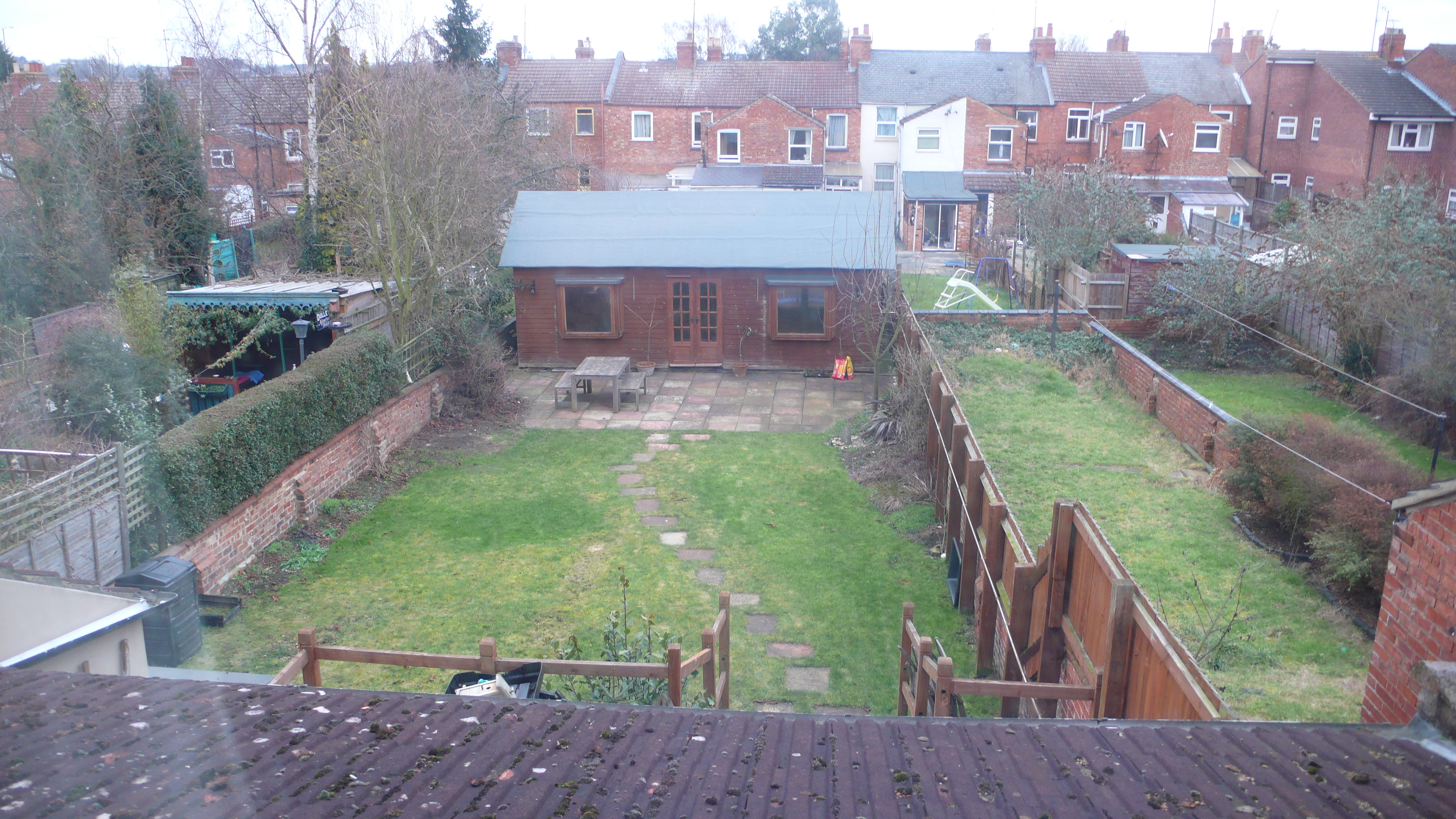
2012-02-22 10.19.23

Over at the Small Pond Science blog, Terry McGlynn has a thought provoking post which asks ‘Are trees the lawns of the future?‘.  I won’t rehash Terry’s arguments, you can read it yourself, but I was intrigued by his stereotyping of lawns as always bad.  As a keen amateur gardener and a professional with research students who have worked on garden biodiversity projects, I’d have to say that there’s lawns and there’s lawns: it all depends on how they are managed and what the purpose is of a particular lawn. Clearly there’s a continuum from high diversity, natural “lawns” (i.e. close-cropped grassland which can support significant biodiversity such as some chalk grassland and African savannah lawns) through to the high resource input, monoculture, perfectly presented lawns seen on golf courses and around important buildings.  In the part of the continuum that Terry’s railing against, typical urban and suburban householder’s lawns and everything below that in terms of “naturalness”, it’s possible to manage lawns in a low-input way that is both productive and can support biodiversity.

In the house that Karin and I moved into about 18 months ago, the garden was almost wholly laid to lawn; the picture at the top shows you what it was like in early 2012.  Since then we’ve dug flower borders, a vegetable patch and planted fruit trees, but kept about 50% lawn (though this will reduce as we widen borders). We don’t water or fertilise the lawn, just keep it regularly mown. I’ve not assessed it systematically but I’d estimate that, in addition to the grasses (some native, some not) there’s another 10 to 15 native plants growing in it, plus fungi which pop up every now and then. The plants include taxa which are popular nectar sources for bumble bees and solitary bees, e.g. clovers, dandelions, etc. These flower even though we mow regularly, and of course these bees pollinate our squashes, courgettes, apples, plums, etc.  The local blackbirds and starlings also find food on the lawn.

I mentioned that the lawn is “productive” and that’s where the grass cuttings come in. They are either put into the compost heap, fed to our chickens, or added directly to the vegetable patch as a mulch.  It’s also possible that the clover, which is a nitrogen fixing legume, is adding to the soil fertility that can be accessed by the far-reaching roots of the fruit trees.  Would be an interesting hypothesis to test.

So I think it’s possible to have a lawn that adds to local biodiversity and is productive for the gardener, but I accept that we may be unusual in that regard.  It’s not the kind of lawn that would make a grass obsessive proud; but that type, as Terry notes, needs a lot of input of resources, not least time.

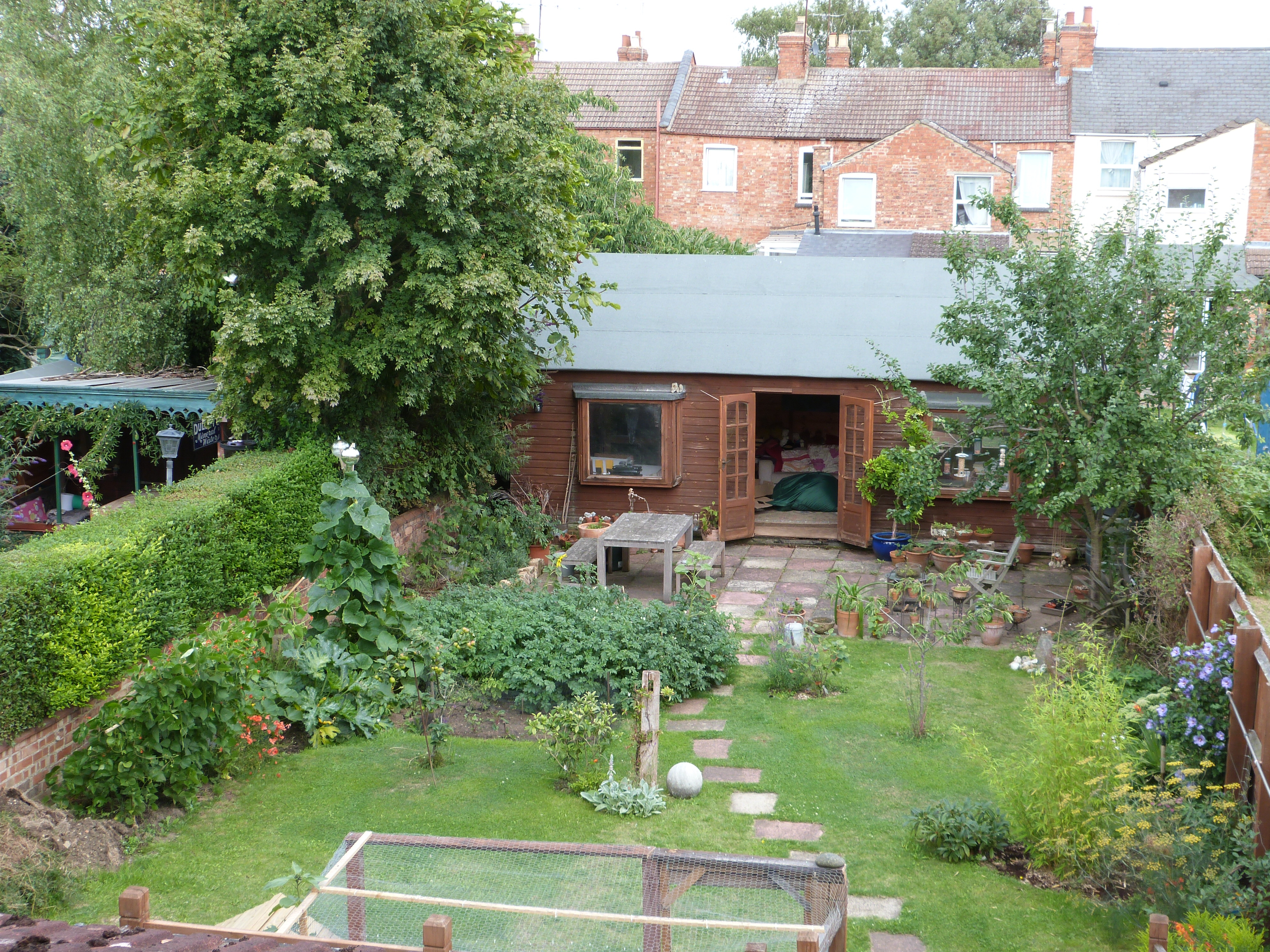
UPDATE –  a few people have asked to see a picture of how the garden looks now, so below is more or less the same shot but taken today (15th August 2013) by Karin.  Comparing a British garden in February and August is clearly unfair!  But hopefully you can see that we’ve done quite a bit of work to it, though as with all gardens it’s a work in progress.

Garden 15th August 2013