
A pollination ecologist was recently working on the reproduction of a tropical plant species and discovered that the flowers were visited by two species of weevils, one large and one small.
The larger weevil was too big to access the nectar from the front, so it chewed its way into the flowers, destroying the petals, and in the process picking up no pollen.
The other weevil species was, however, able to enter the flowers, where it became smeared with pollen, which it then transferred to the stigmas in flowers of other plants.
The pollination ecologist therefore concluded that the true pollinator of this plant was, indeed, the lesser of the two weevils…
That’s not an original joke by any means – it comes from the movie Master and Commander. But it nicely sets up this short post about a review paper that came to my attention earlier in the summer and which fits neatly with my previous post about a special issue of the Journal of Applied Entomology dedicated to the “neglected pollinators”.
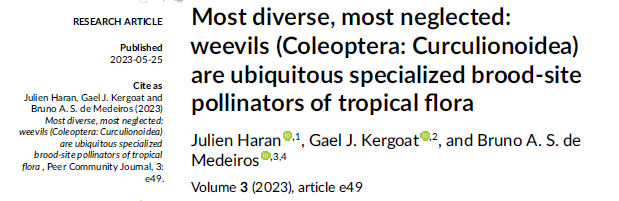
Writing in the open access Peer Community Journal, Julien Haran, Gael Kergoat, and Bruno de Medeiros have produced a really fascinating review of weevil pollination called:
Weevils are beetles, members of the superfamily Curculionoidea, which contains an estimated 97,000 species. Many are herbivores, including seed predators – I first encountered them as a researcher during my PhD when I assessed the impact of one species as a seed predator of my study plant Bird’s-foot Trefoil. Surprisingly, however, pollinating relationships have evolved multiple times between weevils and plants. Drawing on published studies and their own unpublished observations, the authors conclude that such “associations have been described or indicated in no less than 600 instances.” Most of these are brood-site pollination systems that have probably evolved from seed predation relationships.
No doubt many more examples of weevil pollination remain to be discovered but as it stands, this review paper is a great summary of a fascinating and still rather neglected corner of pollination ecology.
 Prof. Jeff Ollerton - ecological scientist and author