
The question of whether interactions between different species are more specialised in tropical environments (as theory predicts) has intrigued me for a couple of decades. In fact it’s just occurred to me that August 2022 was the 20th anniversary of my paper in Oikos co-authored with Louise Cranmer entitled: Latitudinal trends in plant-pollinator interactions: are tropical plants more specialised? That paper was one of the first to seriously challenge an idea that was long-embedded in the scientific and (especially) popular literature, that tropical ecology was in a sense “special” and that the ways in which species parasitised, consumed, or engaged in mutualistic relationships in the tropics was different to what was happening in the subtropics and temperate zones.
Since then I’ve written about this subject in a number of publications, most recently in my book Pollinators & Pollination: Nature and Society and it’s inspired some other researchers to address the topic.
One of the real challenges with asking questions about how plant-pollinator relationships change over large geographical areas is obtaining good, robust data to analyse. It’s a challenge to convince science funding agencies to give money to spend many years travelling the world and collecting the kind of data that are needed. However we can gain some idea of the patterns, and potential processes, that drive the macroecology of plant-pollinator interactions by piecing together databases of interactions for particular taxa, gleaned from published and unpublished sources.
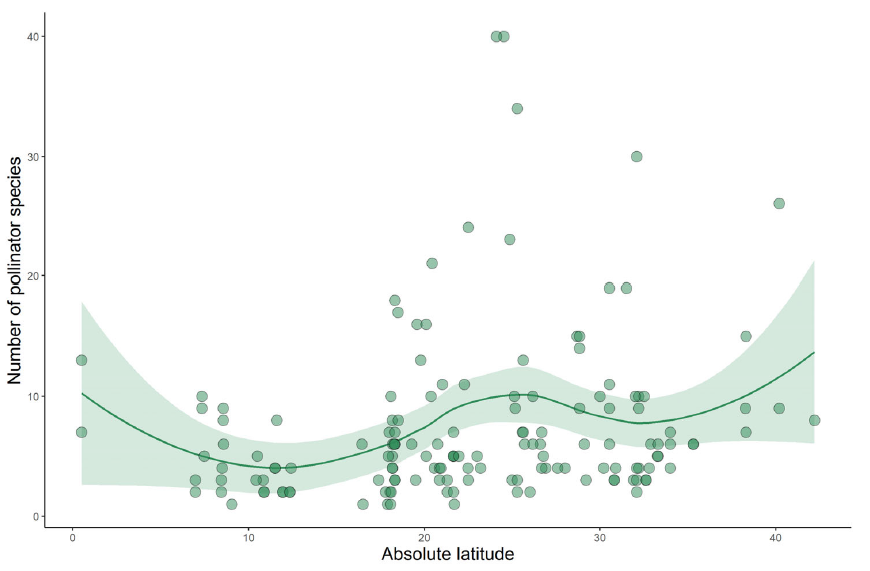
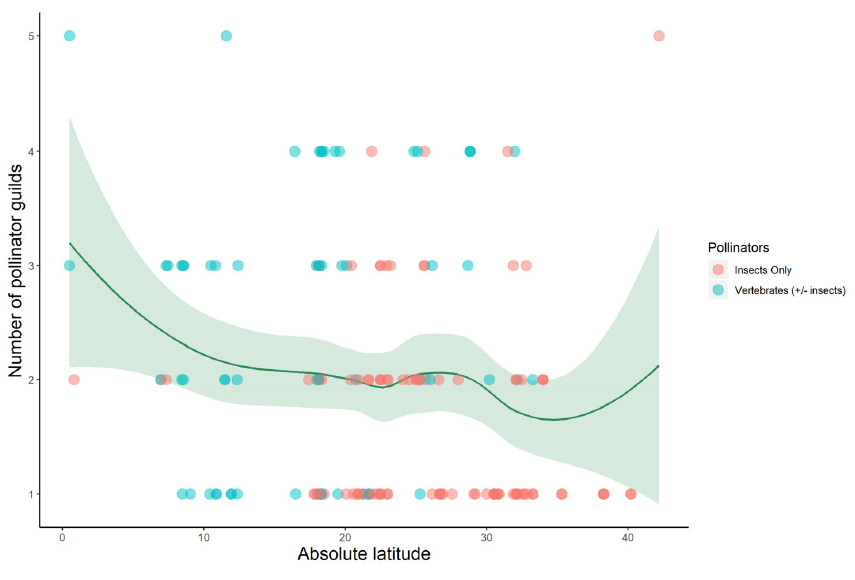
That’s what we have done for the family Cactaceae in a new study led by Pablo Gorostiague from the Universidad Nacional de Salta in Argentina. This collaboration started when Pablo visited Northampton back in 2018 and spent some time with my research group, including helping out with field work in Tenerife. Since then the usual issues (work, COVID, etc.) have delayed publication of our paper, but now it’s finally out. Amongst other results we find that, yes, tropical cacti are pollinated by fewer species on average (though it’s hugely variable – see the figure above) but that functional specialisation (i.e. the number of pollinator guilds that are used by species) is no different in the tropics compared to the extra-tropics (that’s the figure at the end of this post).
The full reference with a link to the paper is below; if anyone wants a PDF, please send me a message via the Contact page:
Here’s the abstract:
Biotic interactions are said to be more specialized in the tropics, and this was also proposed for the pollination systems of columnar cacti from North America. However, this has not yet been tested for a wider set of cactus species. Here, we use the available information about pollination in the Cactaceae to explore the geographic patterns of this mutualistic interaction, and test if there is a latitudinal gradient in its degree of specialization.
We performed a bibliographic search of all publications on the pollination of cacti species and summarized the information to build a database. We used generalized linear models to evaluate if the degree of specialization in cacti pollination systems is affected by latitude, using two different measures: the number of pollinator guilds (functional specialization) and the number of pollinator species (ecological specialization).
Our database contained information about the pollination of 148 species. The most frequent pollinator guilds were bees, birds, moths and bats. There was no apparent effect of latitude on the number of guilds that pollinate a cactus species. However, latitude had a small but significant effect on the number of pollinator species that service a given cactus species.
Bees are found as pollinators of most cactus species, along a wide latitudinal gradient. Bat and bird pollination is more common in the tropics than in the extra-tropics. The available information suggests that cacti pollination systems are slightly more ecologically specialized in the tropics, but it does not support any trend with regard to functional specialization.
 Prof. Jeff Ollerton - ecological scientist and author
Dear Jeff:
Thank you. Your work has now reached a point where it might be timely for you to move on to a bigger topic. You might ask yourself, if the family Cactaceae shows its highest diversity in the American southwest and northern Mexico shouldn’t we all expect some degree of buffering when comparing the pollination of many xeric species versus fewer species in the wetter tropics due to interspecific competition for a limited pollinator resource?
What I think is really needed is a meta-analysis of pollination systems based on centers of diversity. This works at two levels
Should we predict a greater number of specialist pollination systems within a center of diversity for a plant family or genus? What happens to the evolution of pollination systems when plants form species flocks? 2. Likewise, should we expect a greater number of specialist pollination systems within a center of diversity for a pollinator family or genus? Once again, what happens to the evolution of pollination systems when anthophilous animals form species flocks? Paul Williams found 29 bumblebee species on our Yulong mountain. Shouldn’t we find more plants pollinated exclusively by hummingbirds in the Andes and/ or bumblebee species in the Heng Duan mountains? At the simplest level, reread Grant and Grant’s “Hummingbirds and Their Flowers. East of the Mississippi, continental America has only 1 hummingbird species. West and coastal there are at least six. Consequently, Pan-American distribution of Lamiaceae and Scrophulariaceae shows the highest degree of hummingbird-pollinated species West of the Rockies where those species nest in spring and summer.
If you don’t think your own studies on the African Apocynaceae have gone far enough to answer this question, there are other options. Consider the two decades of work on pollination of the Iridaceae of South Africa. I think there are two likely scenarios when it comes to testing the first hypothesis. In centers of plant diversity, pollination specialization occurs normally along lines of genus segregation or within a genus so large it must be subdivided into subgenera (e.g. Gladiolus, Lapeirousia). However, when you look at lineages (genera) within the same family (and/or within the same large genus) you will find much the same pollination syndrome. Competition for pollinators among those with the same syndrome, within a center of diversity, is avoided via allopatric and phenological isolation mechanisms and/or subtle variations in floral variation (e.g. sympatric, co-blooming Cypripedium species in China are bee-pollinated but are pollinated by bees of very different sizes and/or families).
When I am at our field sites on Yulong, I am continually started by three or more different Silene, and/or Primula, and/or Pedicularis species all growing within a few centimeters of each other and all flowering at the same time. You can always invoke adaptive radiation with dispersal, isolation, and emergent species filling pollination “niches” but what happens when geographic isolation comes to an end as it has for so many herbaceous species along the Tibetan Plateau, Sonoran Desert, Albany Region of Western Australia, etc.? Pollinators are another limited resource. Are species flocks of plants in a state of competition for pollinators or does natural selection favor secondary speciation within species flocks by character displacement? In this case Lophocereus schottii no longer competes for bees with other co-blooming cacti as its selection pushed seed parasitism by Upiga species into a mutalistic relationship with its ancestors.
Peter
Thanks Peter, there’s a lot to digest in that! But yes, I agree, there’s a lot more that could be done with these datasets. Unfortunately I’ve found it very difficult to sell these kinds of ideas to funding agencies in the UK, it just doesn’t interest them.