
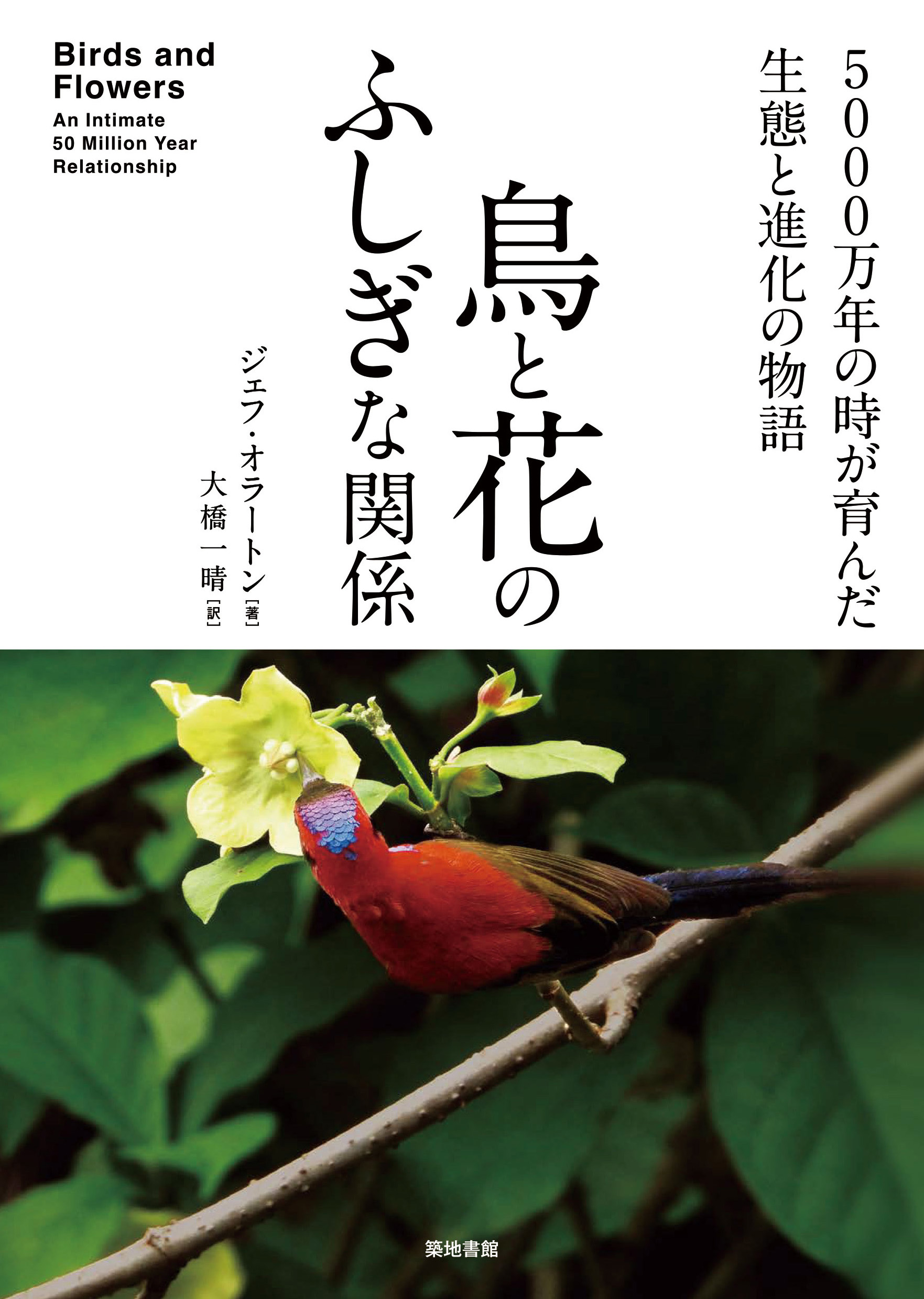
It’s been a good month for me, with two pieces of news that I wanted to share with readers of this blog. First, I’m delighted to announce that my book Birds & Flowers: An Intimate 50 Million Year Relationship has been translated into Japanese! The new edition, published by Tsukiji Shokan, is titled 『鳥と花のふしぎな関係』, which translates roughly as The Curious Relationship Between Birds and Flowers. The subtitle is A Story of Ecology and Evolution Shaped by 50 Million Years. It’s the first foreign-language translation of the book, which was originally published by Pelagic Publishing in February 2024. The Japanese edition is scheduled to go on sale on 18th November.
I’m particularly pleased with the cover, which you can see above. It’s very different from the English edition, with its striking vertical Japanese lettering and a beautiful photograph of a bird (a male Mrs Gould’s Sunbird) visiting a flower (Vallaris indecora – Apocynaceae), taken by my colleague Sinzinando Albuquerque-Lima. There’s something rather special about seeing words that you’ve written transformed into another language, particularly one that you can’t read yourself! My thanks go to the translator, Kazuharu Ōhashi (大橋一晴), and everyone involved at Tsukiji Shokan for bringing the book to a new readership.
One of the things that motivated me to write Birds & Flowers was the realisation that, despite decades of research on bird pollination, nobody had attempted to bring together the full diversity of these interactions in a single book aimed at a broad readership. Hummingbirds are familiar to most people, of course, but bird pollination extends far beyond them, involving an extraordinary diversity of birds and flowering plants across the world.
Japan is an interesting place for this book to appear. Although it lacks the spectacular specialised bird-pollination systems that we associate with tropical regions, East Asia has its own fascinating bird–flower relationships, some of which remain poorly understood. Indeed, as I discussed earlier this year, we’re still discovering just how important birds can be as pollinators even in places where they have traditionally been overlooked, including Britain.
I hope that the Japanese edition will introduce these ecological relationships to a new audience, and perhaps encourage more people to look closely at the interactions between birds and flowers in their own surroundings. You can find details of the Japanese edition on the publisher’s website.
The second piece of good news is that I’ve been awarded a Fellowship of the British Ecological Society (FBES), in recognition of my “significant contribution to ecology and leadership within the ecological community”.
Typically, I’m not a natural joiner of organisations. There’s a raft of societies that I could be a member of and use the post nominals, but but I’m particularly pleased about this award because the British Ecological Society has been an important part of my professional life for many years (I joined in 1990!) It’s the world’s oldest ecological learned society, and its Fellowship recognises contributions across research, teaching, conservation, policy and the wider application of ecological science.
As I wrote earlier this year, 2026 marks the 40th anniversary of my first scientific publication, which appeared in the British Cactus and Succulent Journal in December 1986, when I was just 21. At that point I hadn’t even started my undergraduate degree, and certainly had no idea where my interest in plants, pollination and ecology would eventually take me.
Forty years later I’m still asking questions about how plants and animals interact, still finding things that surprise me, and still enjoying the process of doing science and communicating it to other people. It’s been a career shaped by an enormous number of colleagues, collaborators, students, teachers and friends, many of whom have challenged my ideas, introduced me to new ones, and encouraged me to pursue questions that I might otherwise have overlooked. So I’m very grateful to the BES for this recognition, and to all those people who have been part of the journey.
A Japanese translation and a Fellowship in the same month. Not a bad way to round off the 40th anniversary year of my first publication! And there’s still plenty more science, and writing, to come.

