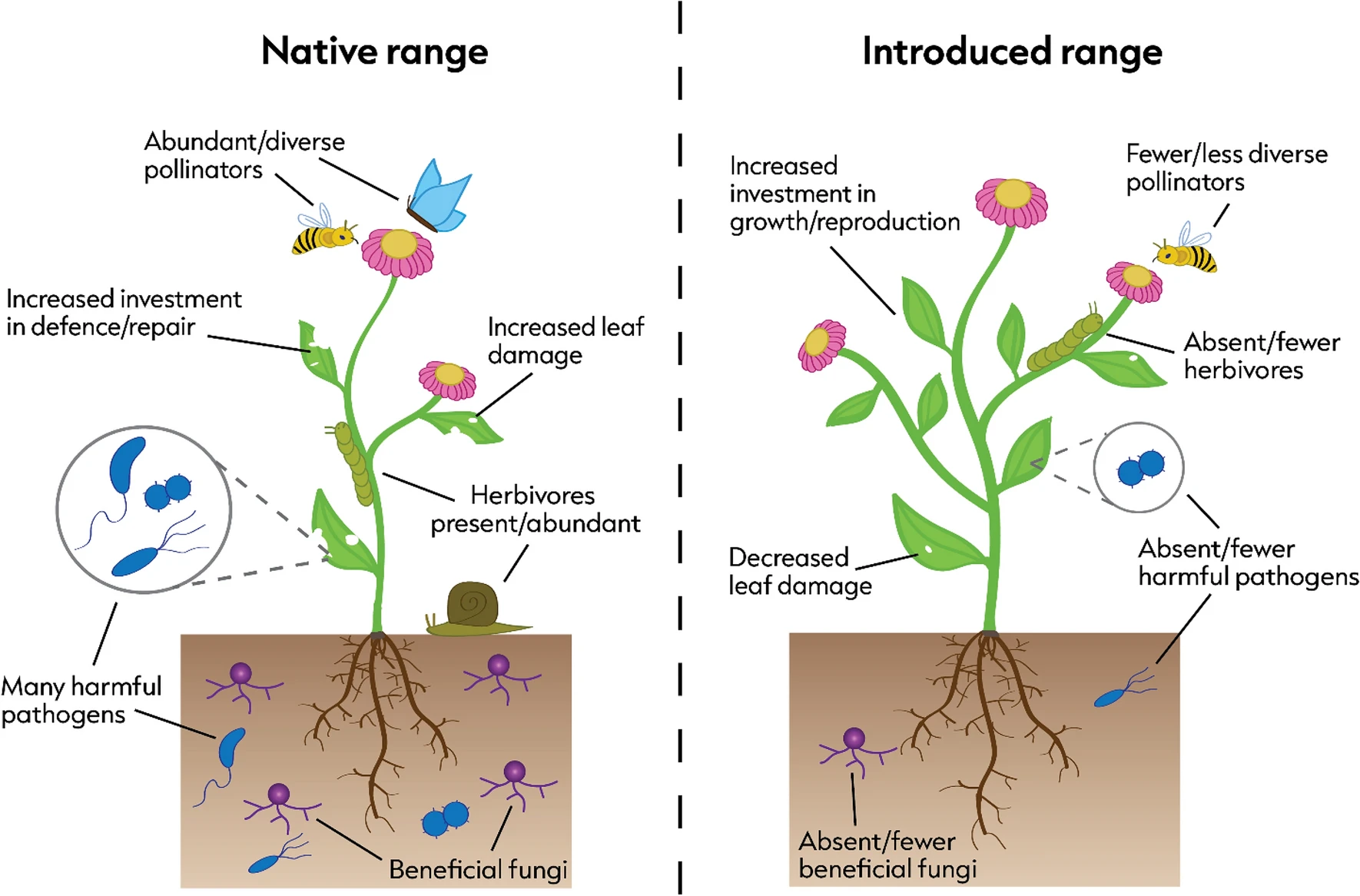
As I’ve previously discussed on the blog, when species are moved to a different part of the world they lose many of the ‘enemies’ – such as predators, herbivores and pathogens – that would normally keep their populations in check. This can have implications for the likelihood of a species becoming invasive, and it’s called the Enemy Release Hypothesis (ERH) and has been well studied. Less well researched is the flip side of the ERH, the Missed Mutualist Hypothesis (MMH), in which species lose their ‘friends’, such as pollinators, seed dispersers, symbiotic fungi, and so forth. It’s a topic I’ve worked on with my colleagues at the University of New South Wales, principally Angela Moles and her former PhD student Zoe Xirocostas.
Another paper from Zoe’s PhD work has just been published and in it she carried out a comparison of European plants that have been transported to Australia, and asked whether they had fewer pollinators in their new range. It turns out that they do!
Here’s the full reference with a link to the paper, which is open access:
Many studies seeking to understand the success of biological invasions focus on species’ escape from negative interactions, such as damage from herbivores, pathogens, or predators in their introduced range (enemy release). However, much less work has been done to assess the possibility that introduced species might shed mutualists such as pollinators, seed dispersers, and mycorrhizae when they are transported to a new range. We ran a cross-continental field study and found that plants were being visited by 2.6 times more potential pollinators with 1.8 times greater richness in their native range than in their introduced range. Understanding both the positive and negative consequences of introduction to a new range can help us predict, monitor, and manage future invasion events.
The summer of 2019, before the COVID-19 pandemic turned the world on its head, feels like a very long time ago. Early in that summer, as I recounted on this blog, Zoe Xirocostas joined my research group for a while in order to collect data for her PhD on the comparative ecologies of plants that are native to Europe but invasive in Australia. That work has proven to be very successful, and the latest paper from Zoe’s PhD has just been published.
The paper focuses on the “enemy release hypothesis” (ERH), a well-studied concept in invasion ecology that nonetheless generates significant debate and disagreement. In essence, the ERH posits that the reason why so many species become invasive is that they leave their consumers, pathogens and parasites behind when they move to a new locality. Those “enemies” would normally reduce the fecundity of the invader, putting a brake on their population growth. But in their absence, the invader can become far more successful. Of course, as well as leaving “enemies” behind the invader also loses its “friends”, such as pollinators, seed dispersers, and defensive or nutritional partners. This “Missed Mutualist Hypothesis” is something that I’ve recently explored with Angela Moles, who was Zoe’s main supervisor, and other collaborators in Australia. Expect to hear more about this from Zoe’s work in the near future.
But back to the enemies. Drawing on the most extensive set of standardised comparisons yet collected of the same plants in native and invasive habitats, Zoe found that plants in the invasive populations suffer on average seven times less damage from insect herbivores, as predicted by the (ERH). Rather remarkably, however, the amount of enemy release enjoyed by a plant species was not explained by how long the species had been present in the new range, the extent of that range, or factors such as the temperature, precipitation, humidity and elevation experienced by the native versus invasive populations.
In other words, it’s extremely hard to predict the extent of enemy release based on historical and ecological considerations that one might expect to impose a strong influence.
The study has just appeared in Proceedings of the Royal Society series B and is open access. Here’s the reference with a link to the paper:
When a plant is introduced to a new ecosystem it may escape from some of its coevolved herbivores. Reduced herbivore damage, and the ability of introduced plants to allocate resources from defence to growth and reproduction can increase the success of introduced species. This mechanism is known as enemy release and is known to occur in some species and situations, but not in others. Understanding the conditions under which enemy release is most likely to occur is important, as this will help us to identify which species and habitats may be most at risk of invasion. We compared in situ measurements of herbivory on 16 plant species at 12 locations within their native European and introduced Australian ranges to quantify their level of enemy release and understand the relationship between enemy release and time, space and climate. Overall, plants experienced approximately seven times more herbivore damage in their native range than in their introduced range. We found no evidence that enemy release was related to time since introduction, introduced range size, temperature, precipitation, humidity or elevation. From here, we can explore whether traits, such as leaf defences or phylogenetic relatedness to neighbouring plants, are stronger indicators of enemy release across species.
All organisms – be they plants, animals, fungi, or whatever – interact with other species throughout their lives, in relationships that include predation, parasitism, commensalism, and the many and varied forms of mutualism. But when species are transported to a different part of the world, as has happened often during the Anthropocene, these interactions typically break down because usually only one of the participants moves. This loss of ecological relationships can play a role in whether or not a species becomes established in its new home, and has been mostly explored in the “Enemy Release Hypothesis” (ERH) which predicts that, by leaving behind predators or parasites or herbivores, a species becomes more ecologically successful and ultimately invasive in its novel range.
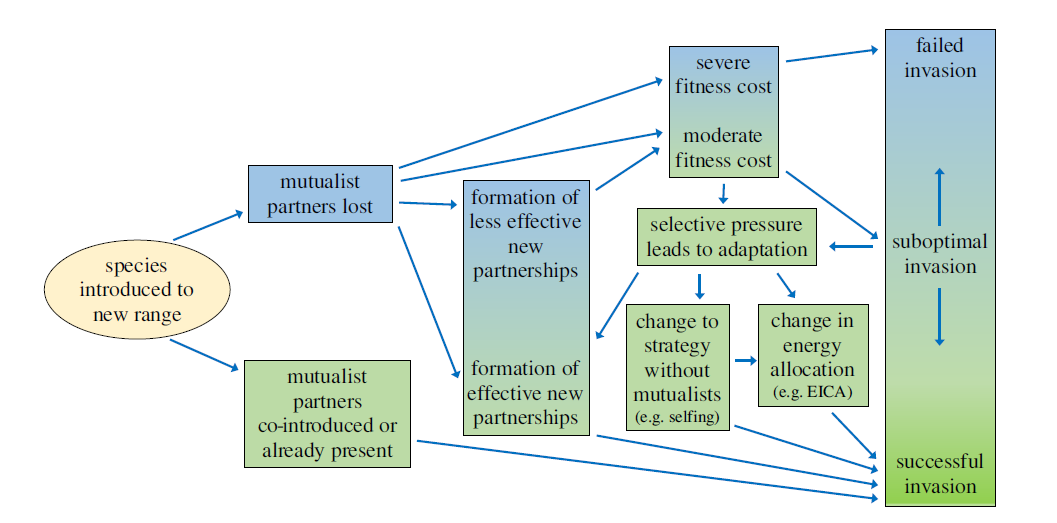
Less well studied, though potentially just as important, is the “Missed Mutualist Hypothesis” (MMH) which in a sense is the twin of the ERH. As well as leaving behind “enemies”, introduced species leave behind “friends” such as pollinators, seed dispersers, mycorrhizal fungi, defensive partners, and other mutually beneficial associates. Negative effects arising from the loss of these relationships could potentially balance the positive impacts arising from the ERH.
In a new quantitative review just published, we review what’s known about the MMH (currently much less than the ERH) and suggest some fruitful lines of enquiry. The study is led by Angela Moles, my collaborator at the University of New South Wales where I spent time as a Visiting Research Fellow in 2019/20 (see my blog posts about that visit starting here). The paper has had a long gestation and gone through several iterations and revisions since we started writing it in late 2019, not least caused by the covid pandemic, but I think that it’s all the better for it.
Here’s the full reference with a link to the paper:
Introduced species often benefit from escaping their enemies when they are transported to a new range, an idea commonly expressed as the enemy release hypothesis. However, species might shed mutualists as well as enemies when they colonize a new range. Loss of mutualists might reduce the success of introduced populations, or even cause failure to establish. We provide the first quantitative synthesis testing this natural but often overlooked parallel of the enemy release hypothesis, which is known as the missed mutualist hypothesis.
Meta-analysis showed that plants interact with 1.9 times more mutualist species, and have 2.3 times more interactions with mutualists per unit time in their native range than in their introduced range. Species may mitigate the negative effects of missed mutualists. For instance, selection arising from missed mutualists could cause introduced species to evolve either to facilitate interactions with a new suite of species or to exist without mutualisms. Just as enemy release can allow introduced populations to redirect energy from defence to growth, potentially evolving increased competitive ability, species that shift to strategies without mutualists may be able to reallocate energy from mutualism toward increased competitive ability or seed production. The missed mutualist hypothesis advances understanding of the selective forces and filters that act on plant species in the early stages of introduction and establishment and thus could inform the management of introduced species.
This is a guest post by Helen Tedds who is currently researching for a PhD at the University of Northampton. Although Helen’s work is far removed from my usual research and consultancy interests of plant-pollinator interactions, I’m proud to be part of her supervisory team! Amphibians were one of my early natural history obsessions, and invasive plants and pollinators are a long standing interest of mine. In this post Helen discusses her research on the UK reptile and amphibian pet trade.
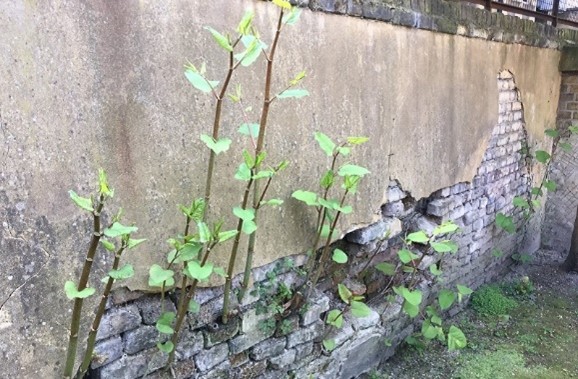
This week (24th-30th May 2021) is Invasive Species Week, an annual event led by the GB NNSS (Non-Native Species Secretariat) to raise awareness of invasive species and how we can help prevent their spread. Generally, the term ‘invasive species’ is defined as an introduced organism that has an adverse impact on its environment by causing ecological and economic damage. They are one of the top five causes of worldwide biodiversity loss through habitat damage, preying on or out-competing other species. They can also spread disease to other species, including humans. The estimated cost of invasive species to the UK’s economy is more than £1.7 billion [1] which is caused by things like damage to buildings [e.g. from the dreaded Japanese Knotweed (Fallopia japonica – fig. 1)], interference with food production, delays on work projects, and the expense of dealing with them. The number of new species being introduced to the UK is rapidly on the increase and can be exacerbated by climate change. This is an urgent problem that without intervention will continue to escalate!
Fig. 1: Japanese knotweed (Fallopia japonica) damaging a brick wall
In 2015 I embarked on a PhD that aimed to quantify the pet herpetofauna (reptile and amphibian) trade across England, mainly to understand the associated socio-economic factors and animal welfare consequences of this. Investigating invasive species was low on my already-full agenda, however, it has been a rabbit hole I ended up going down (pun intended: rabbits were named Britain’s most costly invasive species in 2010 according to The Guardian[2])!
The exotic pet trade has long been known to be a means of new species entering an environment (either through escape or deliberate release), but according to a recent study in Frontiers of Ecology it now ranks as a primary cause of invasive species[3]. It has long been illegal to release any non-native species into the wild under the Wildlife and Countryside Act 1981, however more recent legislation has been enacted to prohibit the trade of invasive species. Whilst the term ‘invasive’ can be subjective, in the UK a species officially considered to be invasive is listed in retained EU law: Invasive non-native (alien) animal species: rules in England and Wales. That’s not to say that other ‘feral’ pets are not ‘invasive’. There are concerns that Indian ring-necked parakeets (Psittacula krameria – fig. 2) that have spread across the UK are potentially out-competing some of our native birds for nesting sites in tree hollows[4]. However there needs to be a body of evidence built to support these claims before a species is added to the legislation.
Fig. 2: Indian ring-necked parakeet (Psittacula krameria)
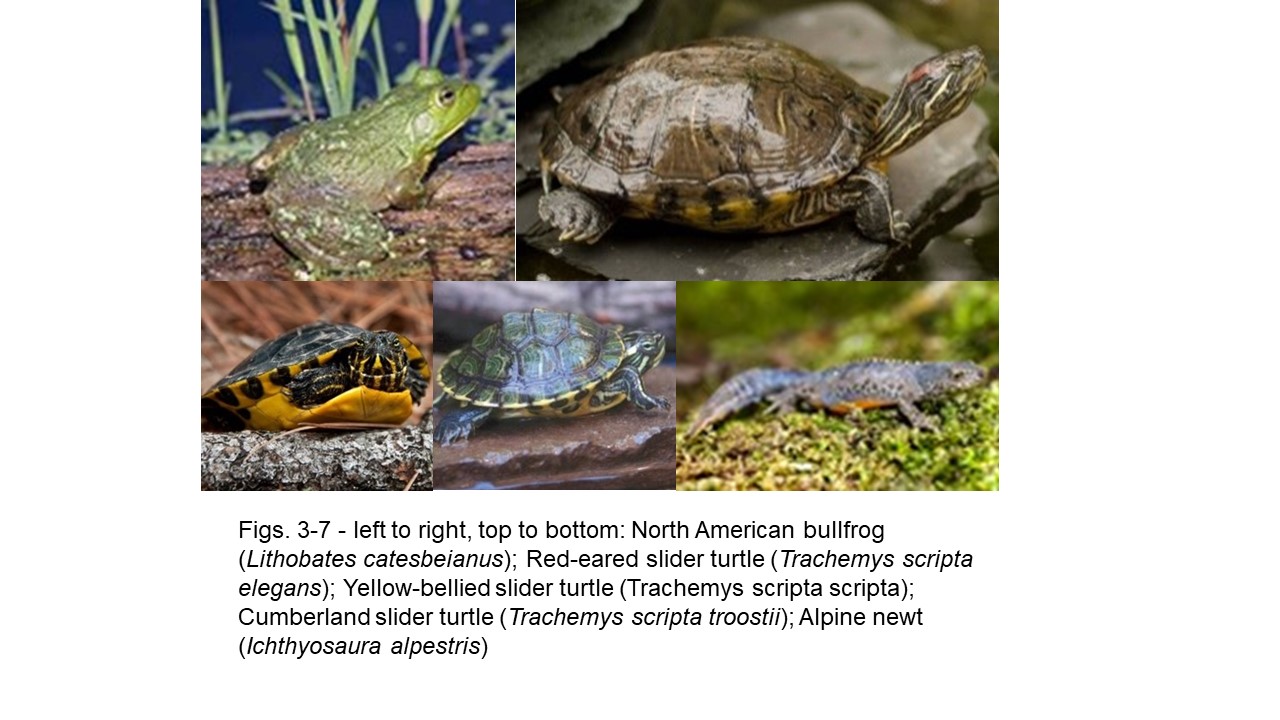
In terms of herpetofauna, there is only one invasive species of amphibian listed in the legislation, the North American bullfrog (Lithobates catesbeianus- fig. 3), and one species of reptile, the common slider turtle (Trachemys scripta) along with all sub-species, including T. s. elegans, T. s. scripta, and T. s. troostii -fig. 4-6)[5]. North American bullfrogs pose a threat to our already vulnerable native amphibians as they will eat frogs, newts, and other similar sized animals[6], and slider turtles threaten our waterfowl as they will eat bird eggs, as well as insect larvae[7].
The law has prohibited anyone from keeping, breeding, and selling these species since August 2016. If you owned one before the law came into force (turtles can be very long-lived) then you have what are called ‘grandfather rights’ where the animal can remain in your possession until the end of its days. If an owner can no longer take care of the turtle they cannot re-sell it- it is best to relinquish them to a rehoming centre that has the relevant license where they can live out the rest of their lives[8], such as The National Turtle Sanctuary at Lincolnshire Wildlife Park[9].
Part of my research into quantifying the herpetofauna trade has involved sampling from pet shops and online classified adverts as to what species are for sale. So far, I have officially documented 431 different reptile species, and 122 different amphibian species[10], and this number is set to grow as I continue to analyse four years’ worth of data. All these species are non-native, and whilst most of them would not survive in our British climate, there are some causes for concern.
In October 2020 a fellow PhD student, Ali North, got in touch with me as she is currently investigating the drivers of establishment and spread of a non-native amphibian in the UK, the alpine newt (Ichthyosaura alpestris- fig. 7). Her project uses distribution data of alpine newts in their native range across mid-Europe with an aim to predict the invasion risk of this species in the UK[11]. I was interested to learn from her that these newts have established various populations in the UK but most concerningly are known to be a vector of chytridiomycosis which can be transmitted to our native amphibians[12]. As part of her research at the University of Plymouth, ZSL Institute of Zoology, and the ARC Trust, Ali wanted to know how often alpine newts had occurred in my data sampling seeing as the pet trade is a potential route for non-native species entering the wild. It turns out that my data set had only 16 records of alpine newts (out of tens of thousands of records) which is not very many, however, do not be fooled by small numbers! It does not take many individual pets being released into the wild for a potentially invasive species to wreak havoc on an ecosystem. Whilst the understanding of alpine newts as an invader is in its infancy, I was delighted to be able to assist Ali with this part of her research and I look forward to reading her final thesis. If you have spotted an alpine newt in the UK you can also help towards her project by reporting it here: https://www.arc-trust.org/news/have-you-seen-an-alpine-newt-in-the-uk
Another interesting thing that my data collection has highlighted is that despite slider turtles being banned from sale for over four years now, they are still appearing on online classified websites such as Preloved, Pets4Homes, and Gumtree. Not only is this illegal, but it is also against the minimum standards set out by the Pet Advertising Advisory Group (PAAG) which these websites agree to adhere to as voluntary members[13]. Since I started collecting data in July 2017 to the time of publishing this blog there have been at least 102 adverts selling slider turtles, and these were the more obvious ones. On deeper investigation some adverts selling yellow-bellied sliders listed them as just the letters ‘YBS’ meaning that they would not be flagged when searching using key words. These adverts have consistently appeared in my data set at a rate of about two per month, with a noticeable spike in Oct-Dec 2020 at a rate of five per month, so there does not appear to be a downward trend since the legislation came into force. Also, some other adverts just listed animals using the word ‘turtle’ or ‘terrapin’; not only does this allow the potential for slider adverts to slip through the net but it also further violates PAAG minimum standards by not advising potential buyers what the species is. How can someone research the correct care information if they don’t know what species they are buying?
Another invasive species that I came into close contact with recently, coincidentally whilst in the process of writing this blog, was in my local park- Elmdon Park in Solihull. An invasive water weed, Azolla filiculoides, or red water fern (fig. 8), had suddenly appeared in one of the park’s ponds. This weed is believed to have entered UK water systems from the ornamental pond and aquarium trade either by spreading via birds’ legs between ponds or from people emptying fish tanks into wild water bodies. It spreads on the surface of water bodies, blocking out sunlight and decreasing oxygen, thereby killing native wildlife[14].
Fig. 8: Red water fern (Azolla filiculoides) in Elmdon Park, Solihull
I sit as Secretary on Elmdon Park Support Group’s[15] committee and run their social media pages, so I found myself reading more about this weed and treatments used to control it, in order to inform the local community on what would happen. The Warwickshire Wildlife Trust lease the land and therefore must foot the treatment bill, which turns out to be the use of a weevil (Stenopelmus rufinasus- fig. 9), affectionately known as ‘Weevil Knievel’ The weevil eats the weed but doesn’t come cheap at a cost of a few hundred pounds for just one container of them[16]. So here we have another casualty to our native wildlife because of the pet trade.
Fig 9: ‘Weevil Knievel’ (Stenopelmus rufinasus)
So, what can we do? Further research into identifying potentially invasive species will help in raising public awareness, whilst initiatives such as Invasive Species Week will spread the message on the consequences of releasing non-native species into our UK ecosystems. But there persists a deeper problem whereby some people fail to properly research the needs of the pets they buy, or fully understand how big they will grow, and feel that it’s easier to release them into the wild rather than to relinquish them via more responsible methods. This is perhaps the area of human-animal interactions that needs more attention and research.
Tedds, H.L., Sneddon, S., Ollerton, J., Clubb, R., and McCormick, W.D., Herps across England: investigating the scale of the reptile and amphibian trade: UFAW Recent Advances in Animal Welfare Science VII Conference Poster, 30th June- 1st July 2020, online.





 Prof. Jeff Ollerton - ecological scientist and author