
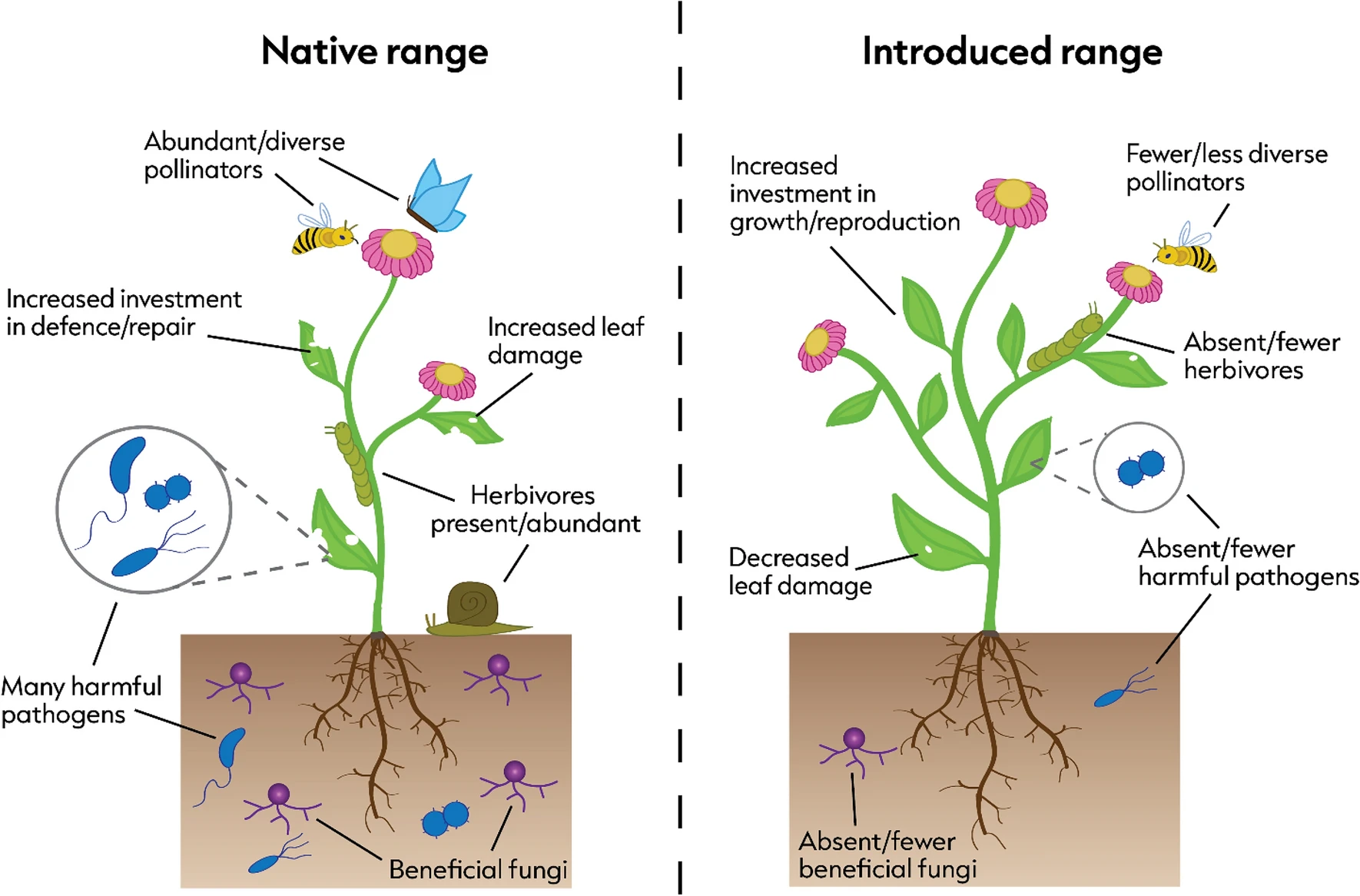
As I’ve previously discussed on the blog, when species are moved to a different part of the world they lose many of the ‘enemies’ – such as predators, herbivores and pathogens – that would normally keep their populations in check. This can have implications for the likelihood of a species becoming invasive, and it’s called the Enemy Release Hypothesis (ERH) and has been well studied. Less well researched is the flip side of the ERH, the Missed Mutualist Hypothesis (MMH), in which species lose their ‘friends’, such as pollinators, seed dispersers, symbiotic fungi, and so forth. It’s a topic I’ve worked on with my colleagues at the University of New South Wales, principally Angela Moles and her former PhD student Zoe Xirocostas.
Another paper from Zoe’s PhD work has just been published and in it she carried out a comparison of European plants that have been transported to Australia, and asked whether they had fewer pollinators in their new range. It turns out that they do!
Here’s the full reference with a link to the paper, which is open access:
Here’s the abstract:
Many studies seeking to understand the success of biological invasions focus on species’ escape from negative interactions, such as damage from herbivores, pathogens, or predators in their introduced range (enemy release). However, much less work has been done to assess the possibility that introduced species might shed mutualists such as pollinators, seed dispersers, and mycorrhizae when they are transported to a new range. We ran a cross-continental field study and found that plants were being visited by 2.6 times more potential pollinators with 1.8 times greater richness in their native range than in their introduced range. Understanding both the positive and negative consequences of introduction to a new range can help us predict, monitor, and manage future invasion events.
 Prof. Jeff Ollerton - ecological scientist and author
Hello Jeff, I would please like to know what your position is regarding Himalayan balsam. I live near the Leeds and Liverpool Canal and the towpath between Parbold and Appley Bridge is covered with this alien species. It smothers the numerous species of native plants and there has been little incentive to get rid of it since 2012. Finally this year a band of volunteers from the Canal and River Trust has been out for a couple of days pulling it out, starting from Appley Bridge, but there is so much of it that I doubt they will continue until that stretch of canal towpath is balsam free. I have been pulling out as much as I can from a mobility scooter, and I see members of the public have also taken some out. Authorities appear to be over-daunted by the scale of the problem and leave it alone as though they can’t cope with it. I want the countryside to be diverse, not covered with a mono species. With regards, Mary Keenan.
Dear Jeff Ollerton, Please will you tell me why Himalayan balsam is allowed to grow freely in public spaces in UK while at the same time we are told that it is an alien species that smothers our native wild flowers and it should be eradicated. The authorities appear to have a great reluctance to remove the Himalayan balsam from public spaces, even though members of the public will pull it out now and then. Thank you. With regards, Mary Keenan
Hi Mary – that’s a really good question but I don’t have an answer, except that I think local authorities don’t have a legal obligation to remove Himalayan Balsam. As they are so cash-strapped they are likely to ignore it and put resources elsewhere.
Pingback: A Christmas lesson from plant ecology: why plants like holly and mistletoe may not be as well defended as we think | Prof. Jeff Ollerton – ecological scientist and author