Tag Archives: Sunderland

The Black Cats go green, and go up!

It’s impossible to be a native of Sunderland and not to have at least a passing interest in football. If you’ve seen the Netflix series Sunderland ‘Til I Die, you’ll know that in my home town, football is more of a religion than a leisure activity. It’s a passion that extends back to the foundation of Sunderland Association Football Club (SAFC) in 1879, whose nickname is the Black Cats.

Growing up, football was always a topic of discussion in our house. My dad played Sunday League football for many years and my Uncle Gordon Howe was a professional footballer. But to the general disappointment of my family, I’ve never had a deep interest in the sport, though I do keep a watch on how well the team of my birthplace is doing. And as of yesterday they are doing extremely well! The team beat Sheffield United (ironically, one of the teams that Uncle Gordon played for) in a thrilling, close-run match to earn promotion back into the Premier League. I watched it live with friends in a local pub, and there was a great reception to the win, even among customers who had no vested interest in the club.

It brought back memories of the mid-1970s when I attended matches at SAFC’s old Roker Park stadium, buoyed up by the club’s ‘giant killing’ win over Leeds United in the 1973 FA Cup Final. But even after my childhood interest in football waned, replaced by a growing fascination with natural history, home matches were frequently a backdrop to Saturdays. The famous Roker Roar always signaled that the team had scored. That shout echoed across the town and down through the Magnesian Limestone gorge of the River Wear, part of which you can see in the photograph above. Exploring the exposed geology, and the grassland and brownfield habitats of that river valley, is an important reason why I became an ecologist, as I recounted on the blog a decade ago.

The shot was taken in early 1986 and it shows the view from the back of the house in which I grew up. On the south side of the river, you can see cranes and sheds associated with the shipbuilding industry, for hundreds of years one of the two main engines of the local economy. Directly ahead, situated on a promontory, you can see an example of the second engine: Wearmouth Colliery, a 2,000 ft deep coal mine that extended out under the North Sea. The mine employed quite a number of members of my family, including my grandfather and several uncles*, one of whom was killed in the early 1900s after a pit pony kicked him. My dad was also a miner for a time but he worked further up river at the Hylton Colliery, which produced more than its fair share of professional footballers, as well as coal.

In 1993 Wearmouth Colliery closed and the site was quickly cleared – see this amazing set of photos that was taken at the time. Four years later, SAFC closed Roker Park and moved to a new purpose-built stadium on the colliery site. They called it The Stadium of Light, a name that honours the ‘miners at Wearmouth Colliery [who] carried with them a Davy lamp as part of their working lives’. Here’s a shot of the stadium perched above the river, taken by my good friend Mark:

Not only have Sunderland gone up, they have also gone green, with a commitment to be carbon neutral and generate their own power from solar installations (though that scheme has attracted some controversy). They are also making the team’s kit from recycled plastic bottles and looking at more environmentally friendly ways of dealing with match day waste – see this press release on their ‘Ready Eco’ initiative. There’s also a plan to tap into the geothermal potential of the mine to heat local houses, though that has been delayed, unless anyone has more recent news on the scheme?

Biodiversity, always the Cinderella of environmental mission statements, is missing from that initiative, which is a shame because the stadium lies adjacent to some very interesting habitats. To the left of the stadium, on the steep slopes of the gorge, you can see patches of Magnesian Limestone Grassland, a relatively rare plant community that is virtually confined to the North East of England.

This minor gripe aside, it’s great to see Sunderland being promoted and taking a lead in thinking about how football as the national sport has an environmental impact. It makes me even prouder of my home town.

*When I was researching this post I came across the following article from the local newspaper. It mentions my Uncle Walter Ollerton who earned a safety badge that is still in my possession. At the outbreak of World War 2 he enlisted and fought in the Far East, where he was captured by the Japanese and held in a prisoner of war camp. After his release he returned to his job as a miner in Sunderland, but his health was never the same:

Evolving a naturalist – happy birthday to me!

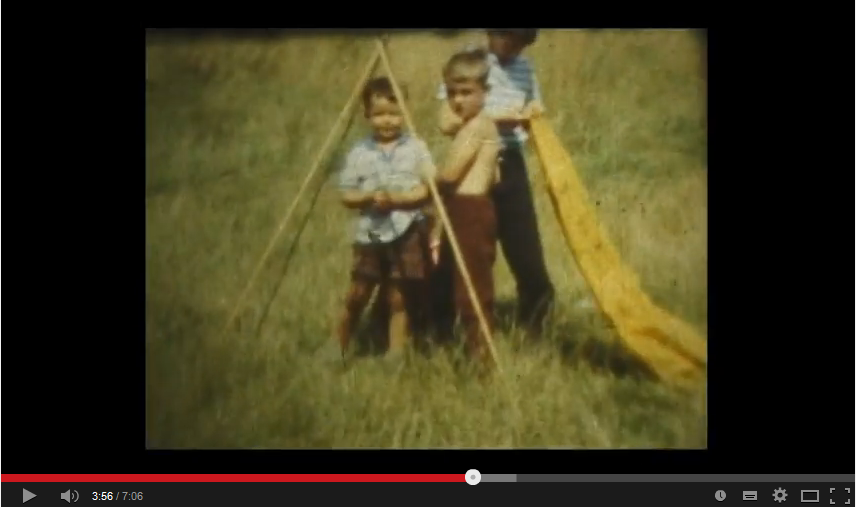
Jeff in the tee-pee

Somehow, today is my 50th birthday.  So I thought I’d mark it with a short post about my personal evolution as a naturalist and, ultimately, professional scientist.

One of the great things about the internet and social media such as Facebook is that you can make exciting discoveries on a weekly basis.  Recently I found out something that means a lot to me on a very personal level: I discovered that a family* who lived in the same street when I was growing up in Sunderland in the 60s and 70s have digitised some old home movies and made them available on YouTube.  In our digital age in which every phone and camera can capture and share events as they happen, it’s sometimes easy to forget that owning a movie camera in the 60s was quite a rarity and the majority of kids living at that time were never filmed.   

These movies are exciting not just because one of them shows me aged about 5 years (in the blue shirt) playing with friends (I’m there from 3’53”) but because it documents, in colour and moving pictures, one of the reasons why I became a professional naturalist with a deep fascination for biodiversity. 

The grassland in which we are erecting a tee-pee is not some country meadow, the kind of wild rural landscape cited by so many other naturalists as inspiring their childhood fascination with natural history.  These grasslands had arisen spontaneously on cleared demolition sites, following the removal of Victorian terraced housing and tenement blocks, some of which were slums and others that had suffered bomb damage in the Second World War (now that does make me sound old!)

Up until the 1950s this area had been very built up, with the houses, shops and pubs serving the local families who were employed mainly in the shipyards and coal mines to the north of the town.  You can get a sense of how urban it was from this 1898 map of Southwick; the places I refer to are just south-west of The Green to the left of the map. 

Following demolition the sites were left to their own ends, and were colonised by plants, insects, birds and mammals from patches of habitat closer to the river that had either been cleared of buildings earlier in the century, or which had never been built upon at all.  There are some nice areas of magnesian limestone grassland nearby along the higher banks of the River Wear valley, and typical calcicole plants such as Greater Knapweed (Centaurea scabiosa) could be found on these post-demolition grasslands.  In fact, in the absence of horse chestnut trees, we used to play a version of conkers using the unripe seed heads of Greater Knapweed.  Was that an echo of earlier children’s games in Britain, prior to the introduction of horse chestnuts in the 17th century?  Apparently similar games were played with snail shells and hazelnuts.  

If you watch the opening minute of this piece of footage from the same series, and ignore the girls posing and playing in the foreground, the background reveals a rich flora of plants, with butterflies hopping between flowers.  The first bird species that I can remember identifying, and being fascinated by its bright colours, was Goldfinch (Carduelis carduelis) feeding on the seeds of tall thistles in the very area where this was filmed.   The first butterfly that I could put a name to was the Small Tortoiseshell (Aglais urticae), also feeding on thistles, but this time on the nectar-rich flower heads, as a pollinator.  We’d collect its caterpillars from the nearby nettles and raise them in jars.

So you don’t have to have had a rural upbringing to appreciate and benefit from nature, and to later influence your profession and passions, any piece of land can inspire interest in kids, regardless of its origin, if nature is left to colonise. Unmanaged, semi-wild green space within towns and cities has huge value, both for wildlife and for the culture of childhood.  They need to be protected just as much as rural nature reserves, including the generally disparaged but actually biodiverse “brownfield” sites, as Sarah Arnold has discussed in a recent blog post.

Some of the riverside grasslands still remain and I hope that they are fascinating new generations of kids with their colour and diversity and flouncing butterflies. But the post-industrial grasslands on which I played and looked for bugs and flowers are all gone; they were cleared and built upon in a flurry of housing and retail development in the 1980s.  Perhaps in the future they may return if those buildings are themselves demolished and the land allowed to lie undisturbed for a while.  That is what nature does: it ebbs and flows across our landscapes in response to human, and natural, interventions, endlessly changing and endlessly fascinating to the curious minds of children and scientists, no matter how old they are.


*My sincere thanks to the Scrafton family who took the original footage, made it available on YouTube, and gave me permission to use it in this post.

Whisht! lads, haad yor gobs, an’ Aa’ll tell ye aall an aaful story

River Wear in the 1980s

Every other Thursday I try to make it to the 6pm seminar organised by the Media, English and Culture department of the School of The Arts.  The seminars take place in the building adjacent to the one in which I work; they feature a diverse mix of internal and external speakers; and wine is always served.

Invariably I’m the only scientist in a room full of staff and postgrads with research and teaching interests as varied as 19th Century Gothic literature, Elizabethan playwrights, the history of the BBC’s Radiophonic Workshop and the scientific romances of HG Wells.  So the wine helps to imbue a cosy sense of oneness with my fellow academics and by the second glass I’ve convinced myself that I can contribute something meaningful to the discussion which follows.  (One day I’ll have to record those conversations and listen to them sober…..)

The seminar this week was by Dr Jon Mackley, a specialist in the literature of the early Medieval and “Dark Age” periods.  Jon talked about the writing he’s been doing aimed at understanding the lost pantheon of gods worshipped by our Anglo Saxon ancestors, and their fates as feast days and rituals were absorbed into British Christian culture.  This replacement of deities put me in mind of Neil Gaiman’s brilliant novel American Gods, but that’s by the by.

What has this got to do with biodiversity, you ask?  Bear with me…..

Conversation afterwards got onto dragon-hero myths and (fortified by some cheap red) I brought up the story of the Lambton Worm.  This legend originates from County Durham, the part of England in which I grew up, and so has always been a part of my personal culture.  My dad often sang the first few lines of the 19th Century  song when I was young and in turn I’d occasionally sing it to my kids when they were very small, in a broad Durham dialect:

Whisht! lads, haad yor gobs,
An’ Aa’ll tell ye aall an aaful story,
Whisht! lads, haad yor gobs,
An’ Aa’ll tel ye ‘boot the worm.

(Wikipedia provides a useful translation of the song for anyone born south of Darlington)

When I was thinking about the legend afterwards it struck me that there were some interesting metaphors regarding biodiversity and ecosystem services contained within it, beyond the culturally important “mythical biodiversity” of such creatures as dragons, unicorns and griffins.

The story of the Lambton Worm begins with young Sir John Lambton fishing in the River Wear:

One Sunda morn young Lambton went
A-fishing in the Wear;
An’ catched a fish upon he’s heuk
He thowt leuk’t vary queer.

Exploitation of wild fish stocks has always been an important provisioning ecosystem service for human societies in a local context, with Sunday fishermen such as John Lambton taking the occasional fish for their family; and at a national level, providing significant amounts of protein for the human food chain.  Global fish stocks are beyond the level at which they can be sustainability exploited, however, and a scandalous proportion of what is currently netted is thrown back into the sea, often dead, as “bycatch“.   The “fish” that Lambton caught was in fact a juvenile dragon (or “worm”) which looked so strange (and presumably inedible) to the young knight that he disposed of it:

But whatt’n a kind ov fish it was
Young Lambton cudden’t tell-
He waddn’t fash te carry’d hyem,
So he hoyed it doon a well

John Lambton throwing the worm into a well could be a metaphor for the way in which our society so often gets rid of the things that we produce and that we don’t want, with no real thought for its fate.  As a kid growing up in the 1970s close to the banks of the very same River Wear where John Lambton fished the Worm, I well remember the stream of turds, condoms, tampons and filth slicks that the river was expected to absorb and to transport into the North Sea.  Later I worked for a while in the local Vaux Brewery which flushed its untreated waste water in vast volumes into the Wear.  By then no one was bothering to fish the river.  In the 1980s new sewage treatment works were built to deal with the effluent of what was at that time the largest town in Britain. Slowly the water quality of the River Wear improved until it is now considered by the Environment Agency to be “one of the most improved rivers in England“.  A river which John Lambton would perhaps now recognise.

Alongside the quality of the water, the quality of life of people who live by or visit the Wear has also improved as the river’s ability to sustain cultural ecosystem services related to work, tourism and leisure has increased.  Which brings us back to the department of Media, English and Culture.  What is a muddy boots ecologist with interests in the biodiversity of species interactions doing sitting in on their seminars on a Thursday evening?  Beyond the fact that they are always entertaining and informative (and they serve wine), it’s the opportunities these seminars provide to draw parallels and create metaphors which relate to my own area of expertise which fascinates me.  Making such connections and spinning these stories is something my brain does without me asking it and I find them useful for understanding not just the complexity of the science I deal with, but also the environmental challenges facing humanity.  As a species we cannot get away from our evolutionary and ecological roots within the totality of biodiversity of planet Earth (a topic which I’ll return to in future blogs) and that is reflected in the cultural biodiversity of ideas and research topics that a university such as Northampton sustains.