
Last year I posted about the work that I’ve been doing on railways and biodiversity with UIC – the International Union of Railways – and the UK Centre for Ecology & Hydrology. That work is now complete and the second of our two reports called UIC Guidelines on Managing Railway Assets for Biodiversity is now out.
UKCEH has produced a press release and I’m copying it verbatim below:
New guidelines for the management of Europe’s railway network to protect and enhance biodiversity have been published.
The UK Centre for Ecology & Hydrology (UKCEH) has worked with the International Union of Railways (UIC), the professional association representing rail companies across the world, to provide technical recommendations and key design features for incorporating and enhancing habitats within the existing European network and new line upgrades, providing examples of best practice.
The UIC European region comprises 118-member companies from 39 countries, amounting to 350,000 kilometres of rail network.
Professor Richard Pywell, Head of Biodiversity at UKCEH who is one of the lead authors of the report, said: “We worked closely with railway companies across Europe to distil the best available knowledge on managing railway assets to benefit nature. For each asset, we considered the most effective measures to protect and restore biodiversity, and how to monitor the outcomes of these interventions.”
Another report author, independent consultant Professor Jeff Ollerton, added: “Working with UIC on this project has revealed just how important the land managed by Europe’s railway companies is for nature. The next step is to better understand how nature supports Europe’s economy, and the health and wellbeing of its people.”
The authors used the widely-adopted mitigation hierarchy approach which guides, developers on protecting existing habitats and ecosystems where possible.
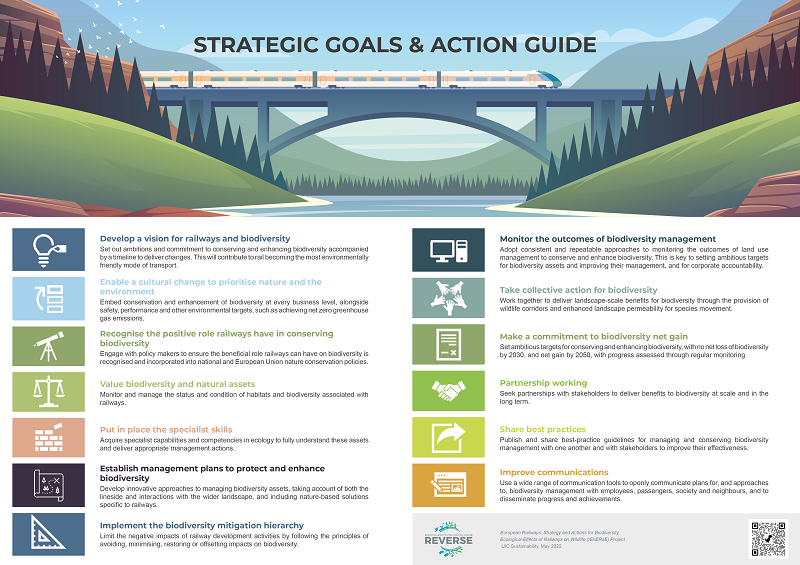
The new UIC Guidelines for Managing Railway Assets for Biodiversity have been drawn up as part of the REVERSE project, in which UIC has worked with its members and UKCEH to formulate a collective vision for protecting and enhancing biodiversity across the European rail network. They now form part of the European Railways: Strategy and Action Guide to ensure management for biodiversity is embedded at every level of the railway business, alongside safety, performance and sustainability. The adoption of the guidelines by member companies will be promoted through various UIC meetings and online events.
The REVERSE project comprises more than 20 European rail companies including Network Rail and SNCF as well as WWF (Worldwide Fund for Nature).
In 2021, UKCEH worked with Network Rail to draw up the rail company’s Biodiversity Action Plan to inform lineside habitat management across the UK. This involved using high-resolution imagery from satellites and aircraft to produce a detailed national map of all the habitats alongside the rail network.
 Prof. Jeff Ollerton - ecological scientist and author