Category Archives: Ecosystem services

Angry Birds! (and startled bees)

The texture of the life academic is nothing if not varied.  After a couple of days working from home thanks to a dose of flu,  Thursday was spent supervising three one hour tests for my first year students, scattered throughout the day from 0930 to 1600.  As I watched over these hurriedly scribbling undergraduates their shifting expressions ranged across boredom, panic, rapt intensity, smugness and exhaustion.   The latter because it’s been a long term and we’ve worked them hard.  The Easter break will be a relief.  Whilst they pored over the questions I shifted between marking second year literature reviews, checking email and gazing thoughtfully out of the window.

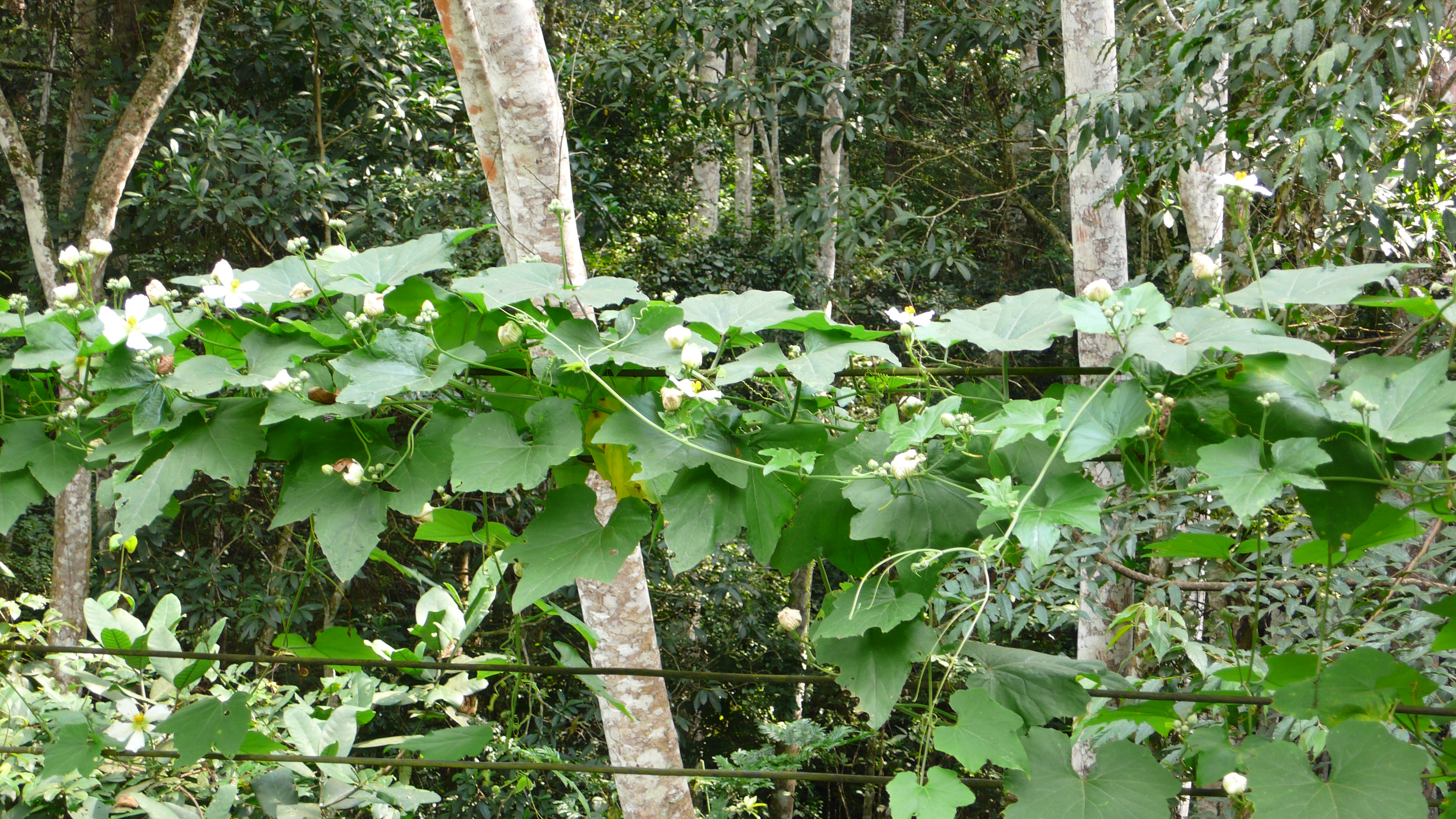
Between tests I went back to the office and worked on completing the first draft of a manuscript that I’ve been promising to send to my co-author Clive Nuttman of the Tropical Biology Association.  It’s based on data we collected in Tanzania last year during the TBA field course whilst observing aggressive interactions between nectar feeding male sunbirds and large Xylocopa carpenter bees.  The bees sneak into the sunbirds’ territories and, if spotted, the birds fly at them, chasing them through the forest.  The plant on which they were feeding is a member of the squash and melon family (Cucurbitaceae) and like many in that family it has separate male and female plants.  Only the male flowers produce nectar;  the females function, in effect, as rewardless mimics of the males.  In addition it seems as though only the bees are pollinators as the birds don’t pick up pollen on their feathers and (crucially) don’t visit the female flowers.  However the birds might be providing a service to the plants by driving the bees to move between plants rather than staying on the male flowers most of the time.  It’s a complex story (which ones in ecology aren’t?) and we’ve only scratched the surface of what is going on, but the aggressive interactions side of it makes a nice starting point for further work.  We’re calling it:   “Angry Birds!  Aggressive displacement of Xylocopa carpenter bees from flowers of Lagenaria sphaerica (Cucurbitaceae) by territorial male Eastern Olive Sunbirds (Cyanomitra olivacea) in Tanzania”.  Let’s see if the journal editor and reviewers will go along with the tongue in cheek pre-title.

Friday started with a meeting between Muzafar Hussain, on of my PhD students you met last time, and Peter Nalder from South Court Environmental.  SCE is a local co-operative dedicated to environmental projects, and organic and permaculture food production.  The group is responsible for managing a number of old, remnant fruit tree orchards around Northampton.  We took a look at a really interesting site over in Abington that was originally a farm.  It’s now been converted into sheltered housing for old folks and a nature conservation area that includes an orchard.  Muzafar is planning to incorporate some of these orchards into his urban bees surveys.  This will add to what we know about the diversity of habitats available to these bees and relates it directly to the ecosystem service of crop pollination that the bees provide.

In the afternoon I drove up to the Wildlife Trust’s offices at Lings House for the first formal meeting of the Nene Valley Nature Improvement Area partners to be held since the announcement that we had secured the funding back in February.   I intend to write more about the Nene Valley NIA in the coming months and years.  But for now it’s enough to say that we’re incredibly excited about the opportunities the NIA will bring to improve the level of biodiversity conservation in the region.  The university is leading on one of five objectives: to assess the range of ecosystem services being delivered in the Nene Valley and the condition of the biodiversity (including habitat as well as taxonomic diversity) that is supporting those services.  We’ll focus on pollination, naturally, but also on other services including fresh water provision and flood alleviation, and possibly carbon storage.  These are new areas for me and it’s going to be a steep learning curve.  A PhD student has already been recruited to work on pollinator diversity and in the near future we’ll take on a post-doc for the main part of the project (if you know of anyone who might be interested ask them to send me their CVs).

Chairing the meeting was Oliver Burke the Wildlife Trust’s energetic and enthusiastic Conservation Manager who has been the real driving force behind the NIA  (which on a map looks like a large intestine squiggling its way across the landscape; in honour of him I renamed it “Oliver’s Colon”.  Not sure if it will stick but I intend to use it in all official NIA documents from now on).  Most of the meeting was concerned with the nuts and bolts of how the finances will work, reporting of activities, membership of the steering group, etc.  Dull but vital if the Nene Valley NIA is to be the success we want it to be.

Also at the meeting was Adrian Southern from the RSPB, standing in for a colleague.  I keep bumping into Adrian in the most unlikely places, first at Biosphere 2 in Arizona in 2001 during an Ecological Society of America meeting that ultimately led to the Waser & Ollerton (2006) edited volume.  Then a few years later at another conference when he was a PhD student at University of East Anglia.  We never really kept in touch so it was a surprise to see him.  Now Adrian’s with the RSPB I hope to talk more with him about some ecosystem services projects he’s working with as part of their Futurescapes programme.  So add that to the lots of different things going on at the moment.  But varied is good.  If tiring.  So looking forward to a week off over Easter.

Whisht! lads, haad yor gobs, an’ Aa’ll tell ye aall an aaful story

River Wear in the 1980s

Every other Thursday I try to make it to the 6pm seminar organised by the Media, English and Culture department of the School of The Arts.  The seminars take place in the building adjacent to the one in which I work; they feature a diverse mix of internal and external speakers; and wine is always served.

Invariably I’m the only scientist in a room full of staff and postgrads with research and teaching interests as varied as 19th Century Gothic literature, Elizabethan playwrights, the history of the BBC’s Radiophonic Workshop and the scientific romances of HG Wells.  So the wine helps to imbue a cosy sense of oneness with my fellow academics and by the second glass I’ve convinced myself that I can contribute something meaningful to the discussion which follows.  (One day I’ll have to record those conversations and listen to them sober…..)

The seminar this week was by Dr Jon Mackley, a specialist in the literature of the early Medieval and “Dark Age” periods.  Jon talked about the writing he’s been doing aimed at understanding the lost pantheon of gods worshipped by our Anglo Saxon ancestors, and their fates as feast days and rituals were absorbed into British Christian culture.  This replacement of deities put me in mind of Neil Gaiman’s brilliant novel American Gods, but that’s by the by.

What has this got to do with biodiversity, you ask?  Bear with me…..

Conversation afterwards got onto dragon-hero myths and (fortified by some cheap red) I brought up the story of the Lambton Worm.  This legend originates from County Durham, the part of England in which I grew up, and so has always been a part of my personal culture.  My dad often sang the first few lines of the 19th Century  song when I was young and in turn I’d occasionally sing it to my kids when they were very small, in a broad Durham dialect:

Whisht! lads, haad yor gobs,
An’ Aa’ll tell ye aall an aaful story,
Whisht! lads, haad yor gobs,
An’ Aa’ll tel ye ‘boot the worm.

(Wikipedia provides a useful translation of the song for anyone born south of Darlington)

When I was thinking about the legend afterwards it struck me that there were some interesting metaphors regarding biodiversity and ecosystem services contained within it, beyond the culturally important “mythical biodiversity” of such creatures as dragons, unicorns and griffins.

The story of the Lambton Worm begins with young Sir John Lambton fishing in the River Wear:

One Sunda morn young Lambton went
A-fishing in the Wear;
An’ catched a fish upon he’s heuk
He thowt leuk’t vary queer.

Exploitation of wild fish stocks has always been an important provisioning ecosystem service for human societies in a local context, with Sunday fishermen such as John Lambton taking the occasional fish for their family; and at a national level, providing significant amounts of protein for the human food chain.  Global fish stocks are beyond the level at which they can be sustainability exploited, however, and a scandalous proportion of what is currently netted is thrown back into the sea, often dead, as “bycatch“.   The “fish” that Lambton caught was in fact a juvenile dragon (or “worm”) which looked so strange (and presumably inedible) to the young knight that he disposed of it:

But whatt’n a kind ov fish it was
Young Lambton cudden’t tell-
He waddn’t fash te carry’d hyem,
So he hoyed it doon a well

John Lambton throwing the worm into a well could be a metaphor for the way in which our society so often gets rid of the things that we produce and that we don’t want, with no real thought for its fate.  As a kid growing up in the 1970s close to the banks of the very same River Wear where John Lambton fished the Worm, I well remember the stream of turds, condoms, tampons and filth slicks that the river was expected to absorb and to transport into the North Sea.  Later I worked for a while in the local Vaux Brewery which flushed its untreated waste water in vast volumes into the Wear.  By then no one was bothering to fish the river.  In the 1980s new sewage treatment works were built to deal with the effluent of what was at that time the largest town in Britain. Slowly the water quality of the River Wear improved until it is now considered by the Environment Agency to be “one of the most improved rivers in England“.  A river which John Lambton would perhaps now recognise.

Alongside the quality of the water, the quality of life of people who live by or visit the Wear has also improved as the river’s ability to sustain cultural ecosystem services related to work, tourism and leisure has increased.  Which brings us back to the department of Media, English and Culture.  What is a muddy boots ecologist with interests in the biodiversity of species interactions doing sitting in on their seminars on a Thursday evening?  Beyond the fact that they are always entertaining and informative (and they serve wine), it’s the opportunities these seminars provide to draw parallels and create metaphors which relate to my own area of expertise which fascinates me.  Making such connections and spinning these stories is something my brain does without me asking it and I find them useful for understanding not just the complexity of the science I deal with, but also the environmental challenges facing humanity.  As a species we cannot get away from our evolutionary and ecological roots within the totality of biodiversity of planet Earth (a topic which I’ll return to in future blogs) and that is reflected in the cultural biodiversity of ideas and research topics that a university such as Northampton sustains.

Business and Biodiversity: Oil & Water?

An early start yesterday to get to London for a meeting/workshop called “Biodiversity & ecosystem services: new collaboration opportunities for academics with businesses”.  The meeting was organised by the Environmental Sustainability Knowledge Transfer Network , a fairly new government initiative trying to link industry/businesses with university-level researchers and third sector organisations.  The aim of the day was to:

“….bring together academics and businesses with an interest in the Natural Capital/Ecosystem Services approach that the Natural Environment White Paper (NEWP) envisages for the UK.  The Natural Environment White Paper has put business at the centre of the stage to deliver the sustainable economy that the Government pledges to provide.”

There’s a lot of scepticism in both camps about whether businesses and researchers can really ever talk mutually comprehensible languages or have convergent priorities.  But I’m open minded enough to attend these events and see what I can learn from them.  It was also an opportunity to catch up with some old friends who I hadn’t seen for a while, and to promote the biodiversity bit of the SEED project.

Highlight of the day for me (other than seeing said friends) was Professor Ian Bateman’s presentation on the UK National Ecosystem Assessment and the ecosystem services approach to valuing nature.  Whilst there wasn’t anything in the presentation that I was not already broadly familiar with, it was a wonderfully clear and forthright exposition on just how much we have under valued the natural capital of the UK.  Putting a monetary value on our biodiversity leaves a lot of scientists and activists uncomfortable and I share some of that discomfort.  But it may be our best opportunity to safeguard biodiversity for the future.

Also impressive (and dryly funny) was the presentation by Martin Ross from South West Water on how his company is providing grants to farmers with land in their catchments to manage farms in a way which minimises pollution and therefore the cost of water treatment.

Lowlight of the day was a (rather young and I think naive) environmental consultant’s claims that “we know almost nothing about biodiversity in this country except for a few charismatic species” and “nature conservation has failed in the UK”.  I thought that a guy from the JNCC was going to explode when he heard that last statement!   The first comment betrayed a lack of historical understanding: we have an enormous reservoir of biodiversity knowledge in this country, added to and developed by both professional and amateur researchers.  What we lack is a truly comprehensive method of bringing all of this together in a way that is usable for biodiversity planning.

In the workshop I attended there was some discussion as to whether technical language such as “biodiversity”, “natural capital” and “ecosystem services” (which one contributor referred to as “eco-babble”) deters senior business managers from engaging with nature conservation.  I pointed out that words and phrases such as “email”, “internet” and “world wide web” were not so very long ago similarly considered to be technical jargon but are now part of our every day language.  Don’t think they were convinced.

Left a very sunny, spring-y London on a packed train, arriving in a colder, over cast Northampton.  A short taxi ride took me to the university in time to enjoy a really stimulating evening lecture by photographer John Hilliard, part of the School of The Arts’ Articulation series.  Great to see a packed audience of mainly students listening intently to an artist of his reputation.  Look forward to next week’s talk by Ian McKeever.

Home by 8.30pm to enjoy delicious chicken soup and (at 9.00pm) furious ranting at the BBC Horizon programme about the subconscious mind, both courtesy of my psychotherapist partner Karin.  Too exhausted by 10pm to watch anything more than the news headlines.  Sleep came easily….