Tag Archives: Houseplants

Book review: Everything you hadn’t realised you need to know about houseplants

When I was growing up, my dad took out a subscription to the Reader’s Digest book club. One of the books he bought was called Success With Houseplants, which first appeared in 1979. I still have it and I think that it’s one of the best volumes on this topic that’s ever appeared in print. Over the years I’ve often dipped into its pages and it provided my first introduction to exotic plant families that I would later see in the wild, including Gesneriaceae, Commelinaceae, and of course my beloved Apocynaceae.

Dad loved propagating and the windowsills of our small house were cluttered with jars of water-rooted cuttings and trays of sown seed. Growing houseplants is still a passion for me though now that it’s become a social media craze it’s hard to keep up with the latest trends in plants for the home.

Enter Jane Perrone, whose writing and podcasting has opened up the world of houseplants to a wider audience and helps us navigate this sometimes confusing and faddish world with humour and sensible advice. Jane has now published a book called Legends of the Leaf: Unearthing the secrets to help your plants thrive. and I’ve had the mixed pleasure of reading it over the last few days. “Mixed” not because there’s anything wrong with the book (far from it) but because Karin and I have COVID and we’ve been laid low for the past five days and counting. The silver lining is that it’s forced me to get on with the ever-mounting to-read pile, in between scratching away at the last few chapters of my next book.

In Legends of the Leaf, Jane has taken 25 iconic house plants, and provided us with a potted (sorry) account not only of their growing requirements, but also of their origin, ecology, history in cultivation, and some fascinating cultural and sociological context. I learned a lot from this book and it elevates the plants with which we share our homes from being simply decorative to become co-habitants with rich and fascinating stories to tell us. The author also has an imaginative line in metaphors, for example likening the flowers of hearts-on-a-string (Ceropegia woodii) to miniature turkey basters, or the dried seed capsules of living stones (Lithops spp.) to a Trivial Pursuit game counter.

A huge amount of research has gone into this book and Jane does not shy away from telling us about some of the darker aspects of houseplant history including colonial attitudes, treatment of enslaved peoples, and misogynous attitudes. It all makes for an absorbing read and I guarantee that you’ll never look at your leopard lily (Dieffenbachia seguine) the same way again.

Full disclosure: I advised on the section about Ceropegia woodii which earned me a mention, which seems fitting: seeing the account of this species in Success With Houseplants was what started me on a quest to understand the pollination biology of Ceropegia.
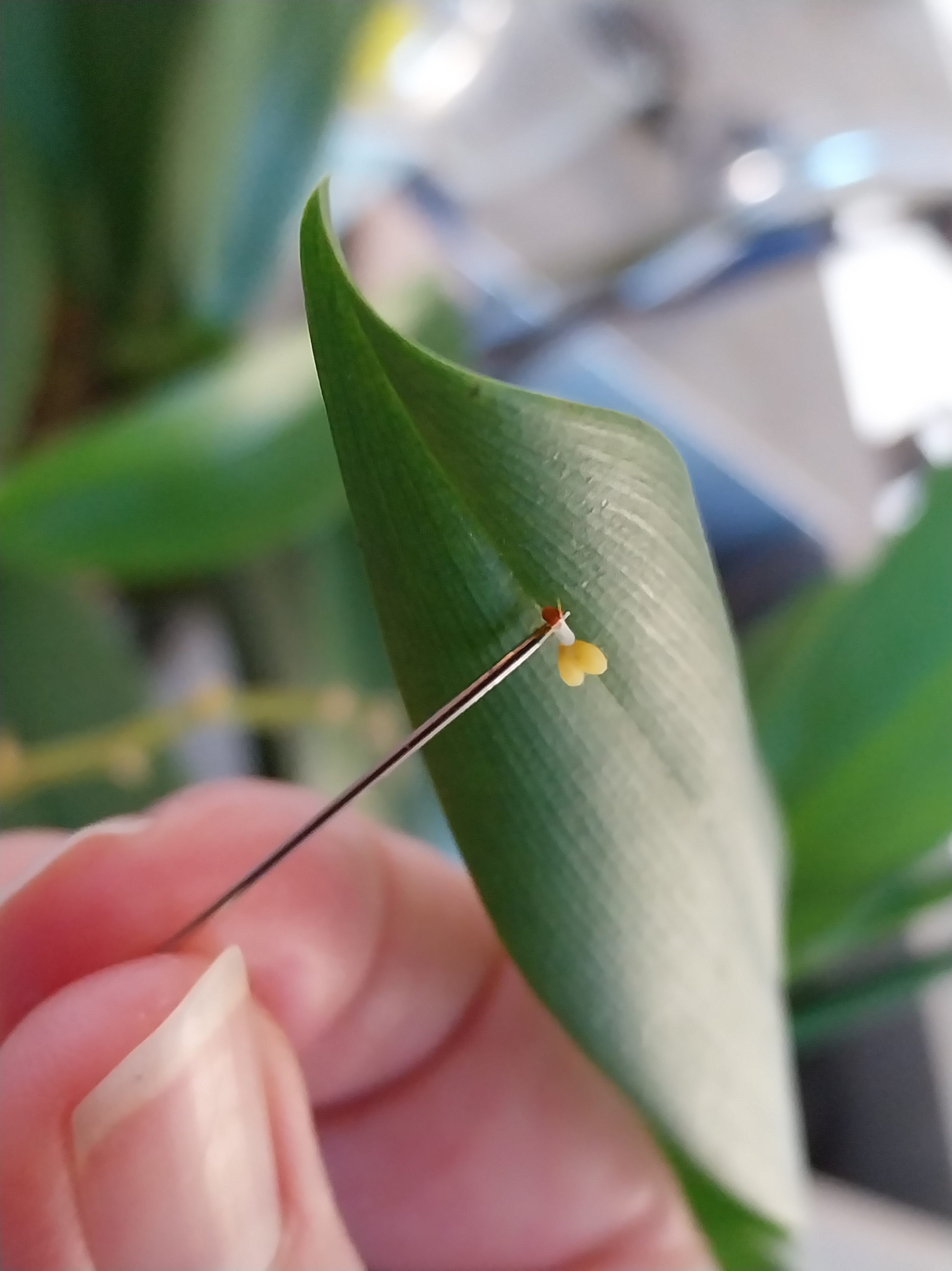
Orchid pollen comes pre-packaged

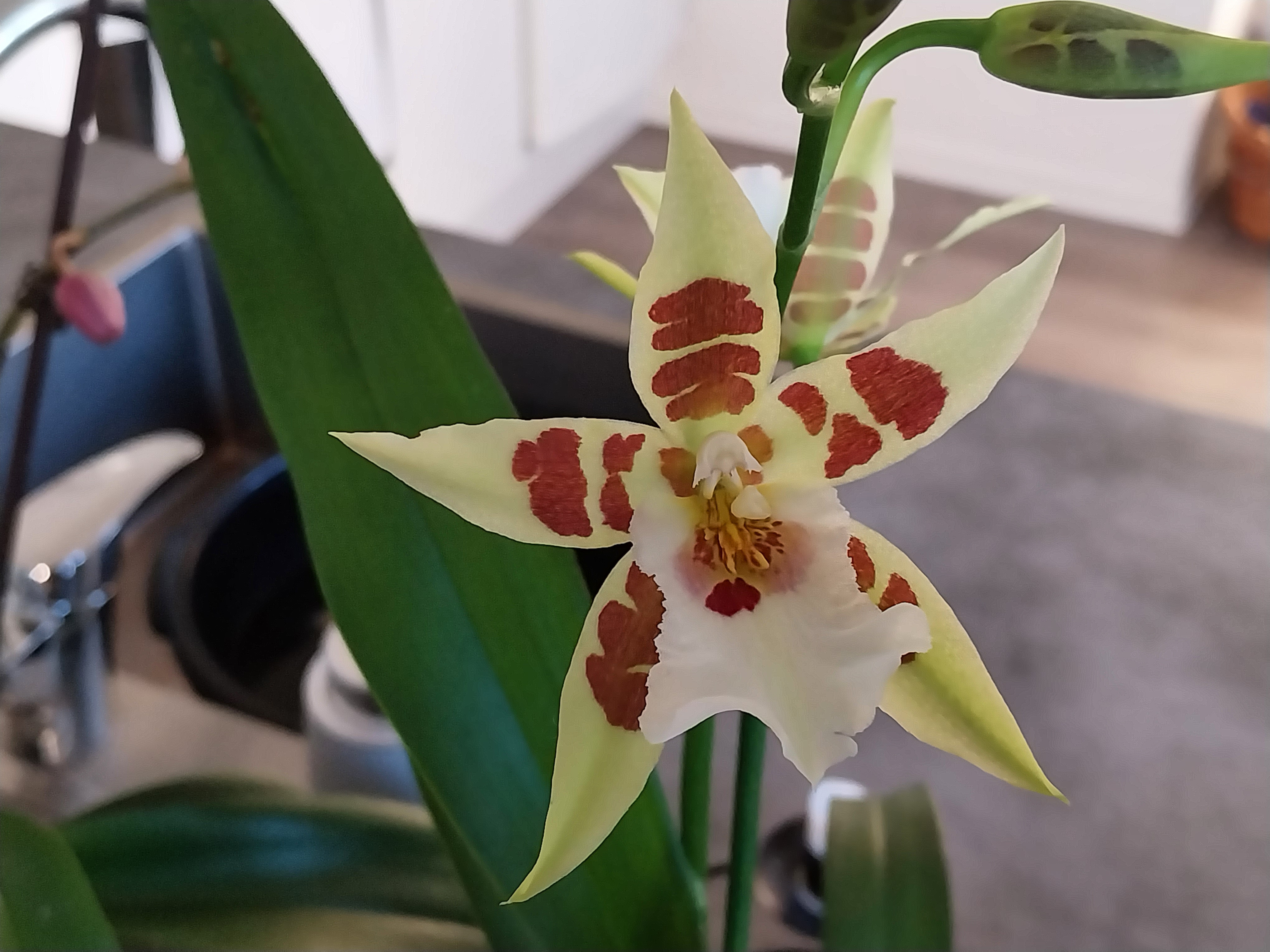
The other day Karin bought a Miltonia orchid to add to the ever-expanding collection of orchids she’s accumulating. It’s nowhere near as large as the collection she accumulated in our old place in the UK – part of it is pictured in this old post of mine – but it’s only a matter of time. This morning I showed her how to extract orchid pollen from the flower and her squeals of delight were something to hear!

As you can see in the image above, these orchids package their pollen into discrete structures that we term “pollinia” – two of them in this case, though the form and number of pollinia vary between different groups of orchids. The pollinia plus the sticky organ that attaches them to a pollinator is collectively termed a “pollinarium”. The only other plants that present their pollen in this way are my beloved asclepiads in the family Apocynaceae. The orchids and the asclepiads are only very distantly related to each other so this is a clear example of convergent evolution, where both plant groups have come up with the same solution to a problem. In this case, the problem is probably that bees collect a lot of pollen which has a reproductive cost for plants. Packaging the pollen in this way prevents bees from stealing it, amongst other advantages.

If you want to look at this yourself, you’ll find the pollinaria tucked under the front of the central “column” of the flower, which comprises the fused male and female reproductive parts. Just take a fine needle and gently stroke the underside of the column. In the image below, taken just after we extracted the pollinarium, you can see the “anther cap” which covered them lying just below the column.

It’s possible to learn a lot about botany from studying even common houseplants such as these!

Houseplants & Happiness: join me at the LEAF Houseplant Festival – 30th & 31st May!

One of my earliest exposures to botany was growing houseplants as a teenager, encouraged by my dad who, as I discussed in Pollinators & Pollination: Nature and Society, was a very keen gardener. It was my dad who taught me about rooting cuttings in water, how to germinate seeds, and so forth. These are gifts of knowledge that I will always treasure and which I have passed on to my own offspring.

So I was delighted to accept an invitation to run a workshop at the LEAF Houseplant Festival in Market Harborough that takes place from 30th to 31st May this year. Tickets can be booked by following that link, though be aware that they are limited due to social-distancing regulations, and it’s first come, first served.

The workshop that I am running is called ‘Potting Up’ and will focus on the different kinds of potting media to use, how to tailor your compost to specific types of plants, and so forth. As you might expect, I’ll be using my knowledge of plant ecology to explain why different plants have different requirements, and what those requirements are.

As well as running the workshop, Karin and I will be selling off some of our own collection of houseplants on a ‘Pre-loved Plants’ stall. We are in the process of selling our house in Northampton and we need to downsize!

Finally, I will also have a limited number of copies of Pollinators & Pollination: Nature and Society for sale. If you would like to reserve a signed copy to pick up on the day, please use the Contact form.

I look forward to seeing some of you there: it will be great to actually mix with people, have face-to-face discussions, and interact with an audience that’s in the same room as me!