
One of the many things that I love about Common Elder (Sambucus nigra), and which I didn’t have space to properly convey in my article about the species last year, is just how adaptable it is as a species. The tree possesses a lot of what biologists term “phenotypic plasticity“. This is the ability of an organism to flexibly change aspects of its morphology or behaviour or physiology in response to differences in the environment. Plants are especially good at this because, if they find themselves growing in less-than-optimal conditions, they can’t just uproot themselves and leave for pastures new. This is obvious to anyone who has seen a houseplant struggling in a dark corner of a room: the poor plant will etiolate and bend as its yellowing foliage tries to reach the light from a distant window. The same plant grown on a sunny windowsill will be more compact, greener, and healthier.
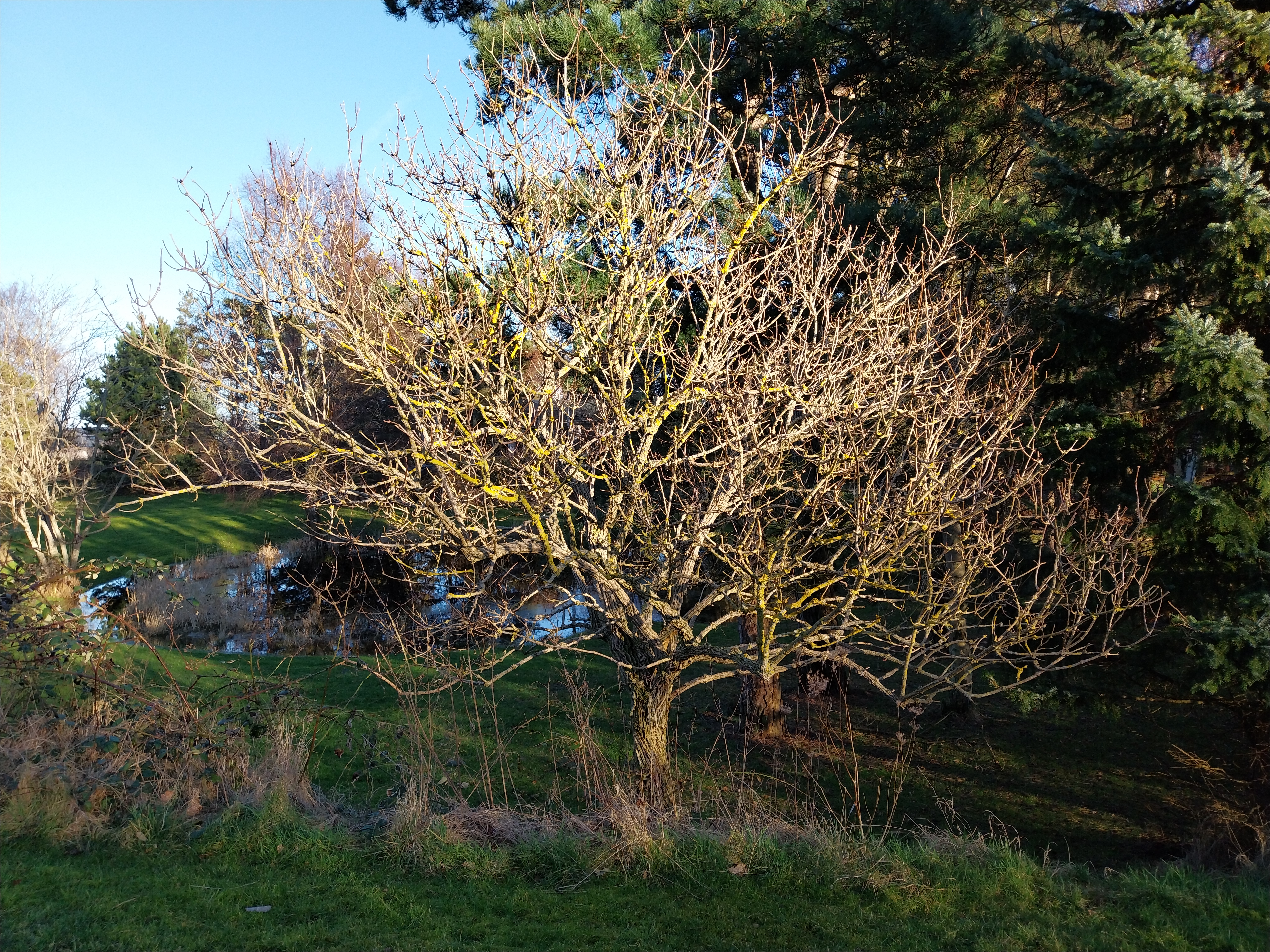
When it comes to Elder, and indeed other trees, winter is often the best time to see this plasticity, when the trunks and boughs are not cloaked in greenery. On a coastal walk at Klintebjerg yesterday, I spotted three rather different phenotypes of Common Elder which nicely illustrate this environmental context dependency.
The first was a wind-tortured tree growing at the base of a low hill, directly in the teeth of the prevailing Kattegat weather, its trunk bent away from the sea and its branches lopsidedly pruned:

The second was a more fortunate specimen, growing in the lee of that same hill and allowed to spread its symmetrical arms, as though waiting to embrace any passing birds. It had clearly never been pruned back by the landowner, who had allowed it to grow as a fine, single-trunked small tree:
As we walked back down the hill via a narrow path, enclosed and over-topped by a fairy tale canopy of dense, twisted Blackthorn (Prunus spinosa), I spotted another phenotype, different again. I initially thought that they were the stems of a woody climber, perhaps Old Man’s Beard (Clematis vitalba) or European Honeysuckle (Lonicera periclymenum). When I looked closer it was clear that these were Elder, growing narrow and long, using the Blackthorn as support, as they struggled to reach up through the canopy to gain the light:
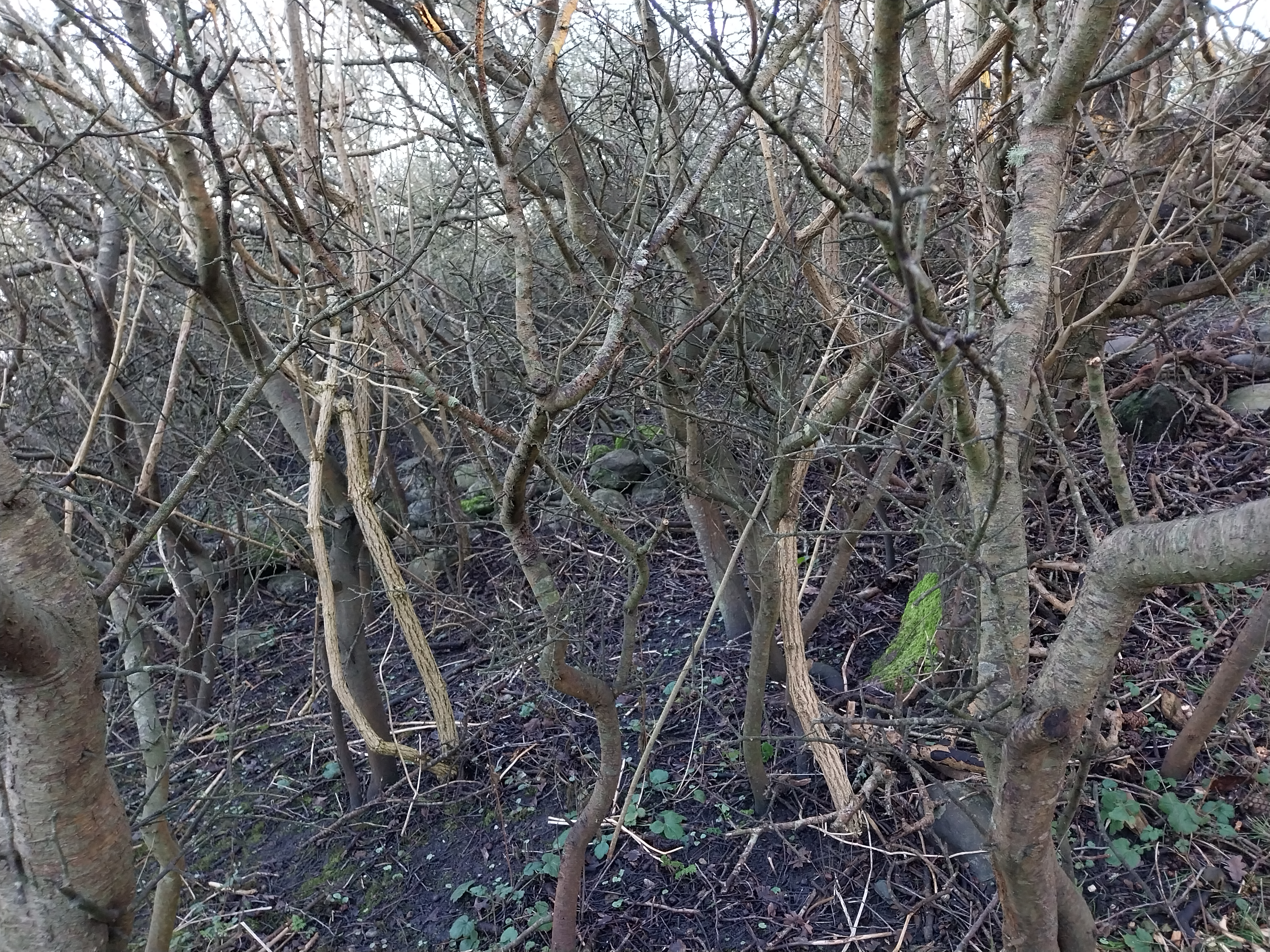
There were several individuals like this, presumably the result of seed dispersal by birds perched within the Blackthorn. I don’t think that I’ve ever seen Elder growing in quite this way before, but then how often do we get to peer deeply into the secrets hidden within a dense Blackthorn patch?
I had only planned to write about Common Elder today, but I can’t resist mentioning that, over on his blog, ornithologist Mark Avery has written a very nice review of Birds & Flowers: An Intimate 50 Million Year Relationship. He describes my book as having:
…a lightness of touch and tone that should not be taken for lightness of understanding….This is a fine example of a book which is pitched to increase the public understanding of ecology and evolution, and succeeds.
Thank you Mark, that’s very gratifying to read, and I’m glad that you enjoyed it!
 Prof. Jeff Ollerton - ecological scientist and author
In my wine making days I recognised two phenotypes of elder, that made for slow and messy, or fast and easy, collection. Most of the trees/bushes in the hedgerows, had small umbels that hung down from tough, red, stems that were fibrous and difficult to snap off. One had to visit many bushes to get a couple of carrier bags-ful for wine. On the other hand, there is another form that tended to be on end of hedgerow or lone trees, where big, wide umbels are held upright on thick, green, stems that are easily snapped off with a press of the thumb (or, if in the flowering time: having a muslim bag popped over them when the anthers turn orange and the corollas are ready to fall, so you can carefully brush them into the bag leaving the umbel in place till berry time). It was one of the things that started me mapping, to mark where the easiest collecting trees and bushes were. One also learned the easiest blackthorn forms or hybrids, for maximizing pick at one handful without getting spiked, too.
Think I still have some 1980s vintage elderberry, saved for special occasions that never happened. Best to make one up before it ends up in a skip! :/
Our obsession with rarity, really does make us dreadfully dismissive of some of our most important plants. It’s shocking what people do to ivy, and to whole hedgerows: smashing them to pieces with flails just as all the berries are ripening! No wonder all the birds and butterflies are disappearing. (I hardly dare look out of the windows when I go anywhere these days.)
Keep it up,
Steve.
Thanks Steve, that’s really interesting. I agree, elder is very variable in the flowers and fruits it offers. I do wonder whether it’s due to features that have been selected for in the past when the plant was more widely used for food. Or if it’s just down to growing conditions.
Either way, I also agree that we treat such common species very badly indeed.